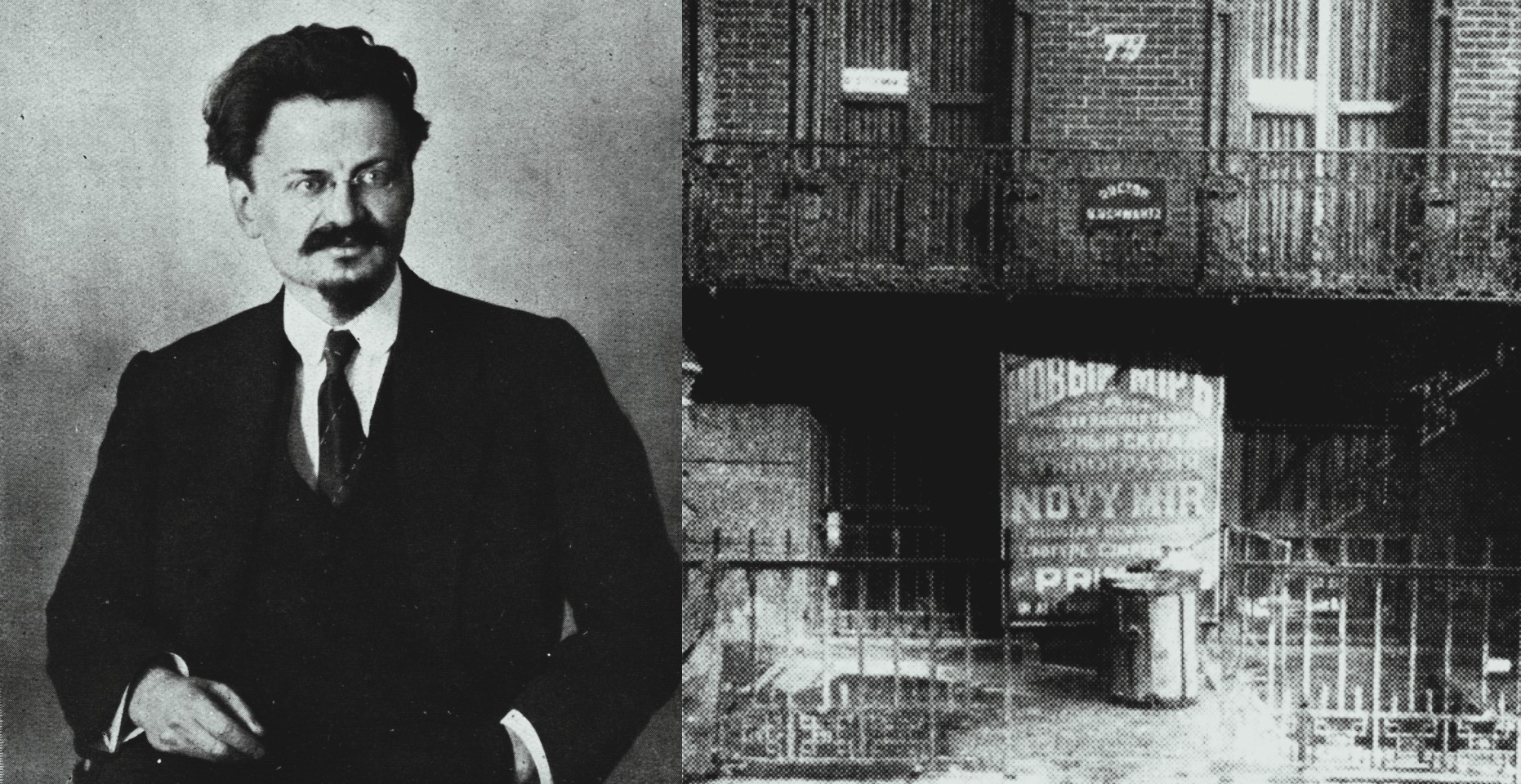
This interview with the editor of New York’s Novy Mir newspaper, with whom Trotsky worked during his New York sojourn, is an early biography and offers details of Trotsky work and life in the United States.
‘Leon Trotsky, Socialist Statesman’ from Truth (Duluth). Vol. 2 No. 3. January 18, 1918.
In the office of a little Russian Socialist daily newspaper, the Novy Mir, in St. Mark’s place, First avenue, New York City, Leon Bronstein–not Brounstein, as it has sometimes been printed–whose pen name of Leon Trotsky is now known to the whole world as that of the Minister of Foreign Affairs of the Bolshevik Government of Russia, labored for two months last year as a member of the paper’s small staff. The Novy Mir, whose second-class mailing privilege was recently suspended by the Post Office Department, occupies three rooms and a hallway in the dingy basement of an old-fashioned brownstone residence inhabited in its upper regions by a dentist, a physician and lodgers, says a writer in the New York Evening Post. Few, if any, of the persons living in the house knew, at the time, of the celebrity that their roof sheltered. He had been famous as a social revolutionist in six capitals of Europe–Petrograd, Vienna, Berlin, Paris, Madrid and London–but in New York he was unknown except to the Russian and fellow-Socialists of other nationalities who had heard him deliver burning speeches on the war.
Out of this nondescript cellar office has come the story of Trotzky, told by his fellow-countrymen and most intimate friend in America, Alexander Menshoy, a journalist and teacher in the public schools of Russia until he came here four years ago. Mr. Menshoy is the editor-in-chief of Novy Mir. In his slow, but excellent English, which he said he seldom had occasion to use in New York, he narrated the incidents of Trotzky’s career, and described his experience in America.
Trotzky did his writing in Menshoy’s sanctum, a room of about 6×10 feet, just of a size to hold two desks, two chairs and a fireplace, with a great litter of Socialist newspapers and magazines from all parts of the word scattered about. A plaque of Count Leo Tolstoy hangs above the fireplace. Over the editor’s desk is a campaign picture of Morris Hillquit. On the top of his desk is a great disorder of newspapers, manuscript, and letters from Russia. The air is heavy with Russian cigarette smoke. In a room to the rear linotype click and a press is heard running.
Humble Weekly Stipend.
Adjoining the editor’s office is another small and dark room, in which the business ends of the paper are negotiated. It was in this atmosphere that Trotzky worked and drew his humble weekly stipend, so small as to be “hardly” worth mentioning,” the editor said smilingly.
Trotzky lived in the Bronx with his wife and two boys, aged nine and twelve, who speak French and Russian, but no English. His living was a precarious one, and he had just enough money to feed his family and keep a shelter over them. Concerning his personal comfort, it is said he cared nothing: money had no meaning for a except as it procured necessities.
“Leon Trotzky, who was a native of the southern part of Russia, came here in the last of January of 1917,” said Menshoy, “to find refuge. He was barred from France, where his paper had been suppressed: he dared not enter his own country at the time, he had been deported from Spain, and a six months’ prison sentence awaited him if he should enter upon German soil as he had been convicted of writing a book in which he attacked the German Government and militarism. England, like France, was hostile to him, as was Switzerland, where he had expected to go, so the only place left for him was America.
“In Paris he had been editor of the Russian Socialist daily. Our World. As a social revolutionist he took an editorial stand against the war. His paper was heavily censored by the authorities, and finally suppressed altogether. We used to receive copies of it here. in every issue big spots had been blotted out. In one issue everything had been obliterated except the title of the paper. It was suppressed a little more than a year ago through the influence of the Imperial Russian Government exerted at Paris.
Ordered to Frontier.
“Trotzky was ordered deported and taken to the frontier. He had wished to go to Switzerland, but through the efforts of the British Government and the acquiescence of the French authorities he was prevented from doing so. This was at the end of November, 1916. He went to Spain, but after crossing the frontier was promptly arrested as the result of a telegram from the French authorities describing him as a dangerous anarchist. For a short time he was detained in prison at Cadiz. His case attracted great attention throughout Spain. The Madrid Government decided to deport him by the first outbound vessel, no matter where bound, but a Socialist campaign of protest dev- eloped immediately in the Spanish newspapers.
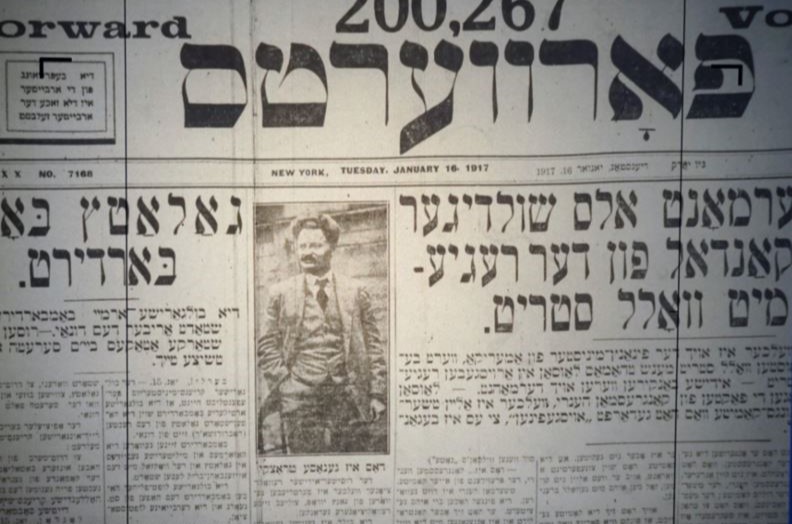
“As a well-known character in the International Socialist movement, it was demanded that he be released from prison and the right granted to him to go wherever he wished. The campaign succeeded, and instead of putting him on the next ship, which chanced to be sailing for Cuba, he was released and ordered out of Spain. He had correspondence with Russian Socialists here and decided to come to the United States.
“He came at once to our office, and began work for us, writing general articles on Socialist subjects, conditions in Russia, and editorial matter. He wrote also of the war and the international situation, and his work attracted much attention from writers of note. He was never interfered with in New York. He also was a contributor to Zubunft, the Jewish Socialist magazine here, and the Jewish Daily Forward.
“Trotzky is a brilliant speaker, and has much personal magnetism. He is absolutely sincere and honest, and always carried conviction to his hearers. In overcrowded halls he addressed many meetings in New York, Philadelphia and other cities. He speaks Russian, of course, good German, excellent French, and a little English.
Back to Russia.
“When the Russian revolution began in March, Trotzky was one of the first of the political exiles from the land of the Czar in this country to undertake to return. He felt he would be greatly needed at p home, but it is unlikely that he had any idea he would be elevated to his present post in the government. With his family and seven other friends he started, funds for the trip being supplied to him by a group of Russian revolutionists in this city.
“Trotzky had been president of the Council of Workmen’s Delegates–there were no soldiers in it then–in the revolution of 1905. He was arrested, and there was a big trial at Petrograd that drew the attention of all Russia to his case. With other delegates that were arrested, he was exiled for life to northern Siberia, a chilly and inhospitable place, I may assure you, where, like other political exiles, he was supplied with just sufficient money by the government to keep him from starving.
“After a little more than a year in Siberia he effected a most thrilling and sensational escape, his own story of which he has told in his book, or pamphlet rather, entitled There and Back. He is one of the best known of the Russian pamphleteers. Afterward he led a Russian revolutionist’s nomadic life for some years, always subsiding by his profession, that of a working newspaper man. He could not sit long in any one place, however. He lived in Germany, Austria, Switzerland and France, meantime writing constantly for Russian newspapers, and keeping in touch with his revolutionist friends. He was a regular contributor to Neue Zeit, a German Socialist magazine, published in Berlin, and also for the Arbeiter Zeitung of Vienna, the official organ of the Austro-Hungarian Social-Democracy.
“He managed to return to Russia several times under assumed names to assist in revolutionary work and propaganda. There is a center of social democracy in Geneva and another in France. For both of these he worked, writing many booklets, which were distributed by the Socialists.
“In Vienna he had a paper of his own, published weekly in Russian. When the war began in the summer of 1914, he was in Vienna working on this paper. He was obliged to suspend his publication by order of the military authorities the day before Austria declared war on Servia. At this time he was in close personal touch with Dr. Adler, the leader of the Social-Democrats of Austria. He was a close personal friend of Fritz Adler, the doctor’s son, who assassinated Count Stürgkh, the Austrian Premier, last year, Fritz Adler, who was a Socialist, scientist and gifted journalist, was condemned to death.
“Dr. Adler warned Trotsky to leave Vienna and the country or he would be interned for the period of the war by the military authorities, so Trotzky took his advice. and went to Switzerland. Here he wrote a book called ‘The War and the International’ (referring to the international Socialist body) in which he took a stand against war and attacked the governments of all the warring countries, Germany and Austria being criticised in bitter terms.
“He maintained that there was no cause whatever for the workers of one country to war on the workers of another, and he especially attacked the Wilhelmstrasse Government. His book was sent into Germany, where it was confiscated by the authorities. A trial was begun against the author, although he was far away from the scene of the trial, and he was sentenced to six month’s imprisonment. If he ever returns to Germany he will probably have to serve the sentence.
“After his experience here and after he had sailed from New York with his friends to join the revolutionists in Russia last March, he was held up at Halifax at the instance of the British Government, searched and arrested. He was put in an internment camp outside of Halifax. The British Government knew his history pretty well, but he was held on the pretense that he was going back to Russia in the interests of Germany and the old Russian regime. We started here a campaign, and at Petrograd another one was begun by the Workmen’s and Soldiers’ Delegates to have Trotzky released. M. Milyukoff, first Minister of Foreign Affairs after the revolution, cabled to Canada and demanded Trotsky’s immediate release. He was released and allowed to proceed.”
Truth emerged from the The Duluth Labor Leader, a weekly English language publication of the Scandinavian local of the Socialist Party in Duluth, Minnesota and began on May Day, 1917 as a Left Wing alternative to the Duluth Labor World. The paper was aligned to both the SP and the IWW leading to the paper being closed down in the first big anti-IWW raids in September, 1917. The paper was reborn as Truth, with the Duluth Scandinavian Socialists joining the Communist Labor Party of America in 1919. Shortly after the editor, Jack Carney, was arrested and convicted of espionage in 1920. Truth continued to publish with a new editor JO Bentall until 1923 as an unofficial paper of the CP.
Access to full paper: https://www.mnhs.org/newspapers/lccn/sn89081142/1918-01-18/ed-1/seq-2
 Revolution's Newsstand