
Marxist pioneers. Biographies of the 1896 candidates from President and Vice President, Charles Matchett and Matthew Maguire, of the Socialist Labor Party.
‘Our Candidates’ from Lincoln Socialist-Labor. Vol. 2 No. 66. July 25, 1896.
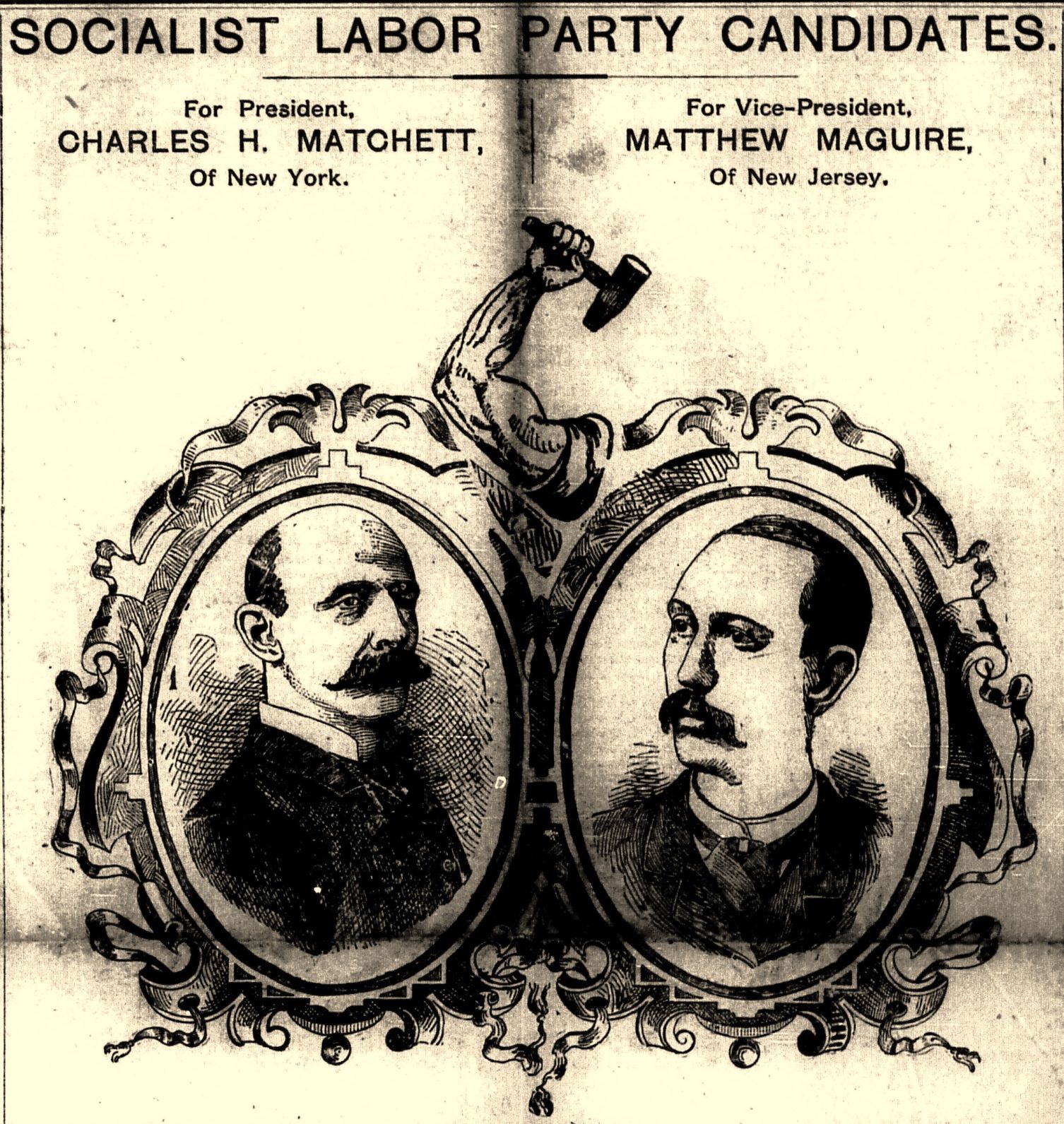
Comrades Matchett and Maguire. Our Standard-Bearers are From the Ranks of the Wage Slaves and Are the True Representatives of the Working Classes.
The National Convention of the Socialist Labor Party on July 9, 1896 nominated Charles H. Matchett of New York for President, and Matthew Maguire of New Jersey for Vice-President.
CHARLES H. MATCHETT.
Charles H. Matchett, the nominee for President, is a resident of Brooklyn, N.Y. He is a genuine New England American. His ancestors emigrated from England in 1630 and 1788. He was born in 1843 at Needham, Middlesex County, Massachusetts, and attended the public schools of Boston until he was 16 years of age, when he went to sea. At the outbreak of the Civil War in 1861, he enlisted on the warship Isaac Smith, stationed in the South Atlantic blockading fleet, and was present at the storming of Fort Royal, S.C., and of Port Pulaski, at Savannah. During the next three years he made several voyages to Africa and South America, and then settled down to the grocery business. This not being to his taste, he became a carpenter and finally a builder and was wrecked in the commercial crisis of 1873; he then again took to carpentering trade, in which he remained until 1886, when he became an employe of the New York and New Jersey Telephone Cable Company.
From early childhood he was endowed with a strong love of freedom and equality, his radical ideas being inculcated by his father, who was acquainted with the Brook Farm Socialist Colony experiment, and a spectator of the American Fourierist Movement. The elder Matchett was a man of leisure and a well-to-do merchant.
Matchett never came in contact with the Socialist Labor party until in 1890. He then commenced diligently to read the scientific literature of the movement. In 1871 he had watched the uprising of the Paris Commune with great interest: his conduct at the time endeared him to the working class. In 1885 he joined L.A. 1582, K. of L. and did much good work as an agitator among his fellow workmen. Although frequently disgusted at the apathy shown by many of these, their proneness to follow corrupt leaders, their internecine strifes, and their timidity to enter independently the field of political action, he ceaselessly continued his work of agitation and enlightenment, and everywhere inspired the despondent with hope through a higher conception of life and the noble, intrepid aims of Socialism. When the Nationalist movement started he was one of the charter members of the first Nationalist Club of Brooklyn, but subsequently, in 1890, he, together with the bulk of New York State Nationalists, went into the Socialist Labor party, as the best way to bring his views into practice.
Of great force of character, of incorruptible honesty, a firm believer in and practicer of what he preaches, Comrade Matchett impresses all who know him as a fit man for the responsible position to which the Socialist Labor party of the United States has chosen him.
MATTHEW MAGUIRE.
Matthew Maguire was born in 1850 in New York of Irish parents. They had settled in Paterson, N.J., and there Matthew was brought up, receiving his first education at the public school of the place like so many others, in fact the majority of the children of his class. His school and play days were shortened by the necessity of earning a living. At 14 he went to work in the factory. Seven years later he took up the machinists’ trade, and in pursuit of this calling moved to Brooklyn.
Immediately thereupon Matthew became active in the Labor movement. In the Eight-Hour League he was representative of the machinists of the Columbian Iron Works, and he was one of the committee appointed to obtain from President Grant the eight-hour day for Government employes. He was the founder of the Machinists and Blacksmiths’ Union and was chosen its first secretary. The crisis that then swept over the country destroyed the organization. All but ten members, among them Matthew, held together, and they Joined the Knights of Labor as L.A. 1562 His entrance into the Order of the Knights of Labor marked a new era in Matthew’s activity. Active as he had been up to then, he thereupon became tireless in the labor movement, his correct instincts causing him to take active part in and even promote greatly the anti-rent movement of Ireland.
The next field of his activity was in New York City. The plan to organize a central labor body in this city, which has proceeded from L. A. 1563, was ably conducted by Maguire, and resulted in the formation, in the spring of 1882, of a central body that at that time expressed the purest and highest aspirations of organized labor of New York City–the New York Central Labor Union, and Maguire was chosen its first Secretary, on account of which he is frequently called the “Founder of the C.L.U.”
Likewise is Labor Day an institution that owes its existence to Maguire’s initiative. He was among its most enthusiastic promotors and to his marvelous effort was due the gigantic success of the first Labor Day demonstration. Daring all this time Maguire was informing himself carefully upon the Social question: his aim was not to give himself a market value and then sell out his fellow toilers by acting as a bunco-steerer for the Capitalist class on election day. His character was too pure for that, and his thorough understanding of the Social question, gained by extensive reading, preserved him from falling into the dry rot of pure and simpledom. He joined enthusiastically the movement of 1886 in this city, but dropped out when he saw a lot of politicians, with Henry George as their leader and their dupe, trying to capture it for the parties of capital.
Since 1889 Matthew Maguire has lived in what is virtually his native city, Paterson. There he joined actively in the Socialist agitation, and as soon as the Socialist movement was set upon its present footing in New York with the campaign of 1890, he worked in Paterson in the same direction. In the spring of 1894 he ran as the Socialist candidate for Alderman in the Eighth Ward. It was a forlorn hope, apparently, but the people had recognized an able advocate and Maguire was elected by a slender majority. His honesty and detestation of every species of municipal jobbery won the admiration of his constituents, and be was rewarded with a neat majority on his return to the Council chamber this year.
Matthew Maguire is now 44 years of age: he is a husband and the father of seven children. The capitalists in Paterson, with their inherent dullness, first looked upon him as a curiosity; they took him for a ‘free lance,” and several of them so expressed themselves to him. But he promptly disabused them, saying: “I am a Socialist; I stand upon the platform of the Socialist Labor party; I represent these principles in the Board of Aldermen, and I shall there promote the ideas of Socialism. If you call that an Independent, all right; but I hold that I represent my party.”
With these candidates the Socialist Labor Party of the United States throws down the gage of battle to the tools and minions of Capital represented by the managers and heelers of the protection gold-bug Republican party and the free trade silver-beetle Democratic party. They are both under the domination of intrenched Capitalism, and we call upon all thinking workingmen to become class conscious, vote the Socialist Labor ticket, and thus aid in overthrowing wage-slavery, abolishing our present curse of class rule and establishing in its stead the Co-operative Commonwealth with all the machinery of production and distribution in the hands of the people in their collective capacity.
The Lincoln Socialist-Labor was published in St. Louis, Missouri by the Socialist Newspaper Union of that city’s Socialist Labor Party beginning in 1895. The editor of the weekly was Philip Kaufman. While the paper claims to be from Lincoln, Nebraska it was in reality the paper of the St. Louis SLP. Four of its eight pages were given over to the printers in exchange for cheaper rates, so only four of the pages were edited and produced by the SLP. However, these were locally produced and do not contain some of the idiosyncrasies of De Leon’s editing. The paper was known for its front illustrations and ceased publishing after about 18 months.
PDF of full issue: https://www.marxists.org/history/usa/pubs/lincoln-socialist-labor/960725-lincolnsocialistlabor-w66-finalissue.pdf
 Revolution's Newsstand