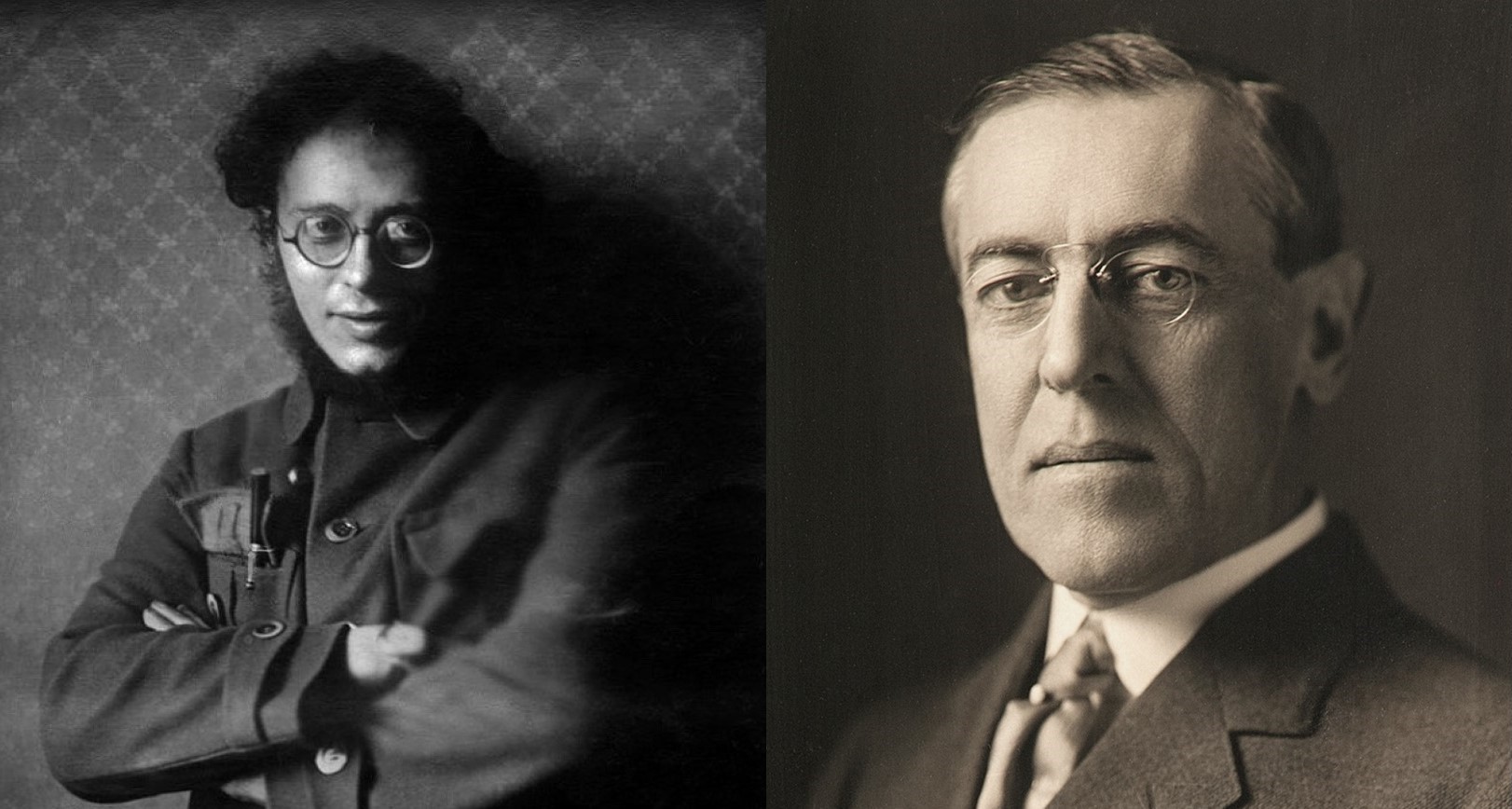
Karl Radek dips his pen in the still-warm blood of Woodrow Wilson in this estimate of the particularly American 28th President who led the U.S. in World War One, winning the Nobel Peace Prize for his efforts.
‘The Last Prophet of the Bourgeoisie’ by Karl Radek from International Press Correspondence. Vol. 4 No. 13. February 21, 1924.
The news of the death of Wilson has left everybody quite unmoved. Wilson died politically on that day when the Versailles Peace was signed. Now, America buries with great pomp that which had remained living after that death of Wilson which had taken place at Paris in 1919.
But with the name of Wilson, there is connected the last Utopia of the bourgeoisie, a Utopia which during the war years inspired the minds of millions of people, a Utopia which was the last great idea of the capitalist world. From the moment of the failure of this Utopia, the capitalist world will live only so long as the working class will allow it.
Wilson’s career represents in itself a model of those peculiarly American phenomena which we Europeans are not able to understand: in America there arrive at the leading posts, statesmen who, as a rule, do not distinguish themselves either by intelligence or by character, regarding whom one is at a loss to know why they became presidents instead of being relegated to the position of oldest coadjutors of the youngest secretary in any of the bureaucratic institutions. Since the death of Lincoln, America has not had one president who was in any way an eminent statesman. It seems as if the past of Wilson should have preserved him from the possibility of becoming president. The man acquired all the qualifications necessary to become a lawyer, but he showed that he justly estimated his capacities, when he dedicated himself to the teaching of young girls. Afterwards, he resolved to dedicate himself to a scientific career and began to write books such as could be hatched out every year by any professor without exercising any other portion of his anatomy than that required for a sitting posture. His book on the History of the State might have been employed in the American prisons as a means of torture for the inmates. His principal work, “History of America” is the most tedious pragmatic textbook by a mediocre bourgeois historian. The only affair in which Wilson shewed something of temperament and thought was his journalist essay dealing with Edmund Burke, the great English conservative writer of the end of the 18th century, who vilified the French Revolution. Wilson eulogises Burke for the fact that this talented, though characterless writer, fought against the penetration of the ideas of the French Revolution into England, and he asks himself fearfully, what would have come about if the ideas of the French Revolution had been victorious in England.
In 1910 Wilson, having resigned his position as Rector of the University of Princeton, where his reformatory school ideas had suffered a complete defeat, became a candidate for the position of a governor of the State of New Jersey. This state which is bordering on New York, had applied the laws regarding the control of trusts even more delicately than this was done in New York. The democratic clique, which at that time was ruling New Jersey, was very much compromised and required the promotion of a candidate “with a clean sheet”. The learned professor, who had not been bribed and was even praised for having, during his rectorship at the University, fought against the intervention of financial men in the conduct of University affairs, appeared to be the most suitable person for concealing the old corruption. The biographer of Wilson, Daniel Halevy, explains in his book, intended to praise Wilson in a very unequivocal manner, why the old rats of the democratic corruption had recourse to Wilson for help. “One of the manoeuvres of the American ‘politicians”, he writes, “consists in their screening themselves behind a candidate who appears not be a professional politician. They promote a person who is capable of pleasing, who bids fair to achieve success, thanks to his name being a new one, or thanks to a certain halo acquired in other spheres: at the University or the Law Court, briefly, a man like Wilson, who can be bought with a high position. The politicians who promote such a candidate speculate upon the lack of experience of the newcomer, and upon their skillfulness to lead him firmly from the very day following the elections and thereby to secure themselves the possibility of ruling also in the future without any hindrances”. Thanks to these methods of the ill-reputed American democracy, our professor became a governor.
While occupying this post, Wilson, without modifying anything in the administration of the state, served up speeches against the domination of the trusts. Whoever reads these speeches, which are collected in a book entitled: “The New Freedom”, would think that at length a just man had arisen in order to destroy Sodom and Gomorrah. Wilson demanded an open administration of affairs on the part of the trusts, he literally promulgated the Bolshevist slogan of 1917, calling for the abolition of commercial secrets, he demanded the subjection of the large trusts to the control of society. This obtained for him the credit of being a genuine democrat and prepared the soil for his being elected President of the United States of America in 1912.
The outbreak of the war found Wilson at this post. Adapting himself to the anti-War mood of the majority of the population of the United States, Wilson delivers one anti-war speech after the other, just as if in him the spirit of pacifist prophets had taken up its abode. He speaks against secret diplomacy, against secret treaties, of the common interests of all nations, the necessity to unite them. He speaks so well, that not only all bourgeois pacifists are enchanted with him, but that in the ranks of the Social Democratic parties also, as soon as war-weariness begins to be felt, there literally begins a Wilson-cult. The old man Kautsky even writes an essay on the historical roots of Wilson’s pacifism. All this time, financial capital of the United States is working under the leadership of Morgan for the equipment of the Allied armies. Some explain this by the ties of blood and nationality between the leading English and American financial circles. But this is nonsense. Bankers of a pure German or of Jewish-German origin, as Baruch, Schwab and Kahn are working for the Entente no less eagerly than Morgan is doing. The cause for this is simple. England has command of the seas, supplies for Germany would provoke a conflict with English imperialism, but supplies to the Allies cannot be hampered by Germany, because the fleet of the latter is closely shut in the North Sea.
From August 1914 up to February 1917, the American trusts were supplying the Entente with ammunition and food- stuffs to the tune of 10,5 milliard dollars. The preponderance of the American export over the import amounted to 5.5 milliard dollars. The Entente is paying with gold, with American securities, which are in the hands of the Entente capitalists. “Within two years of the War, Morgan the younger has gained more than the old Morgan during his whole life time”, writes John Kenneth Turner in his grandiose book on the participation of America in the War; a book which gives the most striking picture, founded on facts, of the dictatorship of financial capital in the democratic United States in the war. Any rumors regarding the possibility of peace negotiations lead to a fall of the shares in the American trusts, and nothing is feared more than peace.
Three quarters of the American press are working for Morgan and for his consorts who are raking in the loot. They do everything possible to prepare public opinion for the War. Hand in hand, there works along with them the American bureaucracy, which at that time, while Wilson in his speeches stands for the defence of freedom and democracy, imprisons thousands of people who are fighting against the war danger. In 1916 the Presidential elections take place, and Wilson figures as the president candidate who saved America from war by his having been a president of neutrality and peace. The trusts who are holding in their grip the whole practical power, are rubbing their dirty paws with pleasure. Wilson emerges victorious. The preparation for entering the War is going on at full speed.
The Entente is suffering increasing difficulties in the payment for new orders in America. It threatens that it will be compelled to content itself with the production of munitions at home, if America will not enter the War. In the Spring of 1917, Wilson makes all preparations for the rupture with Germany and accomplishes this rupture.
The entrance of America into the war took place against the will of the great majority of the American nation. This, in the first place, was revealed by the insignificant number of volunteers who declared their readiness to enter the ranks of the Army. The wave of reprisals, not only against Socialists, but also against every kind of opponent of the War, which in America assumed an extent which even Tsarist Russia had not known, confirms the unwillingness of the Nation to conduct the War. Financial capital has won, now it is able to make such profits as were never seen before in the history of mankind, and, moreover, at the expense of the American masses. Wilson surrenders the entire administration of the War industry, the distribution of orders, the control of prices, to the interested capitalist organizations. He for his part begins his sermon on the conditions of eternal peace which will be obtained after the crushing of the Hohenzollern tyranny.
This sermon reinvigorates the tired armies of the Entente. Wilson’s speeches create the belief in the French, Belgian and English soldier that, if he is to perish, at least the War which will kill him will be the last War. These speeches begin to destroy the morale of the soldiers of Germany and Austria more than the underground propaganda of international Socialism. Wilsonism becomes the faith of suffering mankind on the battlefields, of the petty-bourgeois masses of the whole world. Annulment of the War alliances, of the secret treaties, right of self-determination of the nations, abolition of militarism thousands of newspapers are repeating day by day these slogans of the President of the United States, of the chief of the most powerful State of the world.
There came the day when the German front wavered. The German Government, having perceived the abyss at its feet, clutches as at a straw at Wilson’s 14 points which have to save German capitalism from its being shattered by the victorious Entente. Germany calls upon the American President as the arbiter of peace to pronounce the conditions for an armistice. For a whole month Wilson refrains from announcing these conditions and delicately hints to Germany that she will not be able to obtain peace, unless she gives up the Kaiser. By means of this he literally organized the insurrection in Germany. The insurrection actually breaks out, the German ruling classes capitulate in the Compiègne Forest. The conditions of the armistice are monstrous ones; they involve the complete impotency of Germany at the peace negotiations. But even if anybody in Germany had thought of opposing these, he would have been torn to pieces by the popular mass which profoundly believes that Wilson will stand up for it at the peace negotiations. The Social Democratic Government, fearful of the revolution, encourages these hopes in Wilson. Only Soviet Russia, from the tribune of the Soviet Congress and in the note sent to Wilson, makes plain to the international proletariat that all the promises of Wilson are but one great fraud.
There commences the tragic-comedy of Versailles. We now have a very clear picture of what was going on behind the walls of that room, in which the fate of mankind was decided by four men: Clémenceau, Lloyd George, Wilson and Orlando. The book written by Wilson’s Secretary, Baker, the book by Tardieu, one of the most eminent leaders of the French delegation, of Keynes, the English expert for financial affairs, have preserved these pictures for mankind. On the one hand, the old man Clémemceau, the man of the iron will, knowing that the hour has come to revenge the crushing of France in 71, the man who had been waiting for 50 years for this moment of revenge, the personification of hate; Lloyd George, the representative of the powerful English bourgeoisie, taking care not to afford Germany the possibility of re-establishing her powerful fleet, not to allow France to become a dangerous opponent, to prevent America obtaining the hegemony of the world all this on the one hand. And on the other, the professor, without any concrete grasp of European affairs, weak, over-occupied, arriving at the sittings accompanied by elegant French ladies by means of whom French diplomacy surrounded this American Puritan. But even if he had not proved himself to be a weak-charactered fool among wolves, if he had been a man of steel, even then not one of his promises would have been fulfilled.
American financial capital came out of the War as the strongest one. But had it been possible to create an actual League of Nations, to the decisions of which America also had been obliged to subordinate herself, then the combination of other states within the frame of this League might have proved to be stronger than America. To American capital it was of more advantage to stand opposed to torn, balkanized Europe and to exercise its hegemony over a dozen isolated, weak, countries having need of America’s help. All the ideas of Wilson regarding the creation of an effective League of Nations, opening up the way for the uniting of the whole capitalist world for the establishment of its economy, would have been disadvantageous to American capital. The League of Nations, however, in that form in which it was created after the capitulation of Wilson, could find no support among the American masses.
American financial capital, which had plundered half the world, including the American population, had to take into account the mood of the American petty bourgeois class, which was suffering from the raging high costs of living, the mood of a mass which had grown utterly tired of the War. Away with European affairs this was the attitude of this mass.
The disappointed pacifists were enemies of the Versailles Treaty, because it was a glaring contradiction to all the previous sermons of Wilson, and the mass of the American population was against him, because he imposed on America the duty of securing the Versailles Peace and pushed her automatically into the coming war. Thus, Wilson returned to America a political corpse.
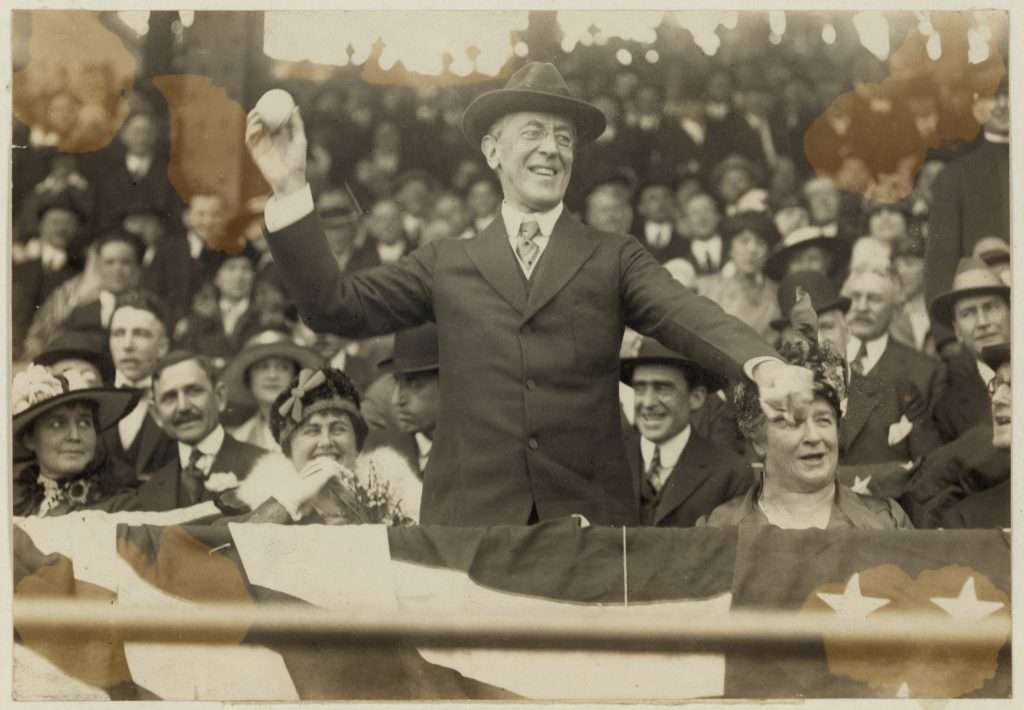
There are those who attribute the failure of Wilson to his weakness, others declare that this last prophet of the international bourgeoisie was a great hypocrite and charlatan. This question can be quietly entrusted to the lovers of biographies of the great men of declining capitalism. Even if Wilson had been a man of crystal purity, a man of heroic character, even then his ideas were bound to suffer shipwreck. The capitalist world is a world based on competition. Against one organization of robbers, which tries to organize the plundering of nations, there arise other organizations seeking new methods for obtaining surplus-profit; with the interests of the bourgeoisie, there are connected the interests of the dynasties, of the military cliques, and all of them are aiming at rendering competition, armaments, wars and national conflicts eternal.
The idea of an organized mankind will cease to be an instrument of deception or a Utopia, only from the moment when it is taken up by the class whose interest it is to abolish the exploitation of one part of the world by the other part, by the class which can finally be victorious only by its international fighting organization and which is obliged, after its victory, to substitute this exploitation with the international organization of economy. Lenin was the personification of this great real idea of organized mankind.
Decades will pass before this idea will be realized. But there is nothing at all Utopian in it: it is the aim for which the international proletariat will strive, because this aim stands before it, like a guiding star. In 1918 it was still possible to say that the next decades would decide the question: who will be victorious.
Lenin or Wilson. Now one can say without any exaggeration – History has given answer to this question: Victory of Lenin or victory of the beast of the new world war, a thousand times more bloody, more cruel, and more senseless than the war of 1914-18.
International Press Correspondence, widely known as”Inprecorr” was published by the Executive Committee of the Communist International (ECCI) regularly in German and English, occasionally in many other languages, beginning in 1921 and lasting in English until 1938. Inprecorr’s role was to supply translated articles to the English-speaking press of the International from the Comintern’s different sections, as well as news and statements from the ECCI. Many ‘Daily Worker’ and ‘Communist’ articles originated in Inprecorr, and it also published articles by American comrades for use in other countries. It was published at least weekly, and often thrice weekly. Inprecorr was a major contributor to the Communist press in the U.S. and is an invaluable English-language source on the history of the Communist International and its sections.
PDF of full issue: https://www.marxists.org/history/international/comintern/inprecor/1924/v04n13-feb-21-1924-inprecor.pdf
 Revolution's Newsstand