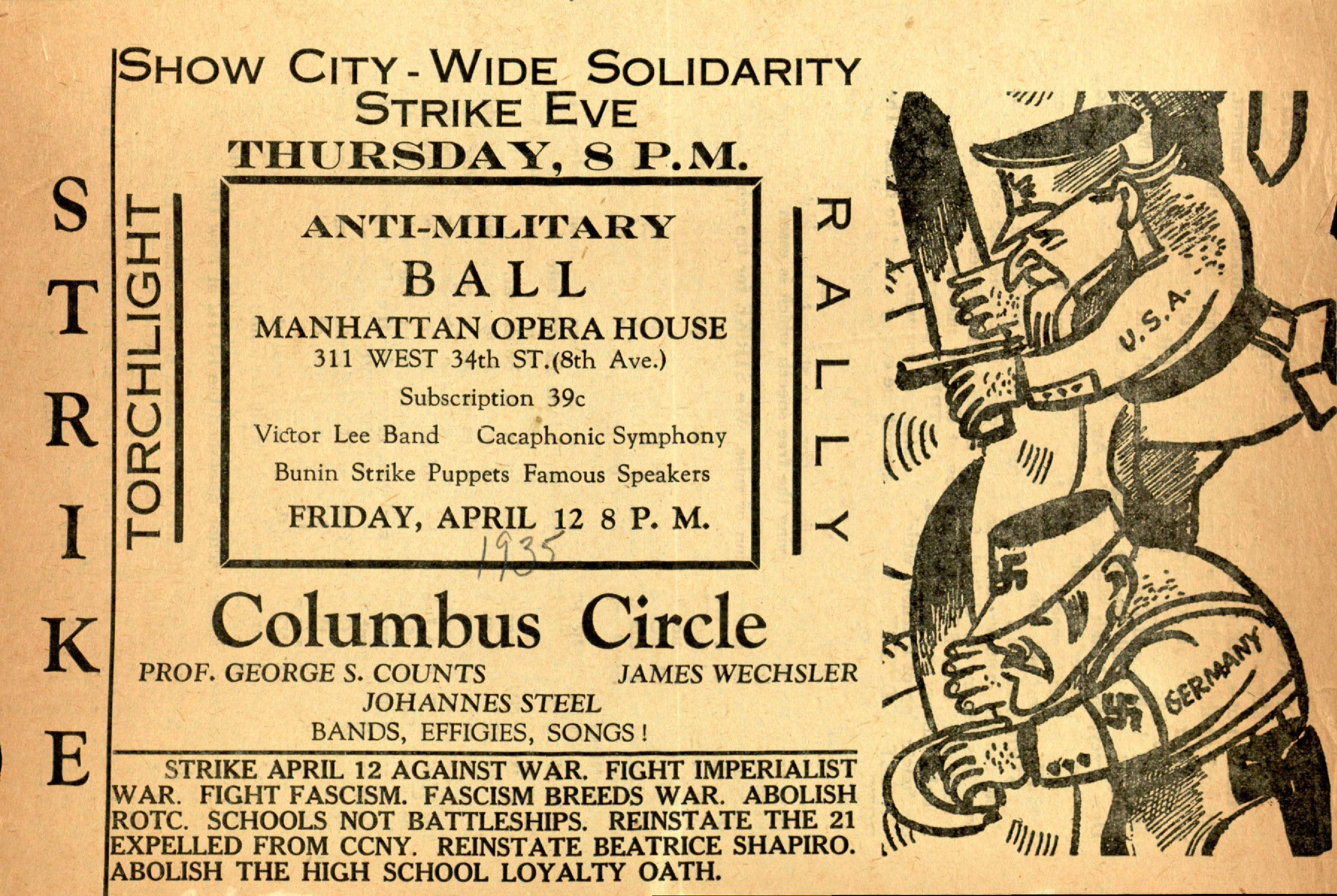
Ruth Oxman, Young Peoples Socialist League National College Secretary, gives a run-down of highlights from the second annual student strike against war held April 12, 1935. Despite the lack of national coordination between left-wing student groups, the strike saw an estimated 175,000 take part.
‘Student Strike Makes History’ by Ruth Oxman from Challenge of Youth (Y.P.S.L.). Vol. 3 No. 2. May, 1935.
Expulsions And Sluggings Fail to Block Students
A Stirring Success! That is the verdict in regard to the 2nd Annual International Student Strike Against War. Not only did the walkout fulfill the highest expectations of the radical leaders who forecast that 100,000 students would leave their classes on April 12th, but even conservative papers conceded 150,000 participated in the strike!
Lessons of the Strike
The strike resulted in two outstanding lessons to student youth. Firstly, it again proved that student sentiment is overwhelmingly against war, not merely in the word, but in the deed. The courage displayed in facing threats of expulsion and actual physical danger testified to the depth of student feeling against war and to the length they would go to combat war.
The second lesson was found in the reaction provoked on many campuses that led to counter demonstrations with a distinctly fascist tinge. Sluggings, stench bombs, and similar de- vices were used in many instances against the strikers by bands of reactionary youth recruited from the R.O.T.C., fraternities and the athletes.
Estimate 175,000 Out
The Student L.I.D., on the basis of reports from its local chapters estimates a good 175,000 students participating in the strike. Following are flashes from a few of the schools and cities testifying to the accuracy of that figure.
Over 8,000 students participated in the anti-war activities in Cleveland, Ohio. In Collingwood High School, 4,600 students attended the largest high school anti-war demonstration ever held in the country. The students were addressed by Peter Witt who roundly scored the American Legion for its attempt to break the strike and who spent the largest part of his time telling of the great Socialist leader, Eugene V. Debs.
Verne and Burt Speak
At Western Reserve, through the efforts of the S.L.I.D. chapter, more than 2,000 students took part in a demonstration. The Cleveland Yipsels concentrated their efforts on John Adams High School and despite the opposition of the National Student League, turned out an outdoor meeting of 450 students who were addressed by Sam Verne, Organizer of the Cleveland Y.P.S.L., and Roy Burt, National organizer of the Socialist Party.
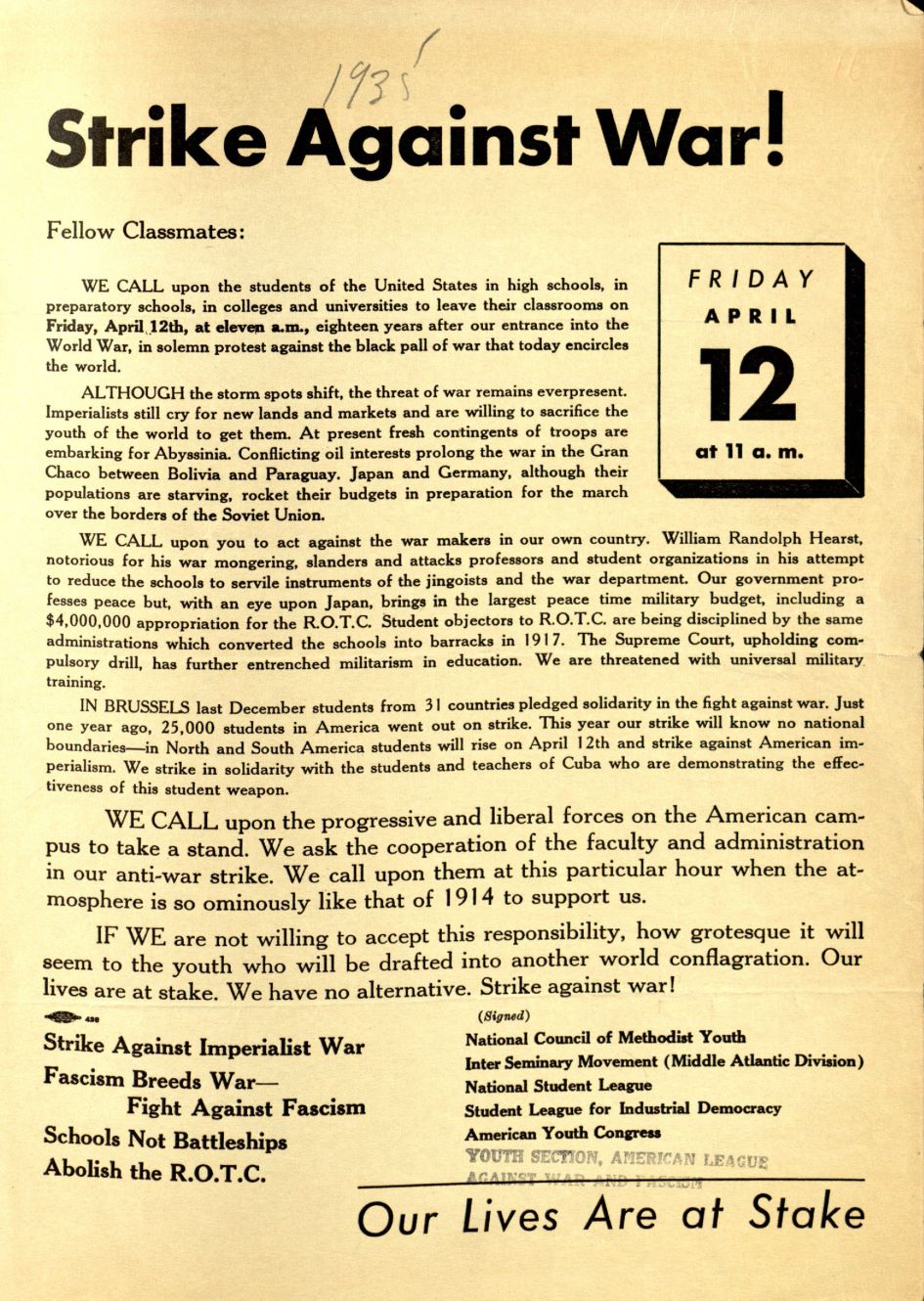
The strike was marked by violence and disorder only when the administration presented active opposition. At Los Angeles Junior College, two girl students were clubbed unconscious by the police, and the huge demonstration was dispersed by streams of water from the college sprinkler. At Chicago, in spite of vigilante attempts to disperse the Strike Parade, 3,000 students kept their ranks intact, taking the Oxford pledge.
A Roosevelt “HEILS HITLER”
At Harvard U., John Roosevelt, son of the President, was seen with his hand in a Fascist salute, while a group of militarists attempted to start a counter-demonstration on the edge of the 4,000 student strike.
In New York City, over 25,000 students came out despite the downpour and the administration and police violence. Attempts of high school principals to prevent students from striking by calling police into buildings, barricading doors, locking students in, refusing to give students their coats when they wanted to strike, led to numerous minor disorders.
Yipsels Suspended
Although the Board of Education has claimed that a very few struck, a tabulation of the attendance at strike rallies shows 8,000 walked out of N.Y. C. high schools. Alfred Dwin, Leonard Pass, Frank Rosenbaum, Morris Licht, and Joseph Ostroy, all YPSL’ers and members of the S.L.I.D. chapter of Thomas Jefferson were suspended for strike activity; as were also Louis Panken, Louis Becker and several other young Socialists at Monroe High School.
New Jersey Comes Through!
Although New Jersey has no radical student movement to speak of, the slogan STRIKE AGAINST WAR captured the imagination of all sections of the student body, organized and otherwise. At Dana, over 250 students participated in the outdoor demonstration, with Dr. Harry W. Laidler, Socialist party member and Executive Director of the L.I.D., as the main speaker.
At Central High, Dr. Frank Kingdon of the Socialist party spoke before an assembly of 800 students. At Barringer Evening High, entirely through the efforts of the S.L.I.D. chapter, a large mass meeting was held. S.L.I.D. and Socialist literature was widely distributed. Disciplinary action is being taken against several Yipsels active in arranging the strike.
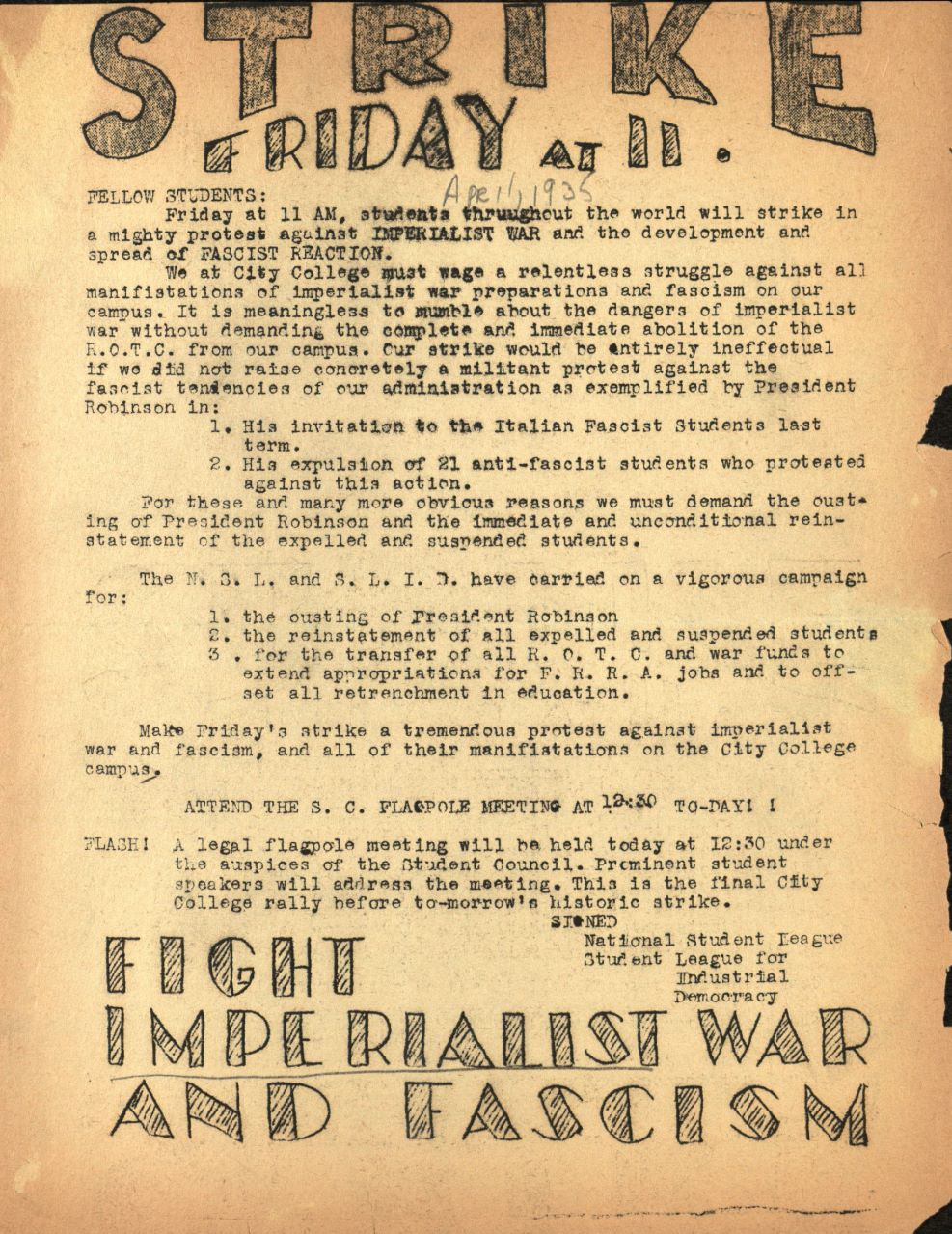
With the students of the University of Chicago playing the leading role, thousands of high school and college students demonstrated their opposition to war in the windy city. At the U. of C. 2,500 students crammed their way into Mandel Hall and at the close of the meeting paraded to the center of the campus where they took the Oxford Pledge, led by Quentin Ogren of the Socialist Club.
Parade Jars Bankers Row
Successful meetings were held at the Central YMCA College, students of which paraded down the heart of Chicago’s financial district to the office of the Board of Education to protest the plan for R.O.T.C. expansion in the high school. Lewis Institute and the People’s Junior College, as well as in many high schools also came out. A number of Yipsels were arrested; others gave good accounts of themselves in the clashes with reactionary students at the U. of C.
Al Hamilton, National Chairman of the SLID and YPSL’er, was slugged by a strike-breaking thug in front of the Central YMCA but continued his activities as strike leader for Chicago.
Berkley Aflame
The university city of Berkley, California has been aflame with the anti-war spirit engendered by the Student L.I.D. and the Y.P.S.L. Eighteen students were dismissed for distribution of anti-war hand bills. More than 300 students took part in the strike held at Sather Gate just outside the campus, the use of which was forbidden by university authorities.
At Connecticut State College, Nat Gere, Hartford Yipsel led a tremendously effective anti-war strike and likewise under his lead, an S.L.I.D. chapter is being set up.
One of the few successful strikes in FERA schools was led in the St. Louis FERA College by Gloria Waldron of the Y.P.S.L. N.E.C.
Thomas Enthuses Philly
In Philadelphia, the Y.P.S.L. leadership of the Temple S.L.I.D. chapter, after much maneuvering, forced the administration to dismiss classes for an outdoor strike at 11 AM. The administration, which at first bitterly opposed the strike, erected a stand outside the school from which Norman Thomas spoke to an enthusiastic, cheering audience of 2,500 of the school’s 3,000 students, despite a heavy rain.
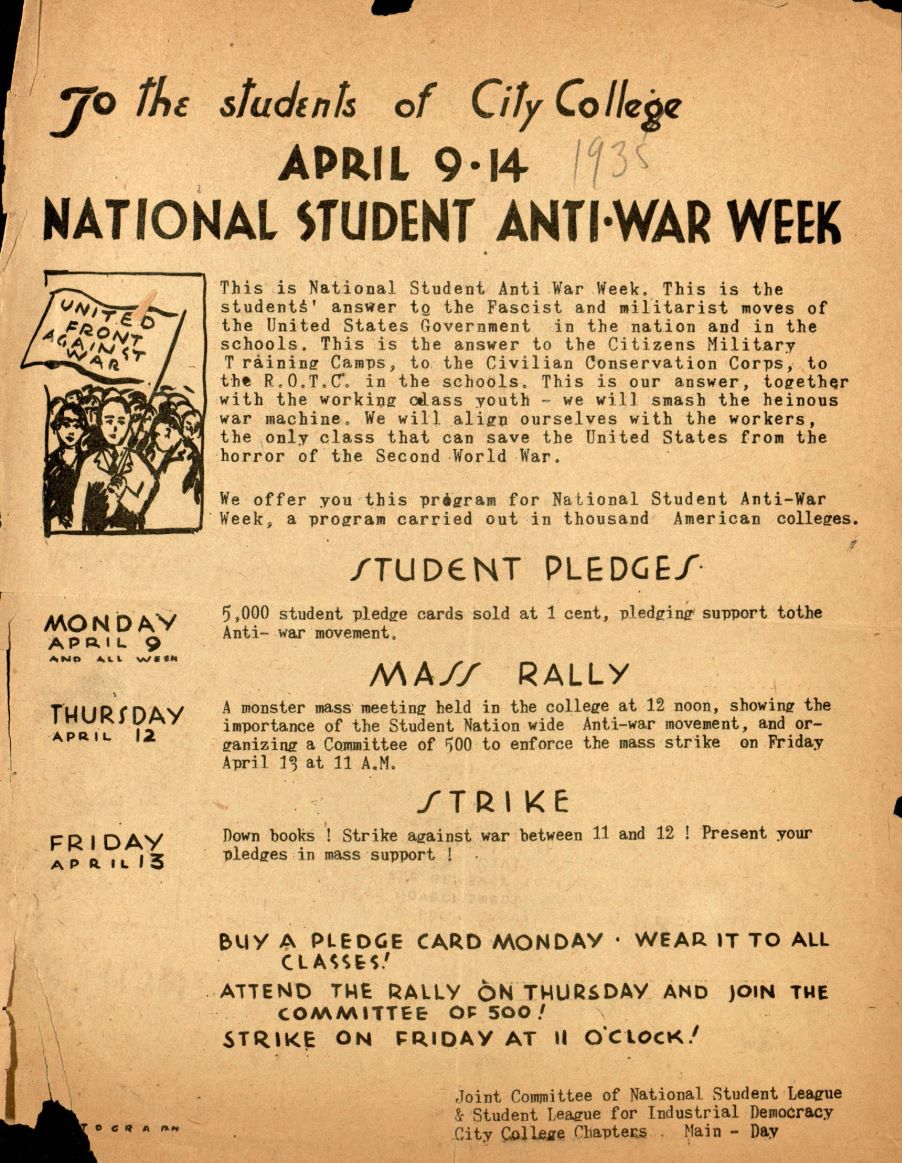
A flying squadron of Yipsels and SLID’ers from Temple started the walkout from Gratz high school. After teachers locked doors, those students who were unable to get outside listened to Thomas from opened class room windows. Bernie Backer, the YPSL’er who did most of the preliminary work in Gratz was expelled.
Locked Doors Block Walkout
Annette Neutra, Yipsel student at Overbrook, tried to present student opinion at the indoor meeting called by the school administration at which a teacher said was unavoidable. When refused the floor she started to lead the 1,000 students in a walkout but was barred by doors locked in violation of fire regulations.
Norman Thomas also spoke at the University of Penn where N.S.L. leadership of the strike compromised on an indoor meeting at noon. The regional strike committee on which Yipsels were active forced the Board of Education to instruct principals to hold anti-war meetings and discussions on the day of the strike. If these meetings are included, about 50,000 students participated in one form or another of anti-war protest in the Philadelphia area, 5,000 of which took part in outdoor strikes.
Against War and Capitalism; For Peace and Socialism!
Are these instances sufficient? Do they not prove the stand of America’s Student Youth in regards war? Now it is the task of Socialist youth to win these students to the fight on the War System-Capitalism!
Begin by bringing them out on May Day-teach them the lessons of solidarity with the workers! Hitler may have harnessed German students to Fascism but we will harness the enthusiasm, the idealism, the courage of American students to the battle Against War, Against Capitalism-For Peace and For Socialism!
Challenge of Youth was the newspaper of the Young People’s Socialist League. The paper’s editorial history is as complicated as its parent organization’s. Published monthly in New York beginning in 1933 as ‘Challenge’ associated with the Socialist Party’s Militant group (the center/left of the party around Norman Thomas). Throughout the 30s it was under the control of the various factions of the YPSL. It changed its name to Challenge of Youth in 1935 and became an organ of Fourth Internationalists, leaving to become to the youth paper of the Socialist Workers Party in 1938. In the split of 1940, the paper like the majority of YPSL went with the state capitalists/bureaucratic collectivists to become the youth paper of the Workers Party.
PDF of full issue: https://www.marxists.org/history/etol/newspape/challenge-of-youth/350500-challengeofyouth-v03n02.pdf
 Revolution's Newsstand