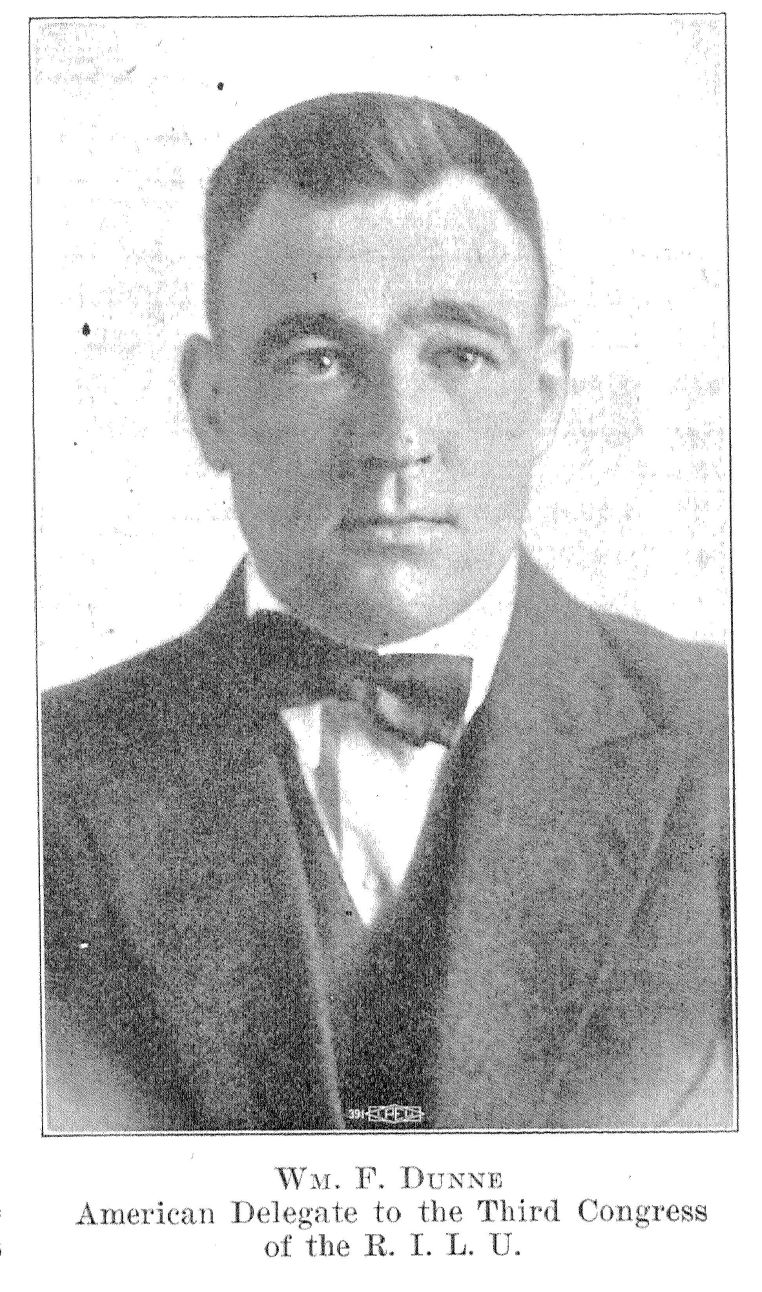
A speech by William F. Dunne acting as representative of the Trade Union Educational League to the Third Congress of the Red International of Labor Unions (Profintern) in July, 1924.
‘Revolutionary Strike Strategy’ by William F. Dunne from Labor Herald. Vol. 3 No. 7. September, 1924.
COMRADES, we are striving here for a unified strategy for the world revolutionary movement. The objectives of the revolutionary movement in every nation are the same–the overthrow of world capitalism, the establishment of the dictatorship of the proletariat. Yet the method of reaching our objectives is a very difficult one, and no better illustration of the difficulties we encounter can be had than the speeches of Comrades Monmousseau and Heckert.
Comrade Monmousseau comes from a country with a de-centralized industry. Comrade Heckert comes from a nation with the highest developed industry in Europe. Their viewpoints naturally are colored by the character of the struggle based upon the industrial development in their respective nations. As soon as we try to lay down uniform rules for the struggles of the working class, we discover that the countries are in different states of development and in every one of the countries the relationship between the forces of the working class and the forces of the capitalist class are different.
Strategical Situation of the American Movement
In the United States the labor movement has no revolutionary experience. It is weak It is weak numerically, but American industry, American capitalism is the strongest capitalism in the world today. American industry is the most highly developed and the most centralized. Exploitation of the working class goes on to almost the same extent as in Germany. But can we use the same strategy in the United States that the revolutionary workers in Germany use, or that Comrade Monmousseau’s forces use in France? Of course not. The relationship of the forces are different.
Any discussion of strike strategy for the United States must take into consideration five major factors: 1) That the workers organized in trade unions in the United States number less than one-seventh of the entire working class. 2) The difficulty of coordinating the strike movements in as large an area as the United States, having as many different industrial conditions. 3) The extremely concentrated character of American industry, the complete monopolistic control of every basic industry. 4) The custom of the ruling class of America of outlawing all strikes, big or little, though the use of court processes, the injunction. 5) Lastly, we must remember that the American working class has no revolutionary class history as have the working classes of Germany and France.
The American trade union movement numbers, at a liberal estimate, some 4,000,000 workers. Inside this trade union movement is a handful of revolutionists. Every discussion of strike strategy must therefore cover two points: The broad question, the strategy and tactics of the trade union movement itself, and the strategy of the left wing inside that movement.
The Proportion of Organized Forces
No strike can be won in America without the unorganized workers. In only two industries are there more organized workers than there are unorganized. In the railway transportation industry there is good organization; in the coal mining industry there is about 75 per cent organization; in the steel industry there are 8,000 organized workers out of a total number of 400,000; in the lumber industry there are perhaps 10,000 organized out of 200,000; in the textile industry, 50,000 workers out of more than 800,000; in the metal mining industry there are not more than 10,000 organized workers out of a total number employed of 75,000.
And so the unorganized workers in America are the section to whom any trade union strategist must appeal, upon which he must base his strategy and tactics. Therefore, for the revolutionary movement in America this question the leadership of mass strikes, the attracting of the unorganized to the strikes of those workers who belong to the unions is of the first importance.
The leadership that has developed in the American revolutionary movement has come out of the great strikes conducted by unorganized workers. The leadership, the prestige, of Gene Debs was due to the fact that he organized and led the railway workers in the great strike of 1893 and 1894. The popularity of Bill Haywood springs from the fact that he was in the struggle of the striking metal miners. The prestige of Wm. Z. Foster comes largely from the fact that he organized and led the packing house workers and steel workers. And so, if the revolutionists of America are to secure the leadership of the American working class, they must first of all secure the leadership of the strikes of the American workers.
We Must Build Leadership from the Ranks
The greatest strikes that have ever taken place, those in which the most determination and class consciousness have been shown, were the strikes growing out of an attempt to organize unions. This was the case of the steel strike of 1919-20, the strike of the West Virginia miners, and so forth.
Before the revolutionary movement in America can acquire the leadership and the important position in the struggle which it must acquire, there must be a closer contact with the working masses. We cannot take over the leadership from above. It must grow up with the persons right from the very beginning of their struggles. And so, first of all, the Workers (Communist) Party of America must have in every industry young, energetic and enthusiastic comrades who will grow up with the industry, who will have, not only a political understanding, but a practical knowledge of the working class knowledge in that industry. That is the kind of leadership that we must have in America, and that is the kind we are trying to build.
There cannot be in the United States a great nation-wide strike that will shake the foundations of American capitalism, if it is based solely on economic demands. The conditions under which the workers are employed in America vary too much to make this possible. For the South, the North, the Atlantic and the Pacific Coasts–it is largely impossible to draft uniform wage scales and working conditions.
Most strikes in America, of which the revolutionists will assume the lead, must have some popular slogan that will catch the imagination of the masses and arouse that moral indignation against the exploiters and the tyrants, without which no mass struggle can be successfully conducted. We must not over-stress the importance of the wage struggle of the American working class. This is the tactic of the bureaucracy of the American trade unions. The American trade unionists have been told for forty years that they should take no interest in politics, that the trade unions are merely for purposes of negotiation with the employers that they should remain neutral toward political parties.
This fallacious idea must be blasted from of the minds of the American working class, and it can only be driven from their minds by a mass struggle against the state power around some slogan that represents something of the moment.
The Relationship of Forces
What is the relationship of the forces in America? Comrade Heckert tells us of the vertical trusts in Germany. He tells us of centralization of German industry. Yet in Germany, growing up with this centralized industry, there was a powerful trade union movement. But this is not so in America. Every basic industry is America is controlled by a little handful of individuals. No strike of the American workers against the employers but becomes a strike against some part of the state power.
The strike of 1922 of the railway shopmen was declared illegal by the government. More than a thousand arrests of strikers were made, but there was no political agitation made by the trade union bureaucracy. The revolutionary minority within the railway unions is as yet too weak to turn the attention of the organized masses to the political nature of that strike.
But we cannot allow ourselves to be discouraged or driven away from the mass organizations of the workers because of our lack of influence and our numerical weakness. We must continue to drive always toward the goal of fixing the minds of the workers upon the state power and against the employers. We must make them see the army and the navy and the courts. We must make them see these not as impartial instruments operating above both working class and capitalist class, but as the capitalist class itself, the iron forces of capitalism that suppress them every time they show their resentment.
In Germany the working class is already beginning to feel the power of American capitalistic imperialism. They may struggle against their own capitalists, but their battle can never be won, the victory of the world revolution can never be complete, until American capitalism has been crushed. This is the reason for the presence of American revolutionaries in a congress of this kind. The fact that their country is the last bulwark of world capitalism, gives to the revolutionary movement of America, an importance far in excess of its numerical strength.
The American working class, although without revolutionary experience, has engaged in many armed struggles with the employers, and the fact that it has shown this militancy time and time again under honest and fighting leadership, is an indication that the task of the Communists in America in not a hopeless one.
We hear of the conflicts between strikers and capitalist forces in Germany, and the attacks of French police upon striking workmen. This is explained as due to the fact that the capitalist class of Europe fears the coming of the revolution. It is nervous and sees in every outbreak of the workers the beginning of the struggle for power.
In the United States for years and years the capitalist class, which has had no fear of revolutionary uprisings, has used the same tactics against trade unions that the ruling class of Europe uses against the revolutionaries. Every strike of any magnitude in America turns into an armed clash, and the history of the organized trade union movement in America is a bloody one. There are long lists of plain trade unionists who died before the rifles of the ruling class.
It should be understood, however, and cannot be emphasized too strongly, that in the United States this militancy is entirely without any political inspiration. It is directed solely against the employer, and it is our task to change the current of this fighting spirit and direct it against the American capitalist class and the government.
The American trade union bureaucracy is not reformistic. It is not social-democratic. It is capitalistic. The union bureaucrats are the agents of American imperialists among the workers, and the struggle in the United States is clean-cut, for that reason, between the Communists on one side and the reactionary agents of capitalism on the other. There is no central group which takes up the shocks.
We must strive in America to initiate among the unorganized workers strikes which we may not even be able to control. We must, in this coming period of depression which looms now in America, when millions of the American working class will be absolutely disillusioned, when their vision of perpetual prosperity will have been shattered, drive home the message to as many as we can reach, that there is no more hope for the American working class without a complete destruction of capitalism than there is for the working class of any other country.
We know now that American capitalism is at last on the down grade, that from now on conditions in America will get worse instead of better. We know that if the Dawes plan is put into operation in Germany it means flooding the world markets with commodities produced cheaper than the capitalists of America can put them on the market.
And this is where we must link up the struggles of the German workers and the struggles of the French workers with the struggles of the American working class. We must be able to show them and we must be able to organize them for protest against these conditions, that the same exploiter, the same world capitalism, dominates the lives of all. This issue must be raised in every struggle, in every demonstration of the American working masses. At first we will be able to reach only a few. But we must concentrate in the industries of strategic importance.
These tasks that I have spoken of are not going to be accomplished in a few months. The American trade union is governed by bureaucrats who are clever although they are reactionary. They have the solid support of American capitalists. They have the support of the capitalist press. They have tremendous economic power. And all that opposes them in the United States is the Workers (Communist) Party and the Trade Union Educational League, the section of the Red International of Labor Unions.
I have the fullest confidence that we will solve our problem in America, and the reason I believe so is that here in this congress there will be worked out a strategy for every nation that will be a handbook for the revolutionary minority.
If our findings and conclusions become, not merely words on paper, but living, breathing portions of the daily struggle of the working class translated into action. through our own energy, militancy and revolutionary spirit, then, even in reactionary America, the capitalist class will begin to feel that not only in the European countries, where the revolution finds expression in the armed struggle for power, but in “peaceful” America, too, the revolution. approaches.
The Labor Herald was the monthly publication of the Trade Union Educational League (TUEL), in immensely important link between the IWW of the 1910s and the CIO of the 1930s. It was begun by veteran labor organizer and Communist leader William Z. Foster in 1920 as an attempt to unite militants within various unions while continuing the industrial unionism tradition of the IWW, though it was opposed to “dual unionism” and favored the formation of a Labor Party. Although it would become financially supported by the Communist International and Communist Party of America, it remained autonomous, was a network and not a membership organization, and included many radicals outside the Communist Party. In 1924 Labor Herald was folded into Workers Monthly, an explicitly Party organ and in 1927 ‘Labor Unity’ became the organ of a now CP dominated TUEL. In 1929 and the turn towards Red Unions in the Third Period, TUEL was wound up and replaced by the Trade Union Unity League, a section of the Red International of Labor Unions (Profitern) and continued to publish Labor Unity until 1935. Labor Herald remains an important labor-orientated journal by revolutionaries in US left history and would be referenced by activists, along with TUEL, along after it’s heyday.
PDF of full issue: https://www.marxists.org/history/usa/pubs/laborherald/v3n07-sep-1924.pdf
 Revolution's Newsstand