
The I.L.G.W.U. had one of the most robust and successful cultures of social unionism. Fannia Cohn was a pioneer and life-long activist of workers’ education. Here as head of the Educational Committee of the International Ladies’ Garment Workers’ Union she reports on the establishment of the Workers University and the Unity House retreat.
‘The Workers’ University of the International Ladies’ Garment Workers’ Union’ by Fannia M. Cohn from Life and Labor (National Women’s Trade Union League). Vol. 10 No. 3. March, 1920.
IT WAS in 1914 that a group of our members began to consider the necessity of having our International initiate education–not the kind of education which was offered to adults with a view to making them more efficient and better workers, but the kind of education that would make them more intelligent men and women workers and citizens of the community in which they reside. That group felt that since many of the workers leave the schools at an early age (before they have an opportunity to develop personality and gain character) and enter into the mills and factories, and since under the strain of daily, continuous work they are apt to get out of touch with effective educational effort, if our International would consider education as a part of its activities, they might bridge the gulf between childhood and manhood.
Have no definite, worked-out plan as to what kind of educational activities would be wisest for us, the members of this group were satisfied to stress the necessity of labor education within the trade union movement until it was generally recognized, for this in itself would mean victory. Once this conception is established, the labor movement will already have found the proper form of education. Inspired by this thought this group of members went to the Cleveland Convention of our International in 1914, and introduced a resolution to this effect.
The start was made when the International appropriated $1,500 for educational activities, doing so in cooperation with the Rand School of Social Science, where special classes were organized for our members. In 1915 the Waist and Dress Makers’ Union, Local 25, of New York City, organized its own educational activities and concentrated them in a public school building under the name of Unity Center. The work was started in cooperation with the New York Board of Education. The understanding was that the Board of Education was to assign teachers of English for special classes organized for our members only. In addition to that, lectures were ranged on different subjects. Lecturers were paid by the union.

At the Philadelphia Convention of 1916 the question of labor education was more seriously taken up, and it was decided that our International appoint a committee of five, and that a fund of $5,000 be appropriated and placed at the disposal of this committee, to be spent for educational activities. The committee accepted the plan of the Waist Makers and opened a few Unity Centers, thus laying a foundation for the Workers’ University, which was opened later. The work was directed by the committee, with Miss Juliet Stuart Poyntz as educational director.
DEVELOPING AN INTELLIGENT LEADERSHIP AMONG WORKERS
The main work that is being done since this movement was started, is the carrying on of an educational campaign among our numerous members, to stimulate in them a desire for labor education. At present our members feel that what they are doing is an experiment for the entire labor movement. They take pride in the fact that they are spending tens of thousands of dollars yearly for the purpose of developing their own intelligent leadership. They feel that through their educational activities they are giving a chance to those of our members who have energy and a desire to serve the labor movement, to develop character and accumulate knowledge that will make them fit for this great task.
Our Workers’ University, supported by the International, meets at Washington Irving High School in New York City. There are classes for officers and other members of our organization. The business agents and other officers of the local unions attend classes of a post graduate character. The courses are on many subjects of university grade. Among them are:
1. Labor and Management. Trade Unionism. Thursdays, 7:30 p.m. Mr. Leo Wolman.
2. Present Tendencies in Literature. Saturdays, 2 p.m. Mr. B.J.R. Stolper.
3. Economics of the Industrial System. Saturdays, 3:30 p.m. Mr. Leon Ardzrooni.
4. Psychology. Sundays, 10 a.m. Dr. Samuel A. Tannenbaum.
5. Public Speaking. Correction of Speech Defects. Sundays, 11:30 a.m.
6. Public Speaking. Correction of Speech Defects (Preparatory Class), Sundays, 11:30 a.m. Mr. Herman Gray.
7. English Grammar and Written Composition. Sundays, hours to be arranged.
Elective Courses (hours to be arranged) 1. American History and American Civics. 2. Modern European History. 3. Current Events and Events and Reconstruction Problems. 4. Elementary Science. 5. The Cooperative Movement.
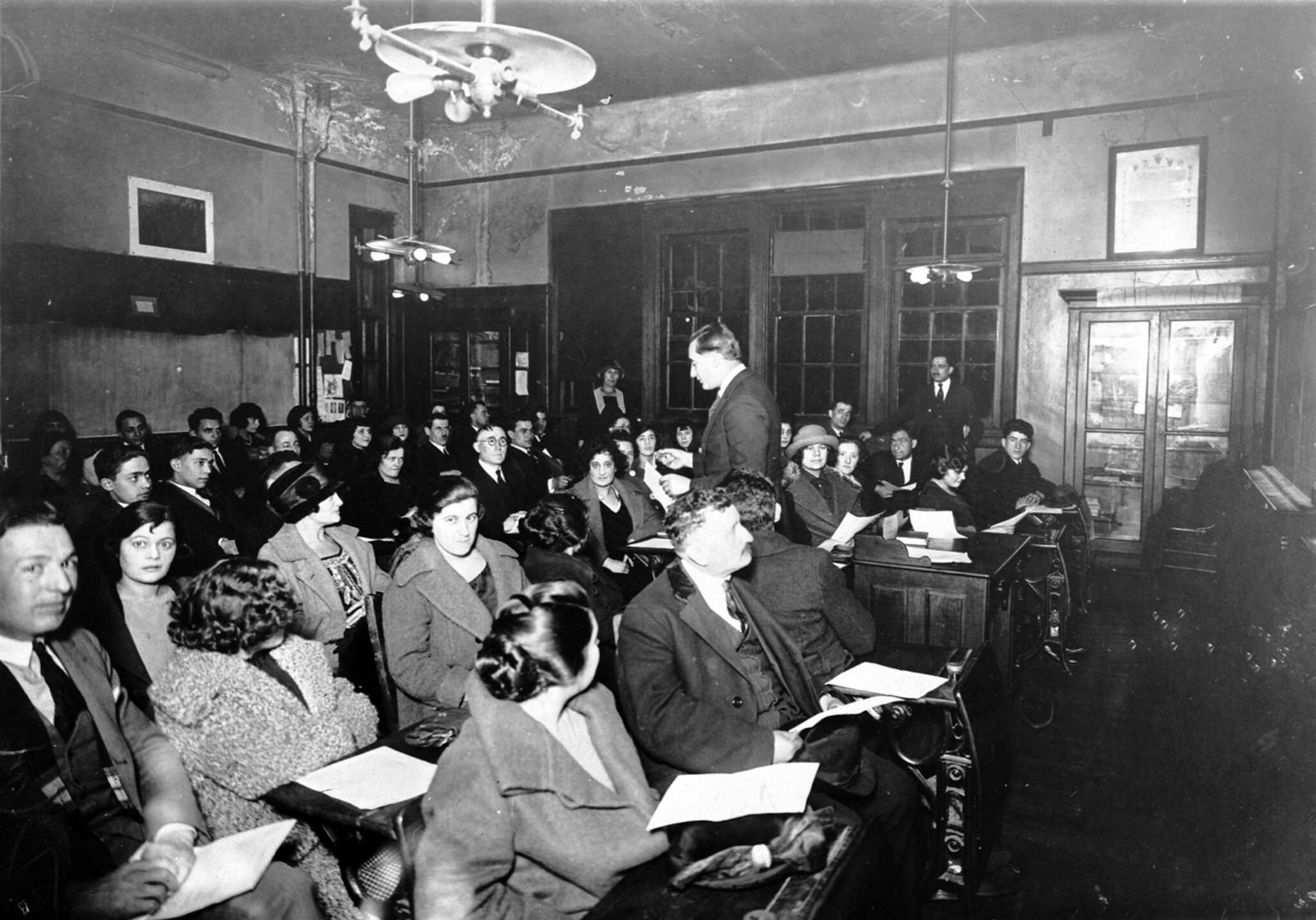
We are well aware of the great difficulties which the worker must overcome while studying: the exhaustion of mechanical labor; the demand upon his leisure made by unregulated overtime, especially in the ladies’ garment industry; the irregular hours of employment; the time it is necessary to spend traveling to and from work, and the many duties of his own class as a member of a trade union, as a citizen of a community–all this is a great tax on his time. Therefore we decided to accommodate our members by having the classes at our University on Saturday afternoons and Sunday mornings.
An important branch of our educational activities is the Unity Center. At present we have six Unity Centers in the public school buildings in different parts of the city where our members reside. In each Unity Center there are classes in English, of elementary, intermediate, advanced and high school grade. The teachers are assigned by the Evening School Department of the Board of Education. At each Unity Center there is an educational supervisor assigned by the Department of Community and Recreation Centers of the Board of Education. Our International arranges independently a series of lectures on the labor movement, trade unionism, and economics. The rest of the curriculum deals with health, or some more cultural interest, such as literature, music, art and educational films, and there are talks on vital subjects.
TEACHERS MUST HAVE MORE THAN ACADEMIC KNOWLEDGE
We realize that no teacher can be successful with our people unless he knows their life, the surroundings they live in; unless he knows their problems, unless he is acquainted with the books they read–from which they are getting their inspiration and their social ideas–and unless he appreciates and sympathizes with the point of view from which these students approach the subject that interests them. Recognizing all this, we take great pains to acquaint our teachers with all these problems before they enter the class. Therefore in engaging the teachers for our University, as well as for our Unity Centers, attention is paid not only to their academic qualifications, but also to their experience or willingness to ac- quaint themselves with all these problems.
The close personal relationship between the students and the teacher is very remarkable. They are like one family, filled with the same realization of the importance of the experiment, and all taking it seriously and feeling themselves to be under honorable obligation not to be interrupted.
That this great work of our International may bear worthy fruit, special textbooks and teachers must both be acquired at any cost. Most of the textbooks are written either for college students or for children in the grades. Realizing the difficult problem this fact presents, the lectures given by our teachers are taken down by stenographers, and we hope by the end of the season to publish them. They will serve as good textbooks for our members and teachers in the future. To make it more possible for our members to get the most out of the lectures, every instructor prepares an outline of the facts presented in the subject he is going to talk about. This outline ends in question form. Copies of these outlines are placed in the hands of the students, and they follow the lecturer according to them. Afterwards the outlines are sent to our local unions in the country, with the advice to arrange lectures according to their contents.

Because of lack of space it is necessary to limit my story to a brief description of only the more important activities of the Educational Committee of the International Ladies’ Garment Workers’ Union. The object of our educational activities is two-fold: individual and social. It is our aim that the individual be given an opportunity for self-expansion and a chance to develop character, gain. personality and get a fuller understanding of the great social, economic and philosophic problems with which he is confronted, together with a clear knowledge of the entire sweep of the industry he is engaged in. We are trying to give our workers the facts of production and distribution in all the stages, from the growing of cotton to the textile mills, and finally to the manufactured product in our shops and factories. And we hope to develop in them a sense of responsibility for their organization in particular and for the labor movement in general.
Our Educational Department is not following a well defined course of study, but the curriculum, as well as the method of teaching, is worked out within the class by the teacher and the student together. This is necessary since adult labor organization within the trade union movement is subject to constant readjustment, and it is therefore necessary to develop it along new lines. Our public speaking class is in reality a clearing house of ideas. Our students express their opinions and exchange views.
Another phase of our educational work is the Extension Division, which combines art and education and arranges special lectures and concerts for the local unions, giving a form of education that reaches the homes and the families of our members. Many of the lectures are given at the business meetings of the organization. These activities are planned and directed by the G.E.B. of our International, together with an educational director, who is himself always an educator.
To prevent the Administrative Committee from becoming too centralized and out of touch with the needs of the local unions, we have established a Permanent Joint Conference of the educational committees of our local unions. This conference meets from time to time, together with the educational director, and the chairman and secretary of the educational committee. They discuss our educational activities and make suggestions to the Educational Department.
Classes and concerts have not been the only type of educational activity of our International. Plans have been worked out for traveling libraries, to include educational books and pamphlets on important subjects.
SUMMER RESORT BECOMES HOME OF WAIST MAKERS
But one of the greatest achievements is the Unity Home of the Waist Makers’ Union that has been purchased by the union at a cost of about $100,000. This is the Forest Park House, in Pennsylvania, formerly a summer resort for millionaires. Among the names in the registration book are Mr. and Mrs. Guggenheim and others, and during last summer 500 of our workers lived there each week in an atmosphere of perfect democracy and fellowship. In this Unity village are twelve beautiful houses equipped with all the conveniences that one could imagine. The beautiful lake with its swimming pool and boats, the billiard room and bowling alley, the tennis courts. and the baseball ground, and the 750 acres of woodland and mountain–all these no longer belong exclusively to the well-to-do who spend their summer vacation there, but to the thirty thousand Waist and Dress Makers of New York City.
Nor is this the only organization that has acquired its own home in the country. The Philadelphia Waist Makers, an organization of five-thousand young women, have purchased their Unity House and have spent about $50,000 upon it up to date, although the organization is so small. It will not be long before the Waist Makers of Boston will follow them.

The Waistmakers’ Union of Philadelphia has also its own lunch room. It is located in an artistically built building in the heart of the business section of the city. There our members are served pure, wholesome, delicious food at the lowest price possible, during both the luncheon and supper periods. Like many of our other local unions, it has an extensive library containing almost 3,000 books on various subjects of interest.
If a Unity Home is good for two weeks’ vacation, it is still better for fifty-two weeks, to live in. A group of Waist Makers in New York City, with the assistance of its union, opened a cooperative house (a Unity Home) where forty young women made their home and managed it on a real cooperative basis. Our Italian sisters and brothers in the City of New York made a good start by opening two cooperative grocery stores, and the ultimate dream of the tens of thousands of our members there is to have our own building, which will become the center of the cooperative movement of education and of fellowship. We mean to have an auditorium with 5,000 seats, where our members with their families will assemble to listen to good concerts, see educational films, and discuss political and economic questions. But the one dream of our organization includes more than 150,000 people. It includes the entire labor movement. We all feel that the experiment we are making will be not for the benefit of ourselves alone, but for all workers of this country.
UNITY CENTERS FEED MINDS AND SOULS
On some certain evening, at one and the same time, some of our members assemble in one Unity Center, where, for instance, they spend the evening listening to a lecture on music, with demonstrations on the piano, and where they are taught how to understand the beautiful language of music. They respond to it emotionally, but wish to approach it intellectually.
In another Unity Center a group of our members listens to a lecture on the drama, with the reading of it by a well known teacher and literateur and instruction in how to understand dramatic art, how to appreciate its beauty, and to understand the emotions and problems that are expressed there.
In another Unity Center still others. listen to a lecture on the Plumb plan, discussing with the teacher whether this would solve the railroad question, and whether it is imitation Guild socialism.
In another, our members listen to a lecture on the labor union and its problems, and discuss the place of the worker in modern society, compare it with the place the same worker occupied in the ancient world, and try to define the status of these different periods in human history.
In another Unity Center they listen to a lecture on health, and learn how to take care of their bodies, and to begin to appreciate the influence that the body has on the mind. They agree with the lecturer that it is worth while to devote one hour a week to the gymnasium for the development of the body in order to have a good mind.
In still another Unity Center they listen to a lecture on the economic history of the United States, on getting acquainted with the country which they have adopted as their own. Through the study of history, they begin to understand better its institutions, and they decide to cherish everything that is good in it, and change those things which they think bad.
In another locality, in the big auditorium of a public school are assembled about 1,500 of our members with their families, listening to a concert performed by artists and to a talk given by a prominent speaker on a topic of the day.
Life and Labor was the monthly journal of the Women’s Trade Union League (WTUL). The WTUL was founded by the American Federation of Labor, which it had a contentious relationship with, in 1903. Founded to encourage women to join the A.F. of L. and for the A.F. of L. to take organizing women seriously, along with labor and workplace issues, the WTUL was also instrumental in creating whatever alliance existed between the labor and suffrage movements. Begun near the peak of the WTUL’s influence in 1911, Life and Labor’s first editor was Alice Henry (1857-1943), an Australian-born feminist, journalist, and labor activists who emigrated to the United States in 1906 and became office secretary of the Women’s Trade Union League in Chicago. She later served as the WTUL’s field organizer and director of the education. Henry’s editorship was followed by Stella M. Franklin in 1915, Amy W. Fields in in 1916, and Margaret D. Robins until the closing of the journal in 1921. While never abandoning its early strike support and union organizing, the WTUL increasingly focused on regulation of workplaces and reform of labor law. The League’s close relationship with the Amalgamated Clothing Workers of America makes ‘Life and Labor’ the essential publication for students of that union, as well as for those interest in labor legislation, garment workers, suffrage, early 20th century immigrant workers, women workers, and many more topics covered and advocated by ‘Life and Labor.’
 Revolution's Newsstand