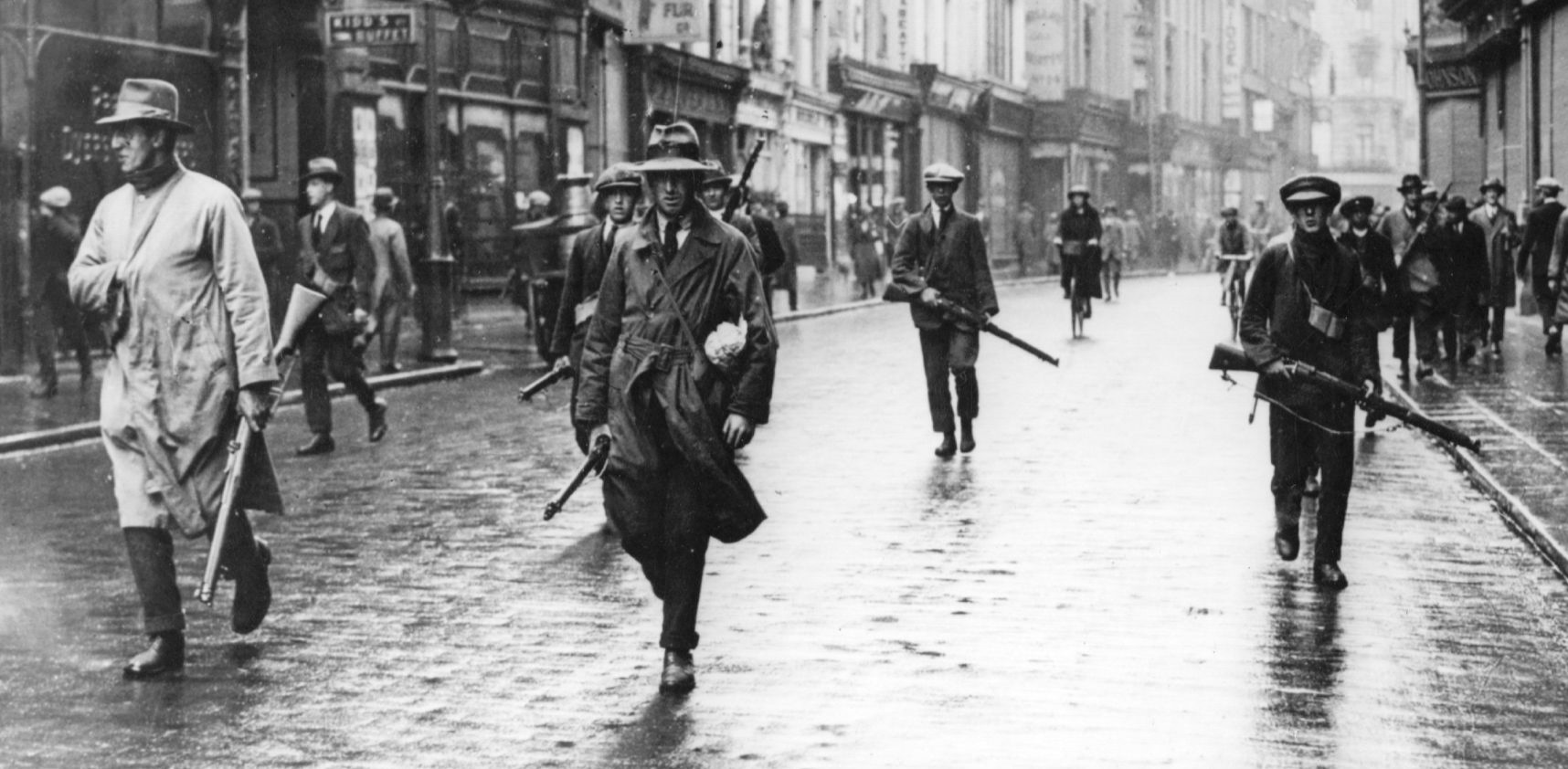
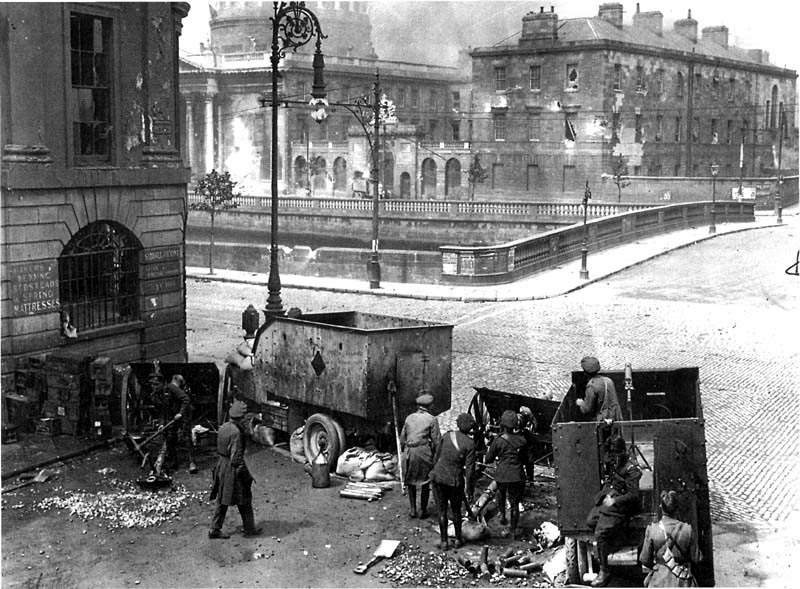
The Communist movement makes clear its position on the treaty which partitioned Ireland, created the ‘Free State,’ and resulted in a bloody Civil War. An election held under threat of total war by the British on June 18 saw pro-Treaty forces win, while a majority of the Republican Army rejected it, with anti-Treaty forces occupying central Dublin. That rejection was supported by the Communist International and Ireland’s small Communist movement. The leadership of the Comintern released this statement just days before the new Free State government opened fire with British guns on the Republican garrison in Dublin’s Four Courts beginning Ireland’s brutal Civil War.
‘To the Workers of Great Britain and Ireland’ by the Executive Committee of the Communist International from International Press Correspondence. Vol. 2 No. 51. June 20, 1922.
The Irish proletariat is again being faced with a fateful decision. After prolonged peace negotiations English Imperialism is again preparing to coerce the Irish people by force of arms.
After all the efforts of the English bourgeoisie to maintain its domination by force of arms had been frustrated by the heroic self-sacrificing defense of the Irish people, it was obliged to come to an understanding with the Irish bourgeoisie. For the semblance of an independent Irish Free State the representatives of the Irish capitalists, Collins, Griffith and Co., sacrificed the fruits of the long and successful struggle, and received in return, as a Judas reward, the right to exploit the Irish workers together with the English bourgeoisie.
The party of the small peasants and of those workers who are not as yet class-conscious, represented by De Valera, saw through this game. However, the election compromise which this party has arrived at with the Irish exploiters, shows their lack of determination to fight against the latter. The working elements of this party, and above all the Irish Republican Army, which consists mostly of proletarian elements, are justified in being indignant at this pact, and in seeing in it the beginnings of a future betrayal.
The Irish Labour Party is fully aware that every attempt at emancipation on the part of the Irish workers will be hopeless until the party will direct its struggle against the twofold oppression of the English imperialists and the Irish capitalists. Nevertheless, the Irish Labour Party is much too opportunist to continue the revolutionary traditions of Connolly or Jim Larkin. In all questions concerning real independence and the Irish Republican Army, the Irish Labour Party does not go beyond fine phrases. Instead of demanding complete independence, it clings to an ultra-constitutionalism, just like its twin-sister, the British Labour Party. Instead of supporting the Republican Army under arms, it advocated an army “under the control of the people.” Confusion and indecision exists in its own ranks, and prevents it from being the leader of the Irish Proletariat.
It is only the young Communist Party of Ireland which has the courage and the determination to point to the right path, and to say:
“It is only after the yoke of the English imperialists has been shaken off, that the struggle against the Irish exploiters will have any chance of success! It is only after the establishment of real independence that the class struggle will be able to develop, untrammeled by any nationalist question.”
The attitude of the proletarian majority of the Irish Republican Army is a proof that the Irish Communist Party, notwithstanding its short existence, is on the right path and represents the will of the Irish working class. The clearer and the more determined it pursues this path, the sooner will the English and Irish capitalists understand that the large majority of the Irish people, the workers, are not inclined to have filched from them the fruits of a long and self-sacrificing struggle for the semblance of the independence which is being offered to them.
The English capitalist class is fully aware of this, and at a moment when it sees that the Irish workers refuse to be swindled on this question, but demand from England a real free state, it again lands its troops in Ireland, and is ready renew the war rather than grant an independence which would interfere with its plans of exploitation.
Workers of Great Britain! Your duty now consists in frustrating this predatory campaign of your bourgeoisie! Do not allow the Irish people to be subjugated once more by English capitalists!
Workers and Peasants of Ireland! You must be fearless and determined in your struggle for the liberation of Ireland, and thus continue your fight for your own emancipation. But you must bear in mind that liberation from the yoke of the English oppressors is only a prelude to the great final struggle for the abolition of the reign of your own exploiters. In this struggle the Irish Communist Party and the Communist International will assist you with counsel and action.
Long live the Irish people freed from national oppression! Long live the Irish proletariat!
Long live the solidarity of the English and Irish exploited workers!
The Executive Committee of the Communist International.
International Press Correspondence, widely known as”Inprecorr” was published by the Executive Committee of the Communist International (ECCI) regularly in German and English, occasionally in many other languages, beginning in 1921 and lasting in English until 1938. Inprecorr’s role was to supply translated articles to the English-speaking press of the International from the Comintern’s different sections, as well as news and statements from the ECCI. Many ‘Daily Worker’ and ‘Communist’ articles originated in Inprecorr, and it also published articles by American comrades for use in other countries. It was published at least weekly, and often thrice weekly. The ECCI also published the magazine ‘Communist International’ edited by Zinoviev and Karl Radek from 1919 until 1926 monthly in German, French, Russian, and English. Unlike, Inprecorr, CI contained long-form articles by the leading figures of the International as well as proceedings, statements, and notices of the Comintern. No complete run of Communist International is available in English. Both were largely published outside of Soviet territory, with Communist International printed in London, to facilitate distribution and both were major contributors to the Communist press in the U.S. Communist International and Inprecorr are an invaluable English-language source on the history of the Communist International and its sections.
PDF of full issue: https://www.marxists.org/history/international/comintern/inprecor/1922/v02n051-jun-20-1922-Inprecor.pdf
 Revolution's Newsstand