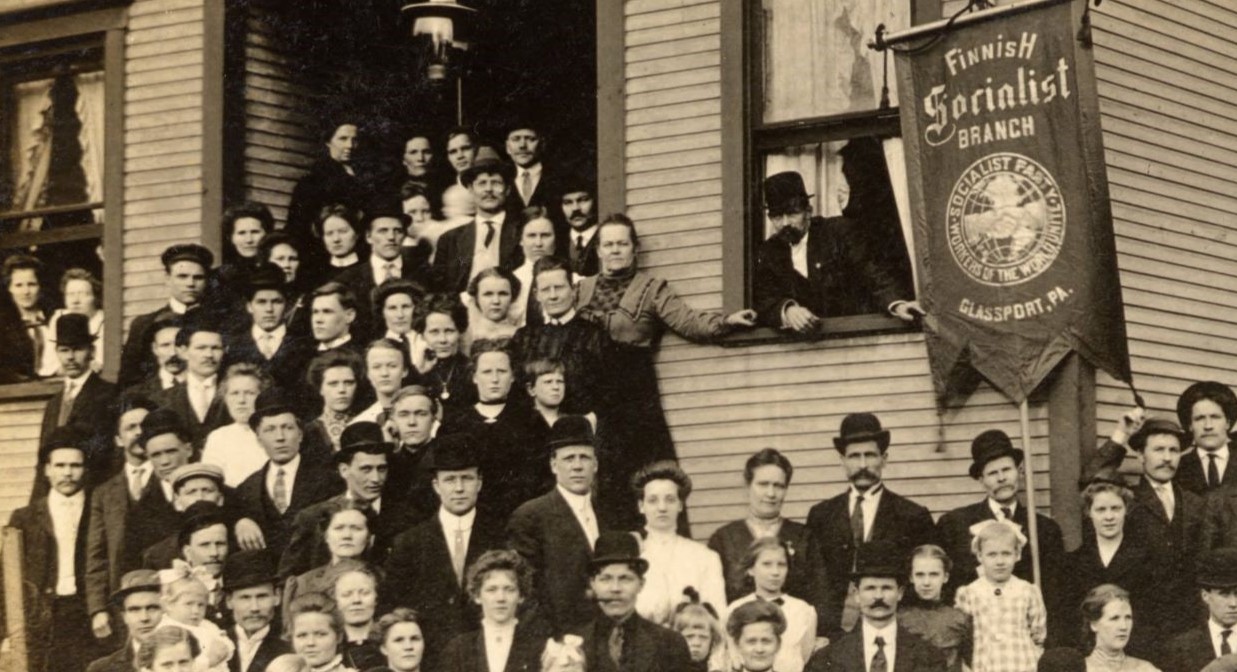
It is hard to imagine the Socialist and early Communist movement in this country without the Finns. Here is a history of the substantial activities of Finnish Socialists in the U.S., growing to become well over 10% of the Socialist Party’s membership. The Finns were also responsible for providing the party with a majority of its women membership, the Finnish Federation being, by far, the section of the movement with the largest women’s participation.
‘Finnish Section Now Contains 9200 Members’ from the Chicago Daily Socialist. Vol. 6 No 53. December 27, 1911.
Powerful Wing of the Socialist Party Owns $500,000 Worth of Property.
Here are some of the facts about the National Finnish section of the United States Socialist party:
For the last two years it has numbered one-tenth of the entire membership of the Socialist party.
The property that it controls is estimated as being worth close to half a million dollars.
Its press consists of two dailies, a tri-weekly, a woman’s weekly and a monthly magazine.
It has established the Working People’s College at Smithville, Minn.
Fifty out of its 221 local branches have built labor temples in their respective localities.
During the campaign in the old country in December and January. 1910 and 1911, the Finns of the United States came to the support of the Socialist movement in the mother country with $3,200.
Its members have been the pioneers of the labor movement in the mines of Michigan and Minnesota and in the textile mills of Massachusetts and! New Hampshire.
It started the movement for the organization of foreign speaking peoples as sections of the National Socialist party.
This is a brief and somewhat incomplete summary of what the Finns have really done. But it gives a bird’s-eye view of what their organization has already achieved. And the promises for the future are greater than ever.
From Under the Czar’s Thumb
The thumb of the czar of Russia pressed heavily upon old Finland only to give new life and spirit to the Finnish Socialist movement of the United States,
The population of old Finland is 3,000,000. Fighting the czar in the mother country are 1,500 Socialist branches with 60,000 members, the basis of a movement that secured 330,000 votes at the last election.
There are 250,000 Finns in the United States. The movement in this country boasts 221 branches, with 9,200 members.
The first Finnish Socialist local was organized in this country at Hibbing. Minnesota, in the heart of the rich Iron mining territory of northern Minnesota, in 1902. Its members were the workers from the mines of which the steel trust was rapidly gaining control.
During 1902 and 1903 Martin Hendrickson, a carpenter om California, toured the country for the Finns, and many Finnish Socialist locals were organized.
About this time the power of the Imatra (workers) League, with headquarters at New York, was at its zenith. Its object was to organize all the Finns in the United States into one organization. There was a growing Socialist sentiment among the members of the league, the only question being as to whether they should Join the Socialist or the Socialist Labor party.
This sentiment found an expression in the first convention of the Finnish Socialists of the United States held in October, 1904, at Cleveland, Ohio. The delegates to this convention and the organizations that they represented were as follows:
J. G. Lehtinen, Imatra Nos. 1 and 33 of Brooklyn; Victor Hall, Imatra central body and Imatra No. 15, of New York city; Hanna Lehtinen, New York City woman’s branch; A. Savolan, Maynard. Mass.: Taavia Tainio, Workers’ Society Salma, Fitchburg, Mass.; Arvo Nathi, Finnish Workers’ Society, Minneapolis, Minn.; Victor Kosonen, American Finnish Workers’ League, the Workers’ Society, of Hibbing, Minn., and Imatra No. 32, of Boston, Mass.: Alex Nieminen, American Finnish Workers’ League, of Hancock, Mich.; Erland Heino Imatra No. 25, of Chicago; Axel Pekkola, Imatra No. 12, of Glessport, Pa.; Anton Thaksi, Imatra No. 30, of Cleveland, Ohio, and Wilho Boman, Imatra No. 19 of Milwaukee, Wis. Robt. Bandlow attended the convention as the official representative of the Socialist party.
Adopted Party Program
The convention passed a resolution going on record as subscribing to the principles laid down in the Socialist party program and recommended it as the program for all of the Finnish workers’ societies in the United States. As a result of this action the various Finnish branches, during the following year, began coming into the Socialist party as individual branches. Not one branch went into the Socialist Labor party, which has never been able to organize a single Finnish local. Twenty-eight Finnish branches were represented at the next national Finnish convention held in August, 1906, at Hibbing, Minn. Alex Halonen, at that time a national Finnish Socialist organizer, was the official representative of the Socialist party.
Widely separated sections of the country were represented at this convention, the delegates coming from Michigan, South Dakota, Minnesota, Wisconsin, Pennsylvania, Washington, Illinois, Wyoming and California, Martin Hendrickson, the first Finnish organizer, being the delegate of the last named state. This convention was instrumental in organizing the national Finnish Socialist organization of the United States as the Finnish section of the Socialist party.
The Finnish section started the year 1907 with 53 local branches, having a membership of 2,450, while a national translator secretary was chosen and established at the national office of the Socialist party In Chicago. By the end of this same year the organization had more than 100 branches, with a membership of 3,465.
Five Organizers in 1908
During the presidential campaign of 1908 the Finnish section of the Socialist party had five organizers in the field carrying on the propaganda and teaching the Finns how to do their part in the campaign for Socialism. The Finns were also among the most enthusiastic contributors to the fund for financing the “Red Special.”
The third convention was held at Hancock, Mich., in August, 1909. This meeting saw the country divided into three districts, the eastern, western and middle districts. This was done in order to better carry on the agitation of the organization, each district having a secretary, one of whose duties was to route speakers and organizers.
The headquarters of the respective districts are as follows: Eastern, New York city: middle. Duluth, Minn.; and western, Seattle, Wash.
This convention also adopted tactics relating to the trade unions similar to those approved by the national conventions of the Socialist party. It also decided to appeal to the National Socialist party to remember May day May 1st, with a general celebration similar to those held in Europe.
It was also decided that the Finnish organizations should call upon all the other foreign language speaking organizations to elect delegates to the next congress of the Socialist party in 1910, and that at the same time a conference of all the foreign speaking organizations should be held, all decisions reached to be submitted to the national Socialist congress.
Much credit for the carrying out of the acts of this congress is due to Martin Laukki, at that time national translator secretary for the Finnish section. When the national Socialist congress met in 1910 the Finnish organization had 162 locals, with 5.183 members. The next Finnish national Socialist convention will be held in 1912. The time and place of meeting not yet having been decided upon.
Dues Stamps Not a Problem
“The question of dues is not troubling us very much at the present time,” says J. W. Sarlund, national Finnish translator secretary. “The only trouble seems to be in New York, where the state organization does not seem inclined to recognize the foreign language organizations.
“Nearly all of the state organizations give a 50 per cent rebate in the dues, allowing the local Finnish organizations to buy their dues from the national translator secretary. As far as I am concerned it doesn’t make any difference whether the Finnish locals get their dues stamps from me or from the English county or state organizations. “The duties of the translator secretary should be to translate party matters for the benefit of the foreign speaking organizations, and he should not be troubled with the handling of dues stamps. I hope that this matter will be settled by the national Socialist convention in May.”
This is the way the national Finnish Socialist movement in the United States has grown until it is organized. at the present time into 221 local branches, having a membership of 9,200, about one-tenth the membership of the entire Socialist party.
The two daily publications of this movement are the Tyomies (Worker), published at Hancock. Mich., and the Raivaja (Pioneer), issued at Fitchburg. Mass. Both of these papers are controlled by stock companies, about 80 per cent of the stock being owned by Finnish Socialist locals.
There is a tri-weekly. Toveri (Comrade), issued at Astoria, Ore.. the same place being the home of the women’s weekly, Toveritat (Woman Comrade). This weekly was started last July.
There is a monthly magazine published at Fitchburg, Mass., called Sakenfa (Sparks).
One-Fourth Are Women
In the American Finnish Socialist movement the women all belong to the regular party branches, carrying on their work side by side with the men. It is estimated about one-fourth of the Finnish party membership is made up of women.
“Several years ago many of the Finns coming to the United States looked forward to the day when they could return to the mother country.” says Translator Secretary Sarlund. “They have given this up now, how- ever, to a very great extent. It is rare that one meets a Finnish Socialist now who is planning to return to Europe.
“During the past year greater interest is being taken than ever before by the Finns in taking out their naturalization papers. We are carrying on a campaign to encourage our members in this direction not only through our press, but the national organizers are instructed to give special attention to this matter.
“The Tyovaen Opisto (Working People’s College) was started at Smithville, Minn., in 1906. Previous to that, it had been conducted as a Lutheran seminary, but it had been a financial failure, and the Socialists got control of it as a result.
Like the Finnish press, it is owned by a stock company, the shares of which are held by party locals and the national organization. The school buildings and the grounds represent an investment close to $50,000. At the present time there are 81 students and five teachers. The school is rapidly expanding and room is being made for more.
The common school subjects are taught, special stress being put upon the study of the English language. There are lectures on Socialism and economic subjects. Every effort is being made to put the tuition as low as possible, while a move is now on foot to have different locals endow scholarships for deserving students unable to pay their own expenses
Property Worth $500,000
Statistics are now being gathered by National Translator Secretary Sarlund on the stock held by the various locals. It is believed that these figures will show that the Finnish locals hold property valued at about half a million dollars, most of which is being invested in the fifty Finnish labor temples in different parts of the country. Fitchburg, Mass., has the biggest local, with 300 members. In the east. in Massachusetts and New Hampshire, the Finnish Socialists work in the textile mills, where they are doing good work, not only on the political field, but also in organizing the workers into labor unions.
In Michigan they are the backbone of the Western Federation of Miners, while a plucky fight is being put up against the steel trust in an attempt to organize the workers on the vast iron ranges in northern Minnesota. In the big cities like New York, Chicago and San Francisco, the Finnish Socialists for the most part are carpenters, tailors and painters, but everywhere they are hard workers.
Finnish locals are to be found today in twenty-nine states, as follows: Mid-district, Illinois, 5; Indiana, 1 at Clinton; Michigan, 22; Minnesota, 46; North Dakota, 2; South Dakota, 1 at Lead; Wisconsin, 16. Eastern district, Connecticut 1 at Hartford; Florida, 1 at Jacksonville; Maine, 4; Mass. 18; New Hampshire, 7; New Jersey 2; New York, 6; Ohio, 10; Pennsylvania, 11; Rhode Island, 1 at Pawtucket; Vermont, 3; and West Virginia, 2. Western district, Arizona, 1, at Lowell; California, 6; Colorado, 2; Idaho, 3; Montana, 11; Nevada, 3; Oregon, 3; Utah, 4; Washington, 14, and Wyoming, 10.
Support European Movement
The Finns are always lavish in their support of the movement in the old country. When the campaign of 1910-1911 was on the enthusiasm among the Finns of this country was great, and $3,200 was raised here and sent across the sea in the fight on the czar. They are now aiding the fight against the Russian autocracy, which is desirous of separating Finland from two of its provinces, Kivenappa and Usekirkko.
These two provinces are the darkest in all Finland, the people being ignorant, thereby making it difficult to carry on the Socialist agitation. Every effort is being made to educate the people.
The Finns are strong prohibitionists. In the old country the Socialists are continually fighting alcoholism, while in this country the Finnish organization proposed a prohibition plank for the Socialist party platform at the Socialist congress of 1908. It was not accepted. Many Finnish Socialists, hoever, are carrying on the agitation in this direction and may bring it up again next May at Oklahoma City.
The last convention of the Finnish organization went on record as declaring that the Finnish organization will in every way promote temperance among its members and generally among the working people. The convention ordered that all party papers, organizers and locals shall explain the prohibition question as it appeals to the working class.
The Finnish diet in the old country. declared in favor of nationwide prohibition, but the measure was vetoed by the Czar, who has the last word in all Finnish legislation.
It is expected that many Finnish Socialists will be at Oklahoma City as delegates of states. They are always listened to with interest whenever they have anything to say on the questions that come up for discussion, because they have an organization that shows they have put their plans into real practice and they have shown themselves to be successful.
PDF of full issue: https://www.marxists.org/history/usa/pubs/chicago-daily-socialist/1911/111227-chicagodailysocialist-v06n053.pdf
 Revolution's Newsstand