
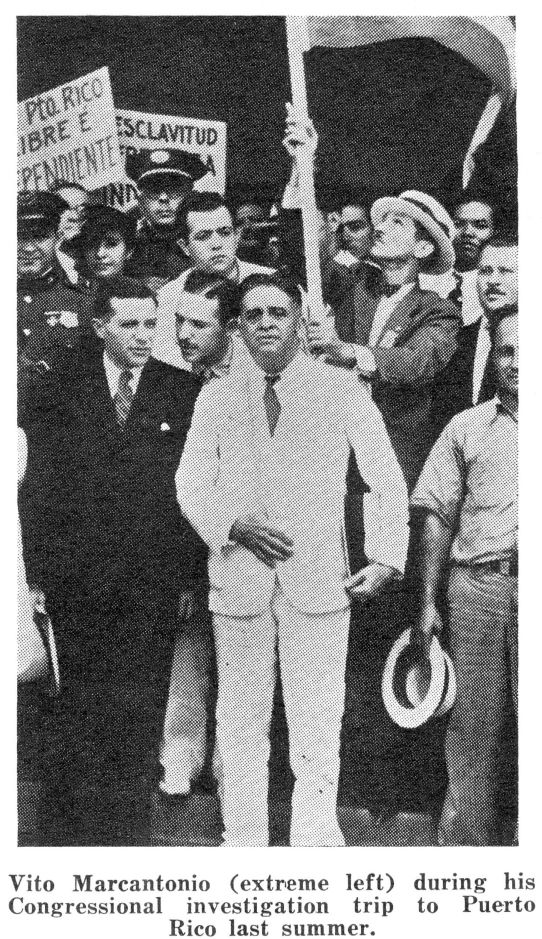
Vito Marcantonio, champion of Puerto Rican independence, on the farce of a trial of leaders of the Nationalist Party of Puerto Rico for sedition.
‘Uncle Sam in Puerto Rico’ by Vito Marcantonio from Labor Defender. Vol. 13 No. 3. April, 1937.
A complete exposure of Yankee imperialism’s attempt to crush the movement for independence among the people of Puerto Rico. This article was written for the Labor Defender by the chief counsel for the framed leaders.
It is not the purpose of this article to give the full story of the indictment and trial of Dr. Pedro Albizu Campos and seven other Puerto Rican nationalists. The following are simply a few glaring examples of the gross injustice practised by the government:
The defendants were tried twice. The first trial resulted in a disagreement. The charge is treason. The men are leaders of the independence movement in Puerto Rico.
The jury in the second trial was composed of ten continental Americans and two Puerto Ricans. The population of the island is 1,700,000 Puerto Ricans and about 1500 continental Americans.
The court set the date of the second trial to take place one week after the jury had reported its inability to agree after the first trial. Defense counsel asked the court for an adjournment so as to permit counsel from N.Y. to be present. This application was denied.
The second trial was conducted in a military atmosphere. The courtroom was filled with police and detectives. The United States Marshall, a Louisianan who had been appointed on the recommendation of Senator Millard Tydings of Maryland, refused access to the courtroom to most of the civilians and the few who were allowed to enter were subject to search and most humiliating treatment. Even the defendants’ attorneys were searched.
The trial judge, Hon. Robert S. Coop, former governor of North Carolina, overruled defense counsel’s objection to a juror, Noah Sheppard. The objections were as follows:
Noah Sheppard was the father of a United States Deputy Marshall who was also a witness for the prosecution at the first trial and who was also used as a witness for the prosecution in the second trial. It was also established that Noah Sheppard was the father of a deputy clerk of the United States District court. Mr. Sheppard, when questioned, admitted that he had consulted for legal advice Mr. A. Cecil Snyder, the United States attorney and prosecutor in the trial. A. Cecil Snyder lived at Noah Sheppard’s home. The court ruled that Sheppard was a qualified juror.
The jury was finally composed of ten continental Americans and two Puerto Ricans. One of the jurors, Frederick J. Todd, was an officer of the National City Bank. Henry Shoemaker was an officer of the Chase National Bank. Carl C. Henderson held an important position in the Radio Corporation of America in Puerto Rico. The two Puerto Ricans, one Francisco del Valle was an engineer working for the Puerto Rico Railway Light and Power Company. His immediate superior had sat on the grand jury that turned in the indictment against the defendants. The other Puerto Rican juror, Jose Gonzalez Torres, was a representative of one of the largest rice importers in the United States.
The jury was composed, therefore, predominantly of men who had financial interests to protect against an independent Puerto Rico which the defendants had been advocating.
Senator Millard Tydings, of Maryland, who is known for having introduced the revenge bill for Puerto Rico in the Senate, was responsible for the appointment of the Federal Court Judge and the U. S. Marshall. He was also responsible for the appointment of Col. Riggs, the police chief who had been killed in Puerto Rico and who was his close personal friend. Cecil Snyder, the U. S. attorney, was not only appointed on the recommendation of Senator Tydings, but comes directly from Senator Tydings’ law office in Maryland. The defendants had been indicted for a conspiracy to commit the crime of insurrection and for insurrection. The testimony was permitted throughout the trial on the killing of Col. Riggs. Evidence was allowed as to the activities of the defendants after the indictment had been handed down. Evidence was allowed as to the activities of people whose connections with the defendants had never been established.
The case was submitted to the jury in the afternoon. People were forced to leave the federal building. The building was filled with police forces and detectives and officers of the court and their friends. Only counsel for defendants were permitted to remain. Even the relatives of the defendants were excluded. The police had surrounded the building with machine guns, rifles, and tear gas bombs.
The Commander-in-chief of the regular army was present in the courtroom. The chief of police was also present. All preparations had been made by the government to remove the defendants to Atlanta by plane. Immediately after midday the jury returned its verdict. The judge immediately passed sentence which is most unusual in all such cases. He would not give defense counsel time to file a motion for a new trial as is the custom both here and in Puerto Rico. He refused to have the defendants serve their term in Puerto Rico. He sentenced them to Atlanta, Georgia. The prisoners were taken out through the cellar. More than 40 sub-marshalls under the protection of the U. S. Marshall, armed to the teeth, escorted the prisoners to several automobiles that were waiting for them. Several days later, defense counsel made a motion for a new trial. Defense counsel produced affidavits sworn to by disinterested witnesses and attesting to the following:
a.) Frederick J. Todd, officer of the National City Bank and a juror in the case had declared in the presence of two of his employees that the defendants should be burned alive. Incidentally, the two employees who signed the affidavit to this effect were summarily discharged by the National City Bank.
b). Affidavits were produced, signed by disinterested witnesses, to the effect that the juror, Jose Gonzales Torrez, had stated before he had been called as juror, that the defendants were guilty and that they should be sent to jail. That in the event he were called as a juror he would not hesitate to find the defendants guilty.
c.) Affidavits were produced and signed by disinterested witnesses to the effect that W.E.A. Lee, author juror, had insulted Dr. Albizu Campos in a public restaurant. The insult had been resented by some of Dr. Campos’ friends and a fist fight ensued. Despite the fact that this juror had had this fight over Dr. Campos, he sat as a juror and passed judgment on a man whom he had condemned in insulting terms, in public.
These facts were urged on the court. The court was asked to hear the people who had signed these affidavits. The court declined to hold a hearing. The judge declared that he knew these jurors personally and that from his own personal knowledge he felt that these jurors would never have sat on the jury if they had had any bias against any of the defendants.
A study of the record in the case will lead anyone to the conclusion that this is no more a trial by jury, than if the defendants had been tried by a lynching meeting in some town in Georgia or South Carolina.
A united defense movement initiated by the International Labor Defense and the Nationalist Party of Puerto Rico, is now developing a broad campaign for the freedom of the prisoners. An appeal against the eight year sentences is now being taken to the United States Supreme Court.
Labor Defender was published monthly from 1926 until 1937 by the International Labor Defense (ILD), a Workers Party of America, and later Communist Party-led, non-partisan defense organization founded by James Cannon and William Haywood while in Moscow, 1925 to support prisoners of the class war, victims of racism and imperialism, and the struggle against fascism. It included, poetry, letters from prisoners, and was heavily illustrated with photos, images, and cartoons. Labor Defender was the central organ of the Scottsboro and Sacco and Vanzetti defense campaigns. Not only were these among the most successful campaigns by Communists, they were among the most important of the period and the urgency and activity is duly reflected in its pages. Editors included T. J. O’ Flaherty, Max Shactman, Karl Reeve, J. Louis Engdahl, William L. Patterson, Sasha Small, and Sender Garlin.
PDF of full issue: https://www.marxists.org/history/usa/pubs/labordefender/1937/v13-%5B11%5Dn03-apr-1937-orig-LD.pdf
 Revolution's Newsstand