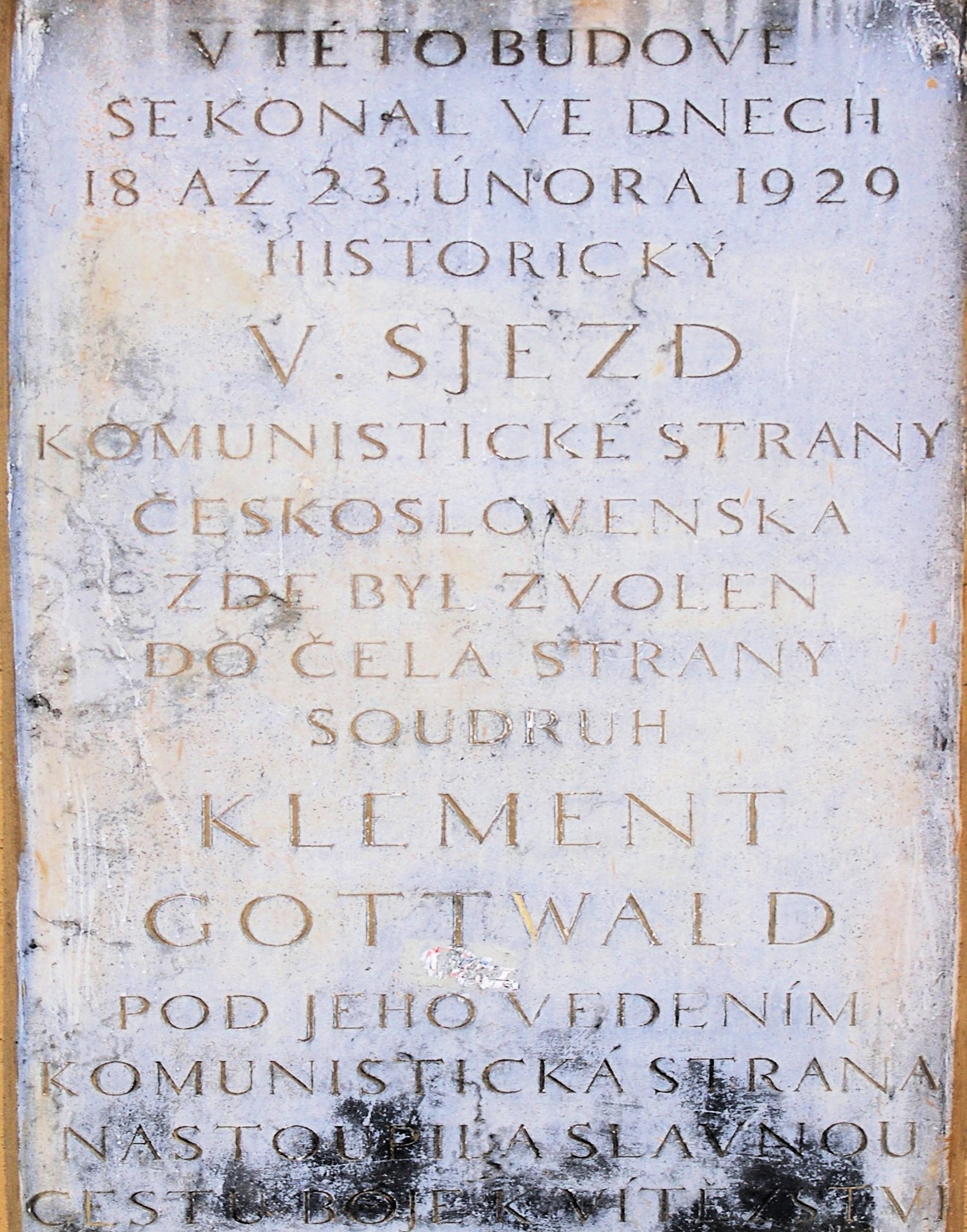
One of the largest and most important early centers of the Communist Opposition (the so-called Right Opposition associated with Heinrich Brandler) was in Czechoslovakia where it published Reichenberger Vorwärts. However, the Czech Opposition quickly declined with a majority joining the Social Democrats in 1932.
‘Czech Communist Opposition Holds Conference’ from Revolutionary Age (Communist Party Majority Group). Vol. 1 No. 19. September 1, 1930.
On July 13 there took place the second National Conference of the Communist Party of Czechslovakia (Opposition). This conference, which met in Prague, was faced with great political, tasks. It had to estimate the work of the Opposition for the last year; it had to declare its opinion upon the plan for trade union unity between the JAV (red trade union center) and the OSC (reformist trade union center) (see Revolutionary Age, August 1, 1930); finally it had to settle accounts with the Kovanda group (Brúnner Opposition) which had departed from Communism and taken the road to Social-democracy.
The conference was attended by 53 delegates representing 110 local organizations; in addition there were 15 delegates who had been elected but could not come because of expenses. The conference gave an encouraging sign of the organizational strength of the Czech Communist Opposition.
In behalf of the German Opposition Comrade Brandler greeted the Conference. Comrade Berger, secretary of the CPC: Opposition, gave the political report which became the basis for a thoro discussion. The conference endorsed the steps already taken by the leading comrades of the IAV in the direction of trade union unity, pointed out that the work in this direction was only just begun since there were still over a dozen trade union centers in Czechoslovakia, called attention to the fact that the split-off Party controlled unions (the so-called “spite unions”) must also be included in the unity process, and made it quite clear that with the steps in the direction of trade union unity the necessity for persistent work in the trade unions along the lines of Leninist fundamentals was even greater than before.
The next question to be taken up was the Kovanda group (Brunner opposition). About one year ago a sort of alliance had been made between the CPC: Opposition and the Kovanda group with a view to laying the basis for eventual unity. The prospects for this unity were not very good and were not made better by the tendency to blur serious differences that was apparent, in the negotiations (see Revolutionary Age, Feb. 1, 1930). As time went on it became clear that the leaders of the Kovanda group were departing further and further away from Communism and approaching “left” Social- democracy (Austro-Marxism). Thereupon a polemic began in the Czech and German opposition press against the Brunner group. This forced the latter to show their color and a number of the leaders came out for open capitulation to the Social-democracy. By the time the conference was held the relations between the Czech Opposition and the Kovanda group were practically broken; nevertheless Burian, the representative of the Brunner, was allowed to present his viewpoint which was categorically and unanimously rejected by the conference. The conference in its resolution drew a sharp line of demarcation between itself and the Brunner whom it characterized as “left” Social-democrats.
The conference decided that the Reichenberger Vorwaerts which had recently been won by the Opposition (see Revolutionary Age, May 15, 1930.) should become its official daily organ in German. In his closing remarks Comrade Muna, chairman of the CPC Opposition, pointed out that the Czech Communist Opposition has already become the point of concentration of all the best Communist elements in the country who are fighting for a united and Leninist Communist Party and Communist International.
Revolutionary Age began in 1929 and was published in New York City by the Communist Party U.S.A. Majority Group, lead by Jay Lovestone and Ben Gitlow and aligned with Bukharin in the Soviet Union and the International Communist (Right) Opposition in the Communist International. Workers Age was a weekly published between 1932 and 1941. Writers and or editors for Workers Age included Lovestone, Gitlow, Will Herberg, Lyman Fraser, Geogre F. Miles, Bertram D. Wolfe, Charles S. Zimmerman, Lewis Corey (Louis Fraina), Albert Bell, William Kruse, Jack Rubenstein, Harry Winitsky, Jack MacDonald, Bert Miller, and Ben Davidson. During the run of Workers Age, the ‘Lovestonites’ name changed from Communist Party (Majority Group) (November 1929-September 1932) to the Communist Party of the USA (Opposition) (September 1932-May 1937) to the Independent Communist Labor League (May 1937-July 1938) to the Independent Labor League of America (July 1938-January 1941), and often referred to simply as ‘CPO’ (Communist Party Opposition). While those interested in the history of Lovestone and the ‘Right Opposition’ will find the paper essential, students of the labor movement of the 1930s will find a wealth of information in its pages as well. Though small in size, the CPO plaid a leading role in a number of important unions, particularly in industry dominated by Jewish and Yiddish-speaking labor, particularly with the International Ladies’ Garment Workers’ Union Local 22, the International Fur & Leather Workers Union, the Doll and Toy Workers Union, and the United Shoe and Leather Workers Union, as well as having influence in the New York Teachers, United Autoworkers, and others.
PDF of the full issue: https://www.marxists.org/history/usa/pubs/revolutionary-age/v1n19-sep-01-1930.pdf
 Revolution's Newsstand