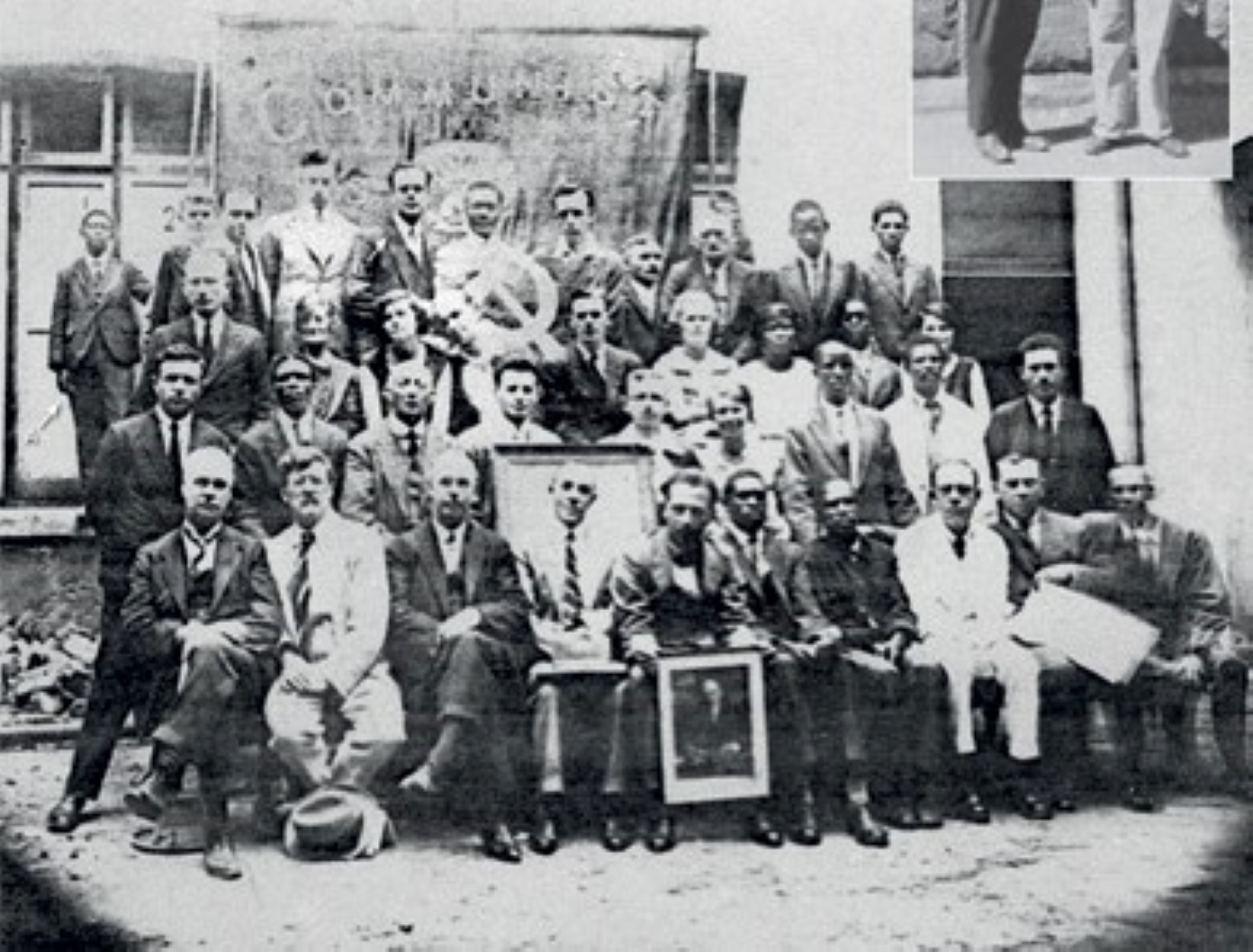
‘Fourth Congress of the Communist Party of South Africa’ by James Shields from International Press Correspondence. Vol. 6 No. 11. February 4, 1926.
On December 26th, 27th & 28th there was held in Cape Town the 4th Conference of the Communist Party of S. Africa. The changing situation in the political field, the growth of Trade Unionism among the natives, and the proposed segregation policy of the Government were examined and reviewed, and the lines of action of the Party for 1926 discussed and decided upon. A big portion of the delegates’ time was occupied with dealing with the Party organisation in order to secure the proper machinery for putting our policy into practice, and it was decided that the system of area groups be adopted in order to increase the recruiting work of the Party and effectively organise the sale of the party organ and literature.
The Conference revealed the weakness of the Party’s Trade Union connections and the need for definitely organising nuclei within the Trade Unions to advocate the unity of all sections of workers, to counteract the strongly existing racial prejudice, and to bring the question of International Trade Union Unity to the forefront.
It was agreed that a more systematic education of the membership in the Party Programme should be undertaken in order to equip our members for their tasks and to facilitate the work of recruiting new blood for the Party — one of the most important needs of the moment.
With regard to the proposed segregation policy of the Pact Government, which aims at taking away the franchise of the native in the Cape Province, etc. the Conference decided to commence a campaign condemning these reactionary proposals, and mobilising an opposition to prevent them being put into operation.
The Asiatic Bill was reported upon by Com. De Norman who pointed out that it was aimed against the wealthy Indian traders, leaving the Indian workers ‘practically unaffected. He urged the Party to establish contact with the Indian workers in Natal with a view to organising them for the struggle for their demands, chief of which were increased wages, shorter hours and an equal status with the European worker. The working-class aspect of the Indian question in S. Africa was strongly stressed, and the Party decided to act accordingly.
One of the most important items on the agenda was that which dealt with the Land & Peasant Question. A long discussion revealed the terrible conditions of the agricultural workers and poor peasants, and the necessity for formulating a programme embodying their demands in order to rally them against capitalist exploitation. The Conference decided to commence propagating the slogan of a Workers’ and Peasants’ Government, and to carry on serious communist activity among the country population. It was felt that the drawing up of a programme for agricultural workers should first of all be carefully considered and much more information secured before being definitely published. This task was left to the new C.E. to deal with and will probably be completed in three or four months The revival of the Y.C.L. which had gone out of existence, some six months ago, was resolved, and an organiser appointed to commence its re-organisation immediately with the assistance of the Party. The formation of the Y.C.L., it was decided, should go hand in hand with the formation of the Communist Children’s Section.
The successful carrying out of the Party’s policy depends to a very great extent on the ability with which the task of recruiting more workers for the Party can be successfully carried out. In order to assist this important work as much as possible the price of the Party’s weekly organ has been reduced from 3d to 1d, and the name changed from the “International” to the “South African Worker” in order to emphasise more clearly the class character of the Party’s objective.
If the Conference decisions are taken up in an active spirit by the Party membership, resulting in an increase of our native work, T.U. work, and increasing membership, then the 4th Conference will indeed mark a decided step forward in the history of the Party.
International Press Correspondence, widely known as”Inprecorr” was published by the Executive Committee of the Communist International (ECCI) regularly in German and English, occasionally in many other languages, beginning in 1921 and lasting in English until 1938. Inprecorr’s role was to supply translated articles to the English-speaking press of the International from the Comintern’s different sections, as well as news and statements from the ECCI. Many ‘Daily Worker’ and ‘Communist’ articles originated in Inprecorr, and it also published articles by American comrades for use in other countries. It was published at least weekly, and often thrice weekly. The ECCI also published the magazine ‘Communist International’ edited by Zinoviev and Karl Radek from 1919 until 1926 monthly in German, French, Russian, and English. Unlike, Inprecorr, CI contained long-form articles by the leading figures of the International as well as proceedings, statements, and notices of the Comintern. No complete run of Communist International is available in English. Both were largely published outside of Soviet territory, with Communist International printed in London, to facilitate distribution and both were major contributors to the Communist press in the U.S. Communist International and Inprecorr are an invaluable English-language source on the history of the Communist International and its sections.
PDF of full issue: https://www.marxists.org/history/international/comintern/inprecor/1926/v06n11-feb-04-1926-Inprecor.pdf
 Revolution's Newsstand