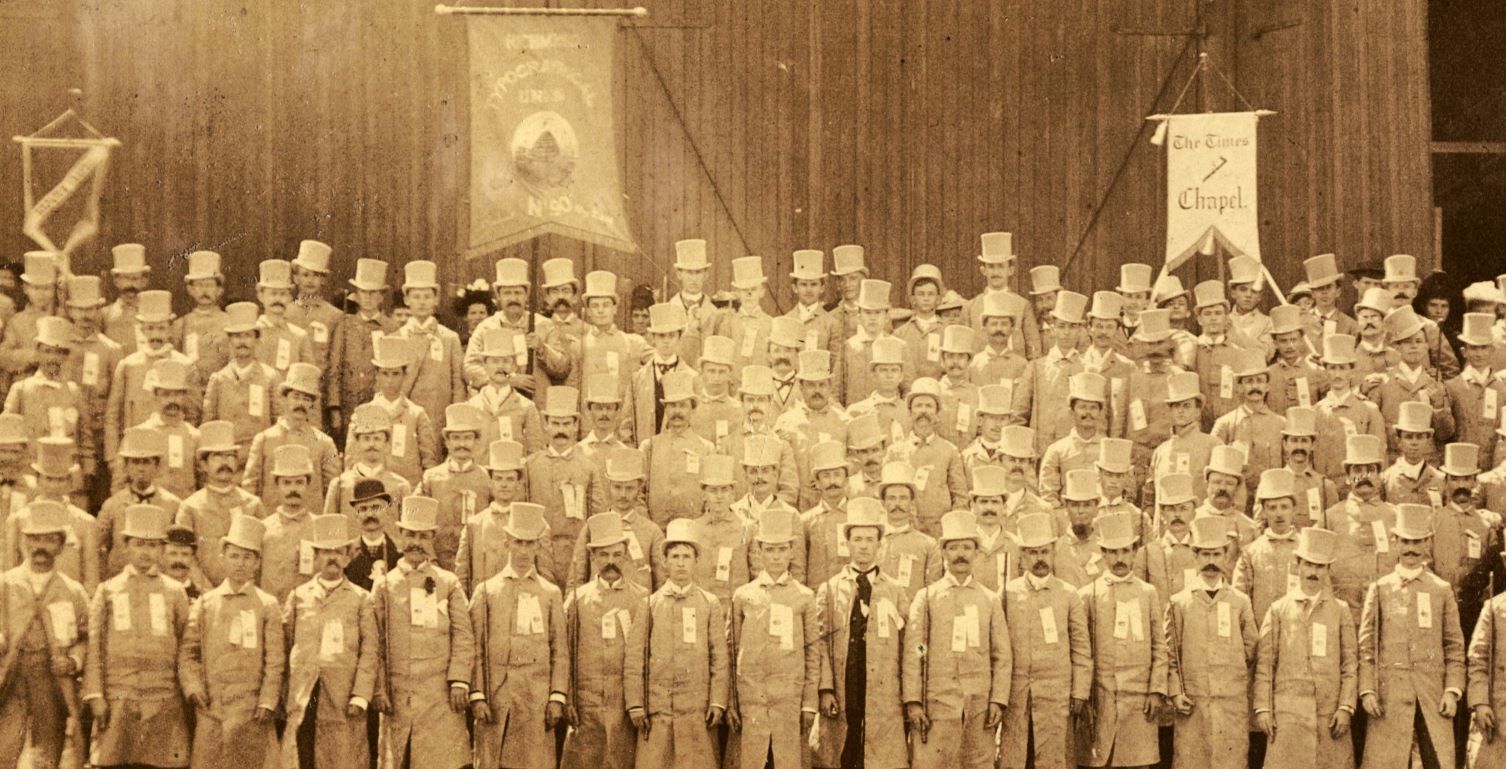
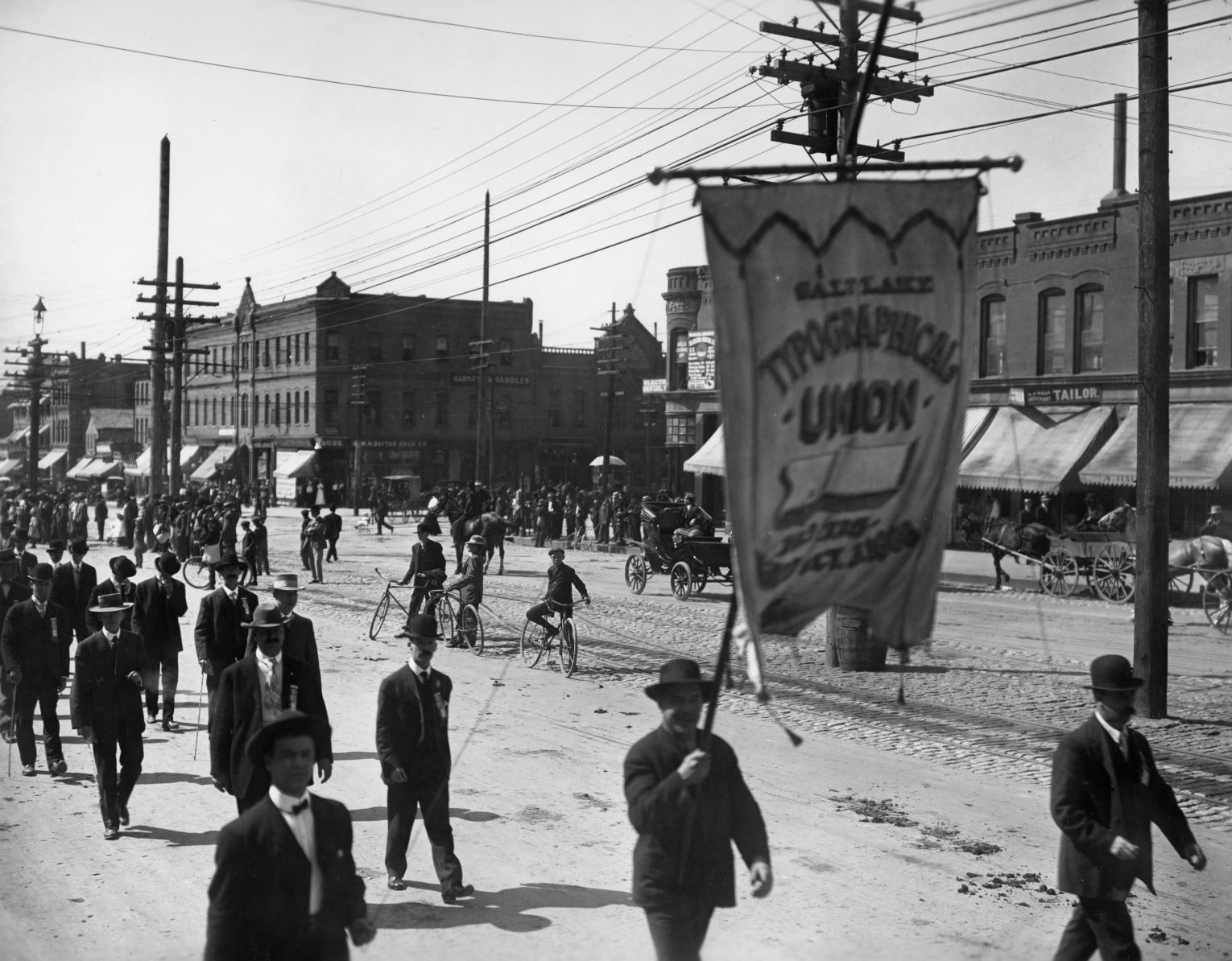
Though it had one of the oldest unions in the country with the International Typographical Union, the printing trades, with varied and new technologies confronting old skills and organizations, were and are beset by craft divisions. Al Smith of the Trade Union Educational League provides a valuable history going back to 1850 of attempts at unionizing the trade industrially.
‘One Union in the Printing Trades’ by Al Smith from Labor Herald. Vol. 1 No. 6. August, 1922.
THE printing trades unions have been through a great struggle. Attacks against their wage standards and hours of labor have been most vicious. Taking the industry as a whole, the workers have suffered setbacks and have been weakened. The pressmen, stereotypers, electrotypers and bookbinders, have lost half their members, have had to take big reductions in wages, and have failed to hold the 44-hour week. On the other hand, however, the biggest union in the industry, comprising more than half those organized, the International Typographical Union, has held its membership well, losing less than 10%, has held the 44-hour week, and suffered no reductions in wages. This has only been done at the cost of millions of dollars and bitter struggle.
The smaller unions in the industry have suffered heavily. They have paid the price for lack of unity among the printing trades workers. They, above all others, should realize by this time that their only hope to protect their interests, and prevent the employers from crushing them, is for them to unite all their forces. One union for the printing trades would be a boon and protection to them.
Strange to say, however, it is the large union, the I.T.U., which is leading the movement at this time for one printing trades union. In spite of the fact that in going alone it fares better than any of the others, it is the first to suggest unity among them all.
At the Quebec convention, 1921, it passed the following resolution, almost unanimously:
“Resolved, That this convention favors the amalgamation of the various printing trades unions, to the end that there be but one union in the printing industry.
This resolution is the most concise statement made of the principle of industrial unity, and is the latest statement of the principle which has animated the progressive elements in the printing trades for many years. There has always been a struggle going on between the advocates of unity, and the forces of disruption. Today the movement for one union for the printing trades is gaining much headway, because the logic of membership figures, wage-scales, and hours of labor, is forcing the issue to a decision. It is amalgamation or annihilation for the smaller unions, as the immediate alternative.
How They Got That Way
The International Typographical Union was organized in 1850, of 15 local unions then existing. Membership was small, and the “printers” generally did everything around a composing room from feeding a press to editing the paper. But at about this same time, the steam power press was introduced, and those “printers” who specialized on these new presses, created the first division in the craft. The I.T.U. endeavored to keep unity of organization, and at the Chicago convention, 1858, recommended to all local unions that they encourage the pressmen to unite with them in membership.
Stereotyping was the next important specialization. During the Civil War the printing business attained a development theretofore unheard of, due to the fact that the people at home demanded news from the front. Stereotyping came into general use, and at the Louisville convention, 1864, the subordinate unions were urged to admit stereotypers into the organization in the usual manner.
In those days, and even up until the late ’80s, the national body could only make recommendations, as the local unions were autonomous bodies; as a rule, however, these recommendations were generally carried out by them.
The unity of organization did not prevent the growing groups of specialized workers from being adequately represented. In 1882 the I.T.U. gave the pressmen the right to elect the second vice-president to have charge of the interests of pressmen. Their delegation at conventions acted as a committee on legislation for the press- men’s locals, and the report of this committee was made a special order of the convention. By 1887 the International included 266 subordinate unions: 31 pressmen, 5 stereotypers and electrotypers, I pressfeeders, I book binders, 2 mailers, and 226 compositors. In cities where there were not enough members of a special craft, all were members of the main compositors’ union. There were a few unaffiliated independent and Knights of Labor organizations, principally bookbinders.
Secession of Smaller Crafts
The splitting of the printing trades began in 1889, through the connivance of the employers with the ambitions and craft feeling of some of the pressmen. Local pressmen’s unions, 11 of them, seceded and set up the International Printing Pressmen’s Union. There can be no doubt of the influence of the bosses in this movement. Vice-President Hall (pressman), of the I.T.U., dealing with the matter at the Atlanta convention (1890), said:
“Eleven unions have gone out from among us since the date of my last report, and but four have been added. This has involved the loss of 469 members. The reason for this is to be found in the assiduous endeavors being made to build up the International Printing Pressmen’s Union.an organization enjoying the favor of the Typothetae (the employers’ organization). It was my fortune last year, under date of November 15, to address the pressmen, calling their attention to the close connection between these two bodies. My assertions were denied… but striking proof of them is afforded in the fact that both organizations will meet in Boston on the first Tuesday in September, 1890, a simultaneous determination on the part of those concerned in it.”
The Typographical Union made every effort to get the seceding unions to come back, and more than two-thirds of the pressmen stayed with the main organization. Also five new unions of stereotpyers and electrotypers were added. The sentiment throughout the trade was expressed at the Chicago convention a year later, when the new vice-president, McFarland (pressmen), said: “In view of the immense strides of invention, we must view with alarm any effort to divide or disrupt our present organization. I am firm in the belief that all persons who contribute labor to the production of a common output should be allied together…I feel satisfied that it would be almost an impossibility for any one of our allied trades to undertake alone the fight for hours and wages.”
This convention discussed the problems of organization involved by the developing branches of the trade, and a plan was adopted which, while fully recognizing the general authority of the I.T.U., gave a more definite organization to the pressmen. An amalgamation project with the German-American Typographia (German union of printers) was carried out. The forces of unification were thus at work even in this period of separation and division of the smaller specialized crafts.
The Allied Printing Trades Councils had been formed in 21 cities. They were very successful and had incurred the wrath of the bosses. worst obstacle in the way of the success of the Councils, was the unsatisfactory relations between the various unions. In many cases members of the I.T.U. worked for firms whose binderies and press rooms were non-union. Some of the more poorly-paid workers, such as the bindery girls and the feeders, were precluded from joining the I.T.U. on account of the high dues. However, this was later remedied by the union, which lowered the dues for these workers.
The bookbinders were in chaos. Since the granting of charters to them in 1887, only seven unions had come into the I.T.U. Some of them attached themselves to local unions of compositors or pressmen, and many belonged to the Knights of Labor. In 1892 a call was issued to these heterogeneous organizations to send delegates to Philadelphia to form a national organization of their own. To this gathering the I.T.U. sent a representative with an invitation to But the throw in their lot with the printers. many forces of division prevailed, and the invitation was not accepted. On two occasions following this, the I.T.U. attempted to open negotiations with the bookbinders, but the efforts failed.

Final Establishment of Separate Crafts
After many years of effort to harmonize the differences between the various organizations, and to unite them all, the progressive elements which had been pushing the idea of one union for the industry, had to give up the fight for the time being. Rather than have warfare between existing unions, who could not be brought to amalgamate, it was decided that it was better to enter into an alliance between them all, which should draw the boundaries of each. Accordingly an agreement was negotiated between the International Printing Pressmen’s Union, the International Brotherhood of Bookbinders, and the International Typographical Union. This alliance provided for complete autonomy for each, who was to recognize the jurisdiction and authority of the others over workers in their respective crafts, and completely separated the organizational and financial machinery. Joint action such as strikes were to be handled by an executive of an equal number of each union, and by agreement of local boards after united request of local unions; any local of either union could strike as heretofore without the consent of the others, but could not compel the support of their allies. The conference was to have control of the label. The agreement was finally ratified on January 1, 1896. The stereotypers and electrotypers made their first move towards separation at the Syracuse convention (1898), in the setting up of trade district unions. The next year the Chicago union seceded on a question of per capita tax. It attempted to get other unions to do likewise, but was unsuccessful. At the Milwaukee convention (1900) some of the remaining local unions proposed to withdraw and set up a separate international union. Their proposal was decisively defeated. The following year, however, the new president, Jim Lynch, favored the separation, and with his backing the proposal was carried by a referendum, the vote being about 10,000 to 6,000.
The same forces which had caused the institution of separate unions for these small crafts now made themselves felt among the photo engravers. According to Ryan, a vice-president and representative of the photo engravers in the I.T.U., “a most farcical proceeding of a so- called convention of photo engravers” was held in New York. This was immediately in conflict with the I.T.U. which lost some of its local unions to the new organization. In 1902 some of the unions which had broken away from the international realized their mistake, and signified a willingness to come back. But in January, 1903, a conference between the photo engravers and the I.T.U. officials was held, and it was decided that it would be better for the I.T.U. to give up jurisdiction over the photo engravers rather than to suffer the disintegrating effects of dual unionism and fratricidal strife. The International Photo Engravers’ Union proposal was definitely accepted by the I.T.U. on April 24, 1904, and the jurisdiction granted them. This brought the period of the establishment of the smaller crafts to a close. The I.T.U. now stood definitely as a limited craft union, comprising the compositors, mailers, newswriters, and type founders.
The Problem of Industrial Solidarity
The great problem of the printing trades is how to get common action, solidarity of the workers in the industry. The idea held so stubbornly in the I.T.U., of one union for the industry, is the only possible one to get this solidarity. The progressive elements failed in their efforts in the past. But in the very act of allowing the smaller crafts to establish themselves, the devotion to united efforts was shown; because the alternative was to carry on a devastating war with the incorrigible craft unionists who set up the beginnings of the separate unions. Now the situation is changing, and we must look the whole situation over again, to know what can be done.
First, the industry has been organized to a comparatively high degree. The deplorable lack of any effective organization which was such a stimulus 20 years ago to craft feeling and personal ambitions, has been largely wiped out. There has also been a great deal done to establish the comparative importance, strength, and mutual relations between these crafts. And where a few years ago they could probably increase their strength more by going out to organize the unorganized, than by closing up the ranks of those already in the unions, this is no longer true.
Much has been done for the workers in spite of the split-up condition in the unions. In 1897, for example, the nine-hour movement was in- augurated, the International Printing Pressmen, the Brotherhood of Bookbinders, and the International Typographical Union carrying on the campaign jointly. After two years of difficult negotiations and struggle, the drive was successful in establishing the nine-hour agreement, on November 21, 1889, with the Typothetae.
The Printing Trades Councils have been an important element of strength, in spite of their shortcomings and the obstacles in their way. But instead of growing in strength and importance, they have tended to become weak and idle. The principal activity left to it now is the control of the label. As the great bulk of printing buyers are actually against having the label on their printed matter, this becomes a petty affair.
“Open Shop” Drive Forces the Issue The great attack of the past two years to force down wages, increase hours, and destroy the unions, has brought the matter to a head. It has shown up clearly the necessities of the situation. In the fact that the small crafts have lost fight after fight, or lost without even fighting, is the lesson that the bosses can only be whipped into line by large numbers. While the pressmen, the stereotypers and electrotypers, and the bookbinders, have lost the 44-hour week, have received slashing wage cuts, and been weakened in membership by one-half, small as they already were; yet the big union which has had the mass of the workers in the industry, the I.T.U., has come out of the fight in comparatively good condition.
Suppose that the power of all these unions had been united, it is certain that all would have fared at least as well as the I.T.U. Considering the multiplication of strength, they might well have bettered themselves instead of merely holding their own. If there could be an argument today against the amalgamation of all the unions into one covering the entire industry, it would be expected to come from the big union. It could say, “we have got on fairly well alone; why take. on the little, weak ones.” But it is exactly this big, strong union which leads the way in calling for an industrial union. It knows through experience that the more workers in an industry belong to the union, the greater the power, and the larger the benefits which the union can wring from the bosses.
The problem before the progressive forces in the printing industry today is, then, how to bring all the smaller crafts into line with the splendid position taken by the International Typographical Union. This can only be done through an educational campaign, undertaken simultaneously throughout the entire printing industry. Such educational work can be done only by a grouping together of the progressive elements from all the unions, who will meet, work out the problems from the point of view of all the varied interests involved, and then carry on a propaganda in all unions at once upon the same lines.

Such a body as just proposed, is provided for in the Trade Union Educational League, in its Printing Trades Section. There in each local group would come together the live wires in the entire printing industry in each locality. The various local groups would then send representatives to a meeting which would elect a national educational committee. The latter would, in consultation with the local groups, work out a complete plan for amalgamating the printing trades unions, and launch a great national campaign for this end in every union. It is the need of the hour in the printing trades. Every militant union man should get busy to put it into effect.
The Labor Herald was the monthly publication of the Trade Union Educational League (TUEL), in immensely important link between the IWW of the 1910s and the CIO of the 1930s. It was begun by veteran labor organizer and Communist leader William Z. Foster in 1920 as an attempt to unite militants within various unions while continuing the industrial unionism tradition of the IWW, though it was opposed to “dual unionism” and favored the formation of a Labor Party. Although it would become financially supported by the Communist International and Communist Party of America, it remained autonomous, was a network and not a membership organization, and included many radicals outside the Communist Party. In 1924 Labor Herald was folded into Workers Monthly, an explicitly Party organ and in 1927 ‘Labor Unity’ became the organ of a now CP dominated TUEL. In 1929 and the turn towards Red Unions in the Third Period, TUEL was wound up and replaced by the Trade Union Unity League, a section of the Red International of Labor Unions (Profitern) and continued to publish Labor Unity until 1935. Labor Herald remains an important labor-orientated journal by revolutionaries in US left history and would be referenced by activists, along with TUEL, along after it’s heyday.
PDF of full issue: https://www.marxists.org/history/usa/pubs/laborherald/v1n06-aug-1922.pdf
 Revolution's Newsstand