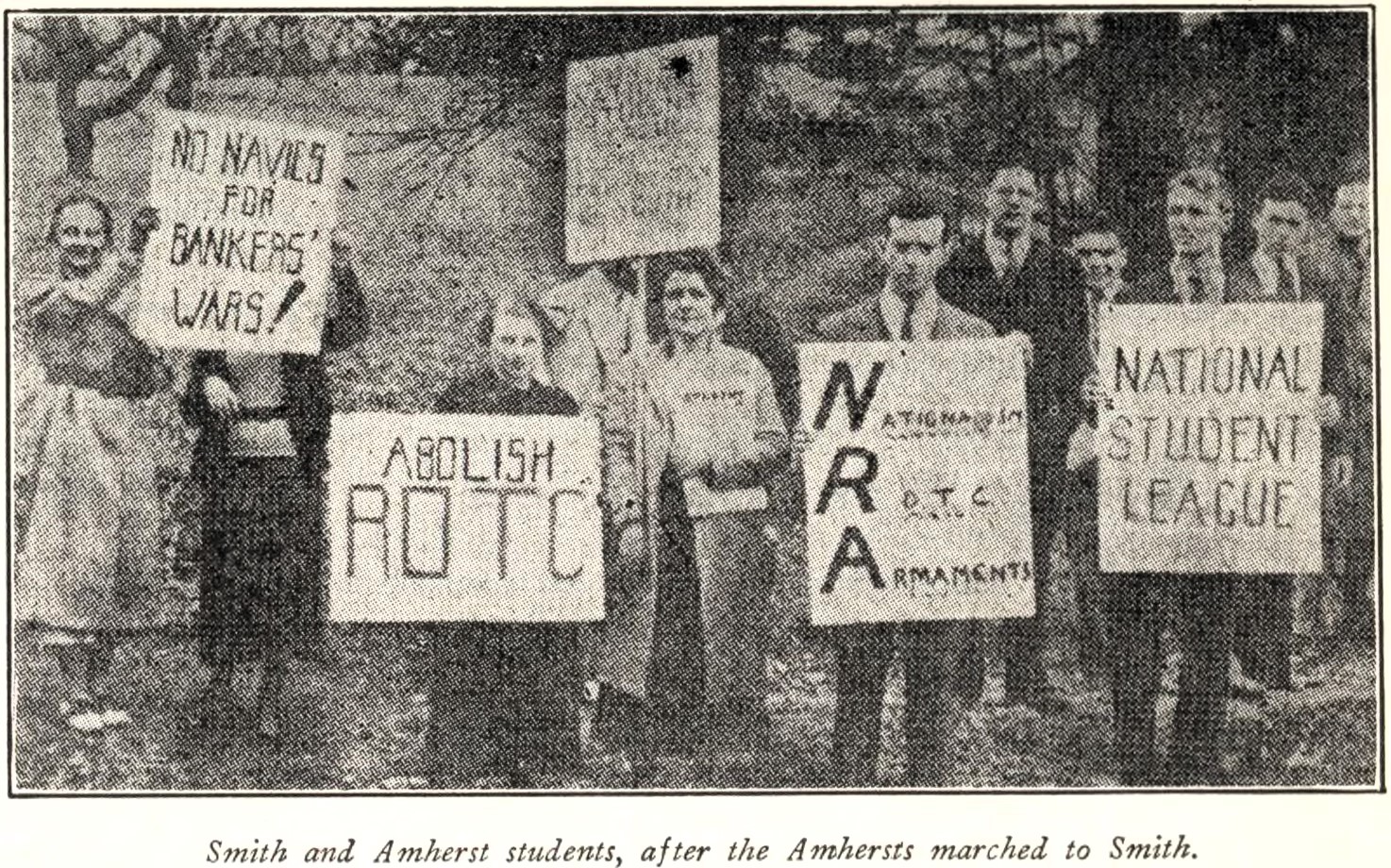
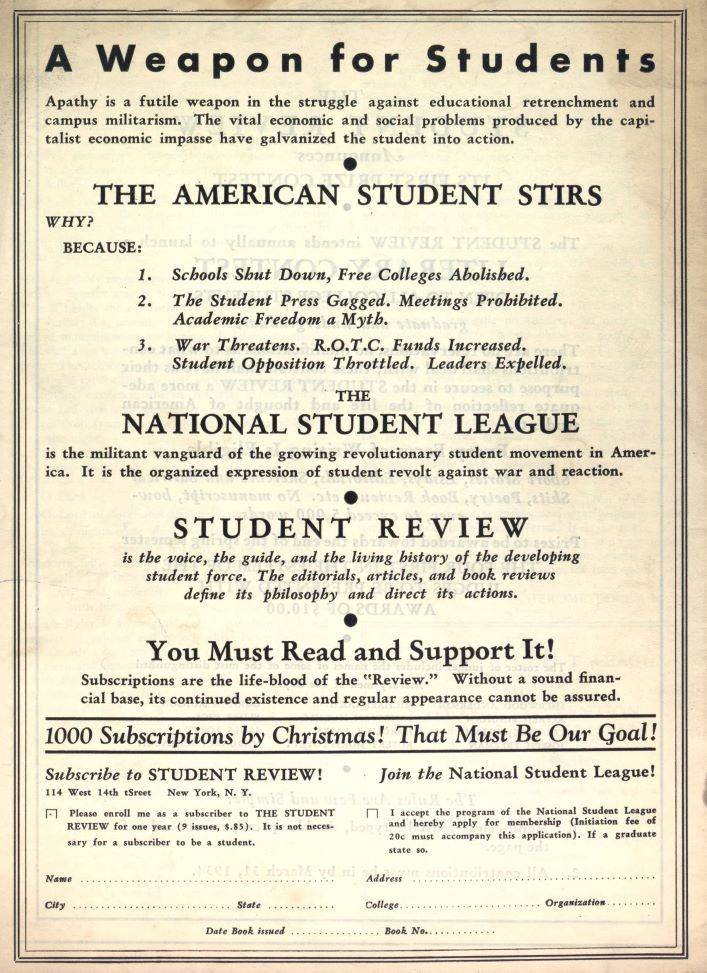
Of compelling interest today. Emerging from the 1931 free speech struggle at City College of New York, the National Student League was founded in early 1932 during a rising student movement by Communist Party activists. The N.S.L. organized from High School on and would be the main C.P.-led student organization through the early 1930s. Publishing ‘Student Review’, the League grew to thousands of members and had a focus on anti-imperialism/anti-militarism, student welfare, workers’ organizing, and free speech. Eventually with the Popular Front the N.S.L. would merge with its main competitor, the Socialist Party’s Student League for Industrial Democracy in 1935 to form the American Student Union. Below is the original program of the N.S.L., along with a preamble, list of demands, and planned activities of the new organization.
‘Program of the National Student League’ from Student Review. Vol. 1 No. 4. May, 1932.
PREAMBLE
The economic forces which have brought about the present world crisis and which are spelling the disintegration and the decay of capitalism are at the same time destroying the narrow insularity of the American college student. While in the past, circumstances permitted and even enforced for the college student an isolation from the world of social and economic events, today the problems presented by the crumbling of a declining system are so immediate that they require and must receive his consideration.
The problems are those of immediate income and future employment. They are the problems of impending wars which are inevitable under our present economic system. They are problems presented by the impossibility, for the mass of students, of successful adjustment to an outworn and decadent culture. These problems are the consequence of the growing economic struggle which refuses to be stopped at the campus gates, and which, once within the forbidden confines, demands a revaluation, on class lines, of the economic and social interests of the student.
In this revaluation, the student’s early perspective of a comfortable life with an assurance of a steady income is being dispelled by the staggering total of world unemployment. All his efforts to prepare himself for a career are wasted as the avenues of professional employment are closed to him. In New York City alone, 8,000 licensed teachers and substitute teachers are unemployed or employed only at infrequent intervals. The professions of law and medicine are “over-crowded,” and employment in the engineering professions is so light that one engineering school invites its unemployed graduates back to classes. The dean of a school of journalism stated several years ago that although there were only 80,000 positions in the fields of journalism, advertising, and publishing combined, all of which were filled, at least 80,000 students were preparing for this work in various professional schools.

Unable to secure employment in the better paid professions, an increasing number of students are confronted by the modern travesty on education. New York department stores, requiring a college education of their employees, pay them less than $15.00 a week. In the commercial and banking fields the small percentage of last year’s graduates who were able to secure jobs are faced with long hours, monotonous work and low pay.
Within the college, students who work their way in whole or in part find extreme difficulty in procuring jobs of any sort. While in “normal” times more than 60%, according to an estimate at a typical college, earned part of their expenses, now a large percentage is in desperate need of the fewer jobs available in the offices, restaurants, and homes adjoining the campus.
Thus many students are realizing that in spite of having been trained in the habits and in the service of the present dominant class, their real interests lie with that class which is striving to build a new social order, a social order wherein this education will be more fully utilized. These students are drawn therefore, through the twofold interest of their immediate needs on the one hand and the larger need for a new social order on the other, to the uncompromising position of supporting the workers in the class struggle.
This conclusion is strengthened when they measure the approach of new wars which are continually threatening.
Imperialist wars under this system of capitalism inevitably flow from the economic rivalries within the capitalist class. These rivalries take the form of a struggle for raw materials, markets, and spheres of investment and influence.
Into the war situation, there has been introduced with the foundation of the first socialist republic, the Soviet Union, with tremendous implications in the analysis of the war danger. The contrast between the success of the Five-Year Plan and the progressive improvement of the conditions of the peoples in the Soviet Union, the impoverishment of the working-class and general economic breakdown in capitalist countries, is a fact which is inescapable to the capitalist ruling class. The governments which represent this dominant class are planning, therefore, a war against the Soviet Union.
Pacifism, a position which does not recognize the inevitability of war under this system, creates the illusion that war may be avoided by liberal resolutions and idealistic platitudes. The liberal and humane attitudes themselves are used by the ruling class to cloak war preparations. This was the part played by the pacifists in the last war. Those pacifists who had become so profuse in their professions of sentiments against war turned quickly when war approached to a noisy and enthusiastic program of support. What happened to individuals was an indication only of what was happening to the pacifist movement as a whole. The pacifist movement was thus revealed as a conscious process of capitalist imperialism. The League of Nations, disarmament conferences, the Nine Power Treaty, and the Kellogg Peace Pact all emerged, not as peace instruments, but as techniques for making war more profitable, and for partitioning defeated competitors. The course of student activity against war lies not in acceptance of pacifist phrases but in support of the working class as the only force historically destined to eliminate war through revolutionary class struggle.
The student realizes that democracy under capitalism is a myth and that political equality does not and cannot exist side by side with vast economic inequality. He sees the principles with which he was indoctrinated as a student become more obviously inconsistent with the increasing use of every conceivable type of extra-legal rule, “class-justice,” and the daily violation of what he was taught were the elementary principles of civil liberty and “democracy.” Especially is the myth of “democracy” and civil liberty exposed in the system of Jim Crowism, segregation, and lynch law. The ruthless use by the governing class of the principle of “divide and rule” is the greatest single obstacle to the success of the Negro and white students in their common struggle. The Negro students in addition to bearing the brunt of race discrimination also find themselves in an economic position even worse than that of the white student. Only by working side by side on the basis of full social and political equality can the Negro and white student build a strong, militant movement.
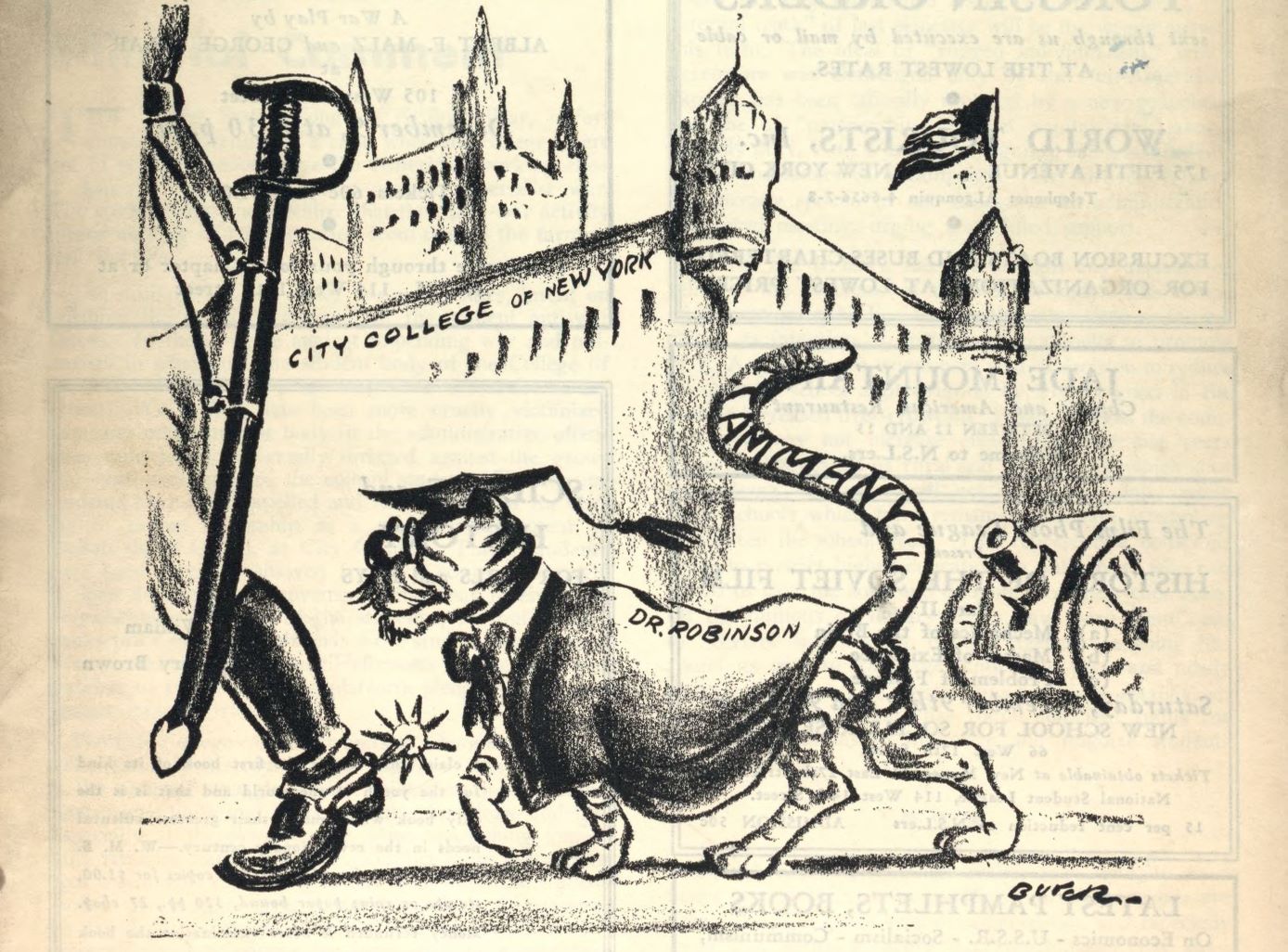
It is for the purpose of giving this orientation to the mass of American students that students have formed the National Student League. The League proposes to encourage and lead the activity of those students who are at present wandering, sometimes aimlessly, in this general direction. It proposes to combat the shortsighted leadership and false policies of all those student organizations which are sometimes unconsciously but actively misleading the student by creating reformist hopes and democratic illusions. In this connection the League for Industrial Democracy deserves special mention. Dominated by a thoroly middle-class, non-student leadership which is completely out of touch with students and their problems, and based on a philosophy of social reform and pacifism, this organization is a major obstacle to the development of a revolutionary student movement. Realizing that in large part the student membership of this organization is dissatisfied and disillusioned with such leadership and such policies, the National Student League appeals to those members of the League for Industrial Democracy who are sincerely interested in the building of an effective student movement to join with it in this task. The National Student League will arouse for activity all students whose purpose shall be to carry into effect the program outlined below.
PROGRAM
1. We propose to prosecute an unending fight for academic freedom, to the end that neither instructors nor students shall be “gagged” in classrooms or out and that they may not suffer discipline for their political and religious beliefs. This is necessary in order that we may continue to exist, and it is vital to us as students so that the channels of information are kept open to us. This is also necessary if we are to disseminate information on working-class struggles among our fellow students.
2. We propose to organize and lead the students in their struggles for better economic conditions on the campus. This becomes increasingly necessary as both private and public agencies attempt to economize at the expense of education and the student.
3. We propose to ally ourselves with and actively to support the revolutionary student movement in other countries, especially those student movements in the American colonies allied with workers’ and peasants’ movements.
4. We propose to fight against racial and national discrimination in college and out, recognizing that race hatred and national prejudice are tools used in carrying out the age-old strategy of ruling classes: “divide and rule.”
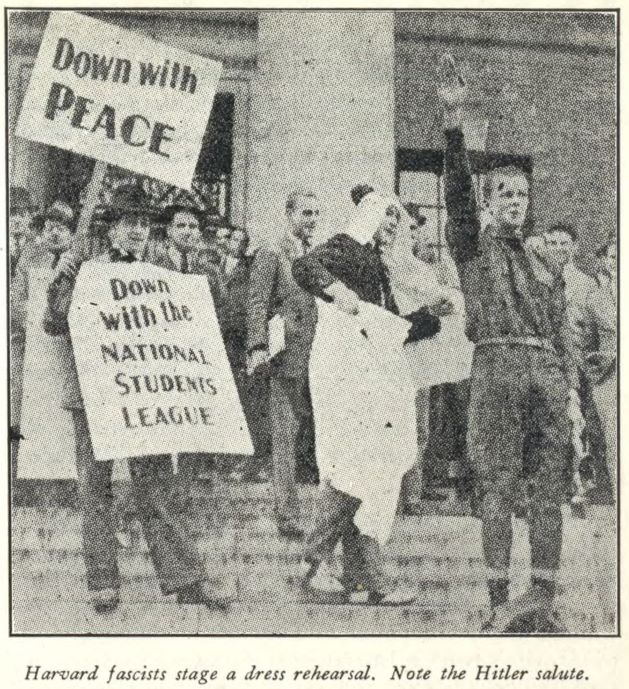
5. We propose to expose and fight against the growing trend in America towards a fascist rule; to educate students against national planning and social control programs, which under capitalism can mean but one thing, i.e. the direct control of governmental machinery by business interests. We propose to point out that such techniques, instituted to bolster capitalism, are at the same time measures which increase and continue the oppression of the working class.
6. We propose to expose the cultural and social decay taking place under capitalism today. The rapid disintegration of the middle class in America is hastening the breakdown of the social fabric and is spreading the degeneration incipient in all phases of our culture. We propose to explain this cultural decay and show its relation to the progressive collapse of our economic system.
7. Because the Soviet Union is the only country in the world which has been able successfully to establish a planned economy, an accomplishment possible only in a working-class society, because they have been able to eliminate crises, unemployment and mass poverty, the Soviet Union stands out as an inspiration and guide to us who in other parts of the world are experiencing and witnessing the social and economic evils which accompany capitalism. The manifold cultural developments in the Soviet Union contrast markedly with capitalist decay. Upon the student movement, therefore, devolves the historic obligation of popularizing the achievements of the Soviet Union and of working for the recognition and defense of the U.S.S.R.
8. We propose to struggle resolutely against imperialist war, against preparations for such wars, and against the attempt to utilize the schools and colleges for war whether this takes the form of outright military training or the more subtle forms of jingoistic propaganda.
9. We propose to expose the sham of “democracy,” the failure of “representative government” to represent the interests of the working class under capitalism, the widespread denial of elementary rights of free speech, press, and assemblage to workers, and the violent repression of working class struggles.
10. We propose to participate in the struggles of the working class by popularizing working class issues, by lending active and financial support to their struggles, and to concretize this support wherever possible by joining picket lines, collecting relief, participating in demonstrations, etc.
11. We will actively support the demands of the millions of unemployed workers in this country for unemployment insurance. This insurance must be paid by the government from funds secured through taxes on the higher incomes, from capital levies, and from funds now wasted in our huge war budget of over two billion dollars.
DEMANDS
It is logical that from our principles there should flow certain demands which represent the needs of the students both as students and as prospective producers.
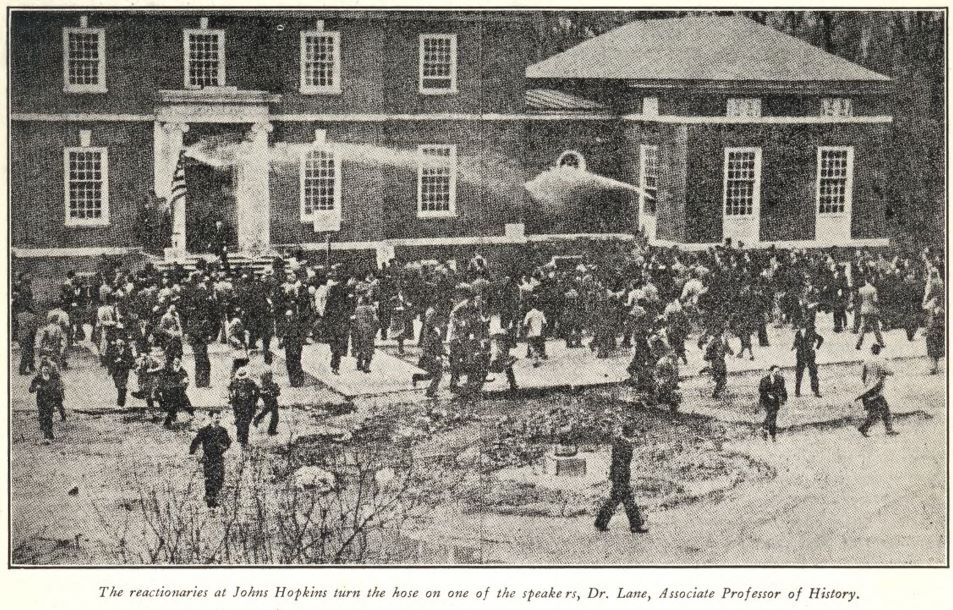
1. We demand that there be no interference in extra-curricular activities by university authorities. College publications must not be subject to censorship by the administration, faculty bodies, or the trustees; the staffs of such publications must not be disciplined for the political or economic views they express. Student clubs must be beyond faculty or administration censorship and must be permitted to affiliate with such outside organizations as they choose.
2. We demand full social and political equality for Negroes and other racial minorities. We demand that colleges and universities abolish all forms of discrimination in admission requirements, dormitory privileges, athletic privileges, use of swimming pools, attendance at social functions, employment opportunities, etc. We demand that Negroes shall have the right to enter freely, and on equal terms with white students, all colleges and universities in the country.
3. We demand for women educational and professional opportunities equal to those offered to men.
4. We demand the elimination of the “Star” system of sports, prevalent on most campuses, which restricts participation in such sports to a small proportion of the student body. We propose in its place a system of intramural sports with an opportunity for all students to participate in athletic activity.
5. We demand that in every city with a population of 25,000 or over that there be established adequate free city colleges.
6. In those schools where they exist, we demand the correction of such abuses as exorbitant tuition fees, dormitory fees, text book fees, cafeteria rates, and laboratory fees.
7. We demand increased appropriations for city and state colleges in order that laboratory and class room facilities shall be equal to those afforded to the students of the better class of private schools. All text books and supplies in such colleges shall be free.
8. We demand unemployment insurance for all students graduating from or leaving college who are not placed in positions. This insurance must be payable immediately after the student leaves school and must continue until he has found employment. The rate to be paid shall be based upon current cost of living to insure a minimum standard, and to be paid from funds collected by the government through taxes on high incomes. A national student unemployment insurance bureau shall be established to administer this.
9. We demand that a free employment agency, to be administered in cooperation with the student unemployment insurance bureau, be established.
10. We demand that a state fund collected from levies on high incomes be set up to assist students in colleges to complete their education. The extent of this need is to be ascertained by a census in city and state colleges which shall be taken by member clubs.
11. We demand the abolition of the R.O.T.C. and all other forms of military training and war preparation in the schools and colleges. All funds now employed for this purpose shall be made available for scholarships to assist students unable to finance their education.
12. We demand the abolition of all forms of compulsory religious services and chapels in all those schools and colleges where these practices exist.
ACTIVITIES
In order to work in the direction outlined by the program and to achieve our demands we shall indicate the major lines of activity. Several specific forms which these activities will take are suggested.
1. We propose to continue the publication of the Student Review. Inasmuch as it will serve as the most effective bond between the members of the National Student League, and as our most powerful organizing weapon in the student movement, we must give it our complete support.
2. The League will support on a national scale the activities and campaigns of its members and their organizations. As occasions arise the League will serve as a speakers and information bureau for its members.
3. The League will participate in the organization of local campus struggles on economic, political, educational, and social issues.
4. The League will carry on educational activities covering all phases of its program and demands. Lectures, symposiums, debates, study classes, and open forums will be utilized.
5. The League will engage in various phases of social and economic research to further its aims. The results of this research will be published in the Student Review and in pamphlet form when desirable.
6. The League will cooperate with other organizations which are working toward the aims and in the direction outlined by the program. It will give special attention to the organization of high school students along these lines.
 Revolution's Newsstand