
A report of the remarkable ceremony a year after his murder in which Joe Hill’s ashes were distributed in dozens of small packets by William D. Haywood to militants during the tenth I.W.W. convention to be spread across the world (except the state of Utah). And they duly were. Joe Hill is all around us.
‘I.W.W. Does Honor to Poet-Martyr’ by Abner Woodruff from Industrial Worker. (new) Vol. 1 No. 34. December 2, 1916.
CHICAGO, Nov. 19. Thruout the ages, the ashes of men have been scattered to the four winds of the heavens in token of some ennobling ideal, but never in recorded history have the few handsful of burned matter that represents an individual been distributed to all portions of the globe to be sown upon all the lands and seas. Into every region where the workers have awakened to the class struggle and are battling for freedom, a packet of human ash will go, and there, in reverence to the desire of the sweet singer–in devotion to the cause of liberty–all that remains of Joe Hill will be thrown upon the earth, that the cause of the workers may be fertilized and the fair flowers of solidarity spring up to perfume all the world with their sweetness.
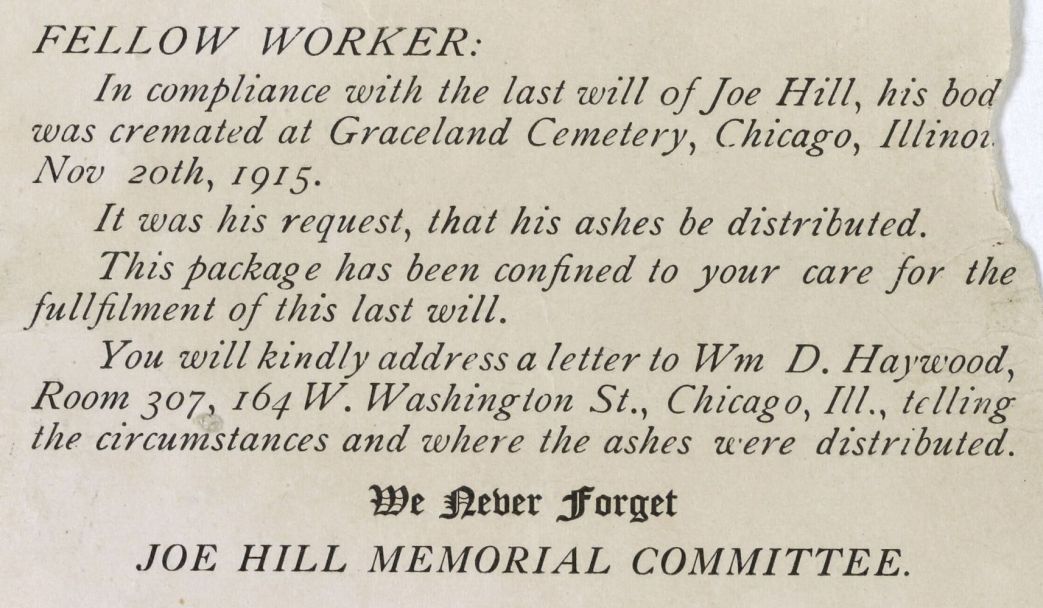
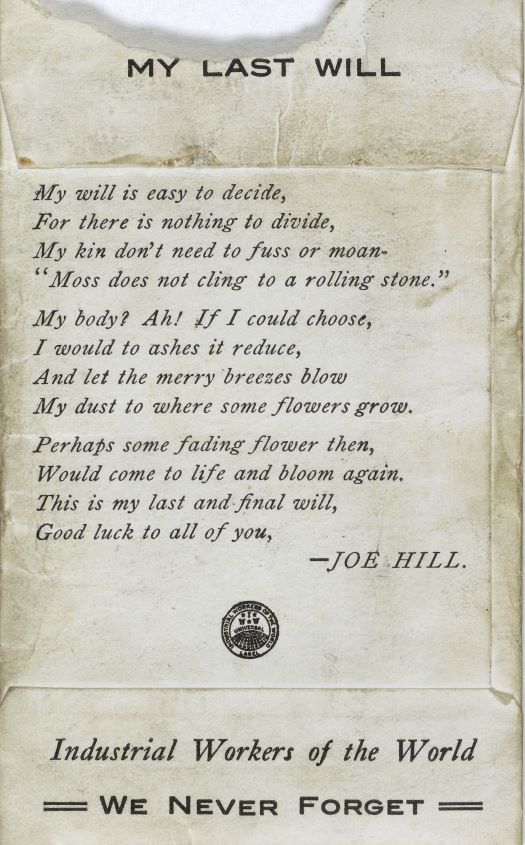
Let those who will call this sentimentality, but the fact remains that Joe Hill did not belong to the workers of America alone. He sang for the workers of all the world, teaching in the simple words of his songs the lessons of Industrial Unity, and carrying inspiration and cheer into all the nations and among all the peoples. His message was universal, and wherever the workers are truly organized, there they are entitled to participate in this great symbolic drama.
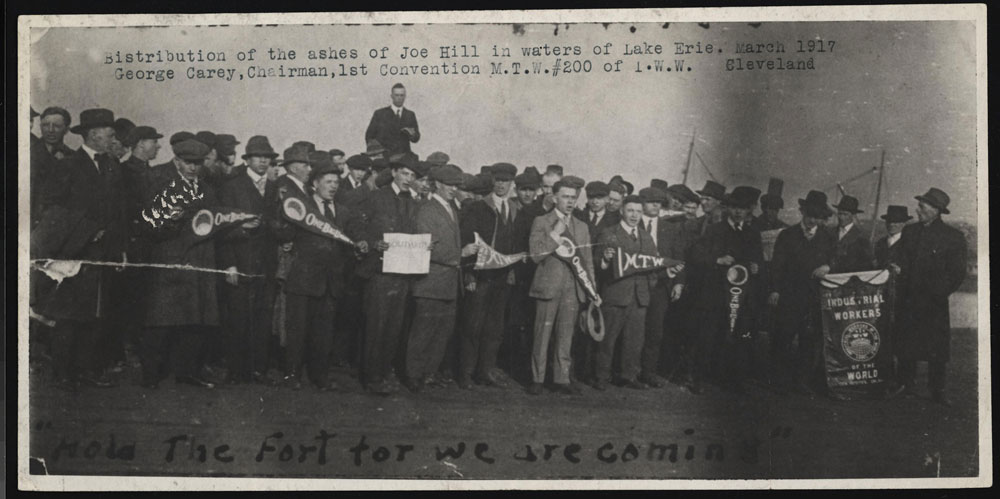
On Sunday, November 19th, 1916, at the West Side Auditorium in Chicago in the presence of a great gathering of the workers and with the impressive ceremony, Wm. D. Haywood, General Secretary-Treasurer of the Industrial Workers of the World presented packets of the ashes of our murdered Fellow Worker to the delegates to the tenth convention of the organization and to fraternal delegates from the organized workers of other countries. These delegates will make the final distribution of these ashes with appropriate ceremonies when they return to their respective homes and countries. By this means, the last will of Joe Hill will be carried out. The breezes will carry his dust to where some flowers grow, and they, revived and nourished, will bloom all the fairer, and the world be that much brighter.
The following program was carried out without a hitch, and reflected great credit upon not only those who participated, but upon those who arranged and managed it:
Call to order at 10 a.m., by Wm. D. Haywood.
“The Marseillaise” by Brass Band.
Address by Wm. D. Haywood, Gen’l Sec’y-Treas. I.W.W.
Reading of letter from Judge O.N. Hilton of Denver.
Address in Swedish, Eric Malm, Mining Industry, Alaska.
Address in Italian, D. Mari, Chicago, Sculptor.
Scandinavian Song, by Fellow Worker Chalem, Chicago.
Revolutionary Funeral March (Piano) Composed-Rendered-Prof. Rudolph Von Liebich, Chicago.
Address in Hungarian, Sam Fisher Metal & Mchr., Cleveland, Ohio.
Address in Russian, J. Lenkewietzkie, of Australia.
“Russian Revolutionary Hymn”, Russian I.W.W. Choir.
Address from the North, Walter T. Nef, Local No. 400, Minneapolis, Minn.
Song, “Power in the Union,” led by Joe Foley, Chicago.
Address from the Middle West, Chas. Plahn, Local 400, Kansas City, Mo.
Address Albert Prashner, England.
Song, “Don’t Take My Papa Away From Me”, Words and music by Joe Hill. Sung by Jeanette Wonyzienski.
Address, Albert E. Woodruff of Mexico.
Address from the East, Francis Miller, Textile Workers, Providence, R.I.
Address from the East, Charles Carter (negro) Marine Transport Workers, Philadelphia, Pennsylvania.
Chorus singing by Children’s Choir, of the Workers’ Institute.
Silver Collection ($45.)
Address from the West, Richard Brazier, Local 400, Spokane, Wash.
Address from the West, Frank H. Little, Mining Industry, Fresno, Calif.
Song, “Workers of the World, Awaken,” led by Joe Foley, Chicago.
Sending of telegrams of comfort and cheer to all the imprisoned workers in jails and penitentiaries in the United States.
Distribution of the ashes of Joe Hill to the delegates and fraternal delegates, by Wm. D. Haywood.
Chopin’s Funeral March, by Brass Band.
March from the hall, the workers singing “Hold the Fort.”
Inspiration breathed from the songs and from the addresses of the speakers. The last message of Joe Hill, “Don’t waste any time in mourning–organize,” was the keynote of the day, and each speaker pointed out how this command was being carried out in the section and among the people for which they spoke. Fellow Worker Haywood specially pointed out the greatest revenge we may now take upon the masters of the bread is not to permit any petty violence, but to go vigorously ahead with the organization of the workers for the final overthrow of wage slavery.
“On the Job” was the message of Local 400, voiced by the various speakers, and so on, down the line. Fellow Worker Nef made a most pertinent suggestion when he pointed out the line of co-operation extending thru Miners and Transport Workers and the Metal and Machinery Workers in reference to the fight upon the Steel Trust. With the headquarters of Local 245 and 300 maintained at Cleveland and co-operating with the Miners Local at Duluth, the emancipation of the steel slaves would be put well upon its way.
Reference cannot be made to all the speakers, but certainly no worker went away from that meeting without a resolve that he would put his shoulder to the wheel for the One Big Union and do all in his power to make the slaves know that it’s a mighty good thing to be a “wobbly.”
The Industrial Union Bulletin, and the Industrial Worker were newspapers published by the Industrial Workers of the World (IWW) from 1907 until 1913. First printed in Joliet, Illinois, IUB incorporated The Voice of Labor, the newspaper of the American Labor Union which had joined the IWW, and another IWW affiliate, International Metal Worker.The Trautmann-DeLeon faction issued its weekly from March 1907. Soon after, De Leon would be expelled and Trautmann would continue IUB until March 1909. It was edited by A. S. Edwards. 1909, production moved to Spokane, Washington and became The Industrial Worker, “the voice of revolutionary industrial unionism.”
PDF of full issue: http://iw.applefritter.com/Industrial%20Worker/1916/1916%2012%202%20IW.pdf
 Revolution's Newsstand