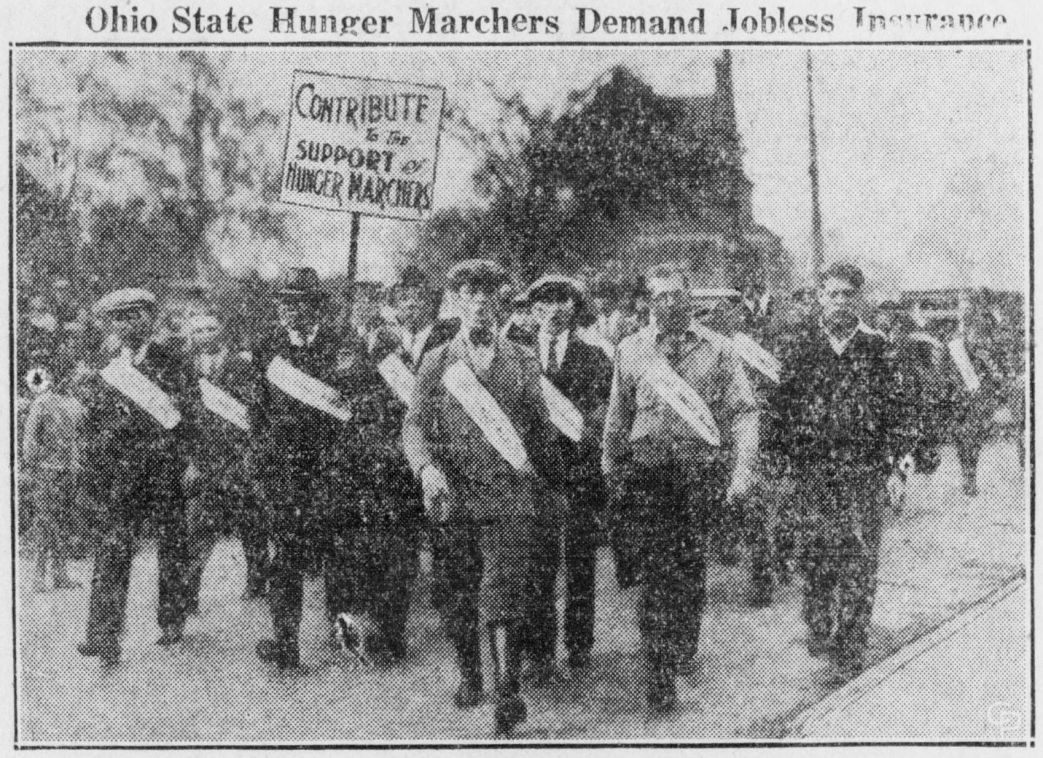
An internal report from a Communist Party activist on the 1933 Ohio Hunger March.
‘Education Through Struggle: Experiences of the State Hunger Marchers to Columbus, Ohio’ from Party Organizer. Vol. 6 No. 7. July, 1933.
One of the most important aspects of any working class struggle is the development of the class consciousness of the workers through political education. This general rule is specifically applicable to the People’s State Relief March of Ohio in that the political education of the marchers was advanced not only through the daily struggle of the march but also through a cultural program administered by an education committee which dramatized the struggles of the march to a higher political level.
All the columns upon arrival in a town on the line of march held mass meetings. At these meetings the marchers spoke about the conditions that had forced them to march, and also about the purposes of the march itself. Pamphlets concerning the unemployed were sold and given away at all the meetings. During the meeting the marchers would mix with the crowds and in this way numerous contacts for future Unemployed Councils were obtained. And also in this way new marchers were drawn in. For example in Marion, Ohio, such a meeting was held. We learned from the people present that not only did the Marion unemployed get only $1.25 per week relief but that they also worked for this relief for a private railroad, and further than the A.F. of L. had an unemployed union that had done nothing to better the conditions of the unemployed of Marion. After our meeting in that town we obtained numerous contacts for a militant unemployed council and also some new marchers.
Another feature of all the columns was the spirited singing and cheering. Slogans such as “Tax the rich and feed the poor”. “We demand unemployed insurance,” were continuously shouted along the line of march. These cheers would sometime draw applause from sympathetic onlookers.
The Toledo column held a different type of meeting with the people of the various towns. This column would hold an informal meetings with a discussion participated in by everyone, marchers and outsiders alike, on the activities of the day. At this meeting such things as police provocations in order to smash the march were pointed out. At the end of the meeting one of the leaders of the column would analyze the political significance of the day’s events. In this way not only the marchers but also the outsiders obtained a practical political discussion that was linked up with the struggles of that day.
Plays Teach Organization
In the Cleveland column a special feature of the mass meetings was the daily plays composed and performed on the experiences of the day. The chief aim of these plays was analytical clarification of the events that the marchers had participated in that day. The plays were prepared only on the basis of an outline of the event that had taken place. No words or speeches were prepared beforehand. This method was of course necessary because of the limited time available for the preparation by the actors. Usually only an hour or two was open to rehearsals and therefore the actors were allowed to develop their own speeches in accordance with the progress of the play, which, as I have mentioned before, was based upon a struggle with the police or some other struggle that had taken place that day.

Beside the mass meetings already mentioned other types of meetings were held. Numerous lectures on subjects such as “Reforestation Camps”, “Industrial Control Bill”, “Role of Women in Industry” and “Working class Youth”, were held and discussions followed in which the visitors participated as well as the relief marchers. And there were also health talks concerning poison-ivy, snakes, etc.
A great deal of publicity was obtained by the “March”. Elected publicity committees visited newspapers in the towns along the route of the march. For the most part favorable publicity was the result. One of the Columbus papers devoted its “Enquiring Reporter Column” to the “March”.
Effective distribution of leaflets popularizing the relief march was carried out throughout the entire state. This passing of leaflets and selling of the Daily Worker was done by a committee that would precede the march a few blocks. Thus territories were reached that had never seen a Daily Worker.
The educational activity of the columns did not differ much after their arrival in Columbus. The marchers camped in Columbus for about four days and during this time many neighborhood meetings were held. A truck would take some marchers into the neighborhoods where small mass meetings would be held. From five to ten meetings would be held in this fashion every night. Speakers were also sent to other unemployed organizations. At a meeting of a Musteite Council, 19 members voted to join the united front of unemployed in spite of sabotage of their leaders. In this way the advantage of militant action was brought to the pacifist unemployed leagues.
As for the marchers themselves, a program was given every night until the convention opened. At these programs, plays singing of folk and revolutionary songs by national groups, as well as movies of unemployed struggles, and of Soviet Russia, were featured.
The march concluded with a convention at which reports of past activity and future plans for State organization of the Unemployed Councils were given. The youth and women had their own convention modeled after the main convention, except their demands dealt specifically with the youth and the women.
I have outlined briefly the educational activity of the People’s Relief March. The success or failure of the march from a political standpoint depends largely upon the educational activity among the masses of people as well as among the marchers. There are two things that will have to be emphasized for future marches. First, larger mass meetings in the towns along the route of march so that a greater mass basis can be established, and second, a better politicalization of the marchers themselves by a daily connecting up of theory and the struggle such as police terror, etc. As for the first part; larger mass meetings can only be obtained by the establishment of local unemployed councils. And this shall have to be the principal activity of the Unemployed Councils of Ohio in their fight for unemployment insurance. By E.T.C. (Toledo).
The Party Organizer was the internal bulletin of the Communist Party published by its Central Committee beginning in 1927. First published irregularly, than bi-monthly, and then monthly, the Organizer was primarily meant for the Party’s unit, district, and shop organizers. The Organizer offers a much different view of the CP than the Daily Worker, including a much higher proportion of women writers than almost any other CP publication. Its pages are often full of the mundane problems of Party organizing, complaints about resources, debates over policy and personalities, as well as official numbers and information on Party campaigns, locals, organizations, and periodicals making the Party Organizer an important resource for the study and understanding of the Party in its most important years.
PDF of issue (large file): https://files.libcom.org/files/Party%20Organizer%206.pdf
 Revolution's Newsstand