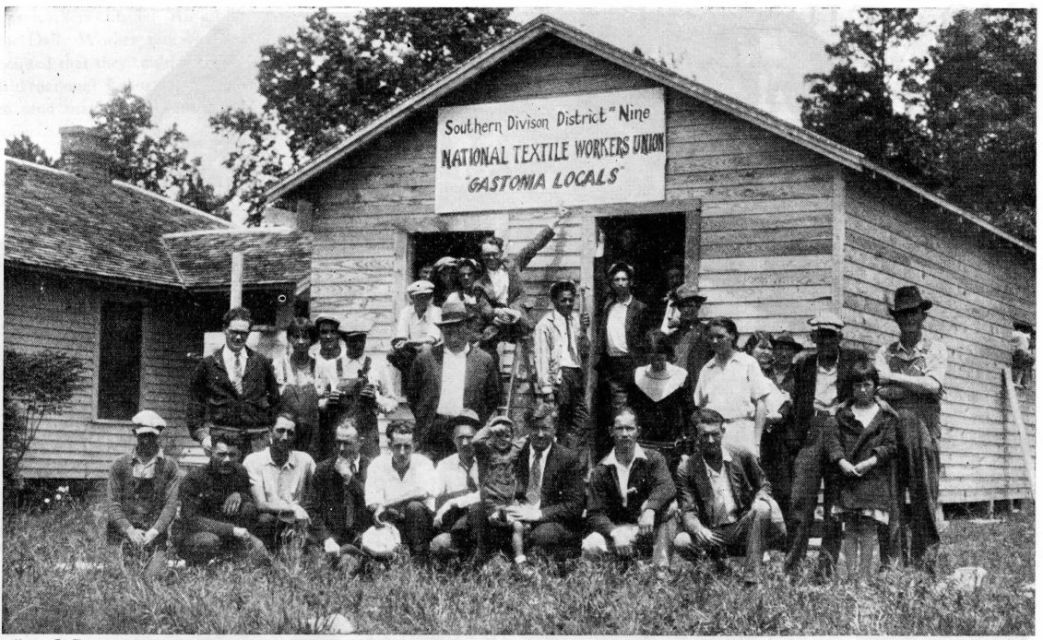
The first large campaign of the Communist Party in the South was the bloody 1929 strike in Marion, North Carolina led by the T.U.E.L.’s National Textile Workers Union. Albert Weisbord reports on its start.
‘The National Textile Workers Union Invades the South’ by Albert Weisbord from Labor Defender. Vol. 4 No. 5. May, 1929.
THE National Textile Workers Union is leading the way in breaking into the “Solid South,” the stronghold of the worst reactionary forces in the United States. For years the textile manufacturers of the south have boasted of the fact that no union organizers could live long in the south. For years the officials of the American Federation of Labor have abandoned the workers of the south to their fate. For years the bosses have made of the southern textile mills veritable hell holes of the worst description.
Now a big strike wave of utmost importance to the entire working class of this country is opening up in the southern mills. Working 10 to 12 hours a day for an average of from 8 to 14 dollars a week, these workers, white and black, have been goaded beyond endurance. On their backs has just been loaded a most ferocious speed-up system, doubling and tripling the work and making life absolutely unbearable.
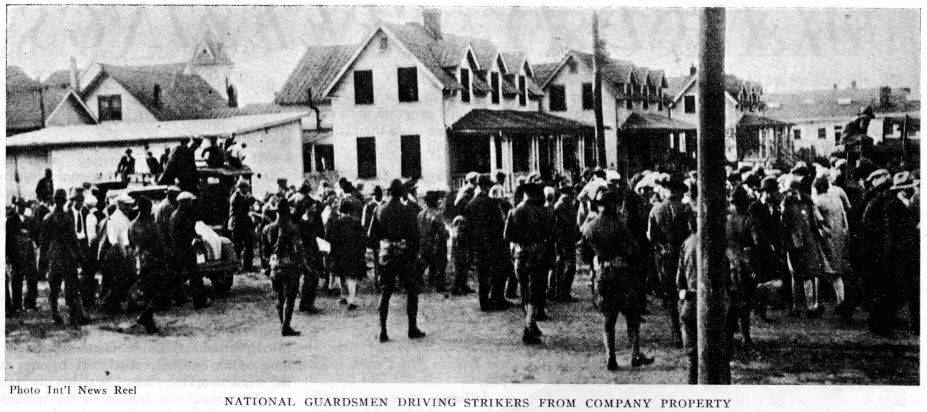
Driven by these conditions and greatly stimulated by the agitational and organizational work done by the southern organizers of the National Textile Workers Union, the southern mill workers are now beginning to strike back. Under the leadership of our union a strike of 3,000 workers has taken place in Gastonia, N.C., in one of the biggest mills of the South. At once workers have been arrested. Companies of troops have been rushed in. More troops are on the way. Our organizers are carrying on their work in the greatest personal peril. But the strikers are holding firm and the strike wave is spreading.
In Pineville, High Shoals, Forest City, Lexington, N.C., and in Anderson, S.C., strikes involving locals of our union have broken out following the strike in Gastonia. Everywhere throughout the Gastonia region itself, having 25,000 workers, there is great restlessness, and a movement on the part of the other workers to join hands with those already on strike in a gigantic movement to involve the whole southern region.
While these strikes are taking place under the auspices of the National Textile Workers Union, simultaneously strikes have broken out in S.C., against the new speed up system that has been introduced. In Ware Shoals, Pelzer, Greenville, Buffalo, Union, Woodruff and other places in S. C. and in Elizabethton, Tennessee, these sporadic strikes have broken out involving 11,000 workers at different times.
There is a difference between the strikes in S.C. and the strikes in N.C., under the influence of the N.T.W.U. Whereas in South Carolina these strikes are defensive strikes, passionate outbursts of unorganized workers against conditions which flesh and blood can stand no longer, in N.C. it is part of a deliberately planned and determined attempt on the part of the militant section of the working-class to organize the 1,100,000 textile workers throughout the country. Whereas the demands of the workers in S.C. are for the reduction of the speed-up system, the demands of N.C. are of the most profound and far reaching character. In a place where 60 hours is the rule, the Union fights for the 8 hour day, and the 40 hour week. In an industry where piece work is the very foundation of labor, the Union calls for the abolition of the piece-work system. In mills where the average wage is $8 a week, the union calls for a $20 a week minimum wage. Here where the color line is taught from childhood on, the union has organized white and black with the greatest equality and has raised the cry of full equality for the negro. In a state where a union is an unheard of thing, workers are fighting for complete recognition of the Union.
The employers are mobilizing their whole forces to crush the workers. They have raised the cry of Bolshevism, of Russian gold, of red anarchy, of revolution, of atheism, of free love, of foreign agitators, of crooks and swindlers, of “n***r lovers.” But they have not been able to shake the workers in their loyalty to the leadership of the strike, or to split their ranks and cause them to go back to work. That these southern workers of old native stock, with traditions of individualism, bred from their life in the mountains and on the farms, rally to leaders professedly communistic, and to a union professedly of a militant character, speaks volumes for the conditions of the South and the correctness and character of the leadership of our Union.
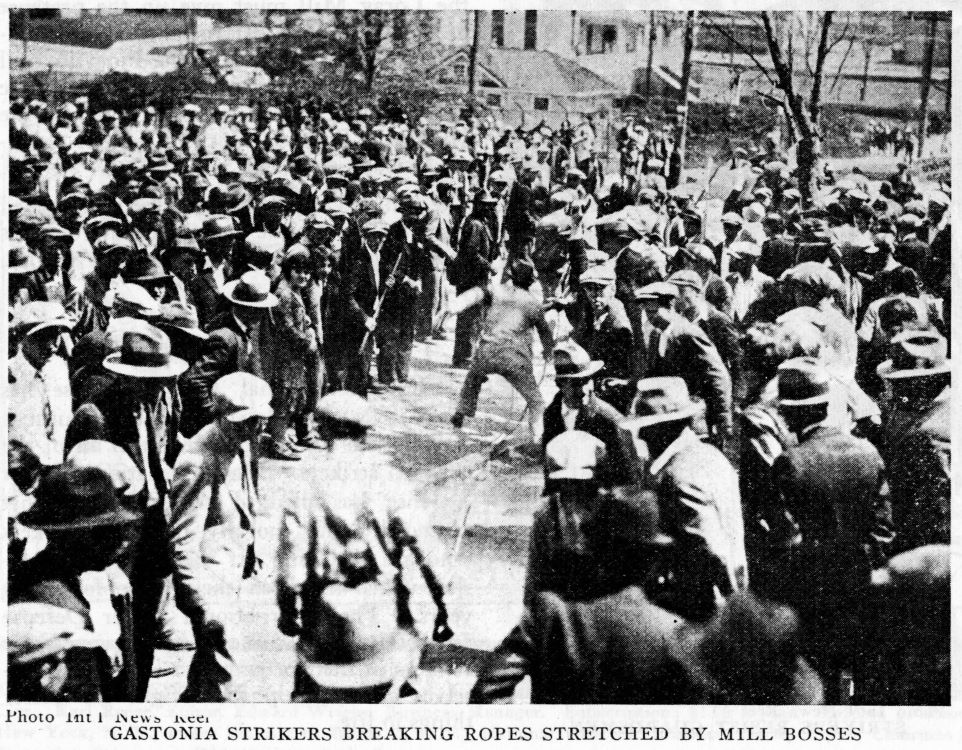
The strike is taking on the fiercest aspect, in which the A.F. of L. is openly joining hands with the state militia and the American Legion and the Ku-Klux- Klan to “give the workers a lesson.” The character of defense in this southern battle will not be a legal one, and the I.L.D., helping the N.T.W.U., has seen clearly that in this fight primarily it is not so much a question of lawyers and lawyers’ fees, or even of bail money, it is a question of building up a strong mass workers defense corps, that will physically wipe out and exterminate any mob of the Chamber of Commerce, the American Legion, the Ku-Klux-Klan, that may try a lynching bee against our organizers.
Our organizers are meeting a situation of grave personal peril to themselves with the greatest heroism and sacrifice. This speaks not only for the organizers of the Union, but for the organizers sent in by the I.L.D. as well. Every effort must be made by the workers throughout the whole country to support the strikers and those organizations like the I.L.D. in their struggle for better conditions and for a militant union of their own.
Labor Defender was published monthly from 1926 until 1937 by the International Labor Defense (ILD), a Workers Party of America, and later Communist Party-led, non-partisan defense organization founded by James Cannon and William Haywood while in Moscow, 1925 to support prisoners of the class war, victims of racism and imperialism, and the struggle against fascism. It included, poetry, letters from prisoners, and was heavily illustrated with photos, images, and cartoons. Labor Defender was the central organ of the Scottsboro and Sacco and Vanzetti defense campaigns. Not only were these among the most successful campaigns by Communists, they were among the most important of the period and the urgency and activity is duly reflected in its pages. Editors included T. J. O’ Flaherty, Max Shactman, Karl Reeve, J. Louis Engdahl, William L. Patterson, Sasha Small, and Sender Garlin.
PDF of full issue: https://www.marxists.org/history/usa/pubs/labordefender/1929/v04n05-may-1929-LD.pdf
 Revolution's Newsstand