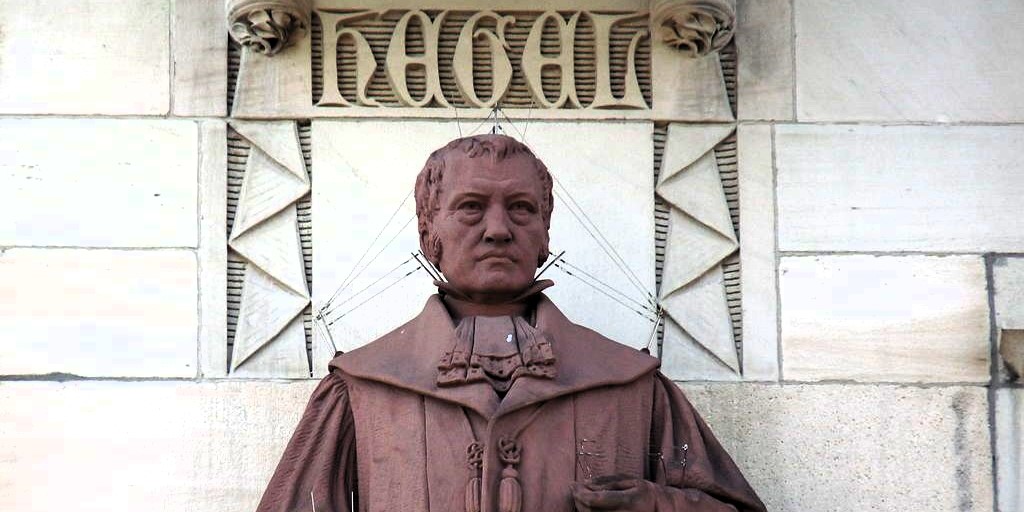
‘The Struggle Over Hegel’ by August Thalheimer from Revolutionary Age (Communist Party U.S.A., Majority Group). Vol. 3 No. 5. January 2, 1932.
On the occasion of the hundredth anniversary of the death of Friedrich August Wilhelm Hegel, one of the greatest thinkers in the history of mankind and an important figure in the pre-history of Marxism, we publish the following article from the pen of August Thalheimer, outstanding Marxist theoretician of Germany.
The German philosopher, Hegel, Professor of Philosophy in the University of Berlin, died on November 14, 1831. He was not merely a professor of philosophy; he was a great philosopher, one of the greatest revolutionary thinkers of the bourgeoisie in the nineteenth century. He is the profoundest and most all-embracing bourgeois revolutionary of the spirit. As such he belongs not only to Germany but to the world; not only to the bourgeoisie but to the working class as well. In him classical German philosophy finds its positive completion.
Philosophy was the generalized spiritual expression of the bourgeois revolution in Germany, the revolution against feudalism and the absolute monarchy. The German bourgeoisie was historically still on the ascendant when Hegel died. The class struggle was still immature and even the German bourgeoisie did not engage in political struggle until 1831. It did not yet fight as a mass, as a class. Only its vanguard, composed of great writers and thinkers, fought on the field of thought, separated from the body of their class, without its active participation, without its practical support. For their very material existence these thinkers and writers of the bourgeoisie had to depend upon the absolute state, upon princely patronage. Kant, Fichts, Schelling, Hegel were professors in universities that stood under the paternal rod of princely absolutism. Goethe, Schiller, were compelled to live in the courts of petty princes.
All of these circumstances make it clear enough why German classical philosophy, in its completed form as Hegelian philosophy, bears contradictory elements within itself. Revolutionary features are mingled with reactionary; the greatest intellectual acuteness, with the greatest practical caution and narrowness. Hegelian philosophy was self-limited thru the fact that it was still bourgeois philosophy and that it had, as its social basis, the German bourgeoisie as yet unawakened to political life.
With the development of the class. struggle in Germany in the course of the 1830’s and 1840’s, there matured also the contradictions within the Hegelian philosophy. The bourgeois classes appeared on the political arena. The Hegelian school split into a right and a left wing. The right wing utilized the weapon of Hegelian philosophy to defend churchly orthodoxy, state absolutism and the junker-buroeratic privileges. The Hegelian left arose in a storm of criticism against the absolute state and against feudalism. In Strauss it dissolved away Christianity: in Feuerbach, religion in general and its last remaining spiritual support, idealistic metaphysics, and thereby also philosophy in the form it had assumed until then. For a short period bourgeois philosophy became materialistic and openly bourgeois-revolutionary, democratic and republican!
But along with the German bourgeoisie the German proletariat also entered upon the stage of history. Spiritually the proletariat formed its point of contact with the Hegelian left. Marx and Engels began as disciples of Hegel and Feuerbach and in the course of a few years crossed over from the extreme end of the bourgeois revolution to the beginning of the proletarian revolution, from the criticism of bourgeois religion to the criticism of bourgeois society and the bourgeois state, from natural-science materialism to historical-dialectical materialism.
In the course of fifteen years, Hegelian philosophy, stimulated by the maturing class struggle, gave birth to orthodox Christians, bourgeois free-thinkers, democratic-republican revolutionaries and, finally, the champions of the proletarian dictatorship, of proletarian Socialism, of Communism! How could this happen? It was the result of the self-contradictory features of Hegelian philosophy as such. The dialectic method of Hegel included the elements of the general formula of revolution. His idealistic metaphysics could be of service to religious orthodoxy and political reaction. One or the other–depending upon whether one took hold of the revolutionary kernel or of the historically conditioned, reactionary shell.
On the one side, Hegelianism ends, materialistically developed in a revolutionary manner, stood on its head as it were, as the dominant philosophy in the Soviet Union. On the other side, crippled in a reactionary manner, as the Fascist philosophy of Mussolini’s Italy.
The German bourgeoisie, of whom Hegel was the representative at the time when it had not yet awakened to political life, is today pushing to their conclusion the reactionary and mystical sides of the Hegelian philosophy–today, when towards the end of its historical course, it is surrendering its political existence in favor of the autocracy of the Fascist state.
Such is the social sense of bourgeois Neo-Hegelianism. Fascism takes possession of Hegel as one who saw “in the state only an expression of the living spirit of the people.” Hegel thus becomes the bearer of the “fundamental spirit of the people.”
Reformist Socialism, at the end of its rope, attempts to bring about a rotten compromise between Marxism and Hegelianism, by revising Marxism backwards to Hegelian idealism. Catholicism celebrates Hegel as the champion of the reality of conceptions, as an objective idealist and therefore as an ally of the orthodox Catholic teachings of Thomas Aquinas.
They all can justify their appeals to Hegel more or less substantially. But they can only appeal to isolated sides of the thinker and his teachings, to those sides that were the transitory, historically conditioned, reactionary externals.
What remains of Hegel, his revolutionary kernel, is the heritage of Communism, of the working class. Thru the working class it receives further development in revolutionary theory and revolutionary practice!
Workers Age was the continuation of Revolutionary Age, begun in 1929 and published in New York City by the Communist Party U.S.A. Majority Group, lead by Jay Lovestone and Ben Gitlow and aligned with Bukharin in the Soviet Union and the International Communist (Right) Opposition in the Communist International. Workers Age was a weekly published between 1932 and 1941. Writers and or editors for Workers Age included Lovestone, Gitlow, Will Herberg, Lyman Fraser, Geogre F. Miles, Bertram D. Wolfe, Charles S. Zimmerman, Lewis Corey (Louis Fraina), Albert Bell, William Kruse, Jack Rubenstein, Harry Winitsky, Jack MacDonald, Bert Miller, and Ben Davidson. During the run of Workers Age, the ‘Lovestonites’ name changed from Communist Party (Majority Group) (November 1929-September 1932) to the Communist Party of the USA (Opposition) (September 1932-May 1937) to the Independent Communist Labor League (May 1937-July 1938) to the Independent Labor League of America (July 1938-January 1941), and often referred to simply as ‘CPO’ (Communist Party Opposition). While those interested in the history of Lovestone and the ‘Right Opposition’ will find the paper essential, students of the labor movement of the 1930s will find a wealth of information in its pages as well. Though small in size, the CPO plaid a leading role in a number of important unions, particularly in industry dominated by Jewish and Yiddish-speaking labor, particularly with the International Ladies’ Garment Workers’ Union Local 22, the International Fur & Leather Workers Union, the Doll and Toy Workers Union, and the United Shoe and Leather Workers Union, as well as having influence in the New York Teachers, United Autoworkers, and others.
PDF of full issue: https://www.marxists.org/history/usa/pubs/revolutionary-age/v3n05-jan-02-1932.pdf
 Revolution's Newsstand