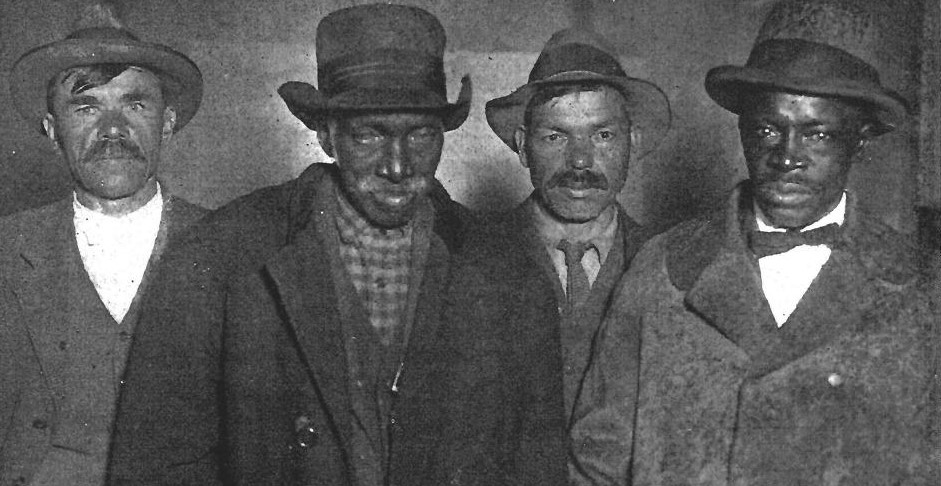
The crisis in the largest, most combative union in the country caused by the crafting and solidifying of a single bureaucracy by the John L. Lewis machine saw many militants leave the U.M.W.A. and attempt to build new, democratic unions in the late 1920s. The U.M.W.A.’s District 5 in Pennsylvania was won by reformers, including C.P.-aligned miners like Tom Myerscough, who would lead the call for a National Miners Union in 1928. Here, Myerscough reads the indictment of progressive miners against Lewis’ leadership.
‘Miners Want a New Union’ by Thomas Myerscough from Labor Unity. Vol. 2 No. 6. July, 1928.
(Recently elected secretary-treasurer of district five, United Mine Workers of America at the special convention which ousted the Fagan machine and elected a progressive slate. Myerscough was the provisional secretary of the National Conference June 12 which issued the call for a National Convention to form a new miners union.)
AS the critical situation in the bituminous strike fields brought about by the ruinous policies of the John L. Lewis officialdom looms as a spectre before the eyes of the miners of America, and thousands of individuals and whole blocks of local unions are being expelled and their relief cut off because they demand that these policies be changed, progressive miners everywhere are convinced that it would be a disastrous mistake to cling to the United Mine Workers of America any longer as the union of the miners.
Executive officers from newly reorganised districts and leaders of progressive movements in the unorganised field and other states where the rank and file has not yet taken over the local union machinery, have issued a call for a National Convention to extricate the miners from the death clutch of the Lewis machine, and build a new union. September 9 to the 16 is the time set for this task.
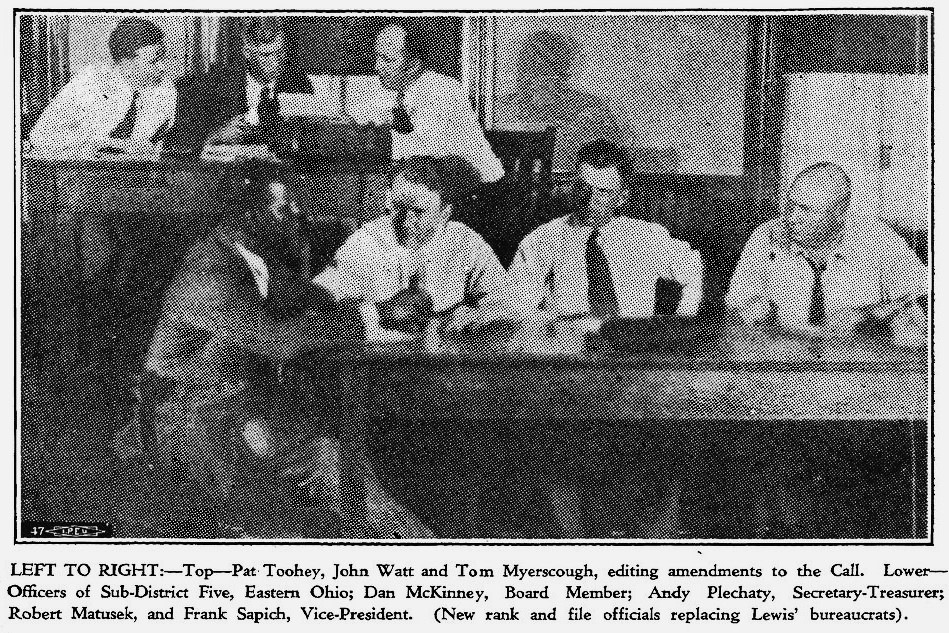
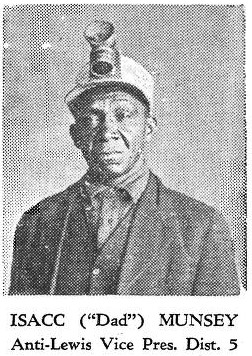
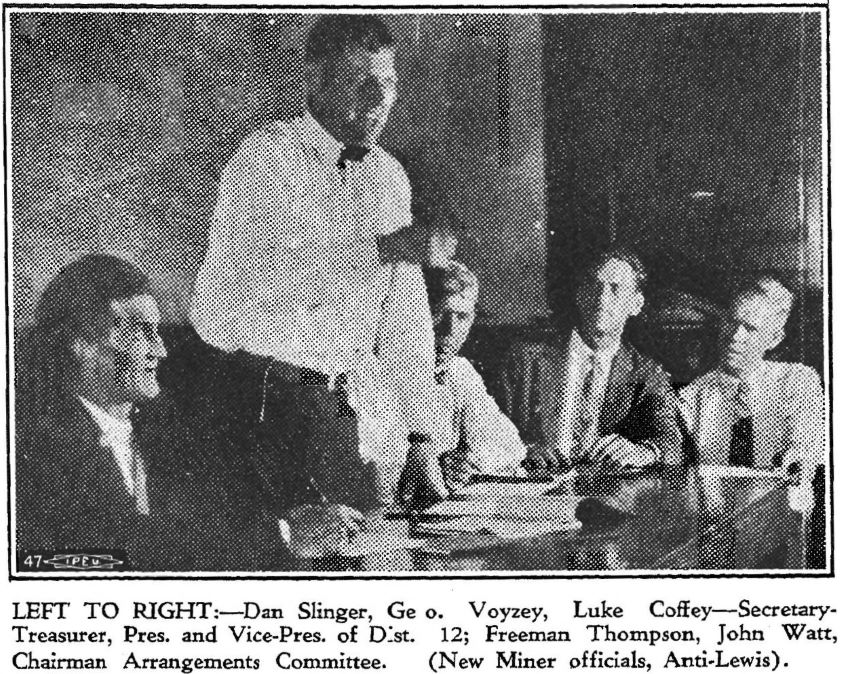
George Voyzey, Luke Coffey and Dan Slinger, progressive officers of the Illinois district, Charles Pryor of Indiana, Robert Matusek, Frank Sepich and Andy Plechady of Ohio, Charles Close of West Virginia, S.T. Wakefield of Kansas, Charles Allander of Colorado, Tom Rodgers, Steve Simons and Killingern of Portage Pa., John Watt, Pat Toohey, Anthony Minerich, Vincent Kemenevieh, Fred Siders, Isaac Munsey and Freeman Thompson, all known to the rank and file for many years as militant fighters, and Milton Chicka of the recently organized Westmoreland County Miners Union, are among those who participated in the National Conference June 12 at Pittsburgh and signed the call for the Convention which will organize the new union.
From K. of L. Days
“I left the Knights of Labor to help build the United Mine Workers of America,” S.T. Wakefield white haired representative from Kansas said. “It was an honest fight, and we built a real union. In Kansas today, we have only the remnants of that union left. The Lewis crowd strangled it. I can’t go to the unorganized miners and ask them to join a union headed by a man who betrayed them time after time. But I give you my guarantee, those boys will be among the front rank fighters for the new union. Kansas will go solid with the new miners’ union!”
Lewis: The Destroyer
A scathing indictment of ruinous policies, failure to carry out tasks such as organization of the unorganized miners, corruptions and dastardly betrayals from Lewis and his official family have found voice in a mighty denunciation of the misleaders who slowly dissipated the strength of the once powerful union, in the call issued by this conference of progressives, for a convention which will build a new union.
“The U.M.W.A. was built by rank and file miners through a whole generation of struggle,” the call declares. “Its history is full of heroic efforts of the miners to build it into a real union in the face of starvation, suffering, bloody assaults from company gunmen, organized attacks by the police, troops, injunctions and all-too-often betrayals by the union’s official leaders. Nor were these struggles without success. With unbreakable solidarity and unconquerable fighting spirit, the miners slowly built up the union. Gradually the organization extended its influence into almost every coal district and it brought about far-reaching improvements in the conditions of the miners. Powerful, progressive and militant, it stood at the head of the whole trade union movement.”
U.M.W. Practically Ruined
But since the reactionary Lewis clique took control, the call points out, progress has stopped and the organization slowly disintegrated. Membership dwindled; four years ago it controlled 70% of bituminous coal mining, and today 20 1/2 still under union control is being filched away by the onslaught of the operators.

“The U.M.W.A. is practically ruined,” the indictment continues, “When Lewis took hold of it only a few years ago, it was a flourishing, growing, fighting union. Now it is a wreck. Lewis’s reactionary policies have broken it and disorganized the miners in the face of the enemy.”
The situation in the Anthracite region where a five year contract foisted upon the miners by the Lewis clique served as an excuse to divide the soft coal workers from the hard coal workers and narrow down the fighting front when it was imperative that the strike be spread to national proportions in order to tie up production and demand a national agreement, was also carefully analyzed at the Conference, and summarized in the call.
No Separate Anthracite Union
“Beware of those false leaders who advocate the formation of a separate union of the hard coal miners,” is the warning to the Anthracite miners. “Stand solidly with the bituminous miners for the new union. Only such a union can abolish the contractor evil and do away with the arbitration-conciliation swindle.”
Lewis’s regime is characterized as the “worst that ever cursed any body of organized miners in the world’s labor history.” The policies which have practically turned the U.M.W.A. into a company union and which were responsible for the formation of the Save-the-Union Committee by rank-and-file miners to fight these policies are specified one by one.
Alliances With Coal Operators
Conference delegates pointed out that the Lewis leaders function as tools and agents of the coal operators. Very frequently they go directly from union offices into the employ of the operators. Like Frank Farrington, they are often on the payroll of union and employers at the same time. “It is this alliance with the operators which is the source of the reactionary policies that have wrecked the union, ” the call declares.
Soon after the Conference, a subdistrict convention called by the progressive officers of district five in Harwick, Pa., was blocked by the reactionary officials by calling in state troopers and deputy sheriffs. Even the company squire was waiting in the union hall before the delegates began to arrive. But the delegates quietly went to New Kensington, some miles away, held their convention, and endorsed the call for the new union.
Refuse To Organize Unorganized
“To unite the great masses of unorganized miners is a life and death problem with us,” the progressives declared. Lewis’ stubborn refusal to solve this problem, and his sabotage of every attempt on the part of the rank and file to accomplish this task themselves, was bitterly denounced.
When 1,125 delegates at the National Miners Conference April 1st called upon the coal diggers in the unorganized field to join the strike, the Lewis officialdom sabotaged. In 1922, Lewis signed agreements leaving out coal diggers of the unorganized who had struck in Pennsylvania faithfully with their union brothers, forcing them to return to open shop mines. “Lewis’ policy is to surrender the unorganized districts to the operators. As a result, the power of the union has steadily weakened until now the whole organization is in a state of collapse,” the indictment continues.
Will Organize Unorganized
Inviting the unorganized miners to hold conferences and elect delegates to the National Convention Sept. 9, the call declares, “Lewis and his corrupt agents have betrayed you time and again. But the new Miners’ Union will recognize as its first task the organization of the unorganized and will undertake this job with all possible vigor.”
Lewis’ consistent strike-smashing activities were felt in Kansas, Colorado and Nova Scotia as well as in the unorganized field. The method of handling the present bituminous strike, too, falls in line with this policy. The systematic splitting up of the fighting ranks through the signing of separate agreements for some mines while others owned by the same operators were still striking or being operated on an open-shop basis, helped divide the miners against themselves. The policy consistently demanded by the rank and file was the extension of the fighting front to include all miners, with one national agreement as the objective.
“In a situation imperatively demanding a national strike, Lewis fought desperately against all efforts to spread the strike,” the call points out. “He split the miners’ union into bits, isolating the strikers in the key districts of Pennsylvania and Ohio and making the union an easy victim for the open shop operators. His whole strike policy has been a crime against the miners.”
Fake senate investigations, reliance upon and cooperation with corrupt politicians, and especially Lewis’ collaboration with the operators to drive 200,000 coal diggers out of the mining industry to swell the great army of unemployed which has already gone beyond the 4,000,000 mark, are sharply exposed. A six hour work day, five day week is the demand made by the rank and file to meet the heavy unemployment problem. A strong fighting union with an honest leadership rather than lick-spittles of the bosses, and a Labor Party to drive out the corrupt politicians and substitute workers’ representatives, are the demands of the progressives.
Glorious History
When Lewis took control of the union, it was among the most militant and progressive in the entire labor movement. The labor party, organization of all fields and the policy of one national agreement were supported by the rank-and-file representation at the first convention Lewis presided over when he assumed the presidency about ten years ago. As the years went by, and Lewis grasped the union machinery more firmly, these and other policies were flagrantly violated. The progressive spirit was choked. Conventions were packed, elections stolen, and the union was kept under his control by gangster methods. George Voysey’s votes in the 1924 election were stolen and then John Brophy’s in 1926, and Lewis continued in office illegally.
“With its program of always retreating and with close support from coal operators,” the call continues, “the Lewis gang has systematically warred against all militancy in the union, ruthlessly expelling the best fighters, among the miners, simply because they dared insist upon a progressive, fighting policy, a real defense of the miners’ interests.”
When the strike situation in the bituminous fields became more and more critical as a result of Lewis’ ruinous policies, the rank and file decided to take matters into their own hands. The April 1, National Conference of over a thousand delegates met in Pittsburgh to analyse the union and strike situations, and draw up a program to save the union and win the strike. “Lewis must go”, “Spread the strike,” “One national agreement,” and “Miners take control of your union,” were among the leading slogans advocated. The strike in the unorganised field was called which later resulted in the formation of the Westmoreland County Miners Union. Delegates returned home to stimulate picket line activity in spite of the reactionary machines’ disapproval, and organise district and sub-district conventions to take over the union machinery. Then the Lewis clique, thoroughly alarmed, declared all delegates expelled from the union. Where locals refused to comply, charters were revoked and relief cut off.
Illinois took the lead. A complete slate of progressives headed by George Voysey as district president, Luke Coffey, vice president and Dan Slinger, secretary, was elected. The exorbitant salaries of officers were cut to $7.50 a day, the Jacksonville scale of wages which the striking miners are now fighting to maintain. Salaries had been raised immediately before the strike. In discussing this aspect, the call declares, “The depths of the U.M.W.A. officials’ corruption was clearly shown up at the last International Convention where Lewis and Murray used the packed delegations to raise their salaries to $12,000 and $9,000 yearly, although the union faced a life and death crisis. All through the long bitter months that the Pennsylvania and Ohio miners have been starving and striking on a dollar or two a week relief money, these false leaders drew their enormous salaries and lived on the fat of the land. From such venal, corrupt leaders, the miners can only expect treachery and defeat”.
Ohio and Pennsylvania soon followed, and ousted their reactionary officials and elected progressive leadership. Constitutions were revised. All appointive power was revoked, putting an end to “one man power”. Here too, the salary was decreased to $7.50 a day. No salaries would be paid during strikes, the conventions declared. Subdistrict conventions followed. A convention is called to meet in Kansas, District 14, on July 1.
But soon it became apparent that the Lewis gang was hanging on to the union with a deadly grasp, and that it was impossible to overcome the obstacles of gangster control, election steals and terrorization to budge the corrupt Lewis machine and rebuild the U.M.W.A.
“Democracy is dead in the U.M.W.A.,” the progressives point out in the call for the September Convention. The Lewis officials, tools of the operators and hopelessly reactionary, refuse themselves to undertake measures necessary to revive the union, and, with the help of the operators, block every effort of the rank and file to enforce the adoption of such policies. During the past two years, the masses of miners, in the Save-the-Union movement, have demanded and fought for the necessary changes in leadership and in policy.
Members Demand Control
“We have pointed out the deadly, ever deepening crisis of the union,” it enumerates. “We have carried majorities in union election and conventions. We have held protest conferences in many districts, culminating in the great national conference of 1,125 delegates in Pittsburgh, April 1st. We have started direct campaigns to organise the unorganised in the U.M.W.A. We have tried to spread the present strike nationally so that it might be won.”
This struggle failed to remove the Lewis clique who maintained their power with the help of the operators and gangster rule. “Our efforts to elect an honest leadership have been defeated by wholesale stealing of elections. Shameful packing of the union conventions with false delegates has stripped the convention of all rank-and-file expression. Our efforts to develop the U.M.W.A. into a fighting organization were resisted by expulsions from the union and blacklist from the industry.”
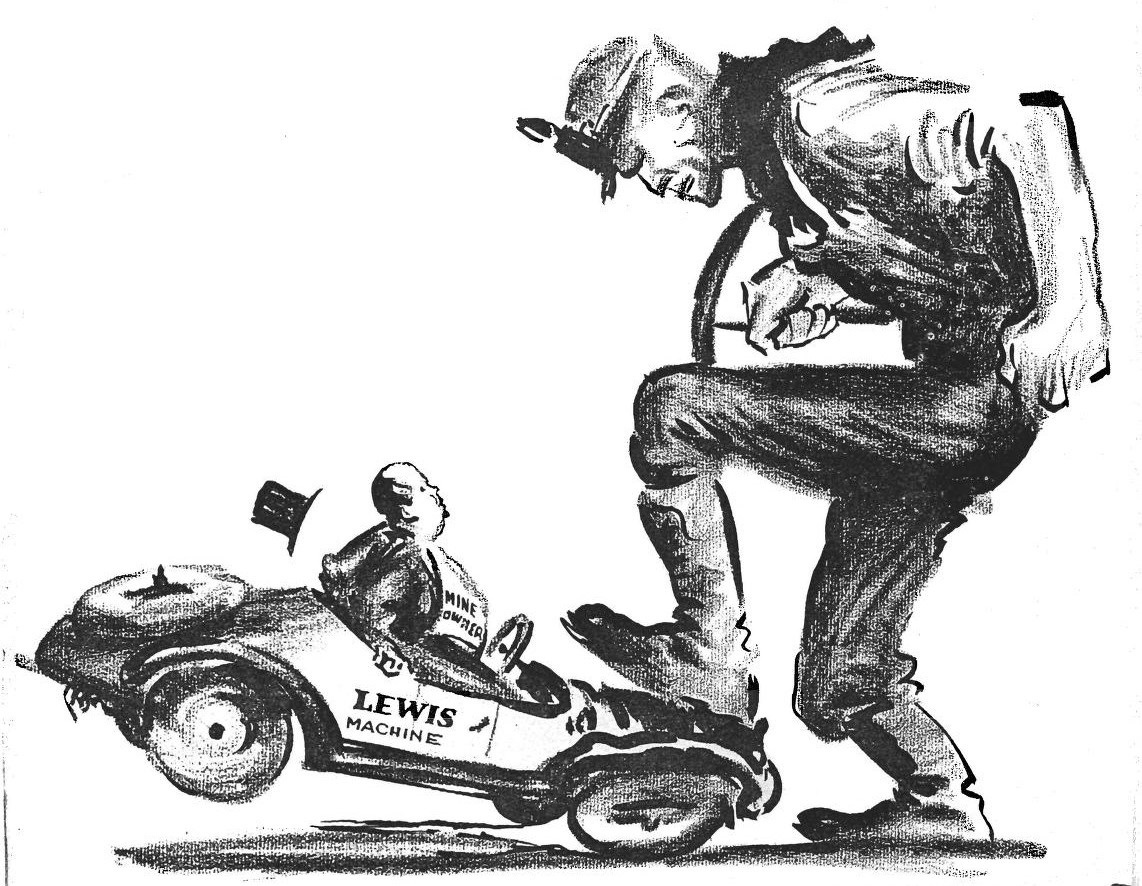
Finally, under the leadership of the progressive officialdom of district five, Pennsylvania, representatives from all districts of the U.M.W.A. and the unorganized field were invited to this national conference in Pittsburgh June 12, which voted unanimously to call a National Convention to build a new miners’ union. Progressive officers at recent conventions, and leading progressive miners from other districts came together.
“We must not surrender the rank and file organization in the U.M.W.A. to the Lewis machine,'” they said. “We must now all unite to unload these false leaders and to build a real miners’ union. To depend further on the broken U.M.W.A. as our union, would be for us to sink deeper and deeper into open shop slavery. We must take the situation in hand ourselves and break the control of the Lewis gang.
“We must organise a new miners’ union, one with an honest progressive leadership and a fighting policy. In this way alone can we organize the unorganised, resist wag cuts, bring about the 6 hour day and 5 day week, relieve unemployment, and establish a national agreement for all miners. Only a new union can shatter the control of the Lewis machine. Only with a new vigorous powerful union can we put a halt to the open shop drive of the operators and reestablish union conditions in the mining industry and prepare ourselves for the great struggles ahead in the industry.”
Confronted with this new development, the machine officialdom is functioning more and more openly in harmony with the employers. District organizers are telling the miners to go back to work, pay their dues to the old union officialdom and “you can still be good union men.” Even to the most nearsighted, this strike-breaking, corrupt, union-wrecking move is obvious.
The miners are convinced that open-shopdom awaits them, with its starvation wages and inhuman working conditions unless they free themselves from the strangling clutch of the Lewis crowd and build a fighting union which will protect the interests of the workers and not the operators. The organisation of the unorganised is recognised as a primary task.
“Workers of the whole labor movement,” the miners are appealing in their call, “Support the National Miners’ Convention. Our fight is your fight. Our struggle against the reactionary Lewis machine, which has wrecked our union, is part of your general fight against the whole corrupt A.F. of L. leadership, which has brought the entire labor movement into a deep crisis.
Relief Needed
“Support the Pennsylvania-Ohio strike. Send all relief contributions to the National Miners Relief Committee, 611 Penn. Avenue, Pittsburgh, Pa.
“Miners, stand together!” the call urges in conclusion. “Lewis and his whole corrupt machine must go. Build a new Miners’ Union! Come to the National Miners* Convention.”
Within the next three months this demand for militant action will be echoed and re-echoed in every local miners” union and every camp where there are unorganised coal diggers.
Labor Unity was the monthly journal of the Trade Union Educational League (TUEL), which sought to radically transform existing unions, and from 1929, the Trade Union Unity League which sought to challenge them with new “red unions.” The Leagues were industrial union organizations of the Communist Party of the United States (CPUSA) and the American affiliate to the Red International of Labor Unions. The TUUL was wound up with the Third Period and the beginning of the Popular Front era in 1935.
PDF of full issue: https://www.marxists.org/history/usa/pubs/labor-unity/v2n06-w25-jul-1928-TUUL-labor-unity.pdf
 Revolution's Newsstand