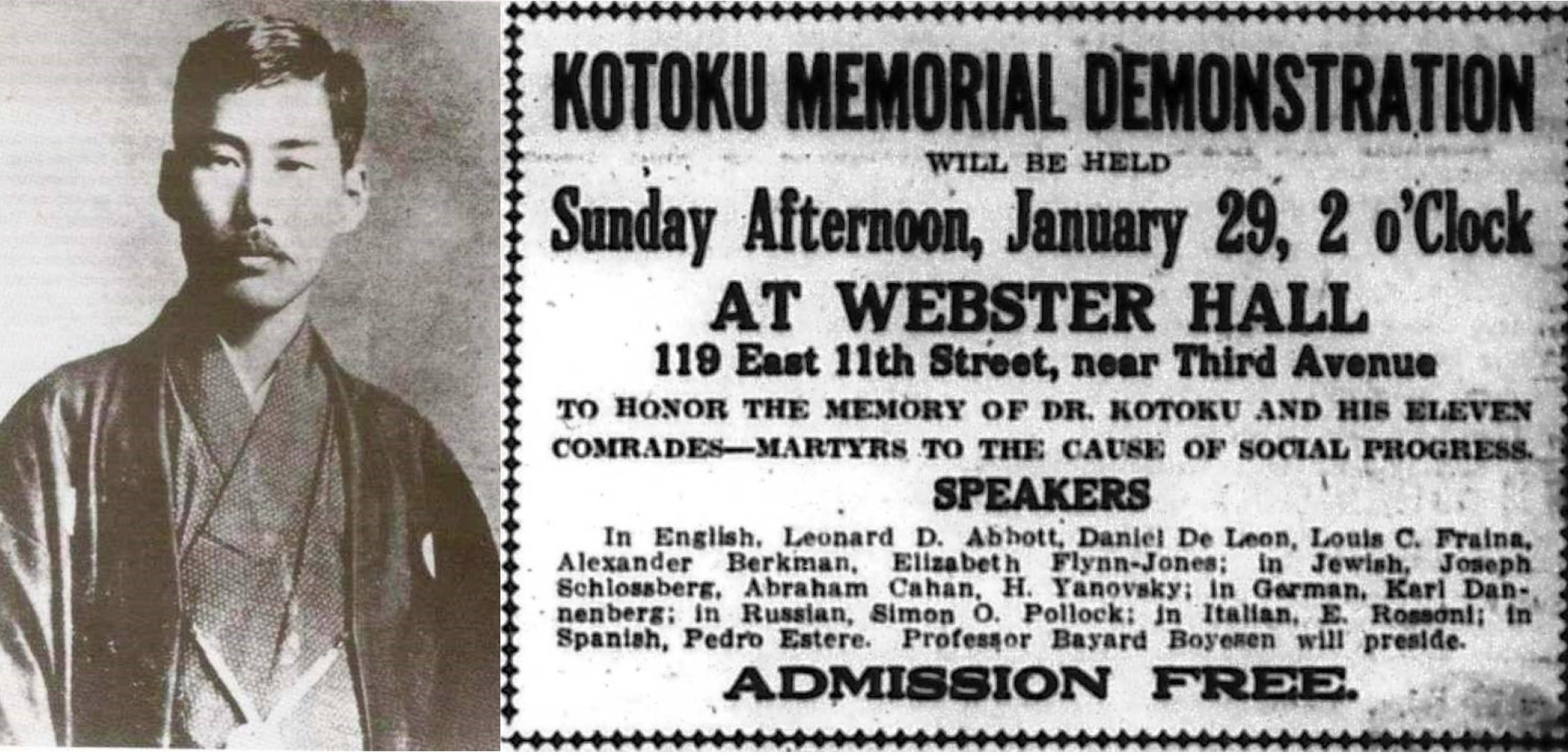
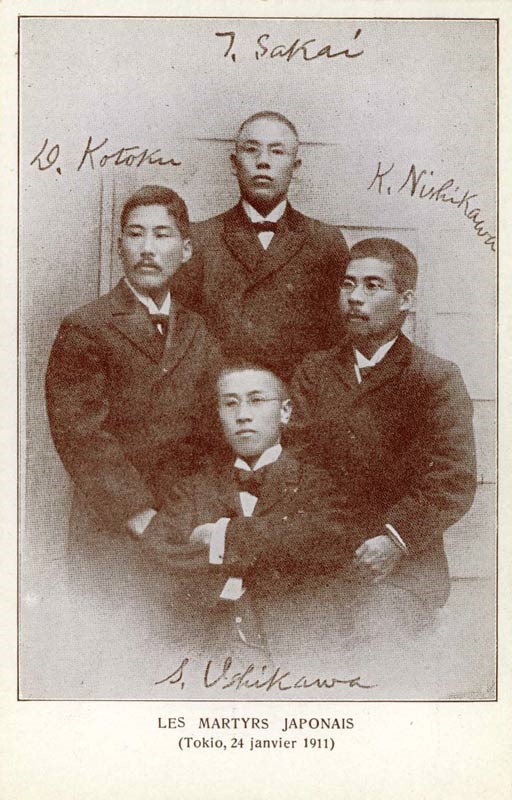
A report of a remarkable internationalist demonstration in New York honoring leading Japanese revolutionaries Denjirō Kōtoku, Toshihiko Sakai, Sanshirō Ishikawa, Kōjiro Nishikawa, and their comrades murdered by the Japanese imperial state on January 24, 1911. Protestors were attacked by police attempting to seize their red and black flags.
‘Police Turn Kotoku March Into Awful “Riot”’ from The New York Call. Vol. 4 No. 30. January 30, 1911.
Demonstration Arising From Mass Meeting Broken Into by Cops Who Are Horrified at Red and Black Flag—FIVE ARE ARRESTED AND ROUGHLY HANDLED—Marchers Were Proceeding to Office of Japanese Consul When, Interrupted by Guardians of “Law and Order.”
Four Men and Woman Seized and Jailed.
Policeman Meyer Pollock, of the Elizabeth street station, last evening held the most ringing protest meeting against the execution of Dr. Kotoku and his eleven radical comrades by the Japanese government that the Western Hemisphere has seen. The story of his demonstration was probably telegraphed and cabled around the world before midnight, and this morning the nations will read it.
Pollock saw a body of about 300 men and women marching down Center street past the Tombs prison, yesterday afternoon, about 5:30. He also discerned that one of them carried in his hand a red flag with a black border. These men and women had broken away from a meeting of protest against the official murder of Kotoku and his comrades, held in Webster Hall, on East 11th street, and had started downtown to the consulate general of his celestial highness, the mikado, at 60 Wall street, to make a demonstration. Probably 150 started from the hall and various onlookers swelled the crowd to several hundred.
Pollock saw an opportunity and seized it by the scruff of the neck. He grabbed hold of the man bearing the red flag and demanded that he release the flag. The flag bearer protested, and a number of marchers crowded about the policeman and his prisoner.
Policeman Pollock gave an alarm, and several other policemen hurried to his assistance. These other policemen called still more policemen, and a score or more bluecoats were soon busily engaged in emphasizing the fact that an Oriental despot cannot assassinate a scholar who makes translations for his people and “get away with it” without protest from the civilized portions of the world.
Clubbing Begins Now.
Pollock and his colleagues strode into the company of citizens and lay about them with their clubs. Many of the citizens fled to escape the clubs of law and order; others remained to be beaten. When the cops grew tired of Exercise A, of the police-made riot code, they decided to arrest someone. A Tammany warrior must take some scalps home with him or lose his own.
Several arrests were made, five of the victims being: Dominick Valentini, 244 East 21st street; Victor Flassiur, 427 Seventh avenue; Benjamin Weinstein, a tailor, of 124 Wallabout street, Brooklyn; Simon Freferman, a hair goods worker, of 148 East 98th street, and Tillie Chesman, a dressmaker, of 410 East 9th street.
The first two prisoners were taken to the Elizabeth street station house and the latter three to the Leonard street station. All were arraigned later in the Night Court at 57th street and Lenox avenue.
At the Night Court Valentine was discharged. Frierman was locked up by Magistrate Butts under $500 for unlawful assemblage, as was Flassiuer and Weinstein.
Miss Chesman was taken to Jefferson Market Court, and the disposition of her case could not be learned. Butts was incensed at “this demonstration against a friendly nation. It was anarchy.”
“Unless restrained by the law,” said Butts, “this gang will overthrow the government. They carry the red Sag of anarchy. Those who denounce their rulers should be punished.”
It was extremely evident that it was the red flag alone at which, with true instinct, the magistrate and police were horrified.
Bolton Hall’s bail for one of the prisoners was refused.
The police told horrible tales of the enormous crowds with which they were besieged.
Considering how little information the police have to guide them in such matters, they must be congratulated on the effectiveness of the protest in favor of Kotoku. Shortly following the brutalities in front of the Tombs, someone told a keeper, who sits at high desk inside of the prison dock that the marchers were making protest against the killing of Kotoku the Japanese scholar, whom the mikado had murdered.
“A Japanese, heh?” responded the keeper. “Why, them, fellows out there wasn’t Japanese, was they?”
Trumping Up Charges.
Over at the Elizabeth street station Valentini and Flassiur were quickly searched and thrown into cells. A number of handbills advertising the Webster Hall meeting were found on Flassiur, and since they happened to be printed in Italian the police thought they were worth keeping for evidence of some dark plot of a midnight assassination. In Dominick’s pocket were found patent papers which had recently been forwarded him from the United States government. When the prisoner explained with great patience that the papers represented the official recognition Uncle Sam of his mechanical ingenuity the guardians of the law stepped back a pace each and took another look at their prisoner. Then both the dangerous pupils of Ibsen and John Brown were locked up in their cells. As they were being led away the lieutenant’s telephone bell began to ring and someone from police headquarters or the Leonard street station wanted to know what evidence of felonious purpose had been discovered on the two prisoners.
“Well, I just booked ’em,” said lieutenant, “and there don’t seem be much to it. We can’t do nothin’ but charge ’em with paradin’ without a permit and carryin’ a red flag, but somethin’ may turn up later so we put in a serious charge. No, we didn’t find nothin’ on ’em but papers about an anarchist meetin’ to be held tonight on 11th street. We’ll have to see about that meetin’. Goodbye.”
The lieutenant hung up the receiver and then someone carefully pointed out to the police chief that the meeting he was going to prevent had been held three hours before.
The Protest Meeting.
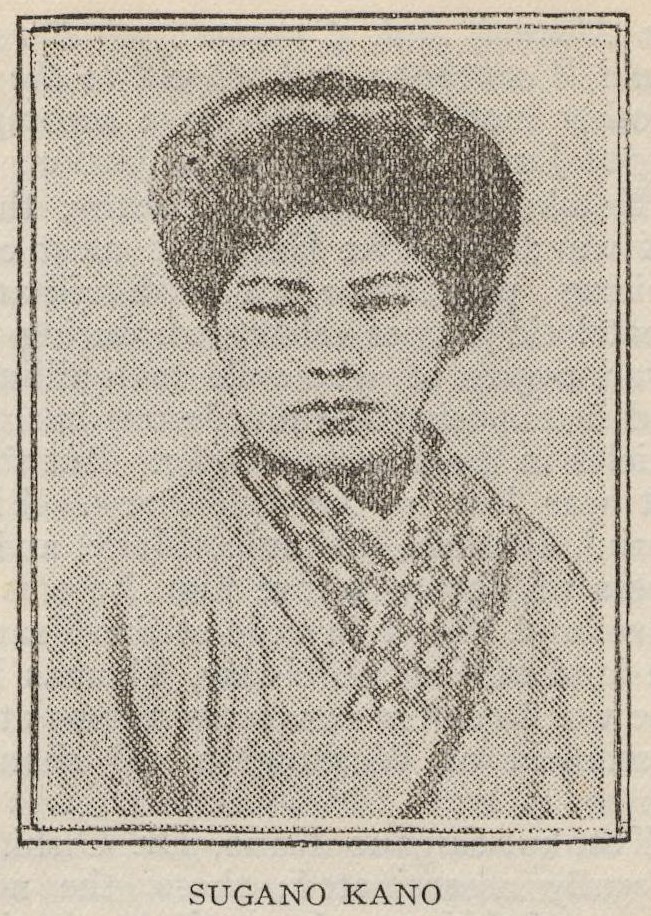
The mass meeting, called as a memorial demonstration against the recent legal murder by the Japanese government of Dr. Kotoku, Mme. Kano, and ten other radicals held yesterday afternoon at 2 o’clock in Webster Hall, on 11th street, Third avenue. The hall was packed to its utmost capacity, though it was a snowy and disagreeable afternoon. Probably a thousand people were present in and around the hall, practically all of them wage-earning men and women. Feeling was high, it being evident that the outrage just committed in Japan was fresh in the minds of everyone.
Bayward Boyesen, who presided save a short sketch of Kotoku’s life, of his persecution at the hands of the authorities, and finally the death of himself and his comrades. There were three agencies he accused of having a hand in the stirring up of ignorant sentiment against the radicals–the Japanese ambassador’s office at Washington, the Japanese Consulate at San Francisco, and the Oriental Information agency presided over by trouble-maker, M. Honda.
Boyesen also told of the fake news handed out from the Japanese embassy in London. He told how Kotoku’s paper in San Francisco was suppressed by the United States at the instigation of Japan’s representatives. He described how more than 200 Socialists and radicals are being allowed to rot in Japanese jails without even a chance at a hearing.
L.C. Fraina sketched the rise of Capitalism in Japan and how Kotoku and his comrades were done away with by a capitalist dominated government.
Simon O. Pollock followed in Russian, telling how the Kotoku case was intimately related with that of Pouren, Rudowitz, and other revolutionists. He read from a letter of Kotoku’s to his friend Johnson, a Pennsylvania man, who had taught him English. Kotoku told how he was being incessantly watched and followed, but of his determination to keep up his work till the last. A short letter from Madame Kano was also read, in which she said: “I shall live for liberty, or I shall die for liberty, for liberty is my life.”
A telegram of greeting from Emma Goldman and Ben Reitman was then read.
Sign of Growth.
Alexander Berkman told how the execution of the radicals is a sign of the growth of the new revolutionary movement in Japan; how feudalism is giving way to capitalism, with its brutal exploitation of women and tender children. The government selected the bravest and most intelligent representatives of the new movement, he said, because it fears the spread of education and enlightenment among the masses.
Boyesen then announced the news of the arrest of 109 anarchists in Russia, of the sentencing of fifty of them to die. He reread the letters from Kotoku and Kano in English.
Karl Dannenberg followed with a stirring speech in German. He explained that the killing of the Japanese radicals was simply part of the ceaseless conflict between the working class and the capitalists of all nations. It was a fight, he declared, that the working class of all countries must take up.
The following resolutions were then read and adopted with a great shout:
“Whereas Dr. Denjiro Kotoku and eleven of his comrades have been hanged, legally assassinated, by the Japanese government; and
“Whereas the only ‘crime’ of these comrades was the effort to disseminate scientific thought among their people, to the end of creating a movement for the overthrow of a social system that breeds misery and degradation for the workers; the charge of ‘conspiring against the throne and person of the emperor’ being false and unproven: and
“Whereas this incident is but one of any incidents of similar nature, it bearing close relation to the so-called trial and legal assassination of Francisco Ferrer: therefore, be it
“Resolved, That we, working men and working women of New York in memorial demonstration assembled at Webster Hall this 20th day of January, 1911, condemn emphatically the brutality and barbarism of the Japanese government, and give it notice that the International Revolutionary Movement will avenge the death of the Japanese and other martyrs to the cause of social progress by the abolition of all class rule and despotism; be it further
“Resolved, That we express our appreciation and admiration of the intrepidly noble work of Dr. Denjiro Kotoku and his comrades, and pledge ourselves to vigorously carry forward the emancipatory struggle for which they were assassinated.”
Other speakers were Joseph Schlossberg, S. Yanovsky and E. Rossoni. After the addresses were over someone made a motion that a demonstration be made through the streets and down to the consul’s office. This was opposed by some as being too sudden and uncalled for, but some of the more radically inclined got together of their own accord, placed a red and black flag at their head and began a march downtown.
There was much enthusiasm, but no disorder till the police interfered. One or two bluecoats tried to seize the flag at Spring street, but could not get through the crowd. Two or three times on the way lone cops tried to stop the procession, but it wasn’t till Center street was reached and the head of the procession was about opposite the Tombs that a forceful dispersal was attempted by the police. Several attempts were made to seize the red flag, and one woman who got in the way was grabbed by a cop, hurled into the mud and water next to the curb, then jerked to her feet by an enraged cop who dragged her away. Two or three cops pulled their revolvers and fired several times, but no one was hit, so far as could be learned. Then the arrests were made and the crowd broken up.
The New York Call was the first English-language Socialist daily paper in New York City and the second in the US after the Chicago Daily Socialist. The paper was the center of the Socialist Party and under the influence of Morris Hillquit, Charles Ervin, Julius Gerber, and William Butscher. The paper was opposed to World War One, and, unsurprising given the era’s fluidity, ambivalent on the Russian Revolution even after the expulsion of the SP’s Left Wing. The paper is an invaluable resource for information on the city’s workers movement and history and one of the most important papers in the history of US socialism. The paper ran from 1908 until 1923.
PDF of full issue: https://www.marxists.org/history/usa/pubs/the-new-york-call/1911/110130-newyorkcall-v04n030.pdf
 Revolution's Newsstand