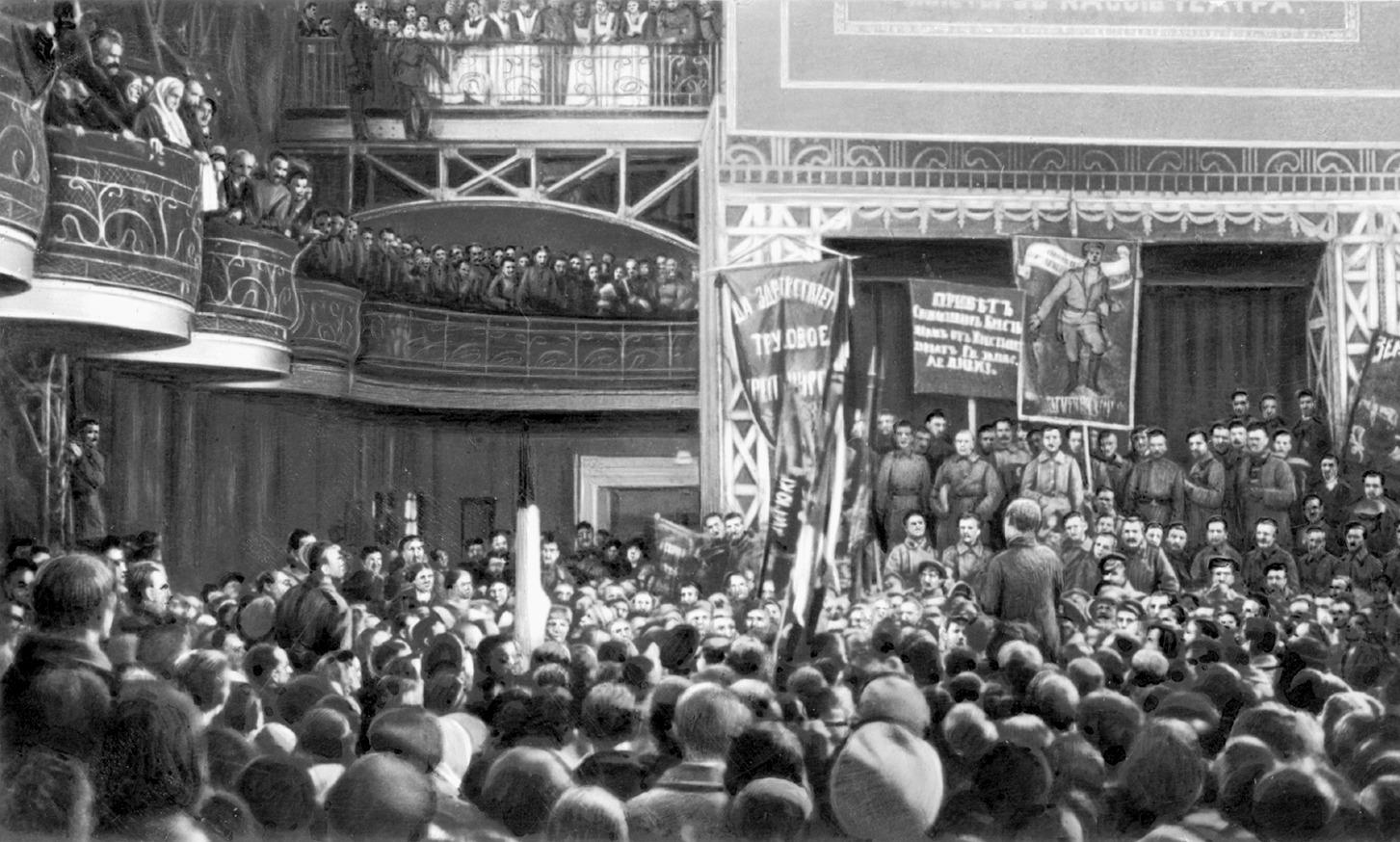
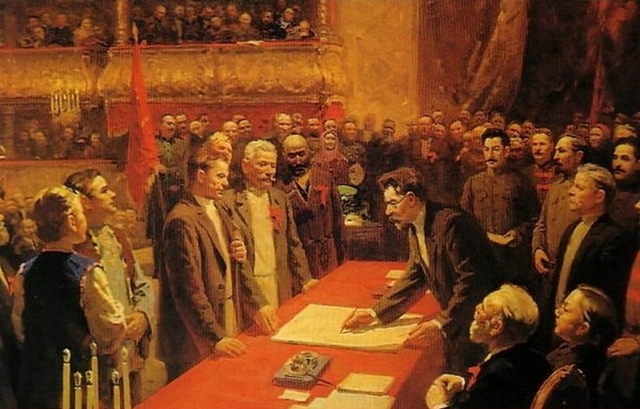
Giacinto Serrati attended the 10th All-Russian Congress of Soviets, which decided the formation Soviet Union, in December, 1922 and penned these observations of the proceedings.
‘The 10th All-Russian Congress of the Soviet Republic’ by Giacinto M. Serrati from International Press Correspondence. Vol. 3 No. 19. February 22, 1923.
We print the following article, although it reached us somewhat too late, because it gives a graphic picture of the character and significance of the congress. Ed.
Moscow. December 1922. On the eve of our Christmas the tenth All-Russian Congress of the Soviets, the great general meeting of the Communist Republic was opened.
What the All-Russian Congress of the Soviets is, is or should be at least, well known to everyone. As a matter of fact the Soviet institutions have, for five years, been a leading object of propaganda, of study, of criticism, of love, and hate, in every country of the world. The Bolshevik revolution, a thousand times proclaimed dead by the janissaries of reaction, has occupied the interest of the general public, and continues to occupy it, to the widest extent. The unforeseen phases which the revolution passes through–difficult phases, which have up to now been successfully overcome by the undeniable skill and determination of the leaders–supply to all sections of society, material for discussion, for hopes, and fears. Beyond doubt: on Russia’s fate depends the fate of the whole world. On the success of this powerful and gigantic experiment depends, at least for a certain time, the result of the struggle between the two principles: individualism or communism.
Two thousand delegates.
The number of delegates attending this meeting, and coming from all provinces of the gigantic country amounted to two thousand. The peoples of the snows of Siberia were represented, and those of the sands, of the Caucasus, the peoples of the Pamir Plateau (whither the news of the revolution did not arrive until some months after its outbreak) and those of the banks of the Volga; the people whose horse is the reindeer, and the people whose horse is the camel. Representatives were there from the enchanting shores of the Black and Azov Seas, where the orange trees blossom, and the orchards yield as delicious and scented fruit as our Mediterranean shores; the men of the Don valley mines and the Altai Mountains were represented, the men who dig for coal, for iron, for gold, for platinum and diamonds; the men who hunt the seal in the Polar sea, and the men who lasso the gazelle in Turkestan. It may well be said that two worlds were represented, two civilizations, which the revolution will fuse into one proletarian world unit with one mighty movement, creating a power transcending all theories.
Among the delegates was to be found the old conspirator, who had languished in the Petro-Polovsk fortress, who had trodden the path of Calvary in Siberia, who had taken part in the most passionate and intense revolutionary conferences in Paris, and had visited Berlin’s scientific circles; we could find industrial workers who had worked in the factories of Petrograd and Twer, who had emigrated to America and absorbed internationalism in the gigantic factories of Baldwin, Armour, and Pullman; there were peasants who at one time scarcely ventured to even raise their eyes, until the revolution transformed them into free citizens of the Communist republic. We could find men and women, old and young, dark and fair, of Mongolian and completely Caucasian types. Their costumes were so multifarious that they defy description. But beneath the varying apparel all the delegates were inspired with one single and united thought. This great miracle has been brought about by the revolution.
In the one-time Imperial Theatre.
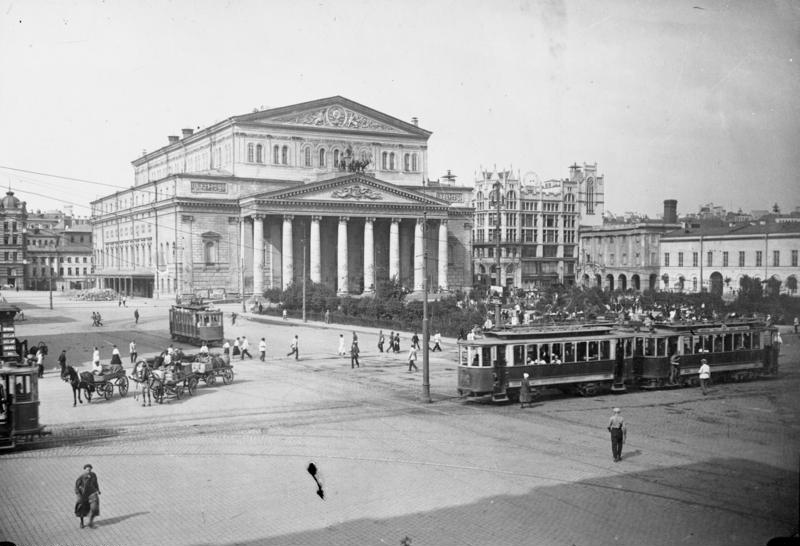
This plenary session of the Soviets was held in the Great Theatre, the one time imperial theatre, a mighty building. The vast and beautifully decorated hall, once the rendezvous of the most aristocratic and wealthiest of Moscow’s bourgeoisie, once the scene of the most luxurious entertainments, is today devoted to meetings convened by the people. The inaugural sessions of the most important congresses including that of the All Russian Soviet Congress, are held in this hall. It must be observed that this variegated throng appeared to feel quite at home in these aristocratic surroundings. There was no feeling of strangeness. The two thousand delegates occupied the pit. On the stage, behind the table of the presidium, were seated the All Russian Central Committee, comprising three hundred members. The boxes were occupied by guests, members of the Communist Party, delegates from the factories, peasants’ and Red Army delegates, all provided with special passes issued with the utmost precaution. The press, fairly well represented, occupied the orchestra stalls while the musicians who played the official anthems were behind the scenes. The Great Box (once the Czar’s box) was an object of peculiar interest, being reserved for the diplomatic and commercial representatives of the various nations already in normal relations with Russia. In the centre was to be seen the tall and serious figure of Brockdorff-Rantzau; this man, in his frock coat, seems to belong to the old order. And all these representatives of the different countries who rose hastily to their feet at the sound of the solemn and heavy notes of the “International”, the official anthem of the republic seemed the embodiment of the whole contrast of our times, the transition from one state of society to another, from one civilization to another, the transition between the revolution which has been victorious and now seeks to consolidate itself, and the reaction which hopes that it is not yet vanquished, and believes itself unconquerable.
Kalinin, the president of the republic, first took his place alone at the long table of the presidium. He received a long and hearty welcome from all present. An exceedingly retiring man, who still wears the black “Rubarsha” or peasant’s shirt. A good-natured smiling face. He delivered a short, opening speech. Amongst the delegates was a man with a great beard and long hair, in peasant costume, reminding one of Tolstol; a slender brown youth from Azerbaijan; an elegantly dressed woman comrade from Petrograd. Then appeared a middle aged woman, with somewhat uncertain steps, gazing around in an embarrassed manner; she wore a large square shawl, as our peasants wear them. She sat down, smiled, and exchanged a few words with her neighbours. The whole had an air of admirable simplicity and naturalness. This I observed, and considered. She must be a factory worker. A few years ago she was nothing; today she sits in the presidency, the supreme assembly in a country of over one hundred and fifty millions of inhabitants. Exactly opposite her sits Count Brockdorff-Rantzau, representative of the vanquished. He incorporates the past, she the future. I admit I was moved, and we are not easily move.
Vladivostok’s greetings.
After the presidium was seated, Kalinin called upon the delegate from Vladivostok to address the meeting. The final victory over the vassals of the Entente has restored Vladivostok to Russia. The last intruders have been banished from Russian soil by this last victory of the Soviet troops. It is scarcely more than three months since the Red troops ousted Merkuloff’s soldiers from this town, which forms the main eastern point of the trans-Siberian railway, and is at the same time a port long coveted by the Japanese.
The Vladivostok delegate who was warmly welcomed by the others, then spoke. What had he to say? He brought the customary greetings. My thoughts wander. How many vain hopes of its opponents has this wonderful republic of the Communists scattered to the winds! Do you remember how Petlura ravaged the South of the country years ago, how Mamutoff’s cavalry almost reached the gates of Moscow, and Wrangel pressed forward into the Crimea? There were many who counted the days and hours which the republic still had to live; but what really happened was that all who butted against the wall broke their heads. And there were not a few of them–they came from all parts of the world: French, Poles, Finns, Greeks, Roumanians, Germans, Czechs, Americans, English–all with the object of crushing the only fatherland of the international proletariat. They did not succeed.
The taking of Vladivostok set the seal on the great work of defense and liberation. All invading armies were beaten. The army of defense of the revolution is today a hundred, a thousand times better than before. It is the model of a good army, not merely on account of its arms and discipline, but above all on account of its moral and political power. It is the army of “comrades”, of fellow citizens, of men armed with two weapons: with steel and with clearness of aim. No army in the world can conquer this one. No flag can wave long in opposition to the red flag, let the diplomatists who want to open the Black Sea to warships strive as they will, conspire as they will; the army of the revolution is unconquerable!
The official speech.
Kameniev ascended the small rostrum to deliver the official speech. A touching scene ensued. A workman in one of the galleries called out: “Comrades, let us send a greeting to comrade Lenin!” The whole audience sprang to their feet and applauded continuously, as if they were calling for the comrade who should have delivered the official speech, who had been expected, but who was still suffering too much from nervous exhaustion to be able to come. The only part of the audience which remained sitting were the diplomatic representatives, who remained unmoved by the enthusiastic greeting sent to the leader of the revolution. The applause changed to singing. The “Iternationale” was sung by all present, to slow time, almost like a lamentation.
On this the diplomats also rose from their seats, etiquette demanding it. In the midst of this spontaneous and heartfelt manifestation the representatives of the old bourgeois world made a cold, almost ridiculous impression.
But Lenin has possession of the hearts of all. All look to him.
Kameniev.
Kameniev, the mayor of Moscow, is one of the most conspicuous personalities of the Russian revolution and of the Communist Party, a member of the Executive Committee of the party, diplomatic representative of Soviet Russia, people’s commissary, an administrator–a man of theory and practice alike. A typical representative of these wonderful leaders of the revolution, who are adapted for taking up any position, real encyclopedisis, present everywhere, bearing prison and banishment with admirable fortitude of soul, and finding–more’s the pity!–only too few imitators among the masses.
Kameniev is a powerful speaker, carrying his audience with him; and on this occasion he delivered a speech worthy of Lenin–only perhaps somewhat different in form. The speech is of tremendous political importance, it expressed the ideas of the government.
The official speech lasted three hours, and was frequently marked with applause, especially in those parts accentuating the capacity of revolutionary Russia to resist every enemy, and with every weapon. It was a political speech of the highest order. It was permeated with tangible strength of will, determination, and power. No deceptive power, not the “power” of an hysteric, who never possessed a definite idea and therefore changes his ideas a hundred times, but the power of men possessing matured and definite ideas, men not obliged to call upon God, for they have faith in themselves.

I shall make no resumé of the speech. It suffices to indicate the most important points, those which relate mainly to foreign politics, and which–as expressed by an interpreter–were directed to the diplomatist’s “box”.
When speaking of the fundamental concessions granted to bourgeois powers, in order to induce these to adopt a policy of international peace and of agreement with Russia, the speaker strongly condemned those who–defeated in their policies of war and blockade–now imagine that they can subjugate the Soviet republic by the wiles and deceits of commercial and diplomatic policy. With great emphasis he said: “We have made much too many concessions at the various international conferences, especially at Genoa, and these have led to no results. We shall make no fresh concessions, on the contrary, we shall withdraw those already made.”
The conference of Lausanne, and the attitude taken up by the representatives of the Entente and of Angora, gave the speaker an opportunity of proving that the freedom of the Straits for the warships of the western powers would be nothing else than an open door to reaction, an aid to armed attacks on communist Russia. But the Bolsheviki are not so easily taken by surprise, for they represent the sole real moral and material force, whilst the bourgeois world is in a phase of decay. This is amply demonstrated by the fact that Russia is the only country able to maintain a stable and permanent government. The bourgeoisie is forced–as in Italy–to rebel against its own laws, to murder its own men, as in Germany and Poland. Despite inevitable uncertainties, and adaptations, the Soviet republic was never so strong as it is today. We are able to consider the possibility of reducing our Red Army, while at the same time increasing its organic defensive power.
Kameniev then spoke of the domestic and political and economic situation, regarding trade and industry. His report was unanimously accepted, without discussion, and with great applause.
The Great Theatre empties gradually. The square surrounding the building, and the side streets, are ostentatiously occupied by extensive armed forces, mounted and on foot. Noone can approach the building in which the 10th All Russian congress is assembled, if he cannot show the required pass.
Two reflectors illuminate the adjoining streets, and especially the windows and roofs of the adjacent houses. It is cold. The ground is frozen hard. The pedestrians quicken their pace. One of us remarks naively: “They do not seem to feel themselves so very secure, or they would not take such elaborate precautions!”
It is naturally an Italian who says this. In Italy the precautions are always taken afterwards. Those who feel themselves secure boast of their security, even if they risk destroying it by so doing. But here, the revolutionists have learnt to be cautious, even and especially at the moment of greatest security. They are well aware that the enemy never sleeps. They are well aware that he does not hesitate to grasp at any means which appear to him to serve his own interests. Prudence and foresight are more than the right of the revolutionists, they are their sacred duty. The Russian communists carry out this duty with the utmost conscientiousness. I only wish we in Italy had carried it out as conscientiously when the situation demanded prudence and caution from us–instead of being over-confident and thoughtless…During the night the Red Guard watches over the sleeping city…
The ECCI published the magazine ‘Communist International’ edited by Zinoviev and Karl Radek from 1919 until 1926 irregularly in German, French, Russian, and English. Restarting in 1927 until 1934. Unlike, Inprecorr, CI contained long-form articles by the leading figures of the International as well as proceedings, statements, and notices of the Comintern. No complete run of Communist International is available in English. Both were largely published outside of Soviet territory, with Communist International printed in London, to facilitate distribution and both were major contributors to the Communist press in the U.S. Communist International and Inprecorr are an invaluable English-language source on the history of the Communist International and its sections.
PDF of full issue: https://www.marxists.org/history/international/comintern/inprecor/1923/v03n19-feb-22-1923-Inprecor-yxr.pdf
 Revolution's Newsstand