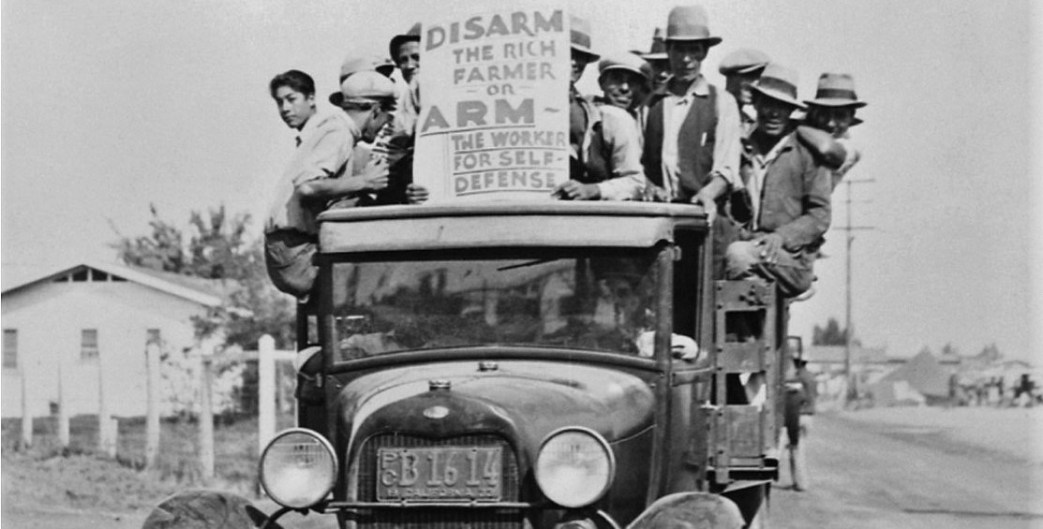
From October, 1933’s Trade Union Unity League-led Cannery and Agricultural Workers’ Industrial Union harvest time strike of cotton pickers in the San Joaquin Valley. Sheriffs handed out guns and permits to the white ranchers and their employees as they evicted strikers from the company homes. Three strikers, Dolores Hernàndez, Delfino D’Ávila, and Pedro Subia were killed, and many more wounded in the reaction. Ed Royce reports.
‘A Scene from the Cotton Strike’ by Ed Royce from Western Worker. Vol. 2 No. 44. October 30, 1933.
We drive into Tulare a day after the shooting at Pixley. Passing cotton ranches with beautiful bungalows dotting the country side, we see well-fed rich ranchers in their large cars driving at breakneck speed probably to interview the state police, county authorities or to meet with the other ranchers in order to better perfect their gangster organization of vigilantes who only the day before had shot and killed four defenseless workers, left large families, fatherless and penniless, maimed and crippled for life twenty-five or more workers. whose families will be left without bread winners. In the main street one sees swanky stores, hotels and fat well-dressed store keepers, farmers, county officials and dozens of state police strolling up and down the streets, filling the hotel lobby with their menacing presence, with guns plainly visible.
One does not get the impression of bloody battles, starving workers, dying children upon entering the town. But one block from the main street, 110 J street, where the Cannery and Agricultural Workers’ Industrial Union has its headquarters, another scene greets one. Here gathered around the office of their fighting union one sees hundreds of Mexicans, native Americans and Negroes. Tattered overalls, torn pants and shirts, and shoes that were once shoes are worn by these workers, creators of all the wealth in this community.
DIFFERENT PEOPLE
One overlooks the torn, tattered clothes, however. Here are real people; their strong faces gaunt, half-starved on powerful frames, faces showing determination, courage, militancy, distract from the clothes. One feels an electric thrill at seeing these men and women, who having just seen their comrades shot down in cold blood, calmly stand around preparing for the largest picket line as an answer to the murder gangs.
On talking to various workers, one learns amazing things. Numbers of Americans, handsome, tall, young fellows, tell you of their ancestors who fought in the revolutionary war of 1776. They tell you this is also a war, guns popping, workers dying. Yes, a war to live. On 60c for picking 100 pounds of cotton, one can only slowly starve to death while piling up wealth for the rich farmers and finance corporations who are growing fabulously wealthy at the expense of the small farmer and worker. They have gone far in the last few months of uniting with Negroes and Mexican workers against their common enemy. No longer the feeling of enmity toward their colored fellow workers, but one of comradeship welded by struggle. Of course, the vigilantes have made every effort to break the solidarity of white and black workers, but every day of struggle only cements them closer.
BROUGHT TO “LAND OF FREE”
Not only are many of the white workers 100% Americans, but the Mexicans also tell you of their ancestors who fought in many revolutions and wars in order that the Mexican people might be free, have some land of their own and have the right to live without fear of starving to death. Of course, they tell you conditions in Mexico are simply frightful, starvation facing the whole population and they had hoped that here they would be able to at least earn a bare living. But what a sad awakening. Promises of good jobs, good wages, good working conditions had been made to them in order that they come here. At that time they were not aware that they were really brought in to undermine the standards of the native workers. And now, they face starvation and death, whether they work or not. There is dignity in their question when they ask what are the comrades in the big cities doing to help smash the vigilantes murder gangs and the policy to starve them back to work. They go on about the four or more children that have died from starvation, of the foodless days for over 30,000 people, just like the war days.
PAT CHAMBERS
While talking to the workers, their leader, Pat Chambers, young, half-starved, fearless worker, beloved by the cotton strikers, comes out and stands around in shirt sleeves, torn trousers, shoes, not to be distinguished from the workers and talks to us. He tells of the attempts on his life, the continual threats against the strike committee of thirty consisting of white, Mexican and Negro workers, how the unity and solidarity of the cotton pickers has resulted in one of the best organized squads and leaders had been developed out of the ranks of the strikers that has thrown the finance corporations, the rich farmers and the Governor, who are trying to break the strike with the NRA, into panic. He goes on to tell us of the camp at Corcoron, the unsanitary conditions prevailing, actual starvation, children dying every day and the only relief coming in is from the workers, all too little, not enough for one meal a day. He repeatedly urged us to set up wide relief committees, send food and money at once as only RELIEF now will win the strike. There is the danger the workers may be forced back by hunger.
“STRENGTHEN PICKET LINE”
He had just begun to tell us something of the magnificent struggle the strikers were putting up in Pixley, Bakersfield, Corcoran, when from all sides state police, dicks, vigilantes moved in on us suddenly. We were greeted with “hello fellows,” “how are you Pat” and a request to Pat to come along. One of the 800 authorities showed Pat a warrant for his arrest on a criminal syndicalism charge. He was hustled into a car and driven off to Visalia jail where he is being held under $10,000 cash bail and incommunicado. His parting words to us all were, “Strengthen the picket line and build the Union.”
The workers were not terrorized by this, however, and they immediately set about getting bonds and securing lawyers for his defense. At this writing there are twenty-two workers in jail in Tulare County, all facing long prison terms. Undaunted the workers strengthen their ranks, build mightier picket lines, set themselves to win in face of jails, starvation and death. All they ask is solidarity from us in the form of relief. Send food, money to Dr. Klein, care of Workers’ International Relief, 1306 Fillmore street, San Francisco, Calif.
Western Worker was the publication of the Communist Party in the western United States, focused on the Pacific Coast, from 1933 until 1937. Originally published twice monthly in San Francisco, it grew to a weekly, then a twice-weekly and then merged with the Party’s Daily Worker on the West Coast to form the People’s Daily World which published until 1957. Its issues contain a wealth of information on Communist activity and cultural events in the west of those years.
PDF of full issue: https://www.marxists.org/history/usa/pubs/westernworker/1933/v2n44-oct-30-1933.pdf
 Revolution's Newsstand