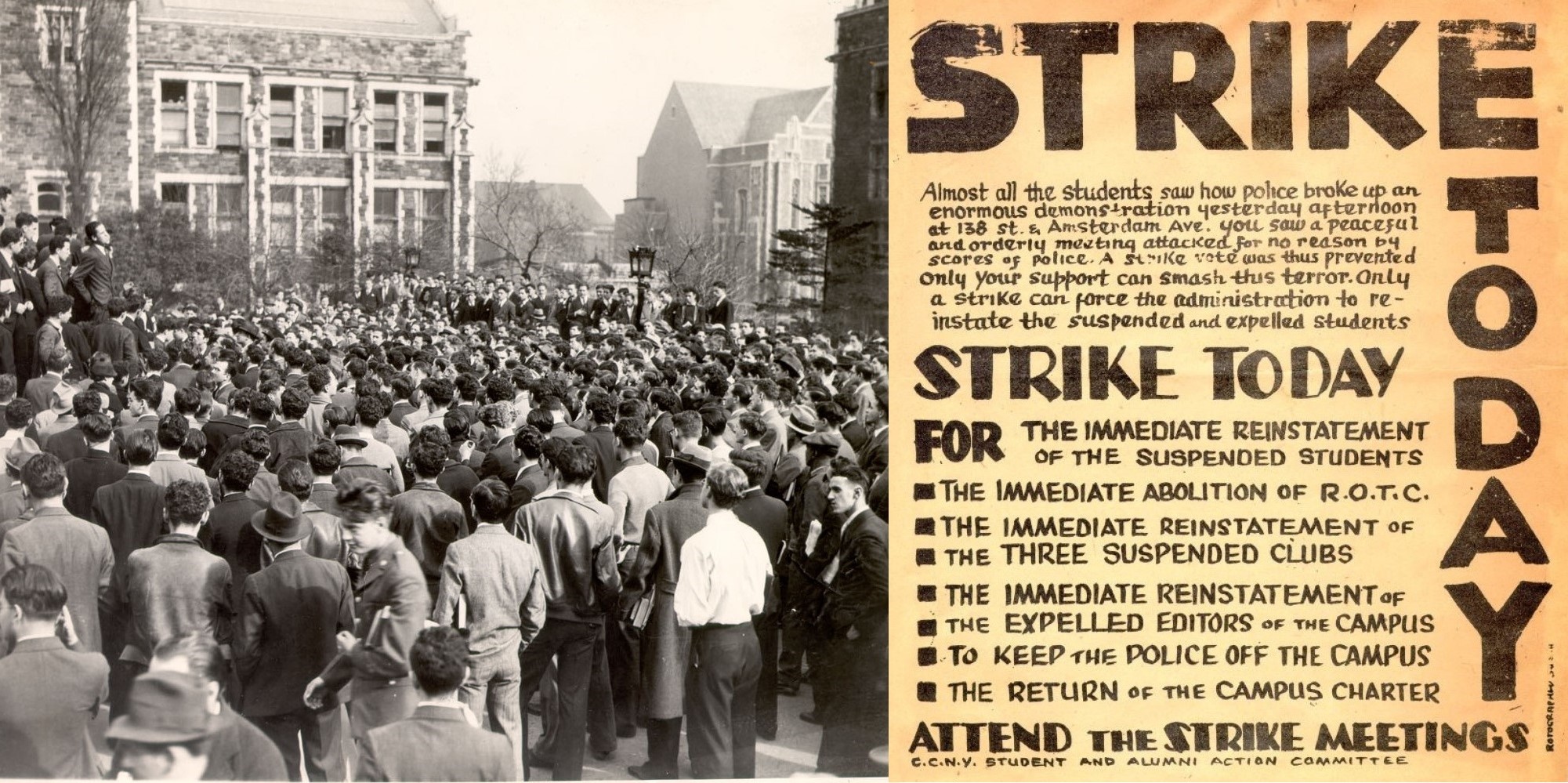
Today’s student militants have many comrades to call on who fought similar battles on the same campuses in the past. City College of New York was one of the most active schools of the Great Depression generation. Here is the full text of a pamphlet produced by those activists describing the anti-war/anti-R.O.T.C. campaign of the early 1930s that led to expulsions, suspensions, and a crisis in the administration. It is not familiar of today’s struggles, it is the same struggle.
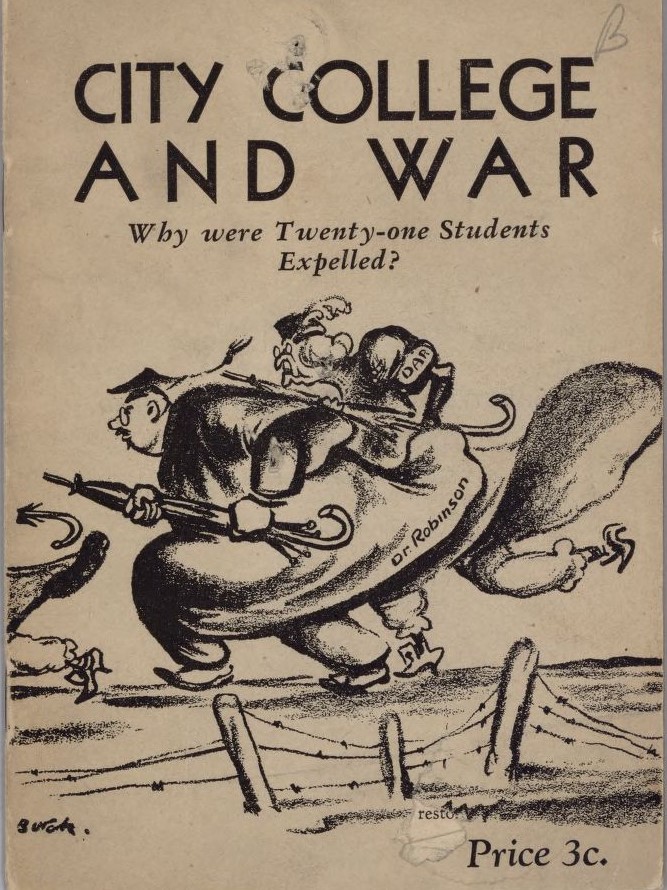
City College and War. Issued by the Committee of Expelled and Suspended City College Students, New York City. October, 1933.
Why were Twenty-one Students Expelled?
PREFACE
For the majority of New York citizens, the tumultuous events of May and June, 1933, at the City College of New York remain little more than a vague memory of a newspaper splurge-a riot of sensational headlines. Few people outside the community of six thousand students and their faculty regard the expulsion of twenty-one students and the suspension of nine for six months as more than an eddy in the swift-moving current of metropolitan life.
Newspaper distortions of the vital issues involved in the student uprisings at City College have so confused the people of New York that it has become necessary to clarify the situation, to bring into the light the causes for the dissension that have disturbed the campuses of the larger institutions of higher learning in the city. Many questions of pertinence have been raised by those who have read in the press of the “rowdies” and “reds” agitating and destroying the tranquility of student life at City College.
What caused the disturbance on “Jingo Day”, May 29, that resulted in the disciplining of thirty students?
Was President Robinson actually attacked and beaten while entering Lewisohn Stadium at the college to attend the military exercises?
What were the charges presented against the participants in the anti-war demonstration?
Why was the punishment meted out to the students so severe? Why should students oppose elective military training?
Why should citizens support the expelled City College students in the fight for their reinstatement?
In view of the tremendous interest the City College affair has aroused throughout the country both as an unprecedented instance of administrative violence and as a symbol in the struggle against militarism in education, the expelled and suspended City College students herewith set forth the facts of the situation and call upon the public opinion of the nation to organize in support of the fight for their reinstatement and the restoration of academic liberty to City College.
Events Leading up to May 29th
EVERY year City College celebrates the anniversary of its founding on Charter Day, May 7th. On this day classes are dismissed in the early morning to enable the students to witness the ceremonies. Prominent city officials, the patriotic societies, the Sons and Daughters of the American Revolution, the Chairmen of the Manhattan and Harlem Real Estate Association all gather in solemn conclave; patriotic and eulogistic speeches resound throughout the Great Hall; the faculty, brilliantly attired in cap and gown, stages an impressive parade; and then everybody moves to the Lewisohn Stadium to view the military maneuvers of the several hundred students comprising the City College unit of the Reserve Officers’ Training Corps.
For many years now the most advanced student clubs and the school newspapers have objected to the military spirit of Charter Day. These groups have argued that it is an incongruity to commemorate the birth of a liberal college with war-like exercises, to “Squad Right!” and “Shoulder Arms!” on the campus of New York’s foremost free educational institution. The history of the last seven years of student struggle against military training at City College reveals an amazing number of casualties suffered by those who dared to raise their voices against preparations for a new imperialist conflagration. The administration conducted a deliberate and consistent campaign of suppression to root out the leaders in the student movement against the war-mongers on the campus, and suspensions and expulsions were of not infrequent occurrence. The student body had constantly voted opposition to war and Military Science and the Curriculum Committee, chosen by the Student Council from among the best students in the school to recommend changes in the curriculum to the faculty, had urged the abolition of the Military Science Department for many successive years. And last Christmas, City College students had demonstrated their antipathy toward the R.O.T.C. when they conducted an intensive drive for funds and sent twelve students to represent them at the Chicago Student Anti- War Congress.
In short, the majority of students objected to the militarization of Charter Day, having consistently manifested their determination to destroy every vestige of the war machine within the college walls.
This year, 1933, the administration finally responded to the pressure of the student body by substituting a sports carnival for the tin-soldier parade. Every one rejoiced at the victory. And then with callous insolence, the administration proceeded to dedicate a special day to the Military Science Department. This deceit angered the students. Monday, May 29th, the day to be devoted to satisfying the exhibitionistic cravings of the R.O.T.C., was immediately dubbed “Jingo Day”. The name stuck and rang through the classrooms even while President Robinson was sending obsequious letters of invitation to the professional patriots and the faculty. “Jingo Day” became a by-word and a password.

Perceiving a splendid opportunity to convince the authorities that an overwhelming majority of the students were opposed to war and “defense preparadness”, the Social Problems Club and the League for Industrial Democracy at a joint meeting with the City College Anti-War Committee which had had its origin in the Student Congress Against War at Chicago, decided to organize a rival parade on “Jingo Day”. The “Campus”, the college paper, published an editorial supporting this decision and exhorting all anti-war students to participate in a spectacular mass demonstration before the Lewisohn Stadium on the morning of “Jingo Day,” to voice the student sentiment against war, the war- makers, and the educators who promulgate blind patriotic doctrines in their classrooms. Leaflets were mimeographed and distributed in the lockers and placards were painted with the slogans, “Keep the War-Mongers Off the Campus!” “Majority Rules- Oust R.O.T.C.” “All War Funds for More Schools and Less Guns!”
The “Jingo Day” Parade
May 29th arrived. At one o’clock all intellectual activity at the college was brought to a complete standstill by an administrative edict. Many students went home. Others went to the library to study. Some loitered about? idly talking and smoking. Some played ping-pong, while others waited for the “Jingo Day” ceremonies to begin. While chauffeured limousines drew up on Convent Avenue and ceremoniously discharged their occupants, preparations went on for the mass meeting. There was a police permit to be attended to; a large American flag to be bought; a speaker’s stand to be procured.
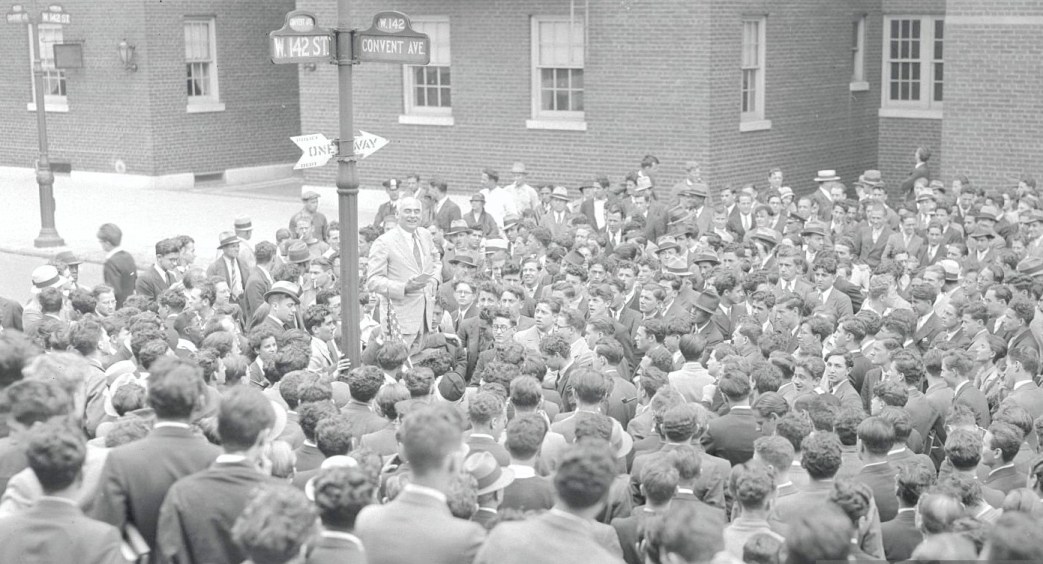
The meeting started about one o’clock with a crowd of about. four hundred students at 138th Street and Convent Avenue off the college grounds. Student speakers held forth. R.O.T.C. had no place in the college curriculum; the students’ side of the story must be heard; an effective means of opposing war was to destroy its weapons in the colleges. The administration had resorted to contemptible chicanery in its dealings with the student body. The meeting exulted over the fact that an anti-R.O.T.C. plank had recently won overwhelming support by a two-to-one majority in the Student Council elections. The Secretary-Elect to the Student Council declared amid applause that he regarded his election as a student mandate to wipe out the Military Science Department.
Then came the parade…. Hats off, our flag is flying high… and the rumble of the drums…the brown cheese cloth uniforms and the blue lapels…the Sam Brown belts. Flanked by blue-coated police, the R.O.T.C. assembled close by where the student. orators were inveighing against the Military Science course. The police instructed the mass meeting, now grown to considerable proportions, to move on. It moved. A half block away, at the top of the hill, on Amsterdam Avenue, the meeting reassembled. The students voted to run a picket line around the stadium. With placards raised they proceeded in double formation around 138th Street and Convent Avenue; thence to 137th Street where the line wheeled about and marched back to 138th Street. At this point, police intervened, ordering the parade to disband. With renewed militancy, the line held intact, continuing unmolested up 138th Street to Amsterdam Avenue. Somebody shouted, “Let’s go into the Stadium. We were all invited.”
Ranks were dissolved with complete unanimity. The students had decided to accept Dean Gottschall’s early morning invitation to view the Second Lieutenants at their machine-gun play.
At the Stadium entrance, police and plain-clothes men-ever- ready ushers of collegiate functions-blocked the way. The students could not enter unless they abandoned their placards. Placards were scrapped. Again the “guardians of the peace” barred the gates in a solid phalanx. A wave of anger swept the crowd. There was a muffled rumble of protest. A student, raised on the shoulders of his fellow-students, spoke for a few minutes. Then with perfect discipline, a line was formed which moved toward the flagpole. Blue-coats again intervened, wielding night-sticks. For the first time on any American college campus, a traditional freshman prank served a useful purpose. A snake dance was formed. Weaving in and out around the flagpole. it thwarted the efforts of the police to disperse the students. A student mounted the pedestal at the foot of the flagpole and called for the decision of the peace paraders. The immediate answer was “Back to the Stadium. All students were invited.”

Back to the Stadium, flanked by police and detectives. The gates were securely fastened. No entrance could be forced. At that moment a number of guests of the administration arrived and the Stadium doors opened to admit them. About 150 students, shouting “Down With Militarism” crowded into the triangular vestibule of the Stadium. The police pressed around. There was much talk and idle shouting. No reason could penetrate the stoic indifference of the police. “Orders is orders!”
Suddenly the doors of the Stadium clanged against their locks– retreat from the vestibule to the street was cut off. A belligerent army of Veterans of Foreign Wars, American Legionaires, plain- clothes–men and men whom the newspapers later euphemistically termed “supporters of the administration,” surged around the students and began to shove them about as if to foment trouble. Brandishing billies and blackjacks, they started to swing them with remarkable rhythm and dexterity. The barometer of student temper rose precipitously under the pressure of these events.
Frustrated, tricked, hurt and increasingly incensed at the fierce onslaught, they beat a forced retreat to the opposite street corner where an orderly meeting was in progress. Here the meeting, swelled by students whom the fracas has attracted, shouted its anti-war slogans in powerful unison. The pomp and glory of the military maneuvers within the Stadium appeared somewhat attenuated by the rival parade.
The police stamped their feet nervously. Newspaper reporters buzzed about seeking to interview the leaders. The newspaper cameramen, standing on top of autos and roofs, shifted to better positions. From afar came the eerie siren of the fast approaching police car.
Then came the most dramatic event of the day. President. Frederick B. Robinson, with his entourage, Colonel Lewis, head of the Military Science Department of the college, General John J. Byrne, several police officers, and two Daughters of the American Revolution approached the Stadium entrance at this time. At the sight of these super-patriots, the students doubled the volume of their slogans “Down Military Training” “Drive R.O.T.C, out of City College.” Apparently outraged at this breach of decorum, infuriated at the temerity which prompts students to protest against war on their own campus, the eminent. liberal, chairman of the League for the Protection of Human Rights, tossed his customary peacock dignity to the winds. Deserting his distinguished guests he rushed into the midst of the students across the street, and like a mad dog run amuck, lashed out blindly and viciously with his umbrella at the faces and heads of his students. Notwithstanding contrary newspaper reports, Dr. Robinson was not and could not have been attacked or harmed by the students, flanked as he was by a body-guard of police and thugs who used their fists with cruel efficiency. Having spent his rage, the worthy president withdrew with his guests into the Stadium, badly winded by his physical exertion.
By this time the riot squad had arrived. Student leaders mounted the fence on the street corner opposite the Stadium and described the incident to those who could not yet believe that the well-dressed man with the Panama hat and waving umbrella was their President. The entire meeting then moved back to the flag-pole, defeating police attempts to break up the line of march. Here the “Jingo Day” parade was officially disbanded.
Conflicting Newspaper Reports Becloud the Issue
That very night and the days that followed clearly exposed the policy of obscurantism so invariably adopted by the metropolitan press in a matter involving controversy between college administration and student body. The New York World-Telegram in its fifth edition on May 29th gave what was substantially an accurate account of the umbrella incident: “They heckled President Robinson as he entered the Stadium with his wife and guests and the President, wielding a sturdy umbrella pounded and routed the students.” In its seventh edition, however, the same newspaper completely falsified the facts: “A squad of policemen rushed to the rescue of Frederick B. Robinson, the President of City College, this afternoon when he was set upon by a milling crowd of pacifist students rioting in protest of the drill and review of the College’s R.O.T.C. Dr. Robinson laid about himself valiantly, using his umbrella as a weapon, but was powerless to withstand the yelling crowd of students. With the help of the police he was able to enter the Stadium.” The Evening Post version of the affair was even more vicious in its distortion: “There were cries of ‘Boo’ and ‘Here comes the Colonel!’ from the advocates of peace and they charged, some waving banners denouncing war and military science, and others brandishing the bare sticks from which similar banners had been torn. As they came on, Dr. Robinson took a firm grip on his umbrella and raised it, swinging it before him. Several students were struck. As the mob, surprised in the attack, fell back, policemen and plain-clothes men rushed forward and cleared a path.”

These conflicting stories, while they revealed the servile role of prostituted journalism, served only to confuse the real issues in the minds of the people of New York. Obviously, the unscrupulous distortions of the facts had their root in the tissue of falsehoods President Robinson broadcast via the press on May 30th: “I was escorting a group of guests, mostly ladies, to the Stadium and as we approached the Amsterdam Avenue and 138th Street entrance, a crowd blocked the way. This crowd began a demonstration aimed particularly at our Professor of Military Science and Tactics, Colonel Lewis, and charged forward. I did not recognize most of them. They were probably Communists from outside, although I did recognize one individual as a student of the College. As they came forward I ordered them back, but they rushed on, and in order to protect our guests it was necessary to clear the path which I did with my umbrella. The guests then passed into the Stadium.” (Italics ours).
The gross falsification of President Robinson’s press statement becomes apparent when contrasted with the report issued by Miss. Florina Lasker, Chairman of the New York Committee of the American Civil Liberties Union following an investigation: “Our investigation of the occurrence at City College on May 29th, revealed that President Robinson left the sidewalk where he was walking with his party and attacked the parading students. in the street with an umbrella, and that he himself was responsible for the riot that followed.” As for the charge that most of the demonstrators were “Communists from outside,” experience has taught us to expect President Robinson to hurl the opprobrious term “Red” at any student attempt to gain a concession from the college authorities. Administrative aberration invariably regards any movement aimed at the amelioration of student conditions as a carefully-conceived Communist plan to subvert the very foundation of the College.
The Inquisition
On June 1st, the entire faculty was convoked to consider disciplinary action against the participants in the “Jingo Day” parade. A committee consisting of Professors Mead and Baber and Dean Gottschall was formed to investigate the matter and was further empowered to “suspend students pending a report to the faculty.” While thousands of students, galvanized into action by this menace to their freedom, held huge mass protest meetings near the college, more than one hundred students were summoned by the administration before the high tribunal of inquisitors. Pointed questions were asked concerning the past activities of these students, their participation in the May 29th demonstration and their attitude toward the question of whether it was morally right to demonstrate. The Committee was exceedingly careful in its avoidance of the more vital question of R.O.T.C. and whether students had the right to fight for its abolition.
At no time were definite charges presented against the students questioned and disciplined, nor was an open and impartial trial ever granted them. Long before an investigation had begun, suspensions were announced by the Dean, and Mark Eisner, Chairman of the Board of Higher Education, publicly declared that “students found guilty” of participating in the anti-war meeting “can expect their college days at City College to be over.” Since all the suspensions came within a few days of examinations, none of the expelled students received credit for the term’s work.
Immediately following the conclusion of the faculty inquisition, twenty-one students were expelled. Those expelled were utterly unaware of the expulsion proceedings and were at no time allowed to present a spokesman in their behalf before the committee. The committee also suspended the Social Problems Club, the Student Forum, and the Liberal Club (Evening Session), for an indefinite period. Although the latter club had not participated in the demonstration, it was suspended, in Professor Mead’s words, for “past activities.” And the Professor added that any action which the Liberal Club might take in support of the disciplined students would “clinch the case against it.”
On June 2nd, through the influence of Colonel Lewis who is rumored to have written letters to every member of the Board of Trustees protesting the College newspaper’s vigorous attack against the R.O.T.C., the charter of the “Campus” was revoked and four of its editors expelled, allegedly for “obscenity” in the March 31st burlesque issue of the newspaper. The administration had left no stone unturned in its offensive against the war fighters. Free speech, press and assemblage became memories of the past.
Student Demonstrations and the “Vigilantes”
During the ten days subsequent to the “Jingo Day” parade, while student indignation was expressing itself through tremendous campus protest demonstrations, the administration hatched an ingenious plot to crush or render ludicrous all student protests. Asserting that “force is the ultimate sanction in this world,” Major Herbert Wolton, Associate Professor of Hygiene, organized a handful of embryonic fascists-third-string athletes (all the prominent college athletes indignantly refused to associate themselves with them) into a “C.C.N.Y. Vigilantes Committee” for the purpose of breaking up all student demonstrations. Unmolested by the police, they attended these meetings en masse and invited trouble by yelling down the student and guest speakers. Norman Thomas of the Socialist Party, speaking before two thousand students at an outdoor meeting, was unable to make himself heard above the ape-like gibberings created by the hecklers who found security in the knowledge that no one dared attack them for fear of a riot. On another occasion, the “Vigilantes” pelted a meeting with eggs and decayed fruit and vegetables. The police looked in the opposite direction.
By neglecting to punish these rowdies, the administration tacitly sanctioned their use of violence. Yet the faculty in its report of the “Jingo Day” affair attempted to make the issue one of manners and “proper” comportment. Surely, the faculty cannot advocate different standards of conduct for different groups of students. “Grossly discourteous manners” on the part of “athletes” should be punished no less severely than that on the part of anti-war demonstrators. The very fact that the “Vigilantes” were not only permitted to conduct a campaign of violence and disorder, but were even encouraged by a member of the faculty proves beyond a doubt that the issue is a more profound one than that of manners. Indecorous behavior was merely a convenient subterfuge which the administration resorted to in an effort to rid themselves of the militant fighters against the R.O.T.C.
The Position of the Faculty
Where did the administration stand during these turbulent events which called for all to take sides in the conflict? The City College faculty had always enjoyed a reputation for liberalism. Professor William Bradley Otis, of the English Department, now thoroughly ashamed of the hysterical tirades he had launched against conscientious objectors during the last war, was preeminent among the faculty liberals for his opposition to R.O.T.C., his humanitarian sympathy for the Kentucky miners, and his long period of advisorship to the Social Problems Club. Professor Morris R. Cohen, distinguished philosopher, was one of the staunchest bearers of the liberal tradition of the College. Professor Harry Overstreet, head of the Department of Philosophy and nationally recognized author, had gained a wide popularity for his liberal tendencies. Yet when the College was precipitated into the seething cauldron of administrative despotism, all the liberals executed a complete about-face. Men who had but recently proclaimed their independence, men who had but recently walked in the pure atmosphere of freedom. and personal integrity, now refused to lift a hand in protest while the fetters of a reactionary administration were being fastened upon them. They could not pass the test, these liberals. A critical moment demanded their decision. And placing their jobs above their intellectual honesty, they capitulated. The liberal tradition was utterly obliterated and displaced by the sycophancy and lackeyism manifested by the faculty in their support of the oppressive measures of President Robinson and the Board of Higher Education. Men like Professor Morris R. Cohen began to invoke the time-honored criticism of student uprisings. Young men should be polite, should behave like gentlemen. Boys, you must not break the rules even if they are designed to prevent you from registering your protest. Liberalism had lacked the courage to withstand the wave of reaction instigated by an administration which had sacrificed justice and ordinary decency at the shrine of Tammany saber-rattling patriotism.
Administration Charges Against the Student Demonstrators

Upon the expulsion of twenty-one of the participants in the “Jingo Day” parade, the faculty committee issued the following statement: “The disciplinary action was in no way related to the views of the students affected concerning military training or any other controversial questions. The issue, as presented to the faculty, is whether college students should be allowed to interfere with a stated college function, to conduct themselves in a grossly discourteous manner, and to defy with impunity college regulations in regard to the holding of meetings on college property.” The committee went on to register its amazement at the “attitude of insubordination,” reflecting “that military science at the college is an elective subject, and that students who take it do so of their own free will.”
Obviously this is a complete evasion of the truth. In the first place, when it becomes a stated function” of the College to flaunt its militarism, the students are entitled as citizens and potential “cannon fodder” to demonstrate against this perversion of education. Secondly, there was no actual interference on the part of the peace paraders. The anti-R.O.T.C. demonstration was non-violent and did not physically obstruct the military maneuvers. The four hundred students participating in the parade consistently gave evidence of their desire to maintain order and discipline. No responsibility for whatever disorder did occur can be attributed to them. It is significant that throughout the proceedings of May 29th no arrests were made and at no point did any of the students offer resistance to the police. Finding all attempts to hold orderly meetings in the vicinity unavailing, barred from entrance to the Stadium, and denied by the police the right to parade, the students had no choice but to gather on their own campus. Here, too, order prevailed despite
provocations from the police. Thirdly, two of the students. disciplined and one of the liberal clubs dissolved did not take part in the May 29th activities, proving that the issue was more than one of “interfering with a stated college function.”
Why Oppose “Elective” Military Training?
As for the committee’s amazement at our opposition to elective R.O.T.C., we can merely dismiss it as a case of poor histrionics. The reason for student opposition becomes clear after an examination of the status of the Military Science Department of City College. This Department enjoys a unique position in that it is the only one in the College which may proselytize the incoming freshmen. On their first day at City College, the freshmen are greeted by the fat, amiable Colonel Lewis who launched into a glowing panegyric on the virtues of military training. R.O.T.C. builds character and leadership, improves physical condition, makes freshmen more alluring to the opposite sex by decking them out in natty uniforms, etc. Accompanying this glamorous exposition of the benefits of military training is a leaflet bearing the innocuous title “Data on R.O.T.C.” Here the freshmen are barraged with a list of palpable advantages to be gained from the course, foremost among which are: “1. No expense-the Government pays all expenses for uniforms and equipments for basic students and pays advanced students approximately $138.00 for the Junior year and $77.00 for the Senior year and all expenses at the R.O.T.C. Camp, from which the advanced student pays his officer’s uniform and Officers Club dues. Advanced students go to camp for six weeks and are paid. seventy cents a day and all expenses. 2. Graduates of the Advanced Course find their Reserve Commissions influential in securing enrollment at other institutions for medical or dental work or in securing positions in civil life with large corporations. The Cadet Colonel of 1930 was accepted for two Class ‘A’ medical schools and had to choose which he would attend. 3. Exemptions from compulsory Junior Hygiene.” The leaflet then waxes patriotic, noting that “National Defense is largely dependent in the future upon successful R.O.T.C. supplying a high quality of the reserve officers who will form eighty-five percent of the army officers in war.”
A pamphlet containing a speech of Lt. Col. Orvel Johnson, Executive Secretary of the R.O.T.C. Association of the United States, called “Military Training in the Schools and Colleges” is also distributed to the freshmen. Reminding them that “all wars fought by the United States of America have been those of defense,” Lt-Col. Johnson laments the “fact” that “sound statesmanship requires that we as a nation should prepare for war, for, until the heart of men are much changed for the better, defensive war is unavoidable…” He therefore heaps obloquy upon the “more than 110 pacifists and radical organizations…known to be working to the common end of destroying all training of a military nature in the educational institutions of the country,” and ends his speech with a fervent prayer: “May God forbid the further development of radicalism in America. May He inspire every pastor with the resolve to do his utmost to save the faith of our people, in their God, their homes, their native land, its flag and the American institutions.”
This intensive propaganda together with the pressure exerted by officials of the Military Science Department in the Registration rooms where freshmen are preparing their programs for the coming term has the effect of enrolling hundreds of gullible. freshmen in the ranks of the jingoists. Once having availed themselves of the naivete of these freshmen, the Military Science Department then besieges them with a persistent propaganda bombardment. Copies of magazines like “Liberty,” containing speeches of Generals on militarism are distributed gratis to the students taking the course and every opportunity is used to disseminate chauvinistic doctrines.
What Caused the “Jingo-Day” Parade?
One might think that the militarists would rest content after this campaign to inculcate the college student with the teachings of “defense preparadness.” But this is only a spring-board for other activities. The busy military bee also buzzes about the offices of the administration. At the beginning of the spring term, 1933, the liberal clubs were required to advance a complete. list of the speakers who would address the clubs during that term. Professor Mead, Chairman of the Committee on Radical Clubs complained that the list was top-heavy with anti-war speakers and made a semi-official statement to the effect that in time of war there would be a rigid censorship of the clubs’ activities. And a month before the “Jingo Day” parade, when the “Campus” attempted to conduct a war poll in order to determine the City College sentiment toward war, the Dean put a stop to it on the ground that the College would thereby incur the displeasure of the wealthy taxpayers. Apparently, the administration, perceiving a crisis in world affairs, which made war imminent, was determined to smash all expressions of anti-war sentiment.

The students at City College, met with an ever-tightening administrative censorship, prevented from voicing their opposition to war, realized that they would be forced to overstep the disciplinary barriers obstructing them. The decision of the college authorities to grant the day preceding Memorial Day to the Military Science Department, convinced the students that it was time to act, to strike a blow at the military preparations. “Jingo Day” was the outcome of their decision. In the “reign of terror” that followed, thirty students who had long been actively identified with the movement to abolish R.O.T.C., and with the students’ struggle against the closing of summer schools and the imposition of fees, were unceremoniously ejected from the college.
Why Was the Punishment so Severe?
What prompted such drastic disciplinary action? The answer lies in the very nature of the “Jingo Day” parade. It was a vigorous challenge to the existence of the R.O.T.C. and militarism in education. To the horror of the Generals and the dignitaries of the Daughters of the American Revolution more than 400 students paraded before them waving placards and shouting,
“Down with Militarism.” “Down With War.” There was no middle path for the administration. To permit the demonstration would be to defy the patriots and to incur the wrath of the millionaire taxpayers (those who do pay taxes). Evidently, the administration could not afford to do this. The war makers who are the patrons of education would not tolerate it. And so it chose the easier path, the path of defiance to the student will, coming out in open support of militarist propaganda at City College.
The City College Affair, an Anti-War Issue.
There can be no doubt that the City College Affair is an anti-war issue. It is but another flagrant manifestation of the policy of suppression being carried on all over the country against civil and academic liberties. As the war clouds loom blacker and more threatening, the war makers exercise greater ruthlessness in their attack upon the opposition of both the intellectuals and millions of workers. Peace organizations may soon be menaced by a government declaration of illegality.
A survey of the world today augurs evil for the future of peace. In an attempt to overcome their internal economic difficulties, nations have begun to quarrel among themselves for the redistribution of old markets and the exploitation of new ones. Armaments grow at a furious pace. World-wide economic chaos leaves no alternative. Japanese imperialism now immerses China in bloody warfare while envious rival nations view this unbridled pillage with glances presaging no good for world peace. South America is already torn by the imperialist strivings of American and British oil interests. Hitlerism’s threatening policy of expansion may at any moment precipitate all of Europe into another slaughter-fest, “a war to end all war.” Any day may bring new destruction and flames to consume millions of youth who have nothing to protect but their masters’ property, nothing to fight for but the blood-soaked spoils of conquest for the aggrandizement of the captains of industry.
What Is To Be Done?
Only organized mass action can stop the war makers. Only by struggling for the preservation of our right to criticize and fight war preparations can we destroy the munition manufacturers and their patrons. We must carry on our anti-war work not only in civil life, in the factories and the mines, in the professions and the offices, but in the institutions of learning. The City College students who were disciplined for their militant protest against jingoism must be reinstated to carry on their fight-and the liberal clubs must be restored to City College to maintain the prerogatives of open and fearless criticism of administrative policy and college war activities.
The expelled and suspended students call upon the concerted mass support of the millions of people who will not allow themselves to be sacrificed to American or any other imperialism. Rally to the struggle to reinstate these fighters for peace! Every victory in the anti-war movement is another blow at the war makers.
Access to original pamphlet: https://digital.library.pitt.edu/islandora/object/pitt%3A31735061656470/viewer
 Revolution's Newsstand