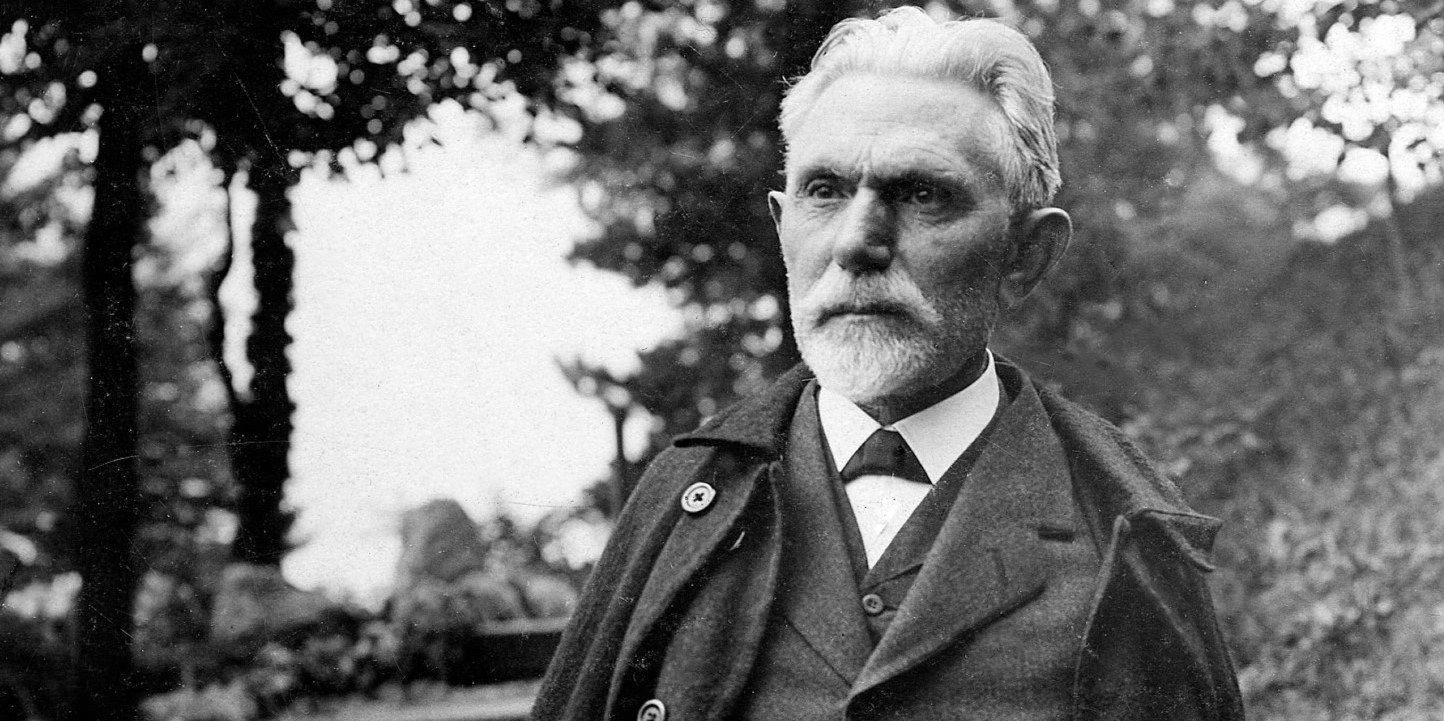
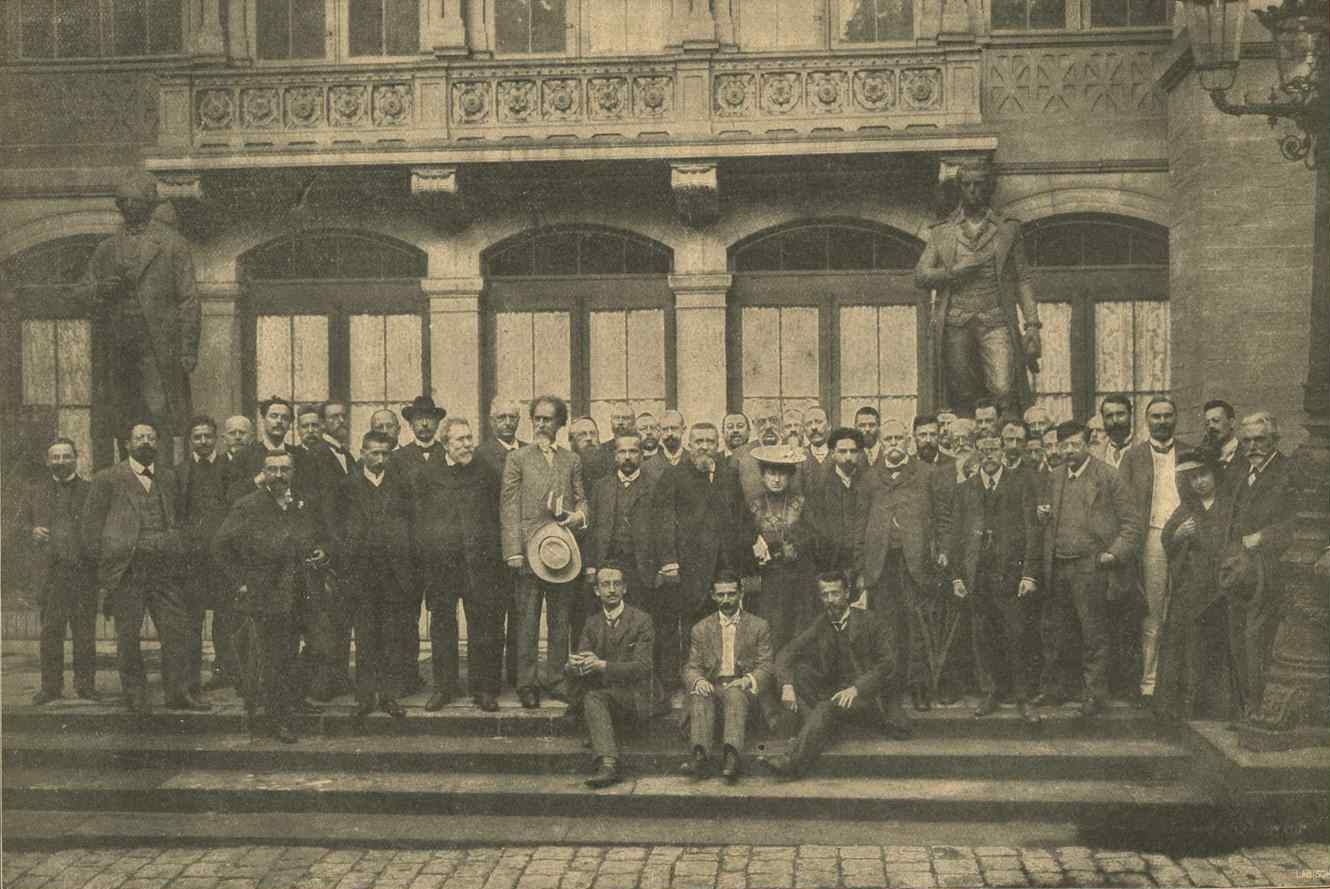
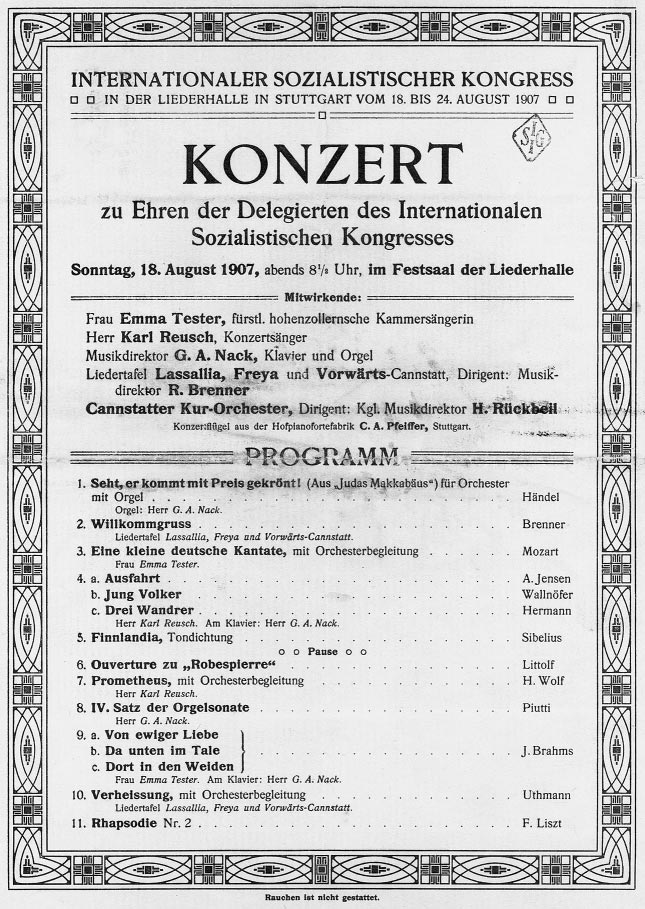
Speech of August Bebel opening the Socialist International’s 1907 Stuttgart Congress.
‘Opening the International Congress’ by August Bebel from The Weekly People. Vol. 17 No. 26. September 21, 1907.
[Translated from the Berlin “Vorwaerts” by G. Ollendorf.]
Party members and comrades-in-arms! In the name of the German Social Democracy, I bid you welcome to Germany and to Stuttgart, and extend to you our best wishes. Now, for the first time, we hold an International Congress in Germany. True, the old International had already decided to arrange for an International Congress to be held at Mayence in the summer of 1870, but then the unfortunate war between Germany and France broke out and the Congress became impossible not alone for that year, but for years to follow. The new German empire was not an empire of liberty and justice. Immediately after its creation, it proceeded, with class legislation and class justice, against persons and parties obnoxious to it, and thus an international congress of Socialists in Germany became an impossibility for the time being. We waited long before we dared invite the International to Germany, and when we extended the invitation at Amsterdam there still existed many doubts as to the advisability of meeting in the new German Empire, which up to that time as far as protection of personal liberty was concerned did not enjoy the best of reputations in foreign countries. have risked it; we have left it in their hands to compromise themselves before the entire civilized world by making impossible in Germany an international congress of Socialists. Certainly, to go to Berlin we had no desire whatsoever. To meet under the eyes of Prince Buelow and of the Berlin police was not exactly to our taste. But we thought that what is not possible in Berlin might be possible in Stuttgart, and, as you see, it is.
Today we have before us a magnificent meeting, a meeting on such a large scale as no previous international congress of Socialists has ever been able to show. (Bravo!) Certainly, in the course of the last few years serious doubts as to Germany’s being the proper country for an international Socialist congress have often entered our minds, and justly so. Exactly two years ago, when the miserable Morocco affair agitated the entire civilized world the Berlin comrades decided to invite our friend Jaures that he, in the name of their French brethren, might speak for peace to the German proletarians. At that time Prince Buelow moved heaven and earth to keep out of Germany the man for whom only a short time before, he had expressed his high esteem in the German Reichstag. He even went so far as to threaten deportation, through the German ambassador. (Cries of Fie!) But you all know about this. (Hilarity.) At any rate, it was not a good omen for the holding of the Congress in Germany. Nearby, Karlsruhe followed the example of Berlin. On the same day as in Berlin a great demonstration for peace was planned to take place in Constance, where the boundary lines of three countries meet. Adler, Greulich, Todes and myself were to be the speakers. But the glorious example of Berlin was followed by Karlsruhe (capital of the Grand Duchy of Baden, in which the city of Constance is situated. Translator.) In Constance, also the meetings were forbidden, but there we had the advantage of being able to say, in friendly adjoining Switzerland, what had been made impossible for us to say on German soil. Furthermore, the attitude of the Prussian-German government towards our persecuted Russian comrades greatly perturbed us. All of you still remember the speech of Prince Buelow as to beggars and conspirators. You all know how dozens and dozens, and at last hundreds, of Russian students were ordered out of Germany in the most ruthless manner. These were moments well calculated to raise doubts as to the possibility of meeting in Germany. We have dared it, as Hutten says, and we hope that this Congress will finish its labors in glory, for the benefit of the entire world of proletarians. See how mightily the idea of internationalism has taken root in the whole civilized world! Tday, before our very eyes, an international movement of hu man progress, on a scale of such grandeur, takes place a movement such as the past history of humanity is unable to furnish a precedent for. Since Amsterdam we have made great progress in many different territories.
All those who had the good fortune. to be present at Amsterdam were deeply impressed, undoubtedly, when, at the opening of that Congress, the chairman alluded to the terrible battles in the far East between Japan and Russia, and when, at this moment, the delegate of Japan, Katayama, and the delegate of Russia, Plechanoff, grasped hands in fraternal greeting. (Bravo!) Furthermore, after the debates in Amsterdam regarding the question of participation in government by Social Democrats, we parted with the idea that the establishment of unity among our French brethren could hardly be expected. But lo and behold! To our joyful surprise the great work has been accomplished. The seed of Amsterdam has produced fruit, our French brethren have waged, jointly, a tremendous campaign; they have emerged victorious, raising their deputation from 37 to 54 and augmenting considerably their vote. (Applause.)
And this gratifying effect is immediately followed by another one. For the first time in the English labor movement the English working class faced the bourgeois parties as an independent labor party in the elections. And behold-what nobody expected this battle, too, ended in glory, and for the first time 32 delegates of the English proletariat entered Parliament as an independent labor party. (Cheers.) It took rather a long while before Europe’s economically most progressive country thus witnessed the march of its proletariat as an independent political party. But, English friends, your beginning was a good one and what followed delighted us still more. Even when that happened, what I predicted already at Amsterdam, namely, that in case of a victory by the English workers the government would admit a Socialist into the Cabinet has also occurred–I also mentioned at that time John Burns. Still this concession has been unable to swerve our English friends even the breadth of a hair from their fighting tactics. (Applause.)
To these victories in France and in England was added the victory in Finland. There, under the Czar’s regime, which denied its own people the most insignificant rights, our friends understood and so exercised a peculiarly radical right of suffrage, that not only a strong male delegation, but also nine female Socialists were enabled to enter the Finnish parliament. (Bravo!) But this does not complete the victories of the International: the great battle in Austria took place. Our Austrian comrades, who for years have heroically and spiritedly battled for the right of suffrage, made their entrance into the Austrian parliament 87 strong, the strongest Socialist delegation in the world. (Enthusiastic applause.) Furthermore, our friends in Holland, as well as in Switzerland, have had great success at the local elections, a proof that the International is everywhere forging ahead.

The German Empire, the German Social Democracy, apparently makes an exception in this regard. I do not need to here state the reasons which, during last winter, brought about the unexpected dissolution of the Reichstag. Never, since the existence of a North Germany and of a German Reichstag, did we have to fight such a campaign. Not only the entire aggregation of the bourgeois parties which was to be expected–but also the governments of the empire and of the individual states, and the local administrations–all of them made one solid front against us in the campaign. The result–and a different one could hardly have been expected after such a campaign–was an increase of the vote from three millions to three and one-quarter millions, decrease of seats from 79 to 43. For this reason the Palace in Berlin indulged in some talk regarding the Social Democracy to the effect that it had been ridden down under the hoof. Friends and comrades of all countries, we do not feel “ridden down” at all; we hold the saddle as firmly as ever we did! (Great applause.) Three and a quarter millions of votes after such a campaign, that means three and a quarter millions of men of iron, men who can be depended upon in any crisis an army of propaganda more numerous than ever existed anywhere else. And in the meantime our opponents have recognized that their victory was an accident; that they cannot depend upon conquering us by such means, and they deserve credit for such recognition. For all of us, down to the last man, are longing to wipe out the stain of January 25th and February 5th. (Spirited applause.) And we most sincerely regret that in all probability no campaign will be fought until 1912.
But the German Social Democracy stands by its guns in the meantime. This, the splendid results of the Hamburg local elections and of the elections to the Bavarian diet–a whole series of supplementary elections, especially that in the district of our late lamented Comrade Auer amply prove.
Furthermore, during last year the number of active party members, male and female, has risen from 384,000 to 530,000. This is an increase of 146,000 or of 38 per cent. (Applause.) In like manner, the party press has grown, in spite of the tremendously expensive battles, the financial difficulties of the party. Really, it is something quite elevating for a “ridden down” party, when its cashier is enabled to receive in one month–during the last–dues to the amount of 170,000 marks.
The German trade unions, with a membership of 700,000 in 1900, now show a list of 1,800,000 members, a colossal growth of proletarian strength. Thus, then, appears the “ridden down” party! If they really believe that we were “ridden down,” in the true sense of the words, why then do Prince Buelow and his master so persistently refuse to grant the general, equal, direct right of suffrage for the elections to the Prussian diet? That would give them one more occasion to ride us down! (Hilarity.) But Buelow’s official organ, in characteristic fear, declares that the demand for general suffrage is “a chase on horseback after wild geese.” (Hilarity.) I therefore can assure you that whenever, within the next few years, the opportunity will arise for the German Social Democracy to swing its sword, it will prove itself the same old party. Perhaps, it really does not do any harm when, after many victories, an occasional defeat comes along. (Hilarity.) It certainly is but human that continuous victories should easily engender fool-hardiness. Our “Altmeister” Goethe already has said that there is nothing more difficult to bear than a series of happy days. Well, we have had a dark day, but the sun shines again, even over this Congress. (Applause.) Perhaps, even the gods are our allies. (Renewed applause.)
In the United States of North America our comrade Haywood has been subjected to a scandalous trial. The ruling class has done its utmost to convict this innocent man of murder. Even the chief officer of the great republic has lent himself to designate Haywood as an undesirable citizen. The trial ended with the triumphant acquittal of Comrade Haywood. But it did more than that it stirred the workers of the United States; it opened their eyes to the faults of the great republic, which, notwithstanding the guarantee on paper of all rights and liberties, has no liberty, no justice for the proletariat. It is to be hoped that the now awakened proletariat of America will take part in the political activity of the republic from now on, in the same forceful manner as the English proletariat does. At all events, we have tday with us a numerically stronger delegation from America than we ever had before.
After all this, I am fully justified if I say: The International marches on! With every year it gains new ground! Already today there are at this Congress representatives from all the five continents of the globe. It will be not very long before every state of the world will also be represented. Thus we see before us a strong, mighty party, rushing forward, fully conscious of its purpose. And so I hope that the labors of this Congress will contribute to nourish and to strengthen the International and to procure new adherents to the great ideas and objects which it aims at. I hope that this Congress here in Stuttgart will produce a different example of international opinion from the international of the governments which meet at the Hague and hold sittings upon sittings, resulting finally in this pregnant mountain giving birth to a wee little mouse, and even this wee little mouse may be still-born. (Hilarity.) But as for us. let us go to work joyfully, sure of purpose; and, as a sign of your assent, I beg you to join me in the cry: “Hurrah for the Social Democracy, the deliverer of nations, of humanity!”
New York Labor News Company was the publishing house of the Socialist Labor Party and their paper The People. The People was the official paper of the Socialist Labor Party of America (SLP), established in New York City in 1891 as a weekly. The New York SLP, and The People, were dominated Daniel De Leon and his supporters, the dominant ideological leader of the SLP from the 1890s until the time of his death. The People became a daily in 1900. It’s first editor was the French socialist Lucien Sanial who was quickly replaced by De Leon who held the position until his death in 1914. Morris Hillquit and Henry Slobodin, future leaders of the Socialist Party of America were writers before their split from the SLP in 1899. For a while there were two SLPs and two Peoples, requiring a legal case to determine ownership. Eventual the anti-De Leonist produced what would become the New York Call and became the Social Democratic, later Socialist, Party. The De Leonist The People continued publishing until 2008.
PDF of full issue: https://www.marxists.org/history/usa/pubs/the-people-slp/070921-weeklypeople-v17n26.pdf
 Revolution's Newsstand