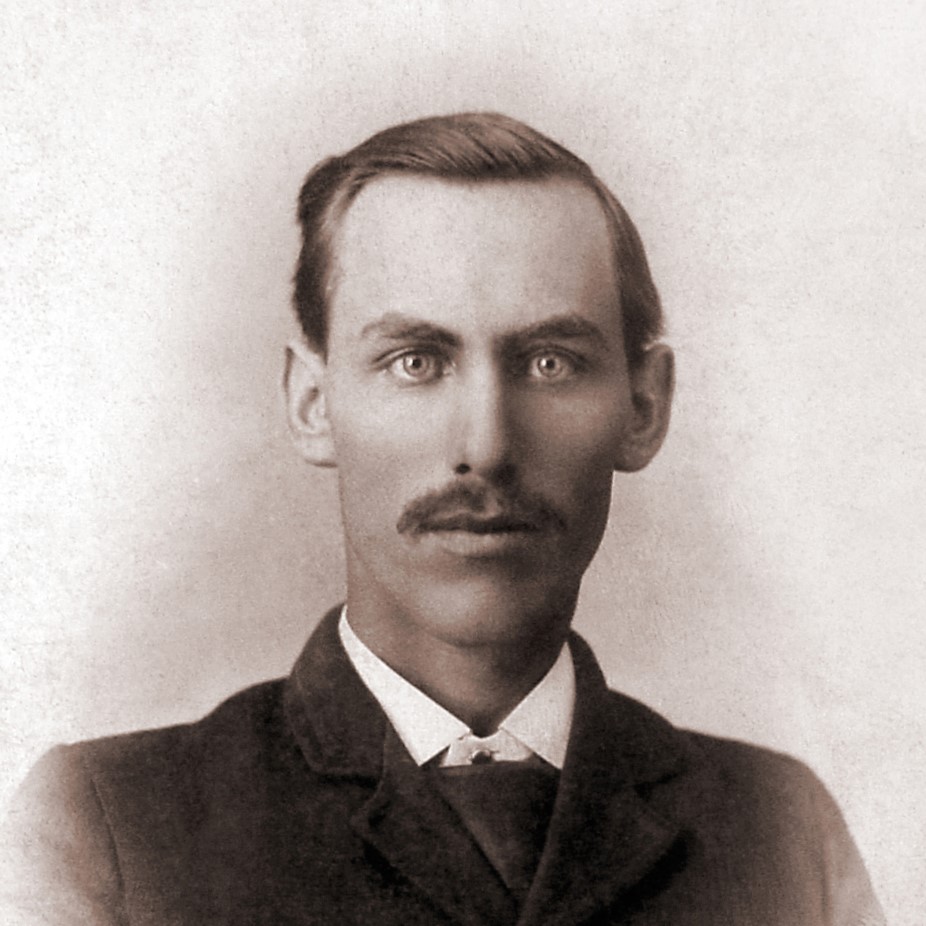
Jay Fox pays tribute to his comrade Ross Winn on his passing from tuberculosis in 1912. Southern-based Winn was one of the leading anarchist writers and publishers in the U.S. of his age.
‘The Death of Ross Winn’ by Jay Fox from The Agitator. Vol. 2 No. 20. September 1, 1912.
“Death comes to all. His cold and sapless hand Waves o’er the world and beckons us away.” A ceaseless worker in the cause of labor was Ross Winn. In spite of poverty, in defiance of sickness, he wrote, printed and published his anarchist paper till the last, till the sapless hand of death beckoned him away.
Like Voltairine de Cleyre, Ross Winn was beckoned away in the prime of life, and like her, he fought the ravages of disease heroically. But the white plague must have its victims, and the power of man cannot prevail against it.
The little known outside the Anarchist circles, Ross Winn has contributed a large amount to the cause of freedom. A clear thinker and a forceful writer, his editorials are fine examples of the intellectual possibilities of the modern proletariat.
He attended no high collar university, he was self schooled in the college of common humanity. He got his knowledge of life from original sources.
Life can only be learned from life. The knowledge that’s screened thru the brain of a University Professor is a perversion. Everything big, everything of real value, gets caught in the cobwebs. It is seldom that a man escapes whole from one of these much vaunted institutions. Factory life distorts the body, college life distorts the mind.
A university is a snob factory, a place where petty minds are made to feel themselves superior. Ross Winn escaped the University. He was, in fact, a self-made man; and he knew more about real life than all the mutts in the University of Washington, and this includes the learned Faculty. From his little corner in the back woods of Tennessee, he looked out upon the world and saw It as it really is a place where a small community of wolves prey upon a great mass of sheep; a cannibal world that hypocritically denounced cannibalism. And while he had the faculties to qualify as one of the wolves, he chose to remain one of the sheep.
He was one of those rare individuals that is becoming less rare as the progress of humanity goes on a man in whom the race instinct was very large. When thinking of mankind he always thought in the plural. To him the aim and object of life was not self, altho no man ever lived who was a greater champion of freedom of the individual.
This is not contradictory, and understanding it is to grasp the essence of Anarchism, of which Ross was a student and propagandist.
When Anarchism proclaims the freedom of the individual the world shouts: “You want the freedom to devour us,” taking its tip from the wolves.
But how does the world account for Ross Winn, for Voltairine de Cleyre, for Tolstoy, Kropotkin, Malatesta and the long list of individuals who have left the wolf class and joined with the sheep to proclaim the freedom of the individual? Verily, there’s a kink somewhere in the world’s thinker.
The doctrine that all men are wolves and only lack the freedom to prey on their fellows, is the doctrine of the wolf minority. It is the doctrine that justifies every outrage committed by the wolves.
The doctrine that “you would do the same if you were in his place,” not only justifies the wolves, but would perpetuate the world of the wolves and the sheep for all time.
Ross Winn saw that clearly and he devoted his life to the propaganda of the idea that mankind must have its freedom in order that individuals may cooperate with each other for the conquest of nature.
He didn’t assume that all men were sheep who lived on grass and minded their own business, no more than that they were all wolves. He knew that all men were both wolf and sheep, and that the wolf element belongs to the past, and is gradually being weeded out of human nature by the process of education and humanization.
He took nothing for granted. He didn’t endow mankind with angelic wings and swear by all the gods that he would not prey on his fellows, in the new age.
He knew that men are not sapless saints, who follow rigidly some rule or principle set down in a book by a sapless philosopher.
He knew that life knows no rule, and that the only rule that can be safely applied to it is to let it alone. Knowing man’s inadaptability to obey rule, and knowing his tendency to wolfism when placed in the position of a ruler, Ross Winn sought a system that would be more suitable to his nature than being either a ruler or a subject.
He early saw thru the sham of seeking “good men” to place in the positions of power. He stopped to ask himself if it might not be the positions that were wrong and not the men.
Having satisfied himself on this point he raised the question of Anarchism, which says “let there be no rule and there can be no abuse of rule. Let there be no land titles and everyone will have land, and having land, they will be economic equals; and being economic equals, they will cooperate for the production of what they want; and having the experience of capitalism, they will trust no one with power.”
And on this basis of freedom will evolve not a system of society, which thing smacks of the sapless philosopher, but a variety of patterns, each group following its experience or its fancy, just as we now follow these fascinating leaders in matters of art and clothing and play.
This was the simple, natural philosophy of Ross Winn, and he thought it and spoke it and wrote it till the hand beckoned him away.
Ross Winn was a prophet of the future and, like all prophets, was looked upon with suspicion where not actually hated and persecuted.
His own words, printed in the June, and last, issue of his paper, The Advance, applies admirably to himself:
“The prophet stands upon the signal tower of progress and beholds the dawn of a new age while the world sleeps in intellectual darkness. The prophet stands upon the shore of the great ocean of truth and sees land on the other side. But the world has no use for the prophet until he has been dead two centuries.”
The cold and sapless hand has beckoned you away, Ross Winn, but it cannot remove the impression you have made upon those who knew you and read your inspiring words. As a prophet of the new age your name will go down the centuries linked with the comradeship of those whose memory not even time will erase.
The Syndicalist began as The Agitator by Earl Ford, JW Johnstone, and William Z Foster in 1911. Inspired by the revolutionary syndicalism of the French CGT, they felt they were political competitors to the IWW and in early 1912, Foster and others created the Syndicalist Militant Minority Leagues in Chicago with chapters soon forming in Kansas City, Omaha, Minneapolis, St. Louis, Denver, Seattle, Tacoma, Vancouver, San Francisco, and Los Angeles. They renamed The Agitator The Syndicalist as the paper of the Syndicalist League of North America with Jay Fox as editor. The group then focused on the AFL. The Syndicalist ceased publication in September 1913 with some going on to form the International Trade Union Educational League in January 1915. While only briefly an organization, the SLNA had a host of future important leaders of the Communist movement. Like Foster, Tom Mooney and Earl Browder who were also members.
PDF of full issue: https://www.marxists.org/history/usa/pubs/agitator/v2n21-w45-sep-15-1912-agitator.pdf
 Revolution's Newsstand