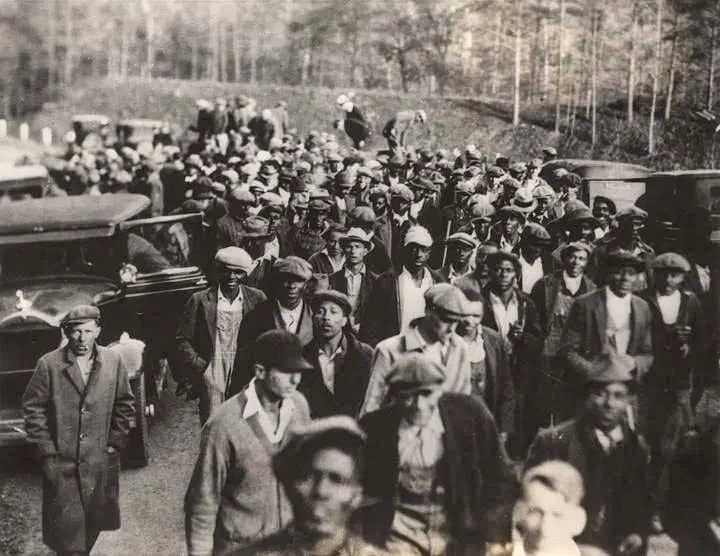
One of the most important Southern strikes of the 1930s was the Jim Crow-breaking interracial strike by insurgent U.M.W.A. Alabama coal miners, a number of whose leaders were Communist Party members. On the picket line in front of the Red Diamond mine in Leeds, police murdered striker Edward England and wounded several others on April 18, 1934.
‘Operators Kill Negro Coal Miner to Break Strike’ from the Producers News (Plentywood, Montana). Vol. 17 No. 5. April 27, 1934.
Natl. Guards With Gas and Machine Guns in Strike Area
BIRMINGHAM. The signal for open murder was passed along last week by Alabama Coal Operators in a panicky effort to break the strike of 21,000 miners.
Edward England, Negro striker, was shot to death in cold blood by Deputy Sheriff N.E. Kirkland and Chief of Police H.L. Mason.
He was murdered on the picket line of the Red Diamond Coal Co. at Leeds. Unarmed, he stood his ground with his comrades as the small army of police and deputies charged the line with drawn revolvers, trigger fingers twitching. “Get the out of here, you black bastards,” snarled the leader.
The pickets hesitated, then stood firm. The thugs paused–but just for an instant. Then two shots rang out simultaneously and England, riddled with lead, slumped to the ground.
The line wavered. More revolvers spoke Gordon Bice, another miner, dropped critically wounded. A third fell in the general firing that accompanied the dispersal.
This instance of open warfare is seen as the first move of a general effort to stampede the men back to work all along the coal front.
With MG’s and Gas
National guard gas and machine gun squads have been sent to the Edgewater mines of the Tennessee Coal Co., a J.P. Morgan corporation.
As befits Morgan’s men, they are armed with pistols, rifles and machine guns. They will supplement the small army of thugs, imported gangsters, and strikebreakers–known as special deputies–now on duty at the Tennessee company’s four mines.
The troops were sent at the request of Sheriff James F. Hawkins, of Jefferson county, the same who has instituted the campaign of torture for the Scottsboro boys in his custody.
On the heels of the England murder, the I.L.D. and the Communist Party started a demand for the arrest and conviction of his assailants and compensation for the victim’s family.
As a result, Communists and I.L.D. leaders are receiving threats, open and underground, to leave the state or take the consequences. William Mitch, district president of the U.M.W.A., declared that the death of England could probably be blamed on the “lawless elements.”
Mitch and other leaders attempting to break up the Negro-white strike unity, rushed out to Porter to try and head off the march of several thousand miners on that town.
The strike unity is by far the most terrifying aspect of the whole situation to the operators up to this point. They are chagrined that U.M.W.A. officials cannot “deliver” the workers now as formerly.
“Racial strife is imminent” said a telegram sent to President Roosevelt by 300 operators. The Age Herald says editorially: “The fact that the Negro miner has become conspicuous in clashes with the officers is fresh and a bedeviling factor.”
Producer’s News was a radical rural voice that became a Communist publication in the late 1920s. First published in Plentywood, Montana in Sheridan County, one of the few places to elect Communists in the 1920s. as the organ of the Montana Non-Partisan League beginning in 1918, took a left turn and passed into the hands of Communist editor Charley Taylor and then the Montana Farmer-Labor Party in 1924. In the late 1920s the paper became the voice of the United Farmers League before becoming the organ of the Communist-dominated Farm Holiday Association in 1935, ending its nearly twenty year run in 1937.
PDF of full issue: https://chroniclingamerica.loc.gov/lccn/sn85053305/1934-04-27/ed-1/seq-1/
 Revolution's Newsstand