Sometimes seemingly small episodes in the class war can have the most profound personal and political impact on those individuals involved. One such actions was a failed strike a C.C.C. camp that, while lost, made an indelible mark on some of those who participated.
‘“No Food, No Work”: The Story of a Strike in a C.C.C. Camp’ from Challenge of Youth (Y.P.S.L.). Vol. 3 No. 1. January, 1939.
The day after we arrived in camp, 10 of us rookies were bundled into an army truck and transported to our first job–weeding at the Painted Post Nursery. The Nursery includes a large area devoted to small seedlings, row on row of these close-packed trees, some rows extending hundreds of yards in one direction. Each morning we would file into the toolshed, receive our pails and weeding knives and go forth to ferret out the little weeds that infested the rows. Now imagine kneeling over a six-inch tall tree, moving your hands through a mass of black earth, discovering a picayune blade of grass or an incipient weed from time to time, and going through these same motions for seven hours a day! This wasn’t lawn-weeding by a long shot; if any of us would change our kneeling position to a half-sitting one in order to relieve the aching in our legs, we would receive a surly rebuke to “get off your behinds” from the sergeant or assistant sergeant who watched us and prodded us like overseers in a reform school.
BLISTERING HEAT
After a while a fine spirit of solidarity and good-fellowship grew up amongst us boys. We appreciated the brutal nature of the work, tried to laugh off our sore distress, but deep down many of us were burning with dissatisfaction. Soon the cool Spring days gave way to the blistering heat of June and July and the drudgery of the weeding work became almost unbearable. Lack of shade, the frequency with which the water tank ran dry, the wracking routine–these would have been enough to drive older men to rebellion. But these inexperienced youths stood in fear and awe of the government: “you can’t strike against the Army” was their usual reply to any suggestion that we do something to improve our lot. Eventually we were to “strike against the Army” in protest and grievance against an intolerable condition.
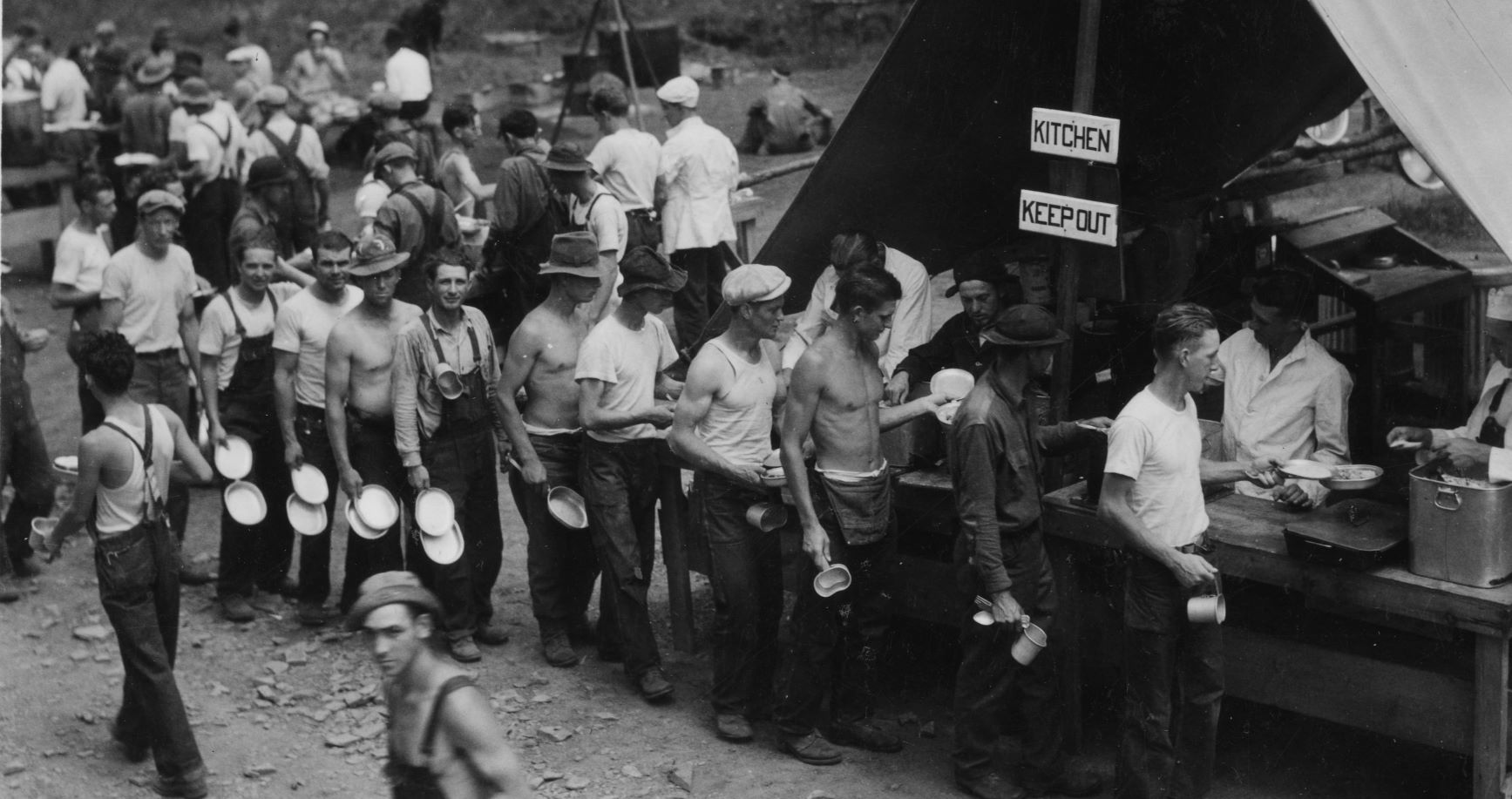
We carried canteens and cups with us on the truck. At noon we would line up for lunch and a mess of beans, bread and coffee would be dished out to us. It would be beans one day, watery stew the next, spaghetti on the third, then the cycle would begin again. On scorching days, steaming food slopped together in a grimy mess kit is slightly short of appetizing, -and with only a half-hour allotment to get the grub, eat it and rest up before returning to the grind, resentment began to simmer in our minds. However, any open expression of discontentment was done in a gay, inoffensive manner, in a way that prevented official lighting from descending on your head. A serious outburst would bring an outcry of “Agitator!”, the worst term of denunciation in camp.
STRIKE AGAINST ARMY
The food was getting worse each day. Some of the boys wouldn’t touch their food, bringing candy bars for lunch. Others gulped down their food without tasting it and heaped curses on the cook. Finally, one noon-time, when most of us had tried to down a miserable concoction of alleged goulash–and failed–our feelings burst into the open like a geyser. A dozen boys broke for the trucks with the howl “No food, No work!” The strike-movement caught on quickly even though we were completely unprepared for it. There was a rush for the trucks and the original strikers were joined by a majority of the boys who took up the cry “No food, No work!” It was time for the work whistle to blow and a few boys had already started weeding.
No effort had been made to organize, to establish a set of grievances, or to appoint a committee of enrollees to lead and direct the movement. My suggestion that we prepare for any that we were through with work for the day and eventuality with an organization met with no response. I pleaded with the fellows in my truck to slough over their holiday spirit, to sober up and realize the serious nature of our strike and prepare for our meeting with the supervisor and camp officials, but they insisted that all that was necessary was to “stick together”.
DELIVERS ULTIMATUM
When the superintendent of our project saw wanted to return to camp immediately, he called us into the barn and delivered several ultimatums, charging us with gross insubordination. Two fellows yielded to his threats of dire consequences, but the rest of us answered with a firm “aye” when the super asked us if we still refused to work. Seeing that we meant business, he began to shake in the knees and big beads of sweat formed on his forehead–this was a reflection on his powers of management and he would probably get blazes from his superiors. “O.K., back to the trucks,” he shouted, “and now you can lay the whole business in the lieutenant’s hands.”
We dashed for the trucks, got set for a wild. ride back to camp. But the super stalled, cleverly trying to dispel the strike spirit, or at least to subdue our militancy. When we got going, it was at a snail’s pace, so that we could avail ourselves of the opportunity of mulling over our audacious act. This tactic proved effective. No one said much on the return trip; all were gravely concerned over our reception in camp: no light hearted spirit of mischief now. One could sense the spreading fear and regret that was sprouting in some minds.
FACE MILITARY MAN
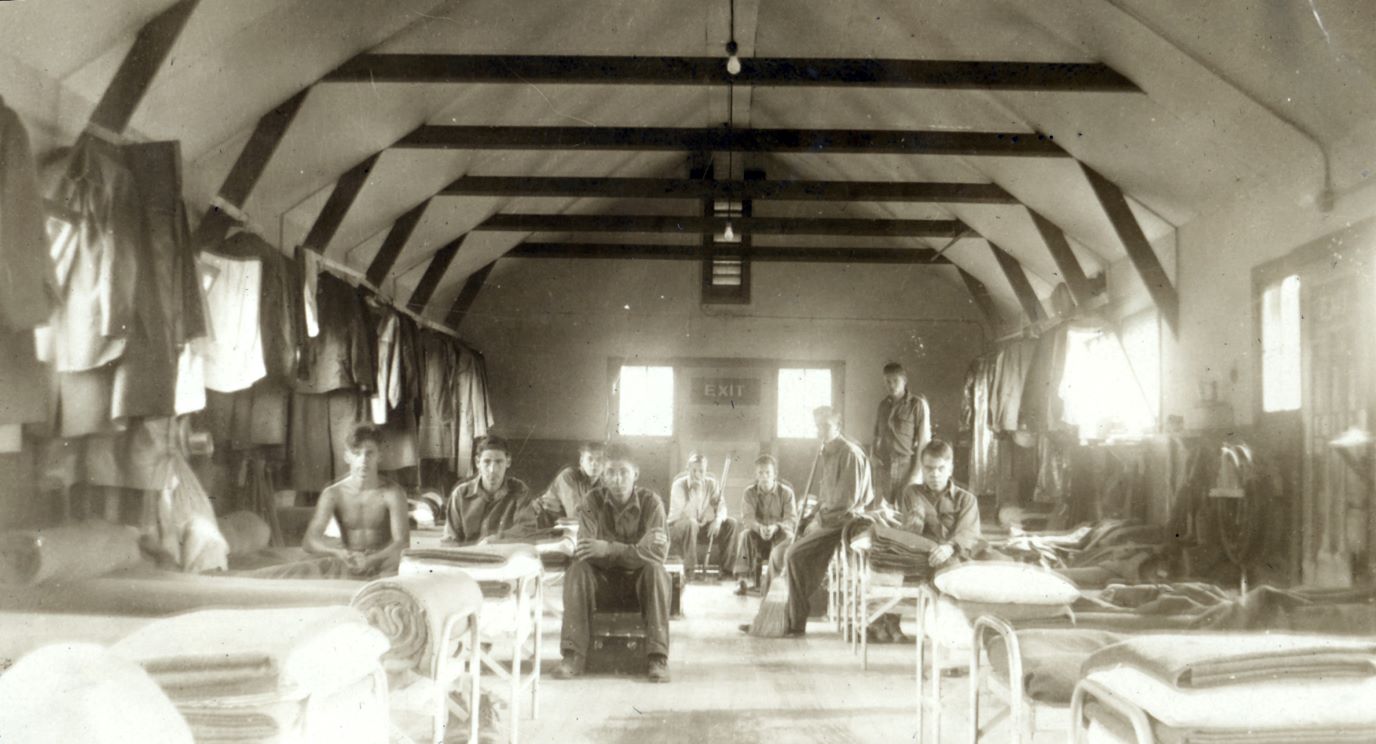
When we arrived at camp, we marched into the assembly hall and there the Looie stood before us on the raised platform, looking grimly and severely at the group. Here was no minor overseer who worked for the Department of Agriculture, but a military man, a representative of the Army–and remember, “you can’t strike against the Army.” The sentiment of the boys slowly changed. The confinement did not liberate the same rebellious spirit that the great outdoors did.
The Looie’s tactics were polished to a shine. First, he split our solidarity by separating us into groups. Then he appealed to our “sportsmanship”, demanding know why there was no protest about the food previously, chiding us for taking such drastic action when we could have dropped into his office at any time to talk things over in a nice, friendly way. Why, after his super-human efforts to spread the limited funds given to him by the government, should we have attempted to stab him in the back? And so he continued in the same vein, spraying us with his “reasonable” personality, but never relaxing his grip for a single moment. The food bad lately? Well, certain restrictions were being carried out in the kitchen due to the latest additions to the camp roster and the failure of new government allotments to come through. Suddenly he challenged any of us to speak out in defense of our strike. After several boys made timid suggestions, I rose and delivered a blast at the I whole luncheon set up, the poor quality of the food, the lack of variety in diet, the short lunch-hour. I spoke again and again thereafter, trying to show the boys that I was willing to lead them in an open struggle for the demands we raised. But nothing doing. The backbone of our strike was broken. The Looie had cajoled the boys into believing that everything would be settled in a peaceful manner.
WORK EXTRA DAY
To prove he was our buddy, the Looie did not punish us. But we would have to make up the lost afternoon by weeding on the next day, our free day, Saturday. No word of dissent. With a sigh of relief that the whole business was over the cowed groups slunk off to their barracks to forget.

The next day we made up for the time lost during the strike. Our relations to the leaders and supervisors and sergeants had not changed one iota. They pretended that the fine demonstration of revolt and solidarity of the previous day had never occurred. They went about barking orders as before. Amongst the boys there was no more talk about the strike; complete obliteration of the weird affair from memory. The rest of the camp called us screwballs and suckers for attempting such an action, never for a moment realizing that its success would have meant improvement of the camp menu and breaking the dictatorship rule in camp.
Some of us, however, will never forget the spontaneous, electrifying spirit of the strikers, the spirit that compelled each to jump into the trucks, excited, aggressive, exultant. We won’t forget the gleam of hope that flashed in our eyes, the will to be liberated from the dehumanizing monotony of weeding, the demonstration that we weren’t slaves and could kick back to redress grievances. We’re just beginning.
Challenge of Youth was the newspaper of the Young People’s Socialist League. The paper’s editorial history is as complicated as its parent organization’s. Published monthly in New York beginning in 1933 as ‘Challenge’ associated with the Socialist Party’s Militant group (the center/left of the party around Norman Thomas). Throughout the 30s it was under the control of the various factions of the YPSL. It changed its name to Challenge of Youth in 1935 and became an organ of Fourth Internationalists, leaving to become to the youth paper of the Socialist Workers Party in 1938. In the split of 1940, the paper like the majority of YPSL went with the state capitalists/bureaucratic collectivists to become the youth paper of the Workers Party.
PDF of full issue: https://www.marxists.org/history/etol/newspape/challenge-of-youth/390100-challengeofyouth-v03n01w10.pdf
 Revolution's Newsstand