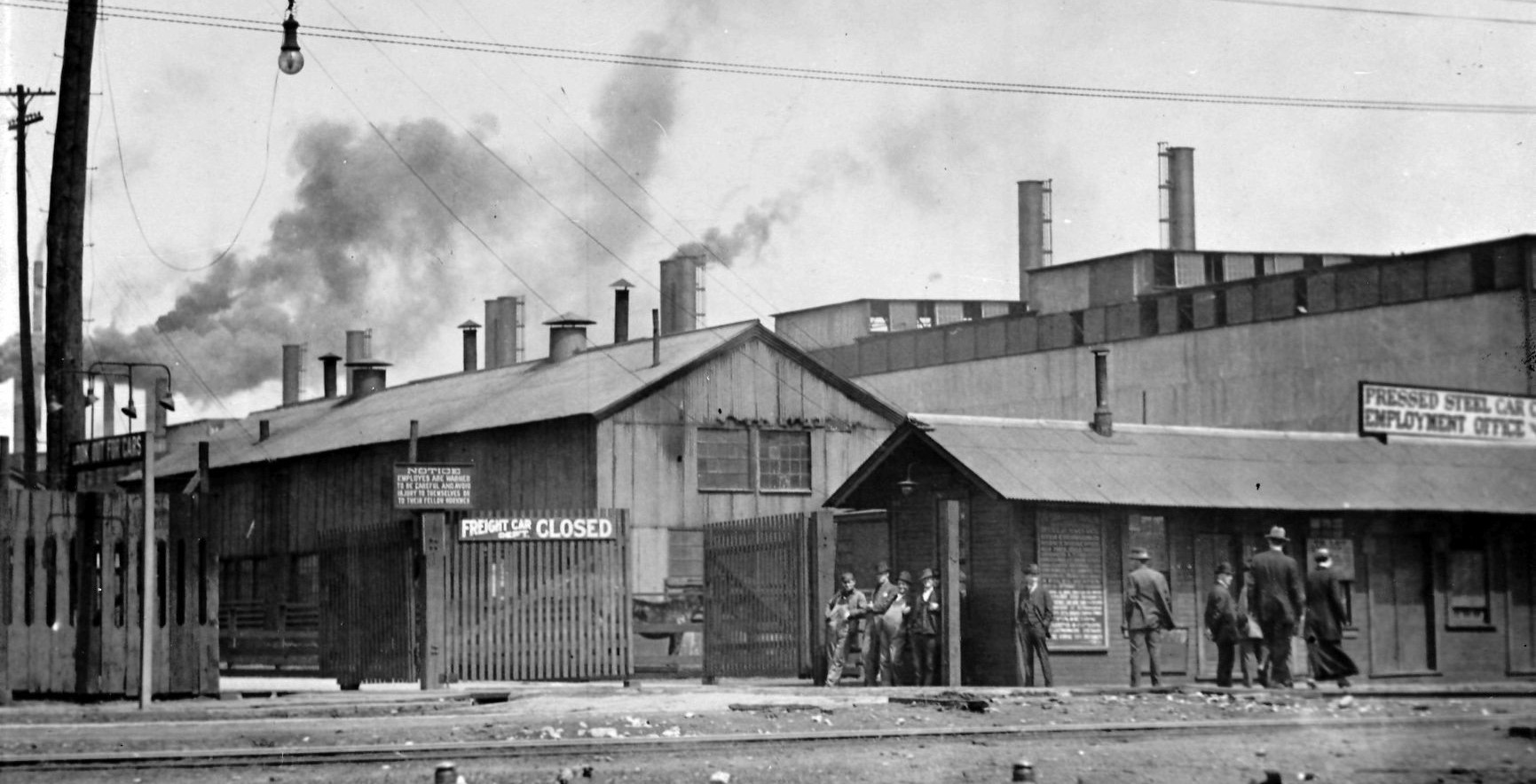
There was not a more savagely fought labor struggle in U.S. history than the conflict around the Pressed Steel Car Works in McKees Rocks, Pennsylvania. Here is some background to the brutality.
‘McKees Rocks the Slaughter House and Last Chance’ by H.A. Goff from Solidarity. Vol. 1 No. 20. April 30, 1910.
Some people may think it very singular that another strike has broken out at the Pressed Steel Car Works so soon after the momentous strike of last summer. Some may imagine that the “Hunkies” are trouble makers and have grown conceited and want to run things, etc.
Now, it is no part of my purpose to write an apology for the workers McKees Rocks. But a decent regard for public opinion prompts me to briefly state a few facts of the past and present history of this typical slave pen.
And, let the reader bear in mind that no body of men ever struck for mere pastime. Strikes are always forced upon the workers by the bosses.
At the start the Pressed Steel Car Company was an “independent” concern. Several changes have taken place in the company control, but now it is a United States Steel subsidiary corporation.
From the start, the Pressed Steel Car Company has made it a rule to employ the “greenborn” emigrants, fresh forces direct from Castle Garden have been in demand at McKees Rocks plants. There are a number of reasons for this. First, the percentage of skilled labor in the car industry is very low and even such few skilled workers as were employed generally worked piece work at a rate that called for, a killing pace in order to make even ordinary wages.
Second, the policy of the Car Company has always been so abusive that none would or could endure it except those who were in a largely helpless condition. Hence the poor emigrant, a stranger in a strange land, without money, far away from home and friends, unable to speak the language unacquainted with the laws and customs of the country. In a word, the most defenseless of human beings. These have always been the chosen victims of the “Last Chance,” the “Slaughterhouse.”

And from the first turning of a wheel in this car works, until the present, there has been a procession of emigrants from Castle Garden to the Pressed Steel Car Works. The more raw and green they were, the better they suited the Company because they could thus be more completely imposed upon.
What this company aimed for from the start was to have men they could domineer, impose upon and rob with impunity.
Here are a few of the regular stock tricks that have been the regular practice in the Steel Car Works.
First, men were constantly being discharged, because (a) if they began to understand English, and were getting “wise,” then they were no longer desirable by the company; and (b) the bosses had a regular system of grafting off of the men, first they had to pay to get a job at all, and second, had to pay to keep a job; hence, firing old men necessitated the hiring of new ones and more graft.
Second, brutal and abusive treatment of the workers, both by petty foremen and police, who did not hesitate to club, kick, and maltreat the men at any time.
Third, the absolutely horrifying disregard of life and limb of the workers. Most of these workers coming from the agricultural districts of Southern Europe, were totally unacquainted with factory work and had little or no conceptions of its dangers, and in the car works these dangers were extraordinarily numerous. But no protection whatever was ever provided by the company. Consequently, accidents, fatal and otherwise, were of an hourly occurrence. Frequently, dead men were left lying unremoved for hours, until it suited the convenience of the bosses to have them removed. Meanwhile, the workers were sternly ordered to go on with their tasks and forbidden to pay any attention to the dead.
Fourth, Coroners’ inquests into these cases soon became a farce, and in many cases were never held.
Fifth, the company’s rent collectors and other employes of the company in Schoenville abused women and girls under coercion that if they did not submit their relatives would be discharged from the Car Company. This charge was brought by the pastors of McKees Rocks.
Sixth, In houses where boarders were kept each boarder was charged house kept by the company, wherein they boarded, this in addition to the rent paid by the real tenant.
Seventh, Standing and watching the pay windows, I noticed that about every sixth or seventh man was short in his pay. At every pay window were two police. When the worker discovers that his pay is short, invariably he returns to the pay window clamoring to interview the paymaster. Forthwith the police hustles him away, telling him to return on Monday, this in English which he does not understand. If perchance, someone clears him up on this point and he returns on Monday to have his pay made right, then red tape does its worst. The worker is sent to this foreman to verify this or that, then to the time-keeper for another endorsement, then to some other flunkey for some other purpose, and so on back and forth from one department to another. Finally, by rare chance, he is sent to the head paymaster for an order for the balance due him; providing that, in the meantime, some of these crooks has not lied him out of his claim. But in majority of cases the poor victim gets totally bewildered and gives up the matter in disgust.
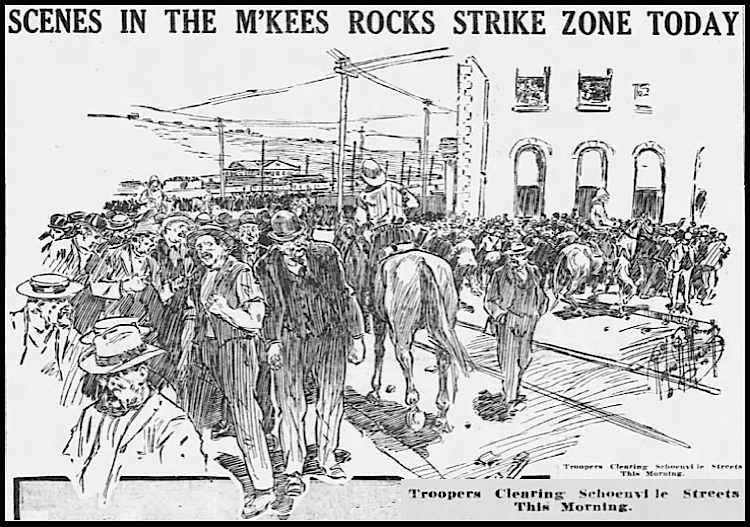
I might enumerate many more outrages, but here is enough to convince any decent person that Dantes’ celebrated inscription over the gates of hell must have been intended for the Pressed Steel Car Works.
And these were the conditions in these works until the Industrial Workers of the World organized the men and started a fight for better conditions.
Coming now to the strike of last year and the present strike. Last year the bosses promised a number of improvements. Not one of these promises have been lived up to in good faith. There has been a pretense in some cases, but all the workers have gained was when they have been able to take by their own acts, as for instance, Saturday half holiday, and where the company was compelled to grant some concession with conditions that has nullified its resultant benefits to the workers.
These things are only a few of the many causes that has led up to the present strike, Again I repeat it is totally uncalled for that any man should pen an apology for the present strike. It is the outcome of a long history of unspeakable barbarities, and the end is not yet. The I.W.W.is determined to purge this plant of at least some of the most heinous of these criminal practices. Only ONE BIG UNION of all the workers can do this.
More power to them.
H. A. GOFF.
The most widely read of I.W.W. newspapers, Solidarity was published by the Industrial Workers of the World from 1909 until 1917. First produced in New Castle, Pennsylvania, and born during the McKees Rocks strike, Solidarity later moved to Cleveland, Ohio until 1917 then spent its last months in Chicago. With a circulation of around 12,000 and a readership many times that, Solidarity was instrumental in defining the Wobbly world-view at the height of their influence in the working class. It was edited over its life by A.M. Stirton, H.A. Goff, Ben H. Williams, Ralph Chaplin who also provided much of the paper’s color, and others. Like nearly all the left press it fell victim to federal repression in 1917.
PDF of full issue: https://www.marxists.org/history/usa/pubs/solidarity-iww/1909-1910/v01n20-apr-30-1910-Solidarity.pdf
 Revolution's Newsstand