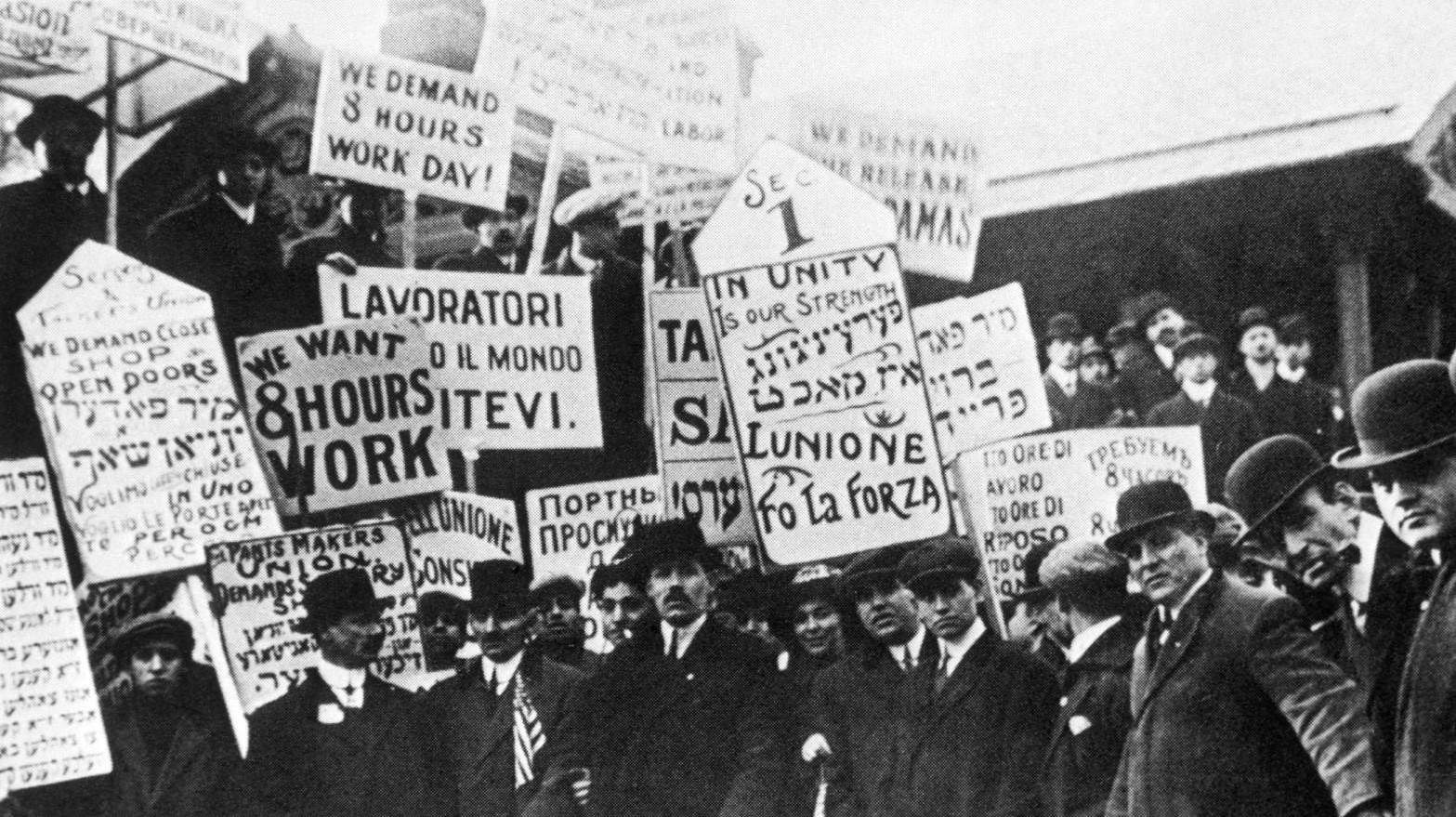
Joseph Zack, Secretary of the T.U.E.L. Needle Trades Section, on the particularities of garment industry organizing and the gains of the militant Trade Union Educational League across its unions.
‘T.U.E.L. Progress in the Needle Trades’ by Joseph Zack from Labor Herald. Vol. 2 No. 6. August, 1923.
THAT the Trade Union Educational League should be making great progress in the needle trades is not surprising. The conditions in that industry were probably more favorable than in most others for the new program. Even in the years before the World War there had been organized left-wing groups in the clothing industry, inspired by various radical elements such as Socialists, Syndicalists, Anarchists, and others. It is true that until the T.U.E.L. came into the field such movements were mainly confined to local issues, and often developed bitter struggles usually without raising national issues. The result was, however, that the needle workers were higher developed than most others in tactics and policies.
Fortunately none of the past movements in the needle trades led to dual unionism, the scourge of many industries in the labor movement. The single exception to this statement might be said to be the case of the United Garment Workers, a reactionary organization, which has performed in a dual capacity to the bona fide union in the men’s garment industry, the Amalgamated Clothing Workers. But here, instead of the radicals being the ones outside the mass union, it was the conservatives and reactionaries who placed themselves in that position. In the needle industry In the needle industry the radicals have always had the established policy of staying with the masses.
When the slogans of the Trade Union Educational League went forth to all the militants in the labor movement, the task of the needle trades workers was, therefore, not to bring the militants into the unions, for they were already there and to some extent active and organized. The task was rather to unify all the existing left- wing groups upon a common national program and stir them into concerted activity. In this the success of the League has been very heartening. A solid and healthy movement has been established.
Today, after a year of intensive work, the militants in the needle trades are organized, several thousand strong, in almost every clothing center in the United States and Canada. There is hardly a local union in which the T.U.E.L. has not established a nucleus, varying in membership from 5 to 100. The bulk of the militant rank and file membership is today enrolled in the League.
At the recent national conference of the Needle Trades Section of the League, the large attendance and the reports there made revealed the great organizational strength that had been developed in less than two years of work. This has found expression not only in League groups, but also in the adoption of our program by local unions, executive boards, joint boards, etc. Most of this progress was made before the establishment of a national basis of trade issues. With the formulation of our concrete national organization with dynamic trade issues as a basis, there is no doubt that the progress of the coming year is going to exceed greatly our past achievements.
As an example of the extent to which the League program has been established in the ranks of the membership, may be cited the issue of amalgamation. The program of the League. containing specific plans of amalgamation of all clothing unions, has been endorsed by 76 local unions and nine joint boards. With a unified. effort of the militants this fall and winter, there is no reason why the 1924 Conventions of the big Internationals should not be carried overwhelmingly. The needle trades unions should be the first big group of unions to amalgamate under the T.U.E.L. plan.
The Shop Delegates system of organization is, after amalgamation, the big issue of the militant clothing workers. This aims to revive the unions from within, changing the union machinery so as to draw the workers of the shops into the life of the union. This progressive step is absolutely necessary to combat the strangling effects of bureaucracy and to allow the mass of the membership to influence and control the policies of the union.
Although little known as yet to the militants in other industries, the Shop Delegate system has long been a vital issue in the clothing industry. It was not until the national conference of the T.U.E.L., however, that practical steps to put it into effect were laid down. The immediate step being pushed forward everywhere is the introduction and development of monthly meetings of shop chairmen. Many militants believe that the field is so ripe for this reform that the needle trades workers will take hold of it even more rapidly than they have the more important issue–amalgamation.
Just now the needle trades unions are at bat with the bosses in a strong effort to regain the ground lost during the “open shop” drive. This movement is being supported and pushed by the militants wholeheartedly, and will surely result in many gains. The League is also making strong efforts to reach into the great mass of unorganized by having the unions launch great organization campaigns.
Before the national conference of the needle trades, the greatest obstacle to our work was the confusion on tactics that prevailed in our ranks. The conference clarified this considerably. We have established the tactic that our work within the unions is to avoid friction in carrying on the daily routine of the organizations. Especially in weak locals we must submerge our differences so far as is consistent with our main issues, in order to make a common front to organize the unorganized against the bosses.
Another important tactic established for the needle trades militants is the use of the regular union machinery for propagating our ideas, rather than any outside or extra-union methods. We are now in a position to influence a considerable portion of the union machinery, sufficient to carry the union for our policies or to educate the rank and file. In the past too many of our comrades had the habit of running away from the real fight by carrying on work in the League groups which should have been taken directly into the union meetings. Particularly in such matters as arranging protest meetings, mass meetings, issuing leaflets, etc., the work should, wherever possible, be done through the regular union machinery.
With the organizational strength which the T.U.E.L. has developed in the needle trades unions, it has already established itself as a first rate factor in the life of the industry. With our national program and dynamic trade issues as a basis for our future activities, we can look forward to yet greater achievements. When all our members realize the opportunity and get busy behind this program we will have one of the best sections of the T.U.E.L. and will be well on the way to putting the policies of the League into effect in the life of our unions.
The Labor Herald was the monthly publication of the Trade Union Educational League (TUEL), in immensely important link between the IWW of the 1910s and the CIO of the 1930s. It was begun by veteran labor organizer and Communist leader William Z. Foster in 1920 as an attempt to unite militants within various unions while continuing the industrial unionism tradition of the IWW, though it was opposed to “dual unionism” and favored the formation of a Labor Party. Although it would become financially supported by the Communist International and Communist Party of America, it remained autonomous, was a network and not a membership organization, and included many radicals outside the Communist Party. In 1924 Labor Herald was folded into Workers Monthly, an explicitly Party organ and in 1927 ‘Labor Unity’ became the organ of a now CP dominated TUEL. In 1929 and the turn towards Red Unions in the Third Period, TUEL was wound up and replaced by the Trade Union Unity League, a section of the Red International of Labor Unions (Profitern) and continued to publish Labor Unity until 1935. Labor Herald remains an important labor-orientated journal by revolutionaries in US left history and would be referenced by activists, along with TUEL, along after it’s heyday.
PDF of full issue: https://www.marxists.org/history/usa/pubs/laborherald/v2n06-aug-1923.pdf
 Revolution's Newsstand