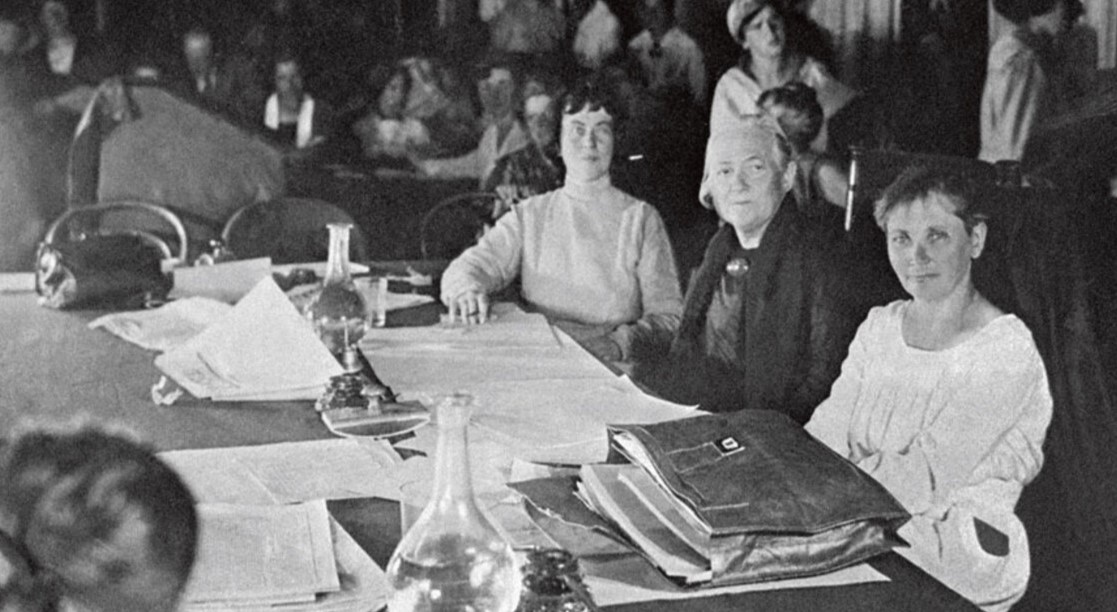
Else Baum (Edda Tennenbaum) looks at the participation of women during the Fourth World Congress of the Communist International and the ‘women’s question’ in its sections.
‘The “Women’s Question” at the IV World Congress’ by Else Baum from International Press Correspondence. Vol. 3 No. 7. January 18, 1923.
The women’s question was one of the items on the agenda of the IV World Congress of the Communist International. It was necessary to have this question discussed at the congress, for it is one of the most burning questions which confront the proletariat today and imperatively demands solution.
Capital is attacking all along the line, and the proletariat is completely lost if it does not defend itself tooth and nail. United and unanimous the proletariat must take up its position of defense, must oppose the front of the exploited to the front of capital. But this front will be incomplete, will contain gaps, if women do not take their place in it. The women who are exploited in the factories and workshops, who receive smaller wages than the men for the same work, or who work for untold hours in the household for repayment whatever; these women who today still form for the most part a compact reactionary mass, may tomorrow be the comrades in arms of the revolutionary, class-conscious, fighting workmen, if the communists succeed in winning their confidence.
These women are easily won over, for the capitalist offensive is sowing misery and death in their ranks. The abolition of the eight hour, day signifies more than prolonged working hours for the proletarian women. It signifies that they will now have to workday and night to fulfill their duties as worker, housewife, and mother. The women are the first sufferers when the regulations relating to workwomen, protection of motherhood, and social insurance, are slackened. The increased exploitation and starvation signify immediate danger to life for the women and their children: they are the easiest victims to tuberculosis. The objective conditions are thus i for winning over the women for the conflict.
The most important question is to ascertain what methods have proved most efficient in influencing the mentality of proletarian women? What are the results of experience? That special methods must be required to reach this backward section of the proletariat is clear to everyone who is not willfully blind. But at the congress, it was still necessary, to again draw attention to and specially emphasize the fact, that particular methods must be employed for inducing women to take their place in the proletarian fighting front. Comrade Zetkin made this perfectly clear in her emphatic and unequivocal speech: “We must not forget that the broad masses of women live under special social conditions. The exceptional position accorded to the female sex in human society has been the means of imparting a special psychology, and as a general rule it appears that women best understand how to carry out communist work amongst women. In the countries where such special organs exist, as for instance in Bulgaria, Germany, etc., the communist women’s movement has become a force in the general communist party life. The same naturally applies to Russia.”
It was necessary to emphasize this, for even within the Communist International there are comrades who have not sufficient faith in this work. They see spectres in broad daylight. They regard every attempt at special organization as an attempt to protect mere sex rights. Many comrades, especially in England and France, are still possessed with fear of the undoubtedly harmful women’s movements which have done so much to weaken class consciousness. The fear is without foundation. The line of class antagonism has been drawn with particular clearness during the last few years, it has not stopped at the “weaker sex”, and an unbridged chasm yawns between the worker bees industriously gathering treasure, and the drones of the leisured class. Women do not soar in the clouds like Raphael’s madonna, they stand with both feet on the hard ground of the capitalist world. The actual experience of recent years has demonstrated that there are no so-called purely feminine interests binding all women to one another without distinction of class. In every case where there is a question of so-called special women’s interests, in questions of protection for working women, mothers, and children, of aid during confinement, protest against abortion laws, etc., the women members of Parliament have invariably bowed obediently under the yoke of their class laws. The “women’s rights” movement has ceased to be a real danger to the class movement of the female proletariat.
Comrade Zetkin’s report on the work of the International Women’s Secretariat showed that a start has been made in all countries, that the beginnings of a communist women’s movement already exist. She could even report that excellent results have already been attained in various countries. Women, especially of late, have taken more and more active part in defending themselves against the lowering of their conditions of living, and against the abolition of the eight hour day. The awakening of the women of the proletariat was internationally expressed at the international women’s conference, and in the relief action for Soviet Russia. It could also be seen from the report that all the weaknesses and deficiencies of the party are mirrored in the women’s movement. The firmer and more purposeful in action a communist party is, the more united its organization, then the firmer and more concrete is the organization of the masses of women within this party and under its control. Every error and confusion within the party has a paralysing effect on the work of the women. Thus the strife in the French and Italian parties, and the weaknesses of the English Communist Party, have not failed to retard the mobilization of the proletarian women of these countries. Petty bourgeois reformist tendencies, retained by some parties as relics of a social democratic past, are also not without influence on the work amongst women.

Comrade Hertha Sturm was quite right when she referred in her report to a general weakness in the international proletarian movement. The women organized in the Communist Parties are, for the most part, housewives. Only a comparatively small number of women going out to earn, working in factories, etc., are organized in the Communist parties. There is no doubt that the proletarian housewife is a valuable, ally in the proletarian struggle, especially at the present time, when the fight against the shameful exploitation and increased misery of the proletariat is receiving the greatest impetus from the suffering housewives. But the fact must none the less be recognized that the participation of the proletarian women working in factories, workshops, etc. will be of more decisive significance, both as regards the great economic struggles for the improvement of conditions of living, and as regards the fight for political power. The times call for women to enter the proletarian fighting organizations, to enter the Party. This weakness of the Party has a fatal effect on the trade union movement. The communists in the trade unions have done very little up to now towards uniting and organizing the working women. This neglect must be made good. The efficiency of trade t ion work in factories and workshops, the establishment of closer relations between the communist nuclei and the leadership of the Party–these are the factors upon which the bringing about of closer connections depend, and these closer connections must be made between the centrals of political agitative work among the women and the working women organized in the communist nuclei.
Besides the report from Russia, which showed the steady systematic manner in which women are entering into the communist sphere of thought, and into the struggle for communist economics, there was another most interesting report, by comrade Kasparova, on work among the women of the Orient. Here communist agitative work falls on a soil already ploughed by capitalism.
During the congress there was a special meeting held by the women delegates from all countries, participated in by a number of male party comrades. This conference resulted in many stimulating ideas and practical suggestions for work among women being brought forward, and succeeded in bringing about that for which written intercourse had proved inadequate personal relations among the comrades, and insight into the conditions of the various parties which is so absolutely necessary if there is to be mutual comprehension, and if correct judgments on international conditions are to be formed.
With that openness which is only found in the Communist International, both the congress and the conference of women delegates discussed all the faults and deficiencies of the various parties and their work.
The resolutions passed by the congress will help to render the parties strong, united internally, and prepared for battle; when they are carried out in all seriousness, they will, at the same time, give a forward impetus to the proletarian women’s movement. The working class can neither defend itself successfully, nor effectually combat the bourgeoisie, if broad masses of proletarian women stand on one side, or even form an actual obstacle in the way. On the other hand, only the united working class can emancipate the working women. We communist women join with Klara Zetkin in saying: “We women want to take part in all the work and struggles of the Communist Parties and of the International and it is our ambition to stand in the front rank”.
International Press Correspondence, widely known as”Inprecorr” was published by the Executive Committee of the Communist International (ECCI) regularly in German and English, occasionally in many other languages, beginning in 1921 and lasting in English until 1938. Inprecorr’s role was to supply translated articles to the English-speaking press of the International from the Comintern’s different sections, as well as news and statements from the ECCI. Many ‘Daily Worker’ and ‘Communist’ articles originated in Inprecorr, and it also published articles by American comrades for use in other countries. It was published at least weekly, and often thrice weekly.
PDF of full issue: https://www.marxists.org/history/international/comintern/inprecor/1923/v03n07-jan-18-1923-Inprecor-loc.pdf
 Revolution's Newsstand