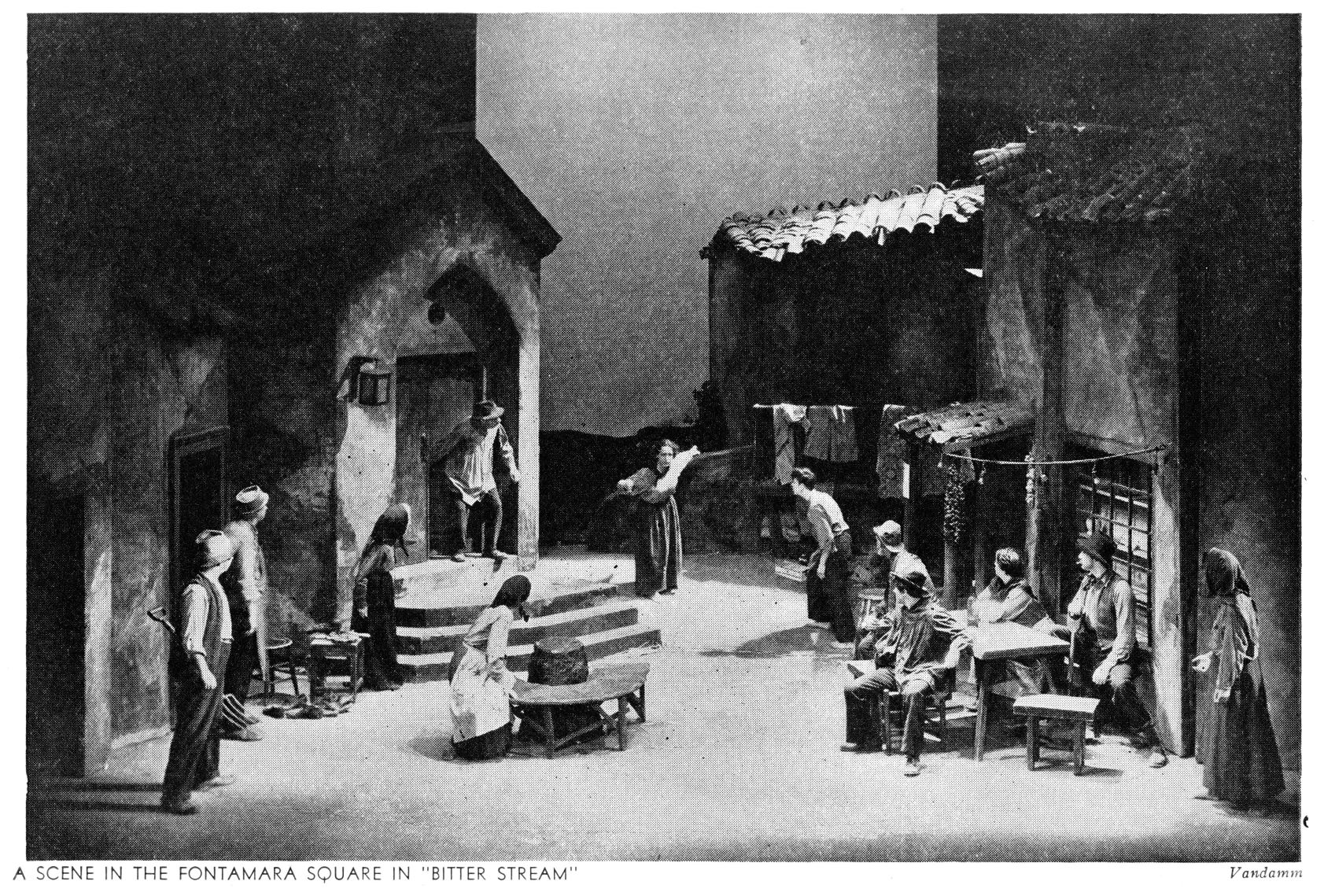
An introduction to Victor Wolfson’s ‘Bitter Stream,’ based on the novel ‘Fontamara’ by Ignazio Silone, about Mussolini’s Italy also takes a look at other anti-fascist plays of the time.
‘Anti-Fascist Play for Theatre Party’ by Martha Dreiblatt from Socialist Call. Vol. 2 No. 53. March 28, 1936.
“BITTER STREAM” HITS MUSSOLINI’S FASCISM
For one reason or another, the theatre tends to lag behind world events one of the reasons, perhaps, is that it takes time for a writer to assimilate the significance of events behind the headlines in order to present them in a creative piece of work.
Thus, though Fascism has occupied a large portion of the front pages of our newspapers, there have been a scant half-dozen plays shown in this country dealing with this central issue of life today, or even with the highly dramatic material of the conflicts that arise under Fascist rule.
The Theatre Union’s production of “Bitter Stream,” the play by Victor Wolfson based on the novel. “Fontamara,” by Ignazio Silone, which opens Monday evening. March 30th, at the Civic Repertory Theatre–and will be seen before that date by those who attend the preview performances given under the auspices of the Socialist Party, March 26-27-28–adds to this number and is the first play about Fascist Italy to be shown on the American stage.
It is also the first of the anti-Fascist plays whose main theme is the fate of the masses of the people, of the workers and farmers, under Fascism; showing what it means in their daily living, and their struggles to find a way out.
Previous Plays
Of the others, in almost every instance Nazi Germany, the fate of the intellectual, and the Jewish question particularly, have been the background of, and provided the material for, the stories they told. One of the earliest of the anti-Fascist plays shown here, for example, was “The Shattered Lamp,” depicting the plight of the German Jewish intellectual married to a Gentile wife.
“Dr. Mamlock,” by Friederich Wolf, which has not yet been produced in New York, also deals with the problem of the Jewish intellectual in the early days of Hitler Germany. “Blood On the Moon,” by Claire and Paul Sifton, also not yet produced in New York, has a similar theme, and so did “Races,” the Bruckner play which the Theatre Guild several times tried out-of-town, before deciding against bringing it to Broadway.
“Till the Day I Die,” the tragedy of a Communist Party member under Nazism, and “Judgment Day,” the material of which was taken from the Dimitroff case, but which concentrated on exposing the machinations of Hitler’s government rather than on the class Dimitroff represented, complete the list.
“Bitter Stream”” One might add also the just-opened “Idiot’s Delight,” the action of which takes place in an Alpine resort on the eve of the next World War, and which shows the impact of Fascism on the tourist abroad.
“Bitter Stream has for its locale Italy in the first decade of Fascist rule, and its people are the men and women of Fontamara, whose farmers own tiny plots of sterile earth, and who must therefore hire out as day-laborers in the fertile miles of fields owned by absentee landlords in order to eke out a living.
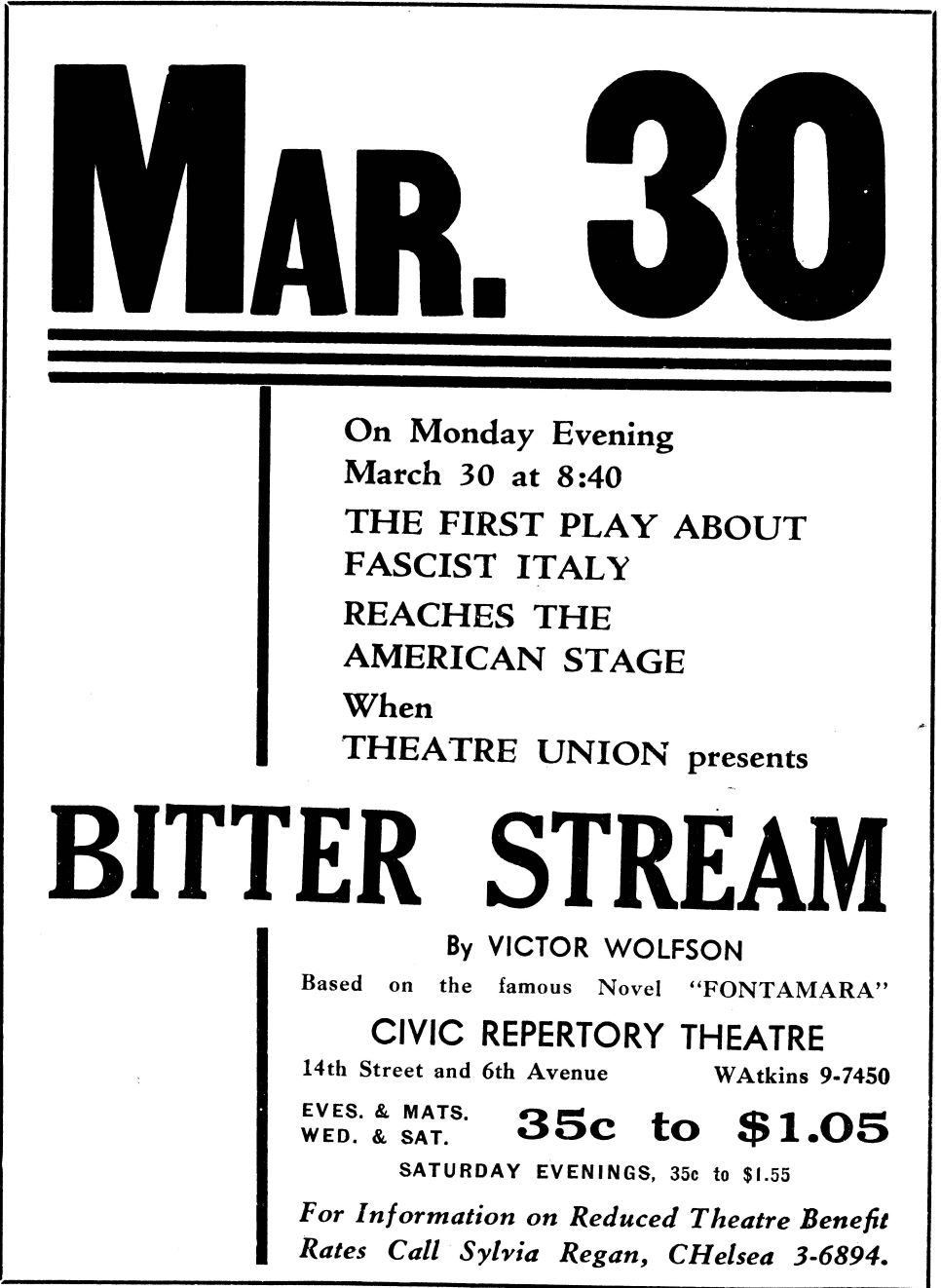
The relevancy of its story to conditions today is brought out by the following quotation from a news report published about six weeks ago in the New York Post. which almost duplicates the basic plot of the play.
According to a report in the Observatore Romano, the dispatch in the Post read, a congress of Italian peasants has just repeated its demand for the division of Italy’s large, landed estates among the poor peasantry. As was to be expected, their appeal fell on deaf ears.
Edmondo Rossoni, Italy’s Minister of Agriculture, was interviewed on the subject not long ago by a correspondent of the New Statesman and Nation, a London weekly. Signor Rossoni was the first organizer of the Fascist trade unions. When Mussolini, in April, 1920. declared that “the land is for those who use it,” Rossoni expressed enthusiastic approval.
Fascists Aid Landlords
The Statesman’s correspondent asked him, “Why not take care of your surplus population by a system of remedial farm legislation instead of trying to conquer Abyssinia?”
“We cannot deprive our landlords of their property,” was the answer. “As for the war against Ethiopia–its economical aspects are far less important than its moral and political objectives.” “But,” the correspondent objected, “what is there to stop you from taking this land for your poor farmers? You are a dictatorship. If you can send your people to war where they will lose their lives for the greater good, why not deprive the absentee landlord of his land for the same reason?” “To which Signor Rossoni replied, “We are Fascists, not Socialists!”
In presenting “Bitter Stream,” the Theatre Union believes that it is producing a play which, through the terms of a human, moving story, mirrors the basic pattern of Fascism, and helps in understanding Italy today and the struggles of all workers and farmers under Fascist rule.
Socialist Call began as a weekly newspaper in New York in early 1935 by supporters of the Socialist Party’s Militant Faction Samuel DeWitt, Herbert Zam, Max Delson, Amicus Most, and Haim Kantorovitch, with others to rival the Old Guard’s ‘New Leader’. The Call Education Institute was also inaugurated as a rival to the right’s Rand School. In 1937, the Call as the Militant voice would fall victim to Party turmoil, becoming a paper of the Socialist Party leading bodies as it moved to Chicago in 1938, to Milwaukee in 1939, where it was renamed “The Call” and back to New York in 1940 where it eventually resumed the “Socialist Call” name and was published until 1954.
PDF of full issue: https://www.marxists.org/history/usa/pubs/socialist-call/call%202-53.pdf
 Revolution's Newsstand