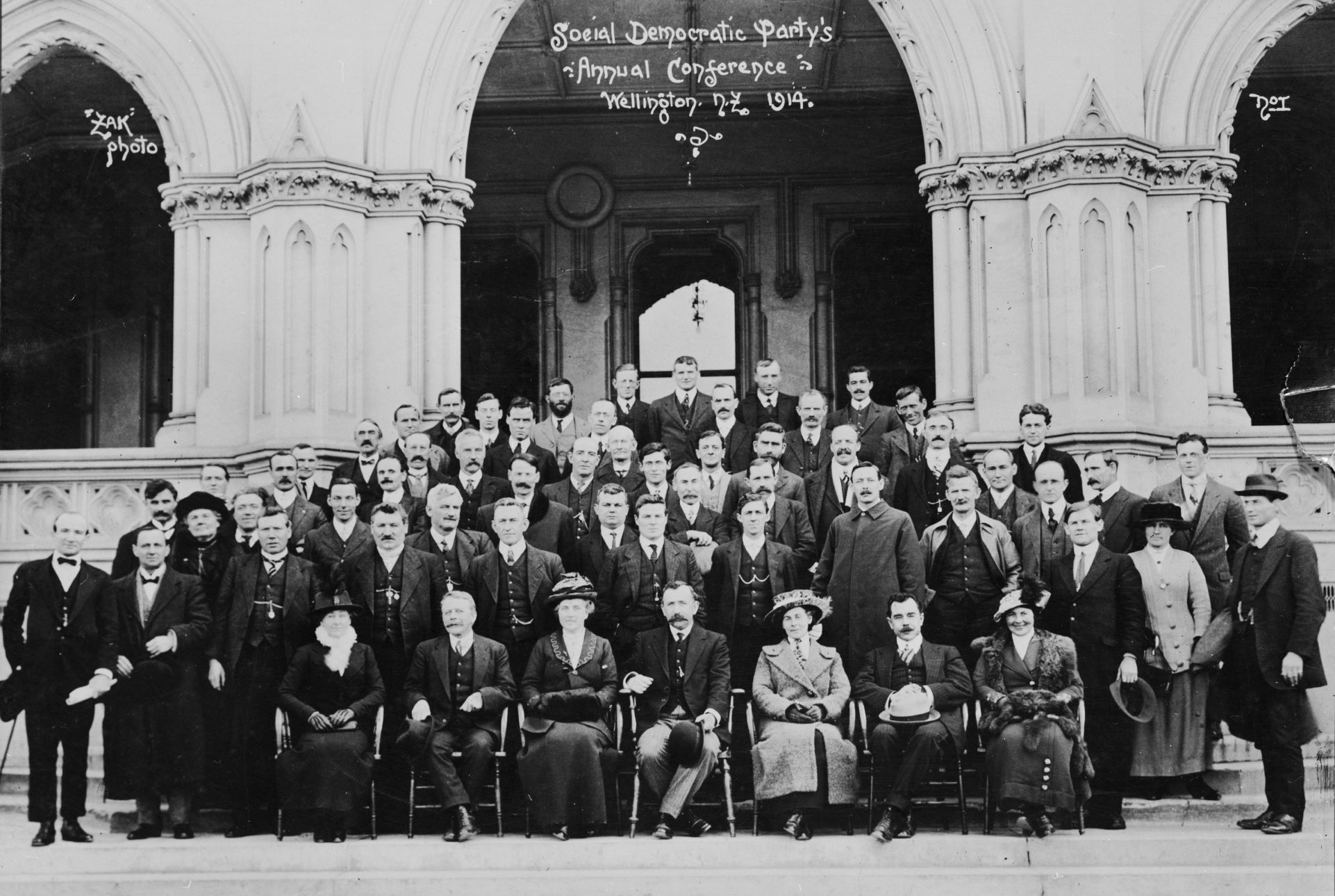
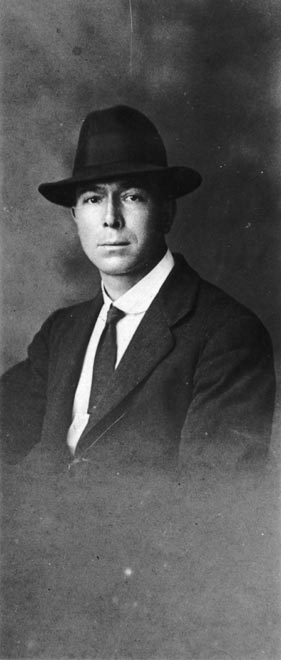
Ernest John Bartlett Allen on New Zealand’s workers’ movement.
‘The Labour Movement in New Zealand’ by E.J.B. Allen from International Press Correspondence. Vol. 4 No. 80. November 20, 1924.
Apart from a few isolated enthusiasts there are no revolutionaries in New Zealand. This country suffers from an overwhelming attack of “Swelled head”. “It is God’s Own Country”! At least, so the people have been solemnly assured by a succession of imported Governors and Governor-Generals, as they are now styled, New Zealand is intensely “loyal”. For instance, in order to insure that the National Anthem be sung at most public meetings, instead of the usual custom of singing it at the close, the first verse is sung at the beginning of the meeting. School children are marched out of school on every Monday morning to “Salute the Union Jack”, the flag of the “brave and the free”. All teachers and other public officials have to take a special “oath of Allegiance” and so does every person who lands on these shores. The amusing part about it all is that the English financiers who run this country on their loans, skin the farmers for all they are worth by the manipulation of the London Markets. A rise in the Bank rate in London sends a number of traders through the bankruptcy courts.
New Zealand has for some time been labouring under a financial crisis, and which is likely to continue for the next two years. The first people to suffer have been the returned soldiers who had been settled on land at inflated prices by the Tory Government, who had purchased huge blocks from their landed friends. When the fall in the London price of Butter and meat occurred, as a result of the cessation of purchases by the English Government, and increased competition from Ireland, Denmark, and the Argentine, as well as the export of butter from Siberia, the price paid to the actual producer was not sufficient to meet the interest on the mortgages on the land. Thousands of farmers have become bankrupt. They have simply walked off the farms and left the mortgagees, whether Government, banks or loan associations, to take the farms as it is impossible to make them pay at the inflated prices paid during the war boom and government purchasing. This year the trading section has been hit. All those business firms working on overdrafts have been pulled up, credit restricted and hundreds forced out of business. Not only have the small men gone, but many large firms also have gone into liquidation, either voluntary or forced. The Labour market is overstocked. The Government is pouring emigrants into the country from Great Britain to make sure of a large and loyal population when the war in the Pacific breaks out.
Australia and New Zealand are only useful as dumping grounds for England’s unemployed. They are not worth the expense of holding. They are undeveloped, and as far as New Zealand is concerned will never be anything more than an agricultural and pastoral country. There is gold here, and coal, but no iron has yet been discovered in commercially workable quantities. There may be oil, but up till now each company formed to develop the oil fields have simply run out of business, in spite of the heavy Government subsidies paid them. The British Government has an oil depot in Auckland for the ships of the Imperial Navy and probably will establish them elsewhere in the Dominion.
The English finance capitalists lend money at good rates of interest to the New Zealand Government. The greater portion of this money goes to pay interest and also the salaries of the thousands of government officials most of whom are unnecessary. The place is overrun with officials of one kind and another. The result is seen in the fact that there is only one person in five who is engaged in real productive work. This is an extraordinary proportion in a country that has only a million and quarter inhabitants all told. In the city of Auckland the number of agents. shopkeepers, lawyers etc. is enormous. It is possible that the ultimate revolutionary impulse will come from this “professional” proletariat, who are too numerous for all to gain an adequate living.
There is a fairly strong Labour Party here. It is similar to the Labour Party of Australia and England, MacDonald is the hero of the Labour Party’s, official organ The New Zealand Worker. The Labour Party itself is composed of a number of Trade Unions, nearly all of them believers in arbitration. The delegates to the conferences are generally the paid professional secretaries, most of whom have a vested interest in holding on to their job, and never fighting the bosses for fear of the union being broken up and their safe jobs vanishing.
There are one or two small local socialist propagandist bodies adhering to the Labour Party. They are relics of the old Socialist Party of New Zealand which at one time was a militant body. There are some pacifist organisations affiliated and some feminist bodies. It has a fairly proletarian rank and file but the people who are being selected as parliamentary candidates are lawyers, professional men, small business men, professional trade union officials and very few of the purely working class, in proportion. There is a fairly good chance of the Labour Party winning the farmers’ vote on account of their propaganda for State Banking. The farmers can understand how they are in the grip of mortgagees and banks, and they are also beginning to understand how the London market is manipulated against them. Thus with a direct appeal to the workers, to the civil servants, who are numerous, regarding obtaining full civil rights and restoration of war bonus, and to the small business man and farmer as to state banking, there is a likelihood of the Labour Party obtaining a majority at the general elections in a year’s time, or at least in the succeeding general election in four years time. Not until the Labour Party has been in power and failed to make good can there be a Communist mass party. Until then the most that can be done is the formation of propaganda groups.
There is a difference of opinion as to the best tactics to he pursued at the present time. Some are of the opinion that the best work can be done by working inside the Labour Party, but also supporting independent propaganda outside. Others argue that the Labour Party, from its very nature, cannot be different from those of Australia and England, that we shall have to fig them sooner or later, and that we therefore might as well carry on an oppositional propaganda right away. Until the Labour Party has assumed office, no one can really tell what it will do. It has so many heterogenous elements within itself, some of them really revolutionary, that whilst we may think we know, yet we cannot actually say until we see how the members of parliament react to the influence of the rank and file. It is possible that they may do different to the others, though it is not likely. They are for the “Empire Labour Party”, they consider that there is a democratic mission for The Empire to fulfil.

There was a revolutionary spirit abroad in the General Strike of 1913, when the miners, waterside-workers, drivers, and many other workers came out in a solidarity strike. This was defeated by the Government, with the same premier, Massey, who holds office at the present time. Special police were organised, British warships in the Pacific came to the principal ports, the guns were trained on the wharves, machine guns mounted on public buildings, and the permanent military force kept under arms and used. The Labour Party derived its birth from that struggle. Just as the Taff Vale decision gave birth to the Labour Representation Committee in England twenty five years ago, so the defeat of this strike was really the beginning of the Labour Party. It is not revolutionary, most of its spokesmen are pacifists, and would I be as much opposed to a civil war for emancipation as they are to any Imperialist war. Some of their resolutions at the Party Conference distinctly state that fact. However, they have established a Labour Research Bureau, and have made the workers familiar with a number of facts relative to the banks etc. Theoretically, they are democrats; they place an overwhelming importance on the establishment of proportional representation. The most inspiring feature of late has been the formation in Auckland of a New Zealand Plebs League along the lines of the English one. It is hoped that sufficient educational work can be accomplished so that a good nucleus of communists will be ready when the Labour Party fails. At any rate a good educational work along Marxist lines will be carried on and it is sure to influence the rank and file of the unions.
International Press Correspondence, widely known as”Inprecorr” was published by the Executive Committee of the Communist International (ECCI) regularly in German and English, occasionally in many other languages, beginning in 1921 and lasting in English until 1938. Inprecorr’s role was to supply translated articles to the English-speaking press of the International from the Comintern’s different sections, as well as news and statements from the ECCI. Many ‘Daily Worker’ and ‘Communist’ articles originated in Inprecorr, and it also published articles by American comrades for use in other countries. It was published at least weekly, and often thrice weekly.
PDF of full issue: https://www.marxists.org/history/international/comintern/inprecor/1924/v04n80-nov-20-1924-Inprecor-cpgb.pdf
 Revolution's Newsstand