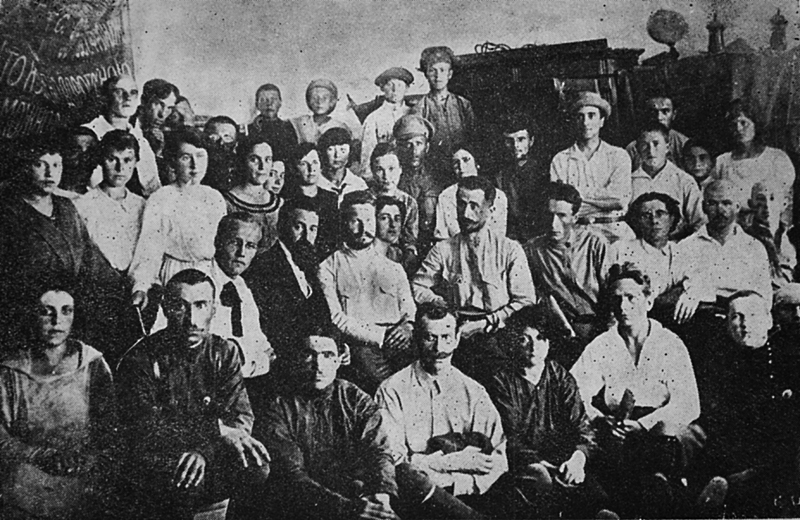
Ghiță Moscu was a Socialist activist, veteran of the Balkan Wars, a founder of Romanian Communism and its delegate to the Comintern. In the Comintern he was Romanian organizer for the Balkan Communist Federation. Along with his wife, also a Comintern worker, he settled in Moscow where he would eventually fall victim to the Purges and executed in 1937–later ‘rehabilitated.’
‘The Nationality Question in Roumania’ by Al. Badulescu (Ghiță Moscu) from International Press Correspondence. Vol. 3 No. 51. July 19, 1923.
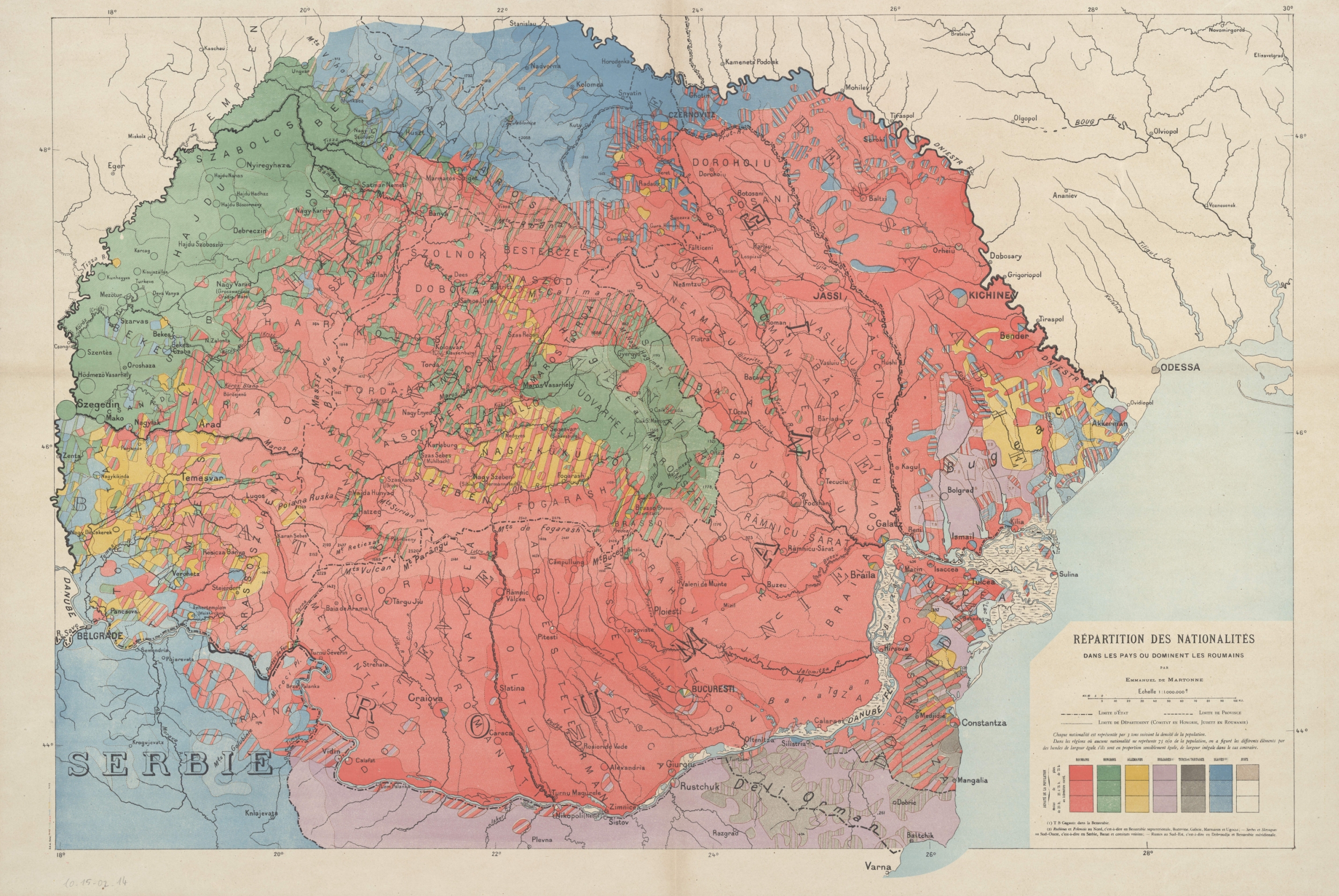
Before the great war there was no nationality question in Roumania. Although many hundreds of thousands of human beings of foreign nationalities had been living there for a long time–in 1911 there were about 300,000 Jews in Moldau and Walachia, and 140,000 Bulgarians and Turks in Dobrudscha (these latter were included in Roumania after the Russo-Turkish war of 1877)–still the ruling classes of Roumania contrived to hush the matter up. The Jews adapted themselves rapidly, and have never made any national demands. The peoples of Dobrudscha had, since they spoke a foreign tongue, no opportunity of bringing up the national question; this province was regarded and treated as a colony for more than 30 years. Today the situation is very different. At the present time Roumania is a state containing nationalities in the fullest sense of the world. The statistics show that out of a population numbering about 17 millions, one third is of foreign nationality. In the separate districts of Roumania the proportions are as follows: In Old Roumania 69.9% Roumanians, in Bukovina 34.4% Roumanians, in Transylvania 57.7% Roumanians, in Banat 524,637 Roumanians and 442,345 persons of other nationalities, in Maramuresch 78,284 Roumanians and” 488,382 of other nationalities, and in Bessarabia 1,688,000 Roumanians and 954,000 of other nationalities. The peoples who speak a foreign tongue are represented, as regards numerical strength, in the following order: Hungarians, Jews, Germans, Ruthenes, Ukrainians, Bulgarians, Russians, Poles, Slovaks, etc.
Thus, although Roumania possesses a foreign population numbering over five million souls, the Roumanian bourgeoisie still thought to solve the nationality question “alone”. The discontentment and the desires of the national minorities began to be heard in Parliament. The Government, the Liberal Party headed by Bratianu, added the following clause to the Constitution: “All Roumanians, irrespective of origin, speech, or religion, enjoy all the public liberties granted by the laws and constitution, as liberty of opinion, instruction, press and coalition.” The deputy for Transylvania demanded, in opposition to this, that the term “Roumanian” be altered in the constitution to “Roumanian citizen”, and that the liberties enumerated in the Constitution be granted equally to all citizens, that is, also to the minorities. This motion was not accepted.
This time the bourgeois opposition parties were not entirely on the side of the minorities, for in their struggle for power they simply opposed the Constitution. It was only from time to time that some “independent” newspapers ventured to maintain that “the nationality problem is one of the utmost importance, and the internal peace of the state will be dependent on its solution”.
The nationalities are formally represented in Parliament, but their representatives fight in the interests of the bourgeois parties. Thus, for instance, the Germans from Transylvania form an expressly conservative party, and the Hungarians will go completely over to the camp of the Bratianu party as soon as the latter has contrived a partial solution of the nationality problem (one section of the Hungarians has already joined this party). The “Federation of native Jews” sells itself to the most powerful. The Bulgarians do not yet venture to speak, the Russians still less. The Ukrainians are branded as “suspicious elements”, and their every footstep closely followed. And, above all, so long as the majority of the people, the working class, has not yet gained its most elementary rights as citizens in this country, so long can there be little hope of acquiring rights for the national minorities.
A few recent examples of the persecution of nationalities will confirm this: The teachers in Bessarabia were prohibited from speaking Russian with the parents of the school children. In the initial stage of their struggle for the “numerus clausus” the Transylvanian students distributed leaflets against the rights of the nationalities. In Oradia Mare the Police President ordered that the gipsy (Hungarian) bands should learn to play the Roumanian national anthem within 3 days (!). Many thousands of Hungarian officials were discharged because they did not know the Roumanian language. Courses of instruction in the language have not been given for four years. The Hungarian school in Oradia Mare has been closed. Many Hungarians, although Roumanian subjects, have been deported from the country. After the general strike in October, 1920, thousands of workers were driven across the border into Horthy Hungary. Many Hungarian teachers are being discharged, and are not accorded the pension to which they are entitled by law. Thousands of Hungarians, Russians and Ukrainians are being thrown into prison for risings, attempted assassinations, irredentist propaganda, etc. In Cadrilater the Bulgarian schools are not only not supported by the state, but even the private schools suffer severe persecution. The orthodox church has been proclaimed as “dominant “. The Hungarian Protestant students are not admitted to the orthodox theological faculty. Anti-Semitism is supported by the bourgeois parties. The Russian students are excluded from the universities; on the other hand, they are prohibited from travelling abroad.
All this naturally does not prevent the bourgeois circles of Roumania from continuing their national agitation. The only parties really doing serious work towards the solution of the nationality problem are the labor parties, and they are doing it in spite of the obstacles put in the way’ of their continued existence and activities. To be sure, great differences exist even among these. The Social Democratic Party, true to its democratic principles, declares that questions of languages and schools are questions of democracy and culture; that the language in which instruction is given in the public schools is a matter of the nationality of the district in question; that, in intercourse between the authorities and the population, every nationality has the right to tender its requests in its own language, and to be heard and answered in its own language; that in all public corporations the minorities must be represented in accordance with their size. The Social Democratic Party demands a national school as well, in, which the Roumanian language forms one of the subjects of instruction. All this is demanded without any mention of the fact that the nationality question can only be solved when the class question is simultaneously solved. social democrats declare instead that the nationality question is “only partially a class question”. The Communist Party, on the other hand, true to its revolutionary principles, true to revolutionary Marxism, is already conducting a real struggle for the rights of the minorities, and maintains the following standpoint: The emancipation of the oppressed nationalities can only be achieved by the victory of the proletariat, and by the overthrow of the oligarchy. The nationality problem of Roumania is a part of the nationality problem of the whole of the Balkans, which are inhabited by so many different nationalities. These nationalities can only obtain complete national liberty through a Socialist Federated Balkan Soviet Republic. The correctness of this revolutionary standpoint is proved by the fact that, despite the world-wide carnage, alleged to have been let loose for the “emancipation of national minorities”, the nationality question remains the most difficult and disagreeable problem of the states of Central Europe and the Balkans. The Federation of the Soviet Republics of Russia shows us the only way to the real solution of this problem.
International Press Correspondence, widely known as”Inprecorr” was published by the Executive Committee of the Communist International (ECCI) regularly in German and English, occasionally in many other languages, beginning in 1921 and lasting in English until 1938. Inprecorr’s role was to supply translated articles to the English-speaking press of the International from the Comintern’s different sections, as well as news and statements from the ECCI. Many ‘Daily Worker’ and ‘Communist’ articles originated in Inprecorr, and it also published articles by American comrades for use in other countries. It was published at least weekly, and often thrice weekly.
PDF of full issue: https://www.marxists.org/history/international/comintern/inprecor/1923/v03n51[30]-jul-19-1923-Inprecor-loc.pdf
 Revolution's Newsstand