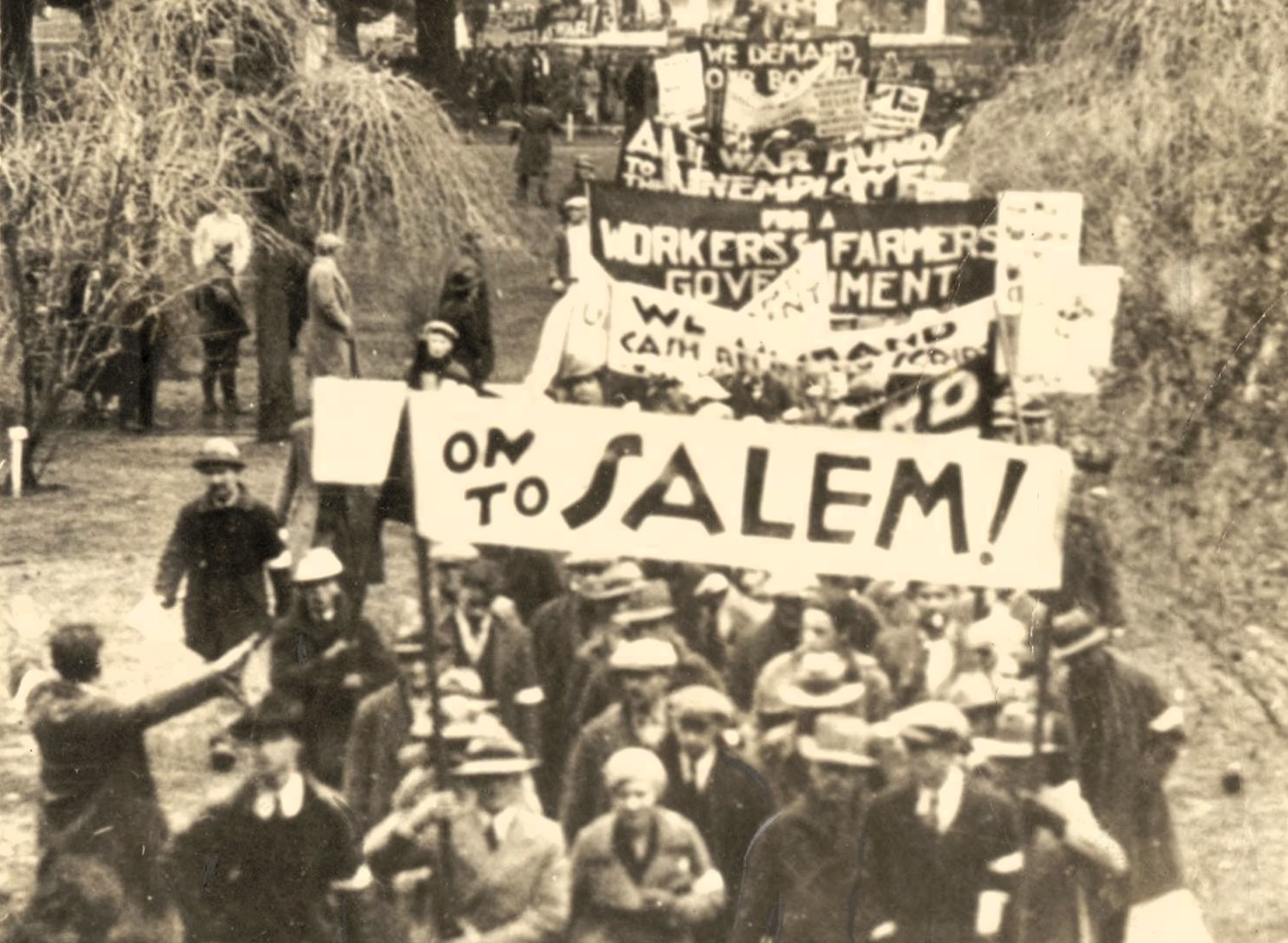
As part of the Hunger Marches workers and unemployed descend on the capital of Oregon to demand immediate relief during the Great Depression.
‘Oregon March, Biggest Delegation Yet Seen’ by Dawn Lovelace from Western Worker. Vol. 2 No. 4. January 23, 1933.
SALEM, Ore., January 9. In a strong united front 1000 workers and farmers from all over the state of Oregon, the biggest delegation yet seen here marched on the state capital and demanded immediate relief. Among the demands were: “No eviction, moratorium of taxes and debts, defeat of any sales tax, cash winter relief, unemployment insurance, cessation of all military training in schools and repeal of the Criminal Syndicalist Law.” At least 100 marchers walked from Portland in a well-organized, disciplined parade stopping at cities along the route where demonstrations were held and the workers mobilized to support the march. Workers and farmers were marching into Salem from all directions, joining and swelling the ranks.
There was not a worker present who was not impressed by the unity and cohesion of all workers, farmers and veterans. The youth responded with a large, militant delegation.
HOLD CONFERENCE
There were special conferences of the youth, the farmers, the unemployed and the veterans, and out of each conference a constructive, concrete program, was formulated, demands drawn up, and basis laid for future activity.
In a mammoth conference which filled the largest hall available, all groups were united and a presidium was elected to organize the demands and present them to the Legislature. Because of the large number of workers, a meeting had to be conducted in the park during the United Front Conference.
Fred Walker made the key-note speech at the conference and exposed the capitalist Legislature by showing the workers how inadequately they are meeting this emergency and failure of any program that would provide for the 180,000 unemployed and the impoverished farmers.
BIG PARADE
Comrade Walker was elected as general spokesman for the presentation of demands, with Comrade Helen Quist as youth spokesman, Comrade Ramp of Roseburg as farmer representative, Comrade Seth Nordling of Portland to stress the unemployed demands, and Comrade Richard Lovelace of Portland to present the demands of the veterans. The veterans, well represented on the march, demanded that the State Legislature memorialize the National Congress to provide for immediate payment of the bonus and other relief demands for the veterans.
In a parade several blocks in length, with banner flaunting militant slogans, the workers showed their strength to the Legislature as the demands were presented at the Capitol Building.
The demands were presented to a joint session of the Senate and Assembly, with the Governor sitting in. The Assembly room was packed with the marchers, who were not hesitant in occupying the soft seats. The capitol building was packed to overflowing.
Two hours were given to the committee. The legislators got an earful on the condition of the jobless throughout the State. The outcome was a promise to “investigate and study” the situation.
The unemployed started home, cheered by the great demonstration but knowing that unless the fight keeps up in all localities, the legislators will be only too glad to forget the whole incident.
Western Worker was the publication of the Communist Party in the western United States, focused on the Pacific Coast, from 1933 until 1937. Originally published twice monthly in San Francisco, it grew to a weekly, then a twice-weekly and then merged with the Party’s Daily Worker on the West Coast to form the People’s Daily World which published until 1957. Its issues contain a wealth of information on Communist activity and cultural events in the west of those years.
PDF of full issue: https://www.marxists.org/history/usa/pubs/westernworker/1933/v2n04-jan-23-1933.pdf
 Revolution's Newsstand