
An insider’s look at Akron’s massive rubber industry between organizing drives.
‘Rubber Slavery at Akron’ by A Rubber Worker from Industrial Pioneer. Vol. 3 No. 4. August, 1925.
WITHIN the last few years the rubber industry has assumed the proportions of a basic industry in this country and it is hardly receiving the attention from unionists that its importance would seem to merit. The production of rubber goods in the United States this year will be valued at about a billion dollars, over half of which will be produced in Akron, Ohio, where some forty or fifty thousand workers are employed without a vestige of organization.
The only rubber workers’ union in this country is at Carrolton, Ohio, where a hundred or so workers are employed by the Tuscan Tire and Rubber Company. They are organized by the company for the use of the A.F. of L. union label which is expected to sell their product and save them from the fate that is in store for the small scale, inefficient manufacturers.
Akron is the center of this world-wide industry and is the home of many of the larger manufacturers, including Goodyear, Goodrich, Firestone, Miller and a score or more smaller ones. With the exception of Firestone all these larger shops and many of the small ones are owned or controlled by New York financiers.
These larger shops are giant horizontal trusts with their tentacles reaching out to all parts of the world and with distributing agencies everywhere, all under one management. The trend at present is to save transportation costs and tariff duties by establishing manufacturing plants in all the principal consuming countries.
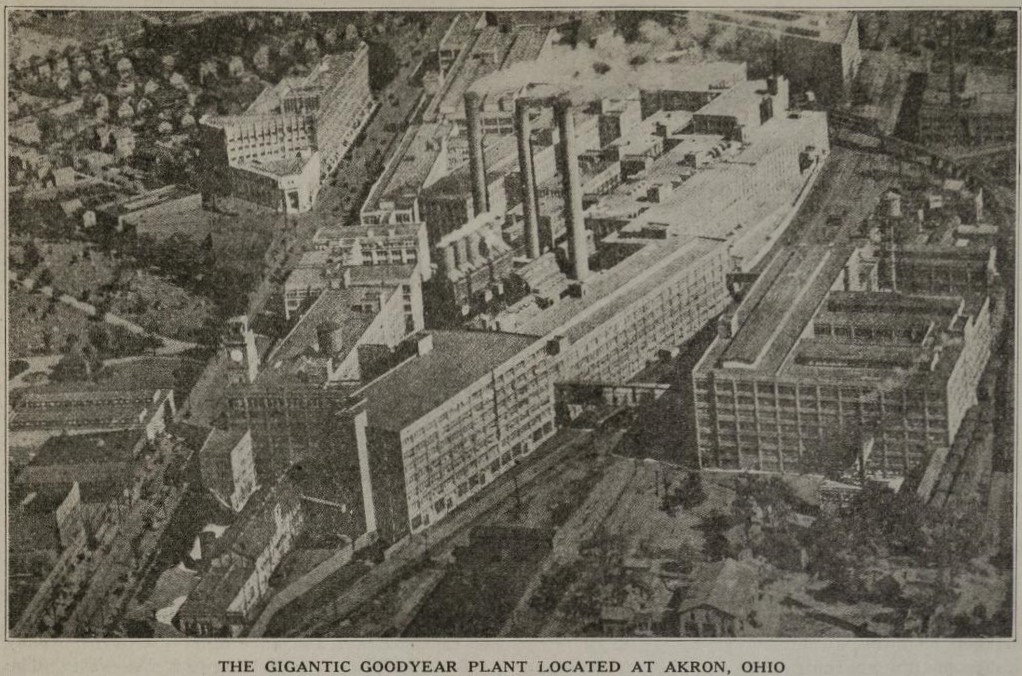
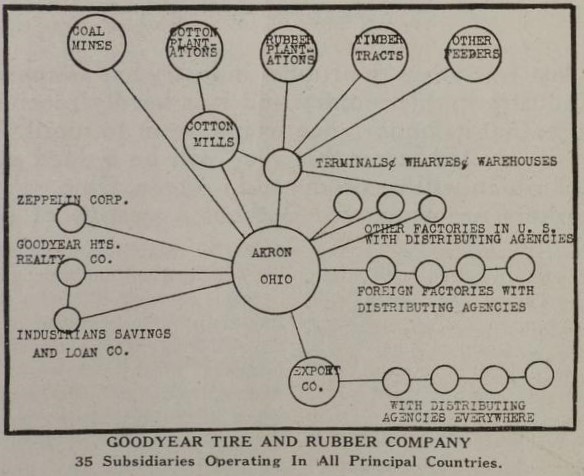
Some conception of the ramifications of these imperialist industries can be had by a perusal of the holdings of the Goodyear Tire and Rubber company, which is shown in the diagram. It is a 156-million-dollar business with 113 acres of floor space in the two Akron plants which have a tire producing capacity of 35,000 daily beside all the thousands of other hard and live rubber products. In 1923 this company produced, in Akron, California and Canada, 9,250,000 tires, 81,000,000 pairs of heels and 25,000,000 feet of hose. They used 50,000 tons of crude rubber and 15,500,000 kilowatt hours of electricity. These plants combined have a floor space of 166 acres.
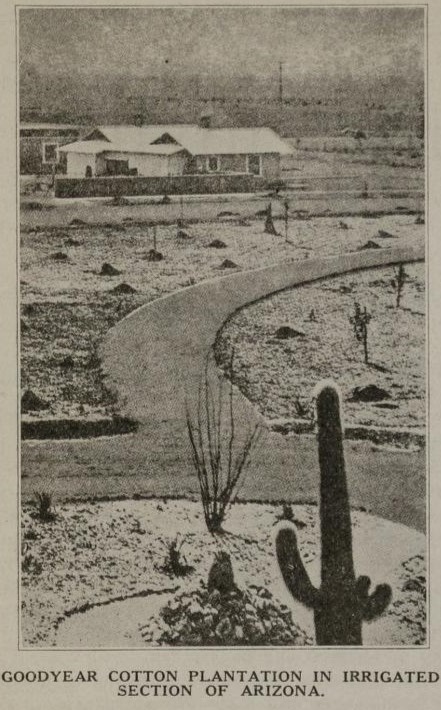
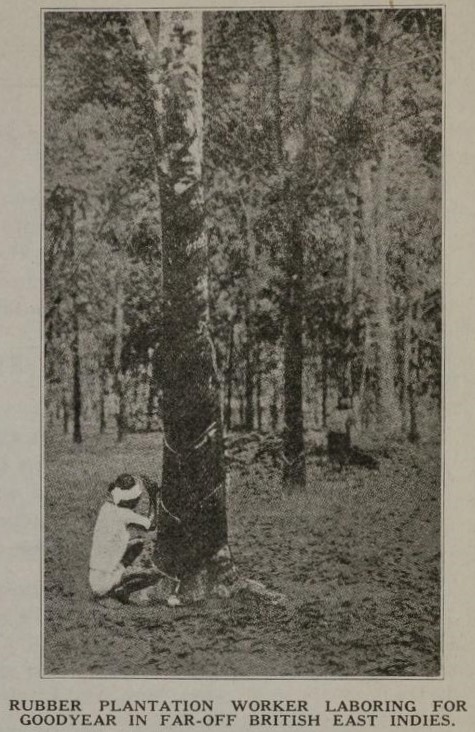
This company has some thirty-five subsidiaries which include coal mines, rubber plantations, cotton plantations with irrigation projects, textile mills, timber tracts, a banking institution and rubber factories in at least ten foreign countries. This list is constantly growing, as they have within the last few months added the million and a half dollar Marathon Tire and Rubber Company at Cuyahoga Falls, a suburb of Akron, and have paid several million dollars for two more textile mills at New Bedford, Massachusetts. The Zeppelin Corporation is also a recent acquisition, although they have for several years been building balloons and airships of the non-rigid and semi-rigid type and have an immense hangar and field near Akron. The Dodge Brothers Company of Detroit, Michigan and Walkerville, Ontario, Canada, has been purchased by Dillon, Read and Company of New York who own the Goodyear Tire and Rubber Company. It is reported that they expect to add several more automobile plants to their string. These will not be a part of Goodyear but will be owned by the same group of capitalists, and E.G. Wilmer, who is chairman of the board of directors of Goodyear is expected to be president of the new company. If he holds both positions at the same time it can be seen that cooperation between them will be very close.
It can plainly be seen that capital is truly international and that narrow nationalism is intended to keep only the workers divided.
Apropos the concentration of capital, it is interesting to note that despite the marvelous growth of the industry in the last few years the number of rubber companies in the United States has decreased from 300 to 100 or 66 per cent since 1900.
The ratio of units produced to men employed has increased by leaps and bounds.
In only a few years production has more than doubled, while the number of men and women employed has been reduced to less than a third.
This is accomplished by adding more elaborate machinery, by simplifying the process, and last, but by far the most important, by increasing the already killing speed at which the men have to work.
These large companies are firm believers in industrial unionism and have powerful organizations. They will not tolerate it among the workers, however, and will ruthlessly crush even an A.F. of L. union with spies and intimidation if necessary, but in most cases it has been found more effective to amuse the workers with many diversions and schemes to keep their minds off their troubles. Of these schemes there are many, including sports and athletics, clubs, etc., and the Goodyear has the best one of all. They call it “Industrial Democracy.”
Goodyear’s Industrial Democracy
The Industrial Assembly was established in 1919 and is patterned after the National Congress. It is composed of a Senate of 20 members with at least five years’ service and a House of Representatives of 40 members with at least one year of service. These are elected by the Industrians. The Industrians are American citizens, 18 years of age or over, and have at least six months’ service with the company. Note how they promote race consciousness and division among the workers.
Members of the assembly are in perpetual fear of their jobs and of course are very servile. Once however, when the assembly was first organized, some of the more intrepid started a move to raise the wages of all workers by fifteen per cent. This passed the House and Senate but was vetoed by the factory manager. It was passed again over his veto and went to the board of directors where it was again vetoed, their action being final.
There are always plenty of candidates for office as members of the Assembly as these members, while attending to their duties get their regular pay plus ten per cent and have other privileges. They have no difficulty in getting out the vote. The factory manager makes the statement that to vote is a privilege and a duty and the votes are cast. In my department at last election there were but two who did not vote. I didn’t hear who the other was or what happened to him, but I’ve been doing all the most disagreeable work ever since.
The department managers actually make work for the Assembly by imposing some petty tyranny on the workers, then very obligingly adjusting the matter when it is up by the committee, thus giving the Assembly a great deal of credit. Strange as it may seem, there are a few workers who believe this “Democracy” to be a great blessing conferred upon them by a benevolent employer.
It is a dandy little play thing to keep the children out of mischief.
Flying Squadron
Following the 1913 strike, which crippled the shops here for some time, the Goodyear formed what they called the “Flying Squadron.” It is composed of about 60 men, two added each year, and who are carefully selected for “character” which means loyalty to the boss. They are given three years’ training, then given a regular job in some department where they are treated the same as anyone else except that they would be the last to go when workers are laid off and that they are subject to call in case of “emergency.”
During the three years these men have to work in every department and learn practically every operation. They are also given physical and some technical training in Goodyear’s private head-fixing institution. The Goodyear Industrial University. There is also a lot of folderal that it designed to make the squad man feel very superior to his fellow workers. The object of the flying squadron is to provide a body of loyal workers trained to break a strike in any department should one occur. It is, however, mainly effective as a moral influence or threat and would be powerless in case all the workers in the shop were organized’ so as to make possible a shop-wide strike.
The Old Game of Debt
One of the very effective schemes this company has for keeping the workers’ noses on the stone is to keep them in debt. Goodyear owned several tracts of land in and near Akron, and one of these, known as Goodyear Heights, was consigned to a subsidiary known as Goodyear Heights Realty Company, which operates in close cooperation with another subsidiary, The Industrians Savings and Loan Company. The Goodyear Heights Realty Company subdivided this tract into very small lots, constructed streets, sewers and other necessities and built what they had the nerve to call houses. These houses were very pretty when first built, but were constructed as cheaply as possible. It has been said of them that there is just enough house to hold the paint and wallpaper in a vertical position. These houses sold to Goodyear employes on the installment plan for from three to seven thousand dollars, with the understanding that if the purchaser stayed with the company a specified period of time a portion of the purchase price would be deducted. Consequently, those purchasers are very careful not to do anything that would bring about their dismissal.
Many of these homes will be mortgaged when they have fallen down.
A.F. of L. Treachery
Early in 1923 a few hundred tire and band builders employed at Goodrich came out on an unorganized strike against a cut in wages. They went to Central Union hall and elected a strike committee led by two individuals who were later found to be private detective. This committee, at the suggestion of Sam Newman of the machinists, sent for an A.F. of L. organizer to come and try to organize the rubber workers. Let me say here that Sam Newman, despite his affiliation with that group of autocrats known as the A.F. of L., was as sincere as anyone could possibly be, and he worked hard and long, even when he could no longer hold a job himself, to induce the rubber workers to organize and fight. If the rubber workers had started to form an independent or an I.W.W. union I believe Sam would have given them all the help he could. I have seen him out in the early morning with handbills to give the workers on the first shift when the rubber workers themselves would not get up and help.
Thomas J. Conboy, an A.F. of L. organizer, was sent to Akron in response to the request, and proceeded to organize a union of the strikers and some other rubber workers who had made inquiries of the C.L.U. Conboy was loyal to the machine and demanded that the union be loyal also. The rubber workers, however, demanded that the first consideration of the union be effectiveness. As the union couldn’t be both loyal and effective, a struggle for control soon started and the rubber workers won, electing a group of progressives to office. Conboy wouldn’t give in and called in the police one day to oust some reds. Thus it was that the union exploded.
The craft unions were very anxious to organize the rubber workers because their little groups were unable to function effectively with the great majority of Akron’s workers unorganized, but to help them the union must be loyal so they adopted the “Rule or Ruin” policy when the union was first started. They had circularized the entire American labor movement for funds with which to conduct the campaign, and nearly two thousand dollars was collected from Canada, United States, Cuba, Porto Rico, Panama, Hawaii and the Philippines. As soon as they lost control this money was misappropriated to other uses and everything possible was done to disrupt the union.
“Labor Shortages” and “Law ’n Order”
There is considered to be a labor shortage in Akron when the number of unemployed drops below 5000 men and women and steps are immediately taken to remedy the matter. Advertisements are placed in Southern papers to bring men here. When they arrive they are told “Nothing today, sorry; but if you will leave your name and address we will send for you;” or, “Come in again.” Thus they keep an army ready if anything should happen, and they keep more than a hundred deputy sheriffs, all klansmen, scattered through the shops so they will know beforehand if anything is going to happen. The presence of these deputies was brought out clearly when the grand jury was investigating the liquor traffic among other deputies who would raid a bootlegger and sell his liquor. The governor ordered the sheriff to discharge his army which numbered several hundred. According to this order they were all dismissed “except slightly more than one hundred who are employed as special police and watchmen in the shops” to use the sheriff’s own words. The sheriff and all his deputies are klansmen and these deputies work without pay from the county.
We Must Educate the Rubber Workers Incidentally, these workers brought here from the South are the greatest obstacle to organization. They come from the rural districts of Louisiana,
Alabama, Tennessee and other points in the “Pure Americanism” belt where wages are low and they feel deeply indebted to the rubber companies who pay a “living” wage.
Here are thousands of men and women working in an atmosphere heavily laden with the dust from a large and choice variety of chemicals, at a speed that warps and kills and in constant dread of that surveillance and the army at the gates.
The Industrial Pioneer was published monthly by Industrial Workers of the World’s General Executive Board in Chicago from 1921 to 1926 taking over from One Big Union Monthly when its editor, John Sandgren, was replaced for his anti-Communism, alienating the non-Communist majority of IWW. The Industrial Pioneer declined after the 1924 split in the IWW, in part over centralization and adherence to the Red International of Labour Unions (RILU) and ceased in 1926.
Access to full issue: https://hdl.handle.net/2027/coo.31924069101339?urlappend=%3Bseq%3D167%3Bownerid%3D27021597770090436-183
 Revolution's Newsstand