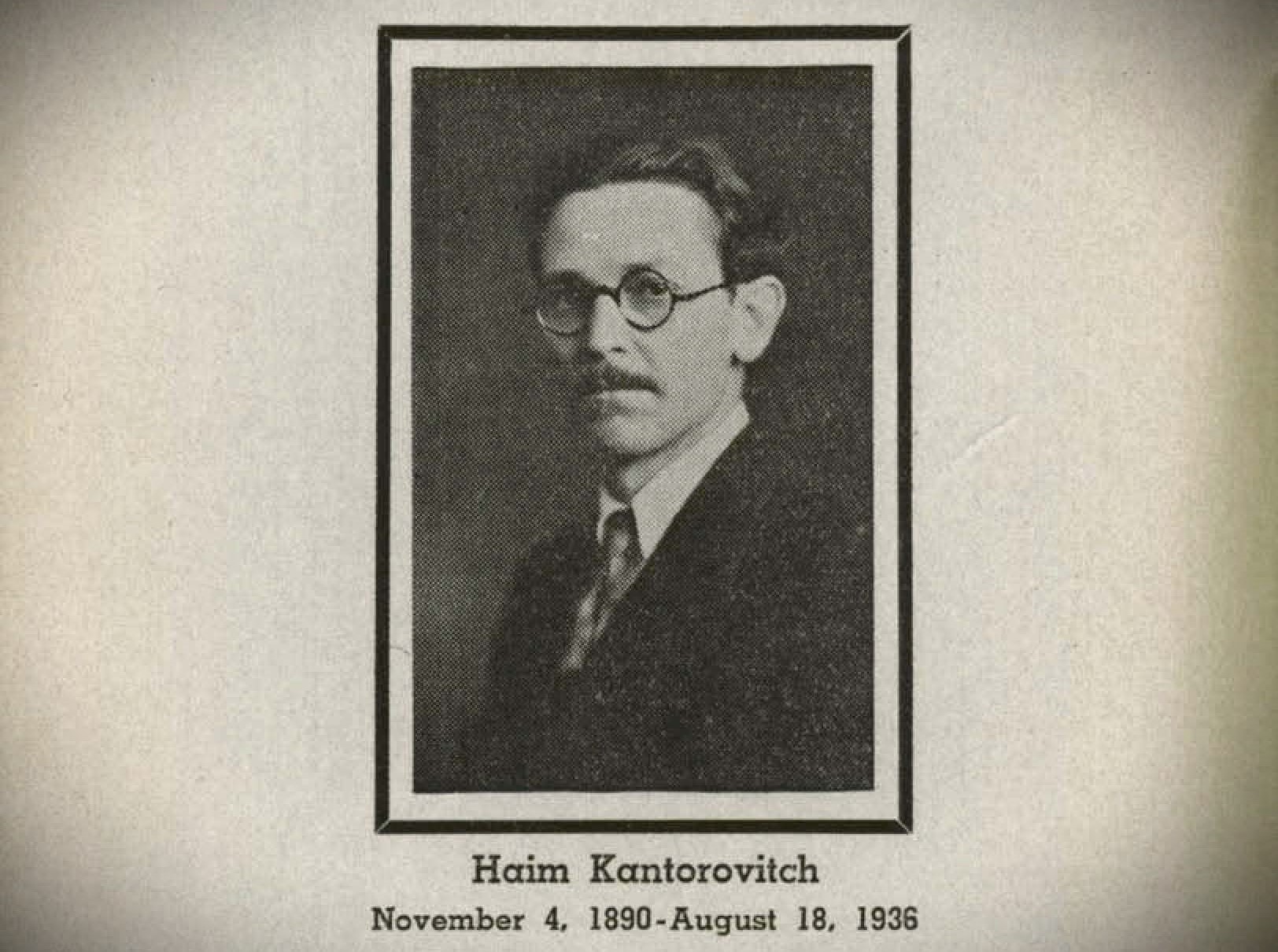
Heading towards a split Haim Kantorovitch, leading theoretician of of the Militant Faction, analyzes the ‘Old Guard’ of the Socialist Party.
‘The Old Guard’ by Haim Kantorovitch from Socialist Call. Vol. 1 No. 39. December 14, 1935.
An Analysis Of Its History And Of Its Principles—Today It Has Been Repudiated By All Socialists
It was clear to anyone who studied the tactics of the Old Guard that they were seeking to cause a split sooner or later. Right after the Detroit convention, the Jewish Daily Forward, which is the ideological and financial dictator of the Old Guard, declared that unity in the Socialist Party was impossible: The majority of the Party that accepted the Detroit Declaration of Principles were communists, Moscow agents, led and financed by Stalin himself, the Forward declared. The New Leader, which is merely a pale echo of the Forward and is its financial subsidiary, repeated this nonsense.
Prepared a Split
That the Old Guard wanted a split is evident from the way in which they prepared public opinion for it. They publicly declared in their own and in the capitalist press that the Socialist Party had been “captured” by dishonest politicians and Moscow agents; that the majority of the Party had betrayed its Socialist principles and was out to break and disrupt the trade-union movement.
The average reader, Socialist as well as non-Socialist, understood of course that no one could make such statements about his own party with any intention of remaining loyal. The campaign of lies and calumny against the Socialist Party and its leaders, the extensive campaign against Norman Thomas which went so far as to forbid him to speak at Socialist meetings all these were clear indications that the Old Guard was carefully preparing for a split in the Party.
What Is the Old Guard?
What is the Old Guard? What’ does the Old Guard stand for? We are at a disadvantage here. We cannot intelligently discuss the Old Guard program for the simple reason that it has none, While the Old Guard constantly ridicules and misquotes the program of the left wing, it has never attempted to formulate a program of its own. If one is to understand the motives behind the Old Guard’s fight against the Party, one must ask not what is the Old Guard but who is the Old Guard?
The Old Guard proudly refers to itself as the “old, tried and experienced Socialists.” The majority of its members are now old and tired in body and mind. All of them were at one time really active in the Party. Some of them have performed great and valuable services for the Party in the past. Some of them have even been revolutionary Socialists in the past. But that was long, long ago. They speak of that time with pride and pleasure–but also with a kind of paternalistic cynicism. That was “the folly of their youth.” They do not regret it. They often admit that when one is young, one “may” indulge in such follies.
Refused to Analyze Communism
But they are no longer young. They have already learned that dreams cannot be cashed and that revolutionary ardor brings nothing but trouble. Their attitude towards Socialism can best be illustrated by their attitude towards communism. During all of the years of the fight between Socialism and communism, no attempt was ever made on the part of the Old Guard to critically analyze communist philosophy, history or tactics. There was no use doing so–this was the answer given to this writer by one of the leading lights of the Old Guard, Leave them alone, they’ll outgrow it even ma we have outgrown our youthful revolutionism. Of course, the Old Guard fought the communists bitterly but only on practical grounds. It was a fight for “the control of our institutions” but not for the hegemony of our principles.
Learned Nothing
It is true that some of them (not all) cling obstinately to their Socialist principles, but these are “principles” that they learned 20 years ago. Despite the colossal changes in the world that have taken place during this quarter century, despite the lessons of the World War, the Russian revolution, the advent of fascism, the experiences of the German and Austrian Socialists our “old, tried and experienced” comrades have neither changed nor even analyzed for themselves their principles and concepts. They simply repeat mechanically what they learned 20 years ago. Their Socialism has become for them something like a religious dogma, something that one is supposed to believe in but not expected to practice.
For many years after the communist split, the Socialist Party was on the decline. The Party, or what was left of it, could not even dream of any kind of activity. Whatever energy was left was used to keep the Party alive. A spirit of apathy and downright pessimism pervaded the Party. The Old Guard theoreticians then began to look for some theoretical rationalization that could serve as a fig-leaf for their lethargy. Thus was born what is now so well known as “dead Marxism.” Marxism in their hands became nothing but dead, dogma, a rationalization for doing nothing. “Socialism is inevitable; it will come as a natural result of social evolution. There is nothing that can be done to hasten its realization.” They made a virtue out of a tragedy and raised inactivity to a principle.
It was even worse in practice. In its fight against communism, the Party leaders of that time sought allies. The only allies they could get were the trade union leaders who had a common practical interest with them in the fight against communism. Before the split, Socialists had always been in the opposition to the official leadership of the AFL. To be sure, they were no DeLeonites. They were opposed to dual unionism. They were not for party control or party dictatorship in the unions. Ther were active in the unions and never lost an opportunity to write and speak in criticism of what was false and misleading in AFL ideology, its obsolete craft-union organization, its opposition to working-class political activities and its lack of class-conscious leadership.
After the split, all this was changed. Instead of being a Socialist opposition in the trade union movement, the Old Guard leaders became its servants. Every form of criticism was prohibited. The Socialist press became the official apologist for the AFL leadership, The theory was proclaimed that we were with labor, right or wrong. We were with the labor leaders not because they were right, but because they were leaders–and when necessary even with the leaders against the working masses.
But the Socialist Party Grew
Gradually the scene changed. At first slowly, then more rapidly, the Socialist Party began to grow again. At first dozens, then hundreds and after that thousands of new members began joining the Socialist Party. These were young, energetic Socialists who decided to devote themselves to the fight for Socialism. They were driven to Socialism by the evident decline of capitalism. They learned from the tragic experiences of the European Socialists that if we want Socialism, we will have to fight and fight hard for it. Their knowledge of American conditions convinced them that now was the time when a fighting revolutionary party could be organized.
They joined the Party because they wanted to be active, to do something. But what they got from the Party leaders was. the dead Marxism of the Lees and Oneals. This told them that the best thing one could do for Socialism was to do nothing. “Socialism is inevitable,” Lee repeats. “Don’t make yourself a nuisance in your mind” (i.e., don’t criticize), Oneal advises. “Don’t keep on nagging the city officials,” Louis Waldman chimes in (in the capitalist press, of course). “You can’t make revolutions by holding mass meetings or mass protests or marching through the streets of New York with red flags like a bunch of irresponsible children,” teaches Julius Gerber.
But what shall we do? Isn’t there anything for the members of the Party to do? the newcomers asked. Oh, yes, was the answer. You must pay your dues, you must read our press and during the political campaigns distribute literature and expound our Innocuous Socialism, and assure those present that they must not be afraid of the Socialist Party because it is not really revolutionary, and seeks to live in peace with everybody. The result was that not only did many refuse to join the party, but new members left It. They had nothing to do.
There are deep and fundamental differences in theory and tactics between the left and right-wings of the Party. It is, however, significant that the inner-party fight which culminated in the present situation began not as a fight for or against this or that principle, but purely as a fight between activists and quietists. It is significant that among those who now repudiate the Old Guard and declare themselves loyal to the newly-reorganized city central committee are many centrists as well as comrades who do not accept the ideology of the left-wing. They threw in their lot with the left-wing because the left-wing stands for a Socialist Party which is alive, democratic, active and is ready to organize and fight for Socialism.
Unbelievable as it may sound, the Old Guard leadership in New York has done everything it could to prevent new members from joining the Party, especially if the new applicants were young; they developed a positive fear of youth and activity. They even repudiated a decision of the national convention and their own promise to the national executive committee to admit YPSL members to the Party, all because they feared that these younger elements would demand aggressive Socialist activity.
When the Old Guard leaders now accuse the left wing of being communists, they know it is not true. The cry “communist” is only to serve as a smoke-screen for their disruptive activities. It is not communism they fear–it is Socialism.
Despite the machinations of the Old Guard, its violation of Party democracy, its misuse of the Party machinery which it controlled–they failed. They failed to present the growth of the party and consequently the growth of the left-wing. In despair they decided to resort to the most vicious, most undemocratic and really suicidal means at their disposal–namely under the guise of reorganization to expel from the Party everyone who disagreed with them.
Fortunately for the Party, the Old Guard failed. The bulk of the Party membership in New York, including the YPSL, repudiated their leadership, freed themselves from their dead weight and are ready now to begin organizing a real revolutionary Socialist organization. There is no question but that the New York Socialists will in this work meet with the full support of every Socialist in the United States.
Socialist Call began as a weekly newspaper in New York in early 1935 by supporters of the Socialist Party’s Militant Faction Samuel DeWitt, Herbert Zam, Max Delson, Amicus Most, and Haim Kantorovitch, with others to rival the Old Guard’s ‘New Leader’. The Call Education Institute was also inaugurated as a rival to the right’s Rand School. In 1937, the Call as the Militant voice would fall victim to Party turmoil, becoming a paper of the Socialist Party leading bodies as it moved to Chicago in 1938, to Milwaukee in 1939, where it was renamed “The Call” and back to New York in 1940 where it eventually resumed the “Socialist Call” name and was published until 1954.
PDF of full issue: https://www.marxists.org/history/usa/pubs/socialist-call/v1n39-dec-14-1935.pdf
 Revolution's Newsstand