
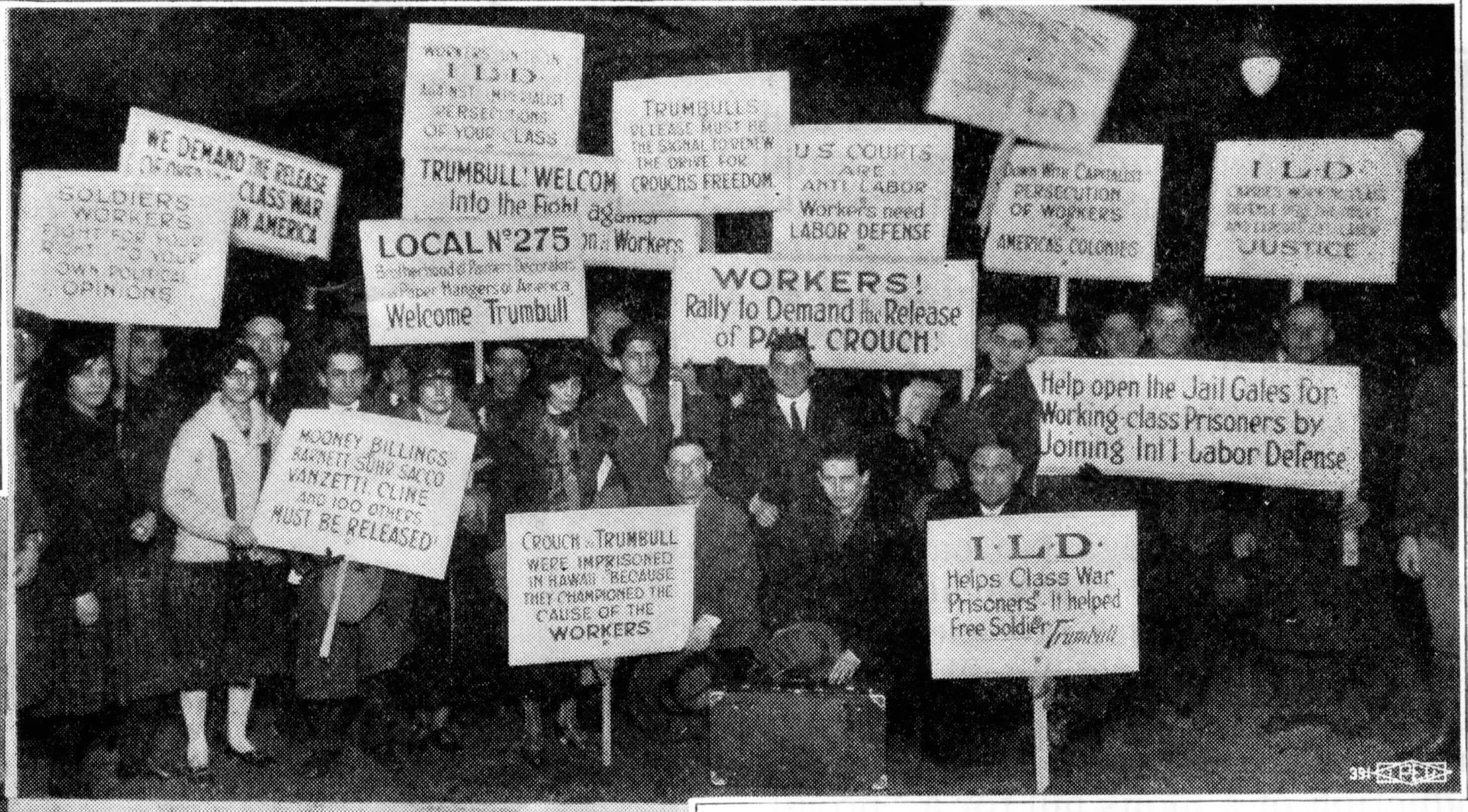
A report on the founding convention of International Labor Defense in 1925. Originally a non-partisan defense organization initiated by the Communist Party, the I.L.D. was a central force in campaigns around Sacco and Vanzetti, Scottsboro, Tom Mooney, and many others. A membership organization, it had local chapters in many working class communities and provided relief for political prisoners. By the early 30s it has become a more explicit appendage of the Party and changed with it; its magazine, the essential ‘Labor Defender’ becoming ‘Equal Justice’ in 1937, until it formally dissolved into the Civil Rights Congress in 1947.
‘Labor Defense Conference Makes History in Struggle of American Working Class’ from the Daily Worker. Vol. 2 No. 145. July 1, 1925.
The National Conference for Labor Defense held Sunday in Ashland Auditorium, that gave birth to the first great non-partisan labor defense organization in the history of American labor, is an achievement that marks an epoch-making step forward for the working class.
Such was the opinion of the delegates to the conference returning home to complete the establishment of the International Labor Defense they began on Sunday.
The constitution providing for the founding of the “International Labor Defense” as an organization composed of individual memberships and labor collective organizations was passed unanimously by the more than one hundred delegates present.
No Discrimination In Defense
The delegates represented trade union bodies, workers’ fraternal and benefit societies and defense organizations from all parts of the country.
They declared in their constitution that the International Labor Defense will “serve as a non-partisan defense body for the protection of all workers persecuted by organized capital for expression of opinion or for their activities in the labor movement, regardless of political or industrial affiliation, race color or nationality.”
Ex-Class War Prisoners Attend
A feature of the conference was the attendance of many ex-class war prisoners who were seated unanimously by the delegates. Among these were Fred Mann, Harrison George, George Speed, Alfred Wagenknecht, John Edenstrom and Ralph Chaplin.
Labor Defense Council Dissolves
George Maurer, secretary of the Labor Defense Council presented a resolution from the executive committee of the council offering its equipment, organizational machinery and funds to the “International Labor Defense” founded by the conference.

Chairman James P. Cannon, accepted for the conference and expressed the gratitude of the delegates, saying “This provides an immediate, material basis and gives us a beginning we are thankful for.”
“Dangerous” Red Lamp
Eight resolutions submitted by the resolutions committee were drafted as instructions for work to the International Labor Defense. Andrew T. McNamara of Pittsburgh, reporting a resolution for campaign against anti-labor legislation and injunctions said, “If you are in the labor movement in Pennsylvania you never know what minute you are going to be put in jail.
“We have laws and injunctions down there that will pat a worker behind bars any time the authorities who represent the iron and coal magnates feel like it. One worker was sent to jail in my state for having a red lamp in his parlor.”
Amnesty Campaigns
Rose Barron of New York submitted a resolution instructing the International Labor Defense to make special provision for adequate relief for the families and dependents of class war prisoners. Harrison George, an ex-class war prisoner who spent five years in Leavenworth penitentiary, reported on a resolution for campaigns demanding the release of all political and industrial prisoners.
He reviewed the history of the wholesale jailing of workers since the beginning of the war and warned the delegates that if the workers did not now begin the job of widespread pro- test it was giving the labor baiters encouragement for more and greater excesses in their persecution of the more alert and conscious section of the labor movement.

“The railroading to prison of I.W.W.’s and Communists is only a rehearsal for the time when the whole labor movement will be attacked in an attempt to annihilate it.” he said.
Unity in Defense
The chairman of the conference, James P. Cannon, presented a resolution calling for the co-operation of all sections of the labor movement in the work of labor defense and instructing the new defense organization to secure united action with all existing defense bodies.
“The job of defending ourselves against the attacks of the exploiters of labor is a basis for a common platform upon which workers of all beliefs and affiliations can unite. am convinced that this conference has made this materially possible and there is no doubt in my mind that the International Defense will rally all organizations of workers for the fight against the persecutors of labor and find means to effect fraternal co-operation with all existing defense organizations that are engaged in the common cause of labor defense.”
Know of 128 Prisoners
Cora Meyer of the National Prison Comfort Club reported the resolution on relief for class-war prisoners.
She reviewed the work done in this field by her organization which will amalgamate with International Labor Defense and expressed confidence that the latter organization will provide for the 128 class war prisoners in the jails of this country.
Gitlow Scores White Terror
“The international character of capitalism makes the class struggle an international one” said Benjamin Gitlow, reporting a resolution on support to workers persecuted in other lands, “and it devolves as both a duty and necessity on the workers in this country to defend their brothers in other countries who suffer oppression and persecution by the iron heel of imperialism.”
Gitlow came to the conference very uncertain whether he would have to leave for Sing Sing before it was over. He was recently remanded to prison by a decision of the U.S. supreme court.
Manifesto For Unity
The manifesto of the conference, passed unanimously, ends with the slogans, “Release all class war prisoners,” “Repeal all criminal syndicalism laws,” and “Unite for Labor Defense.”
The manifesto calls upon the labor movement and those sympathetic to the workers’ cause to rally behind the International Labor Defense.
Large National Committee
Thirty-seven nominations were made for the national committee and by unanimous vote of the body all were made members of the committee.
On the committee, among others are, Eugene V. Dens, Upton Sinclair, Scott Nearing, Alice Stone Blackwell, Alex Howat, William Z. Foster, Bishop William Montgomery Brown, Robt. W. Dunn, Andrew T. McNamara, Ralph Chaplin, C.E. Ruthenberg, Ellen Hayes, Benjamin Gitlow and James P. Cannon.
High-Time Says Maurer
George Maurer, secretary of the Labor Defense Council, said after the conference, “At last the labor movement has made a substantial beginning on a job that should have been done years ago, the uniting of all sections of the working class in a sincere non-factional national movement in behalf of all class-war prisoners and for the protection of all workers against persecution.”
Workers Will Support I.L.D. Members of the national committee expressed the opinion that the International Labor Defense will be immediately acclaimed and supported in the labor centers of the country. The work of setting up the local units of the new organization will begin directly after the meeting of the national committee.
The Daily Worker began in 1924 and was published in New York City by the Communist Party US and its predecessor organizations. Among the most long-lasting and important left publications in US history, it had a circulation of 35,000 at its peak. The Daily Worker came from The Ohio Socialist, published by the Left Wing-dominated Socialist Party of Ohio in Cleveland from 1917 to November 1919, when it became became The Toiler, paper of the Communist Labor Party. In December 1921 the above-ground Workers Party of America merged the Toiler with the paper Workers Council to found The Worker, which became The Daily Worker beginning January 13, 1924.
PDF of full issue: https://www.marxists.org/history/usa/pubs/dailyworker/1925/1925-ny/v02b-n145-NY-jul-01-1925-DW-LOC.pdf
 Revolution's Newsstand