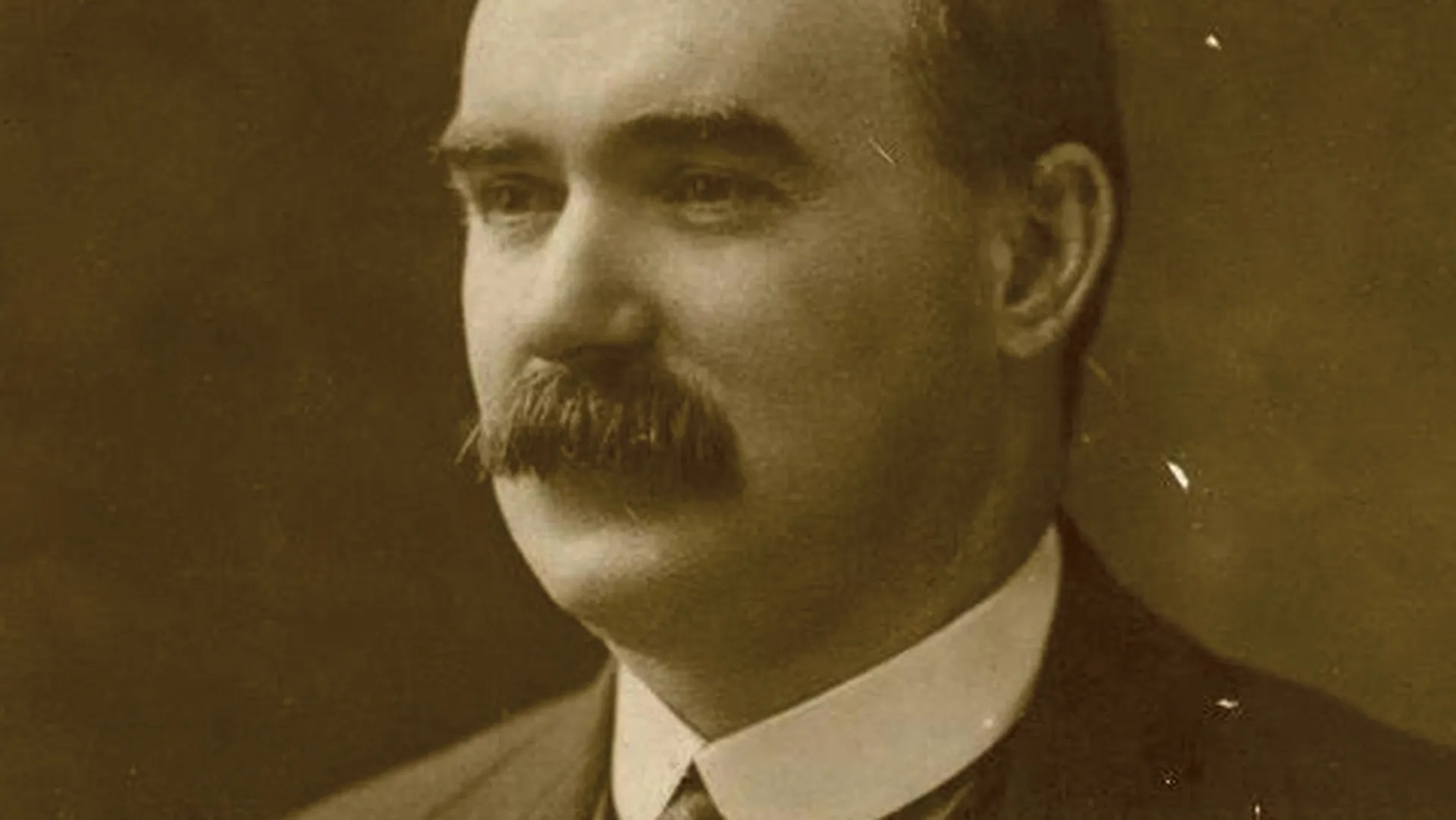
‘Slugs From the Social Matrix’ was the title of James Connolly’s short-lived column for the S.L.P.’s Daily People. Though only six were published in March and April of 1906, they will be of immense interest to students of Connolly and of Socialist history. These articles differ from what we are used to from Connolly as they are focused on life and politics in the U.S., Connolly then living in New Jersey. Full of asides and missives, this is a colloquial Connolly telling stories and writing poems to make profound political points. Wonderful. Transcribed for the first time.
‘Slugs From the Social Matrix’ by James Connolly from the Daily People. March & April, 1906.
Slugs From The Social Matrix. March 11, 1906.
According to the capitalist press the conference of reformers which met at the house of the Stokes in New York, and which included amongst their number the much-heralded millionaire “convert” to Socialism, Mr. Patterson of Chicago, dispersed without coming to any agreement. How sad!
But it cannot be true. We refuse to believe it. There is one point at least upon which a conference composed of such elements was bound to lie in perfect agreement.
The constituent parts of such conferences are men and women who believe that capitalism is a very ugly thing and produces ugly fruits and nastiest of them all is the Revolutionary Working Class.
Such has ever been the attitude of the reform elements amongst the ruling class toward the oppressed class in society. They will do anything for their slaves, would die for them if need be, but the whole aesthetic soul rises up in disgust and horror at the idea of those slaves doing anything for themselves. That is anathema.
***
It is an old story. Long before the French Revolution happened along, and as long as the old-aristocratic and monarchical order seemed rooted in the order of nature the courts of Europe often feted and lionised the theorists who discoursed in elegant sentences upon the Rights of Man, and ladies and gentlemen whose whole lives were perpetual sacrifices upon the altars of pomp and fashion conversed and wrote about the desirability of a return to the supposed innocence and simplicity of primitive humanity.
The first legislative proposal in Europe in favor of Universal Suffrage was made in the most aristocratic chamber in the world at the time–the English House of Lords, by an English nobleman, and made at a time when the so-called popular house of legislation was a reactionary, corrupt and time-serving body.
But alike in England and in continental Europe aristocratic sympathy for the people vanished when the fall of the Bastile called the people to arms on their own behalf. From that time forward Freedom had no more bitter enemies than those who a few years before had composed sonnets and delivered soft speeches in praise of her beauties.
***
The history of the Socialist Movement tells the same story.
Engels tells us in one of his prefaces to the Communist Manifesto that when the manifesto was written the writers thereof and their sympathizers could not be called Socialists, that was rather a term for the mere theorists and spinners of fine phrases. Socialism was aristocratic, so to speak, Communism was democratic and working class in its tendency and advocates.
Socialists, in fact, were drawing pets, lions of the salon and the court. So much so was this the case that a king of England, William IV., was mentioned amongst the “converts” of Robert Owen, and when that great Englishman published a work upon his doctrines he dedicated it to that sovereign, and felicitated him upon his good fortune in being called upon to rule in England at a time that would witness this great social transformation.
But when Robert Owen, recognizing his tactical error, appealed direct to the Working Class to free itself by the force of its own arms and intelligence he had at once to face the implacable and unscrupulous hostility of all the dilletanti sympathizers who had previously lionised him.
***
American history tells the same tale in relation to the Emancipation of the slaves. Much of the hatred felt toward John Brown and the supineness of the North at his hanging had its origin in the fact that that hero not only sympathized with the Negro in his miseries, but counselled him to strike for freedom and to end his miseries by force if possible.
The classic work of the anti-slavery movement-“Uncle Tom’s Cabin,” idealizes a Negro who suffered wrongs and prayed for the wronger. Another work by the same author “Dred, a Tale of the Dismal Swamp,” tells the tale of a Negro who revolted and preached revolt to his fellow-sufferers. The first was and is circulated by the million copies, the latter is practically unknown, frowned out of circulation by those who control the agencies which direct the popular taste in literature by a judicious discrimination in the supply.
***
And in America to-day the same phenomenon is observable, Many indeed. are those who would “do something” for Labor, if Labor did not prefer to do something for itself.
To such gentlemen the idea of a Revolutionary Working Class is a thing of horror, and bitter indeed are their feelings toward the capitalists whose too open brutality lend it strength and nutriment.
***
Mr. Samuel Gompers.
Sammy Gompers was in Newark, N.J., in the course of last week and after his usual trade union stunt was interviewed by the reporters. He is reported to have said:
“I hope I shall not have to leave New York without seeing Mr. John Mitchell, who is a very dear friend of mine.”
There now, is not that nice? Does it not promise nice things for the future to know of such fine relations existing between such men?
“My dear friend, Mr. Mitchell.” “Our esteemed president, Mr. Gompers.”
You scratch my back, and I’ll scratch yours.
Alleluia to the great god Bunco. Bless his holy name!
***
The hayseeds from rural districts are not the only Americans upon whom the confidence game is worked.
“My dear friend, Mr. Mitchell.” If I mistake not Mr. Mark Hanna was also a dear friend of Mr. Mitchell, so is August Belmont, the greatest employer of scab labor in New York. And to the Anthracite miners Mr. Mitchell is also very dear, not an exhorbitantly priced article in all the pluck-me stores of Pennsylvania costs them more, is more dear or worse value.
And you Mr. Samuel Gompers. Well, when the history of the, modern, Labor Movement comes to be written, if the capitalist class should conquer what a page will be devoted to Sammy, what enconiums will be heaped upon him, and when he dies should our masters still feel, the necessity of chloroforming their beaten slaves what an epitaph he will have!…
Should capitalism not conquer history will be written somewhat differently.
Talking of epitaphs. It is not often that the estimate of a man held by his contemporaries, and that upon his tombstone agrees, yet we might make an exception in the case of Gompers. At least. I humbly suggest the following four words which have this advantage that they will be equally truthful and appropriate whether placed upon his tombstone after death or gracing the platforms of his meetings during life:
They are: HERE LIES SAMUEL GOMPERS. Dead or alive that will fill the bill.
***
Tipping waiters. I see that that great organ of the people, the “Evening Journal” has devoted a whole grave editorial to the question of tipping waiters. It recommends the practice.
As a rule, I should say, the custom is demoralizing. But there are exceptions. There is a certain restaurant in New York, and whenever I feel sufficiently like a millionaire to blow myself into a fifteen cent regular dinner I, even I, always tip the waitress–a wink.
And I think that is the usual extent of the tipping done by the working class.
Slugs From The Social Matrix. March 18, 1906.
“Trade Unionists in Chicago have organized a company to purchase land for a cemetery in which none but trade unionists shall be buried.” So runs the newspaper report.
A trade union graveyard! Thus at last our life may be rounded off according to the rules of pure and simpledom.
***
We could always be shot by union made bullets from the mouth of union rifles in the hands of union militiamen who were summoned by union telegraphers, and brought to the spot by union railroad men guarded by union deputies, and now we can be buried in an union graveyard. O, the sweet felicity of the thought!
For this life at least we can seal our devotion to the holy principles of the gospel according to Saint Samuel (Gompers). If there is a fly in our ointment at all it will be on the “other side.” Perhaps when the great Day of Judgment comes, when the Angel Gabriel stands with one foot on the shore and the other in the sea and blows the last trumpet to call all the dead to judgment, perhaps then we may discover to our chagrin that the trumpet is a scab made trumpet and does not bear the label, and Gabriel himself is not a regular dues-paying member of the musicians’ union.
In that event, of course, every self-respecting pure and simpler will refuse to rise until a regular union man is hired for Gabriel’s job.
***
There is another grimly humorous side to this grave business enterprise. But in order that you may appreciate it better let me tell you a true story.
In the time of the Third Empire in France there lived in Paris a certain Freethinking marquis whose propagandist enthusiasm for freethought principles took the peculiar form of attending secular funerals. Wherever anyone was to be buried without priestly observances this gentleman would strive to be present and deliver a speech expressive of his satisfaction. His speech was short, and though somewhat ambiguous never varied.
It was: “Messieurs, it is with a fresh pleasure each time that I stand beside the grave of a Freethinker.”
The fact that the words might have come as sincerely from the mouth of a bigoted Catholic never seemed to occur to him.
***
The application. We are to have a union graveyard; like every other enterprise under capitalism its success or non-success will depend upon the amount of business done; lots of dead unionists, good business; lots of healthy unionists, bankruptcy.
We can imagine at some future annual meeting of the shareholders the secretary bringing in his annual report as follows: “Mr. Chairman and Gentlemen, I am pleased to state that a great many trade unionists have died or been killed during the past year, and therefore we are in a position to declare a good dividend.” Or, “I regret to state that there is a very low mortality amongst trade unionists, and so there can be no dividends this year.”
I would respectfully suggest to the promoters that Mr. Parry of the Manufacturers’ Association, and Mr. Baer of Pennsylvania would make ideal agents to push the business of the new corporation. Certainly they would like to see it do a rushing trade.
***
Trouble in China. You see of course that our wise and benevolent government is about to interfere in China on behalf of the missionaries in that country. That is right; something must be done for the missionaries.
Over 100,000 children of school age in New York City are underfed, miserably clad and have their whole lives blighted their physical growth stunted and their intellectual horizon darkened because of the poverty forced upon their parents. The souls of these children are daily and hourly murdered by the atrocious social system of which our government is a prop; we can do nothing for these children, but we must do something for the missionaries.
An army of men as large as the population of some European states are unemployed, and in the vain search for a master wander the streets and roads of our country, rapidly being driven from the status of honest laborers into the condition of tramps and outcasts; but we must do something for the missionaries.
Every year an increasing number of women are compelled to enter the factory as wage-earners, and often in the most sacred period of a woman’s life, when nature calls for every care for the sake of the coming generation, are lashed by grim necessity to the yoke of a profit-monger for 10 or 12 hours per day. But we must do something for the missionaries.
The children of the working class are dragged from school at the most receptive and formative period of their lives and their little limbs harnessed to machines when they ought to be romping in the fields and building up strength and energy for the future. But we must do something for the missionaries.
Every factory and workshop in the land is bespattered with the blood of the working class needlessly spilled; the one city of Pittsburg alone is officially recorded as having more workers killed and wounded by accident in one year than were lost in action in the whole South African War. We can do nothing for them, but we must do something for the missionaries.
The missionaries of old, styled martyrdom “the gates of Heaven,” the modern missionary telegraphs for U.S. troops to rescue him from those gates.
***
The Socialist knows that the desire of our rulers to “mix it” in China is not prompted by love of the missionary who is only a convenient tool for the purposes of the capitalist. There are two reasons prompting interference in China, as in inciting slaughter in the Philippines. These reasons are: First, the ever-present necessity of commercial expansion born of the increasing productivity of our labor. Second, the desire of our rulers to have an army accustomed to bloodshed and holding human life as cheap, in order that such army may be fit for repressive work at home. This latter desire has figured in the plans of every ruling class in the world’s history. It is a matter of record that glory abroad has ever had as its counterpart despotism at home.
***
“When Ancient Rome had conquered the world the yoke of the Roman serfs and plebeians was harder than ever before.” The words Macaualay, the English essayist, puts into the mouth of one of his characters in the “Lays of the Ancient Rome” are worth quoting in this respect dealing as they do with the time in question and supposed to come from the mouth of a soldier-citizen:
“Still press as far your cohorts and when the fight is done,
Heap up your garners from the soil that our good swords have won;
Still like a spreading ulcer that leech craft cannot cure,
Let your foul usance eat away the substance of the poor.”
Although as a rule Macaulay’s brilliant style and literary grace covered a most lying perversion of history to bourgeois tastes and bourgeois interests, yet he occasionally, as in this instance, revealed a truth.
***
The African Empire of France beginning with the conquest of Algiers on the pretext of ending piracy had its origin also in the desire of a French king to placate the commercial interests of his turbulent nation, while removing his army from contact with the populace and training it to the work of slaughter.
***
The ruling class of the British Empire–the most scientifically conducted capitalist government of the age–have also long pursued the same line of policy. At the great battle of Waterloo which ended the Napoleonic regime the overwhelming majority of soldiers in the British army were from Scotland and Ireland and at that time both countries were being devastated by clearances and evictions almost unparalleled in their savage ferocity. And the English workers themselves were shortly afterward to see the self-same “heroes of Waterloo” ride upon an unarmed, peaceable meeting at Manchester and cut down their own countrymen and women as ruthlessly as they had cut down the conscripts of Napoleon.
***
It is with these great “principles of government” we have to deal when we see that the time when the working class of America is agitated by the outrages of Colorado is the psychological moment chosen by our rulers to stir up the blood lust of their soldiery in the Philippines and China.
The Capitalist Class is a beast of prey with all the savage instincts of the beast. It cannot be conciliated, it must be crushed.
Slugs From The Social Matrix. March 25, 1906.
Powder and Light. It is said to be the height of folly to bring a naked light in the neighborhood of powder. Some thought like this flashed across my mind last week when I read in the capitalist press. an account furnished to Representative Gillespie at Washington of the doings of the Powder Trust. This account did indeed let a light in upon the subject, but it was a light dangerous to capitalist interests, and calculated to arouse explosive passions.
This account as it appears in the public press calmly recites that while the price of ordnance powder as furnished to the government is 70 cents per pound “the actual cost of the powder complete after all salaries and expenses are added is from 30 cents to 35 cents a pound.” Or more than 100 per cent profit. Observe these are not my figures, they are the figures made public by a member of the capitalist class, one of their chosen law makers.
***
From these figures there are several lessons to be drawn. One lesson is that they prove conclusively the Socialist contention that the profits of the capitalist class represent stealings pure and simple–represent in short that part of the product of labor which remains after all the expenses of production are accounted for. That Labor creates all value, pays its own wages, renews the capital necessary to production, and then with a largeness of heart and open-handed charity that puts a Christian saint to shame, hands over to the capitalist more than it receives itself.
***
Be it observed that this cost of production given here, 30 to 35 cents per pound includes all salaries, the salaries of directors and highly-placed officials as well as the salaries of the workers.

Yet the profits to the Powder Company in one year’s sales to the government are estimated at $2,500,000. The gentleman who makes this statement public considers the transaction as a fraud upon the government, the discriminating working class reader will see in it an exposition of the process by which Labor is skinned and left to shiver while the skinners quarrel over the disposal of its hide.
The employes of the Powder Company are but types of the Working Class in general, as their employers are but types of the capitalist class in every other industry. Once the Working Class is skinned it becomes immaterial whether its hide is sold to the government as powder to destroy life, or to private individuals as necessities for the support of life.
***
The labor of the Working Class having entered into the article–the commodity, whatever it may be, having absorbed our sweat and blood and tears it becomes a matter of indifference to us what its ultimate fate may be.
***
The building trades do not go out on Monday mornings to build for a week, they go out to earn a living. Their building is mere incident of so little concern to them that if what they built all one week were to be destroyed by an earthquake on the following Sunday the fact would cause not grief over handiwork destroyed or labor lost, but joy over the prospects of a job in rebuilding what had been thrown down.
And so on all through all industry. The worker loses his identity as a craftsman or artificer and sinks to the level of a mere cog in the mechanism of capital, an indifferentiated earner of wages. Therefore the analysis of the stealings of the Powder Company are applicable to all industry, and enable all workers to see as upon a stage the process of skinning Labor.
***
Another lesson it teaches is that of the patriotism of the Capitalist Class. As small arm manufacturers have often sold rifles to the Indians when about to go upon the warpath, and yet were patriots of the most lurid hue, so the Powder Company manufactures powder to defend the coasts of America, sells it to the government at double its cost and pocketing the cash whoops it up for Old Glory.
Artemus Ward when he said “that every man should be prepared to sacrifice something for his country, and he was prepared to sacrifice all his wife’s relations” gave a good picture of capitalist patriotism all the world over.
***
Such is capitalistic love of country. “The rich man,” said Lammenais, “loves his country because he believes it owes him a duty.”
***
Bad Grammar or Bunco. Which was it that was ladled out to the members of the S.P.C.A. at their meeting in New York when the letter of resignation from their president was read? It was one or the other.
After the resignation was accepted a report was read from a firm of actuaries who had examined the books of the Society. After stating that there were no traces of misuse of the society’s funds it declared that “any erroneous opinion that may have been entertained to the contrary are entirely unfounded.” that a specimen of the English of the “educated classes,” or were they only bamboozling their hearers?
***
We should not require a firm of actuaries to tell us that an “erroneous” opinion was “unfounded.” If they had also added that “any well grounded suspicion was entirely justifiable” it would have meant exactly the same thing though sounding so differently.
Both phrases are meaningless, and the first is put a trifle suspicious, as suspicious as the zeal for the welfare of animals shown by some persons who are notorious for their indifference to the sufferings of humans.
***
But it is significant of that moral decay in society which louder than anything else proclaims its rottenness that even its charitable institutions are accused by their own membership of being harborers of graft and corruption.
When tyranny no longer believes in itself its end is near, and when capitalist society can no longer credit the existence of philanthropy untainted by motives of personal gain then indeed it is ripe and rotten ripe for destruction.
Rotten! Did I say rotten; why it is putrescent! Even its simulation of virtuous indignation only arouses contempt, and its tears of ink in its prostituted press have more of bathos than of pathos. You observed of course that the capitalist press exploited the sufferings of ‘Bertha Claiche to its own advantage. But did you notice the manner in which it attacked vice in the Tenderloin?
***
For days its columns were filled with articles about “foreign” criminals in the Tenderloin, and its scare headlines aroused public sentiment (?) upon this great question of “foreign” criminals, until I began to wonder if the native American sentiment was outraged at the idea that “foreign” criminals were trespassing upon the preserves of the scoundrels of home manufacture.
I would not have been surprised to see a petition presented to President Roosevelt by, say, W.R. Hearst setting forth that the influx of “foreign criminals created great competition to the detriment of the native born graduate of Sing-Sing.”
***
Bah! How sickening it all is: All this sham and hypocrisy would set our soul on fire with wrath, would wear us out with a consuming sense of our present impotence to end it were it not for the saving sense of humor which enables us now and then to snatch a laugh at the antics of the mountebanks who rule the world.
Rogues, Rogues all! Diogenes the old Greek went out with a lantern in broad daylight to look for an honest man. Were he to assay the same task in capitalist America to-day what a long search he would have unless he met James Connolly.
Slugs From The Social Matrix. April 1, 1906.
Hurricanical. Never saw that word before, did you? It was coined by a comrade of mine in Dublin, Ireland who was rather given to florid phraseology. Calling upon the working class to do something he said they should make a “hurricanical” effort, borrowing his word from the velocity incident to a hurricane.
The word recurred to my mind when I read in the daily papers that Joseph Medill Patterson, the newly converted “millionaire Socialist,” is about to start a Socialist daily newspaper of which he is to be editor. Three weeks ago he stated to the reporters that he had only read one Socialist book, and did not know enough to talk upon the subject. Now he knows enough to edit a privately owned Socialist Daily. Certainly his progress in acquiring knowledge has been nothing short of “hurricanical.”
Or perhaps he is only gauging his knowledge by the standard of the editors of the privately owned Socialist papers already in existence. In which case although a little optimistic his judgment is all right.
***
New fledged converts are generally optimistic. I knew a comrade in Scotland who told me that when he first became a Socialist he was so convinced of the imminence of the Social Revolution that he was afraid to sleep too long in the mornings lest the Socialist Republic be established overnight. Like the poor that type of genial optimist is always with us. If you suggest to one of these that Socialism is not just around the corner, but may be even as much as nine or ten blocks away yet they generally look upon you as a traitor of the deepest dye.
***
When Nunquam of “Merrie England” fame first published that book he announced that Socialism in England was well under way. It was in fact to be a mere problem in proportion: So many copies of the book, so many Socialists; so many Socialist voters, so many Socialist legislators and the trick was done. In like manner I am sure Joseph Medill Patterson has it figured out that the progress of the movement toward Socialism will have as its register the circulation of his paper.
***
Queer things come up with the tide, and the tide of social evolution also bears strange monstrosities upon its surface.
***
I read in the capitalist press that an appropriation for a private palace car for President Roosevelt has been voted down by our lawgivers. A Private Palace Car for the advocate of the Simple Life! Reads curious don’t it? When I read it as I sat in the trolley car I was so transported with enthusiasm that I imagined myself already seated in such a car–and forgot to pay the conductor.
A Private Palace Car for Roosevelt. I have just received by telepathic despatch from Washington the following verses which I am informed Teddy had in preparation to sing before the Senate if the appropriation had gone through.
THE SIMPLE LIFE
In me behold your President,
A talker of great fame,
To teach the people maxims wise
My one desire and aim
With every nation big enough
To fight, avoid all strife.
And preach to pampered workingmen
The sweetly Simple Life.
Chorus.
Hurra for the Simple Life,
No luxury to mar,
The Simple Life of your President
In a Private Palace Car.
The pilot engine’s gone before
To clear the railroad line,
If any danger is ahead,
‘Tis theirs the risk, not mine.
I send this word to boys in blue,
“Give Moros to the knife.”
For Moros have no votes, and they
Despise our Simple Life.
Chorus.
What ho, the Simple Life!
Such fruits its blessings are,
The Simple Life of your President
In a Private Palace Car.
Just sixteen servants go with me
Whene’er abroad I ride,
To trim my nails and brush my clothes
And wait upon my side.
I three French cooks consult each day
With joy their talk is rife
At home, abroad, at work or play
I live the Simple Life.
Chorus.
Whoop la! the Simple Life.
No rude remarks to jar.
The Simple Life of your President
In a Private Palace Car.
Blind to the future of his race
The Workingman aspires
To have the joys the rich possess
And glut his base desires.
But weary hours of toil for him
And shoddy on his wife
Shall teach him that his lot must be
Severely Simple Life.
Chorus
Hoch, Der Simple Life
And as its shining star
The example of your President
In a private Palace Car.
And there is more truth than poetry in that effusion.
***
Must be exterminated. Governor Curry of the Philippines announces that the Fulljanes must be exterminated. He announced this after returning from a three days’ flight into the wilderness where he fled from some Fulljanes who were anxious to have an interview with him. His troops beat off the half-armed natives, but the Governor was missing for three days and had been given up for dead.
According to the press reports Gov. Curry personally called upon the tribesmen to surrender. Instead of doing so they made a rush on the American troops, and when the Governor saw them coming he suddenly remembered that he had an important engagement elsewhere and–skidood. He ran so fast and so far that it took him three days to get back again. Naturally he now feels bloodthirsty enough to exterminate all the witnesses of his sprinting exploit, and will assuredly slaughter all those who have not died with laughing at the remembrance. The “dignity of the American flag” is surely safe in the hands of this Falstaffian hero.
***
Talking of Governors did you observe that the Labor Fakirs of New York assisted, and indeed inspired, by J.C. Chase and other so-called Socialists in the Socialist Party, have made the martyrdom of Mover, Haywood and their comrades the occasion for a grand stand play and the excuse for a grand junket across the continent at somebody else’s expense? The pretext is to be the interview with the informer Orchard promised by the Governor of Idaho. Instead of slapping this capitalist hireling in the teeth by telling him and the world that. the man who could say as Governor Gooding has said, that hearing the story of one man on one side would convince them of the guilt of men whose story they would not be permitted to hear must be either criminally insane or insanely criminal himself, they treat this high-handed criminal as an honorable man and propose to their dupes to allow them the expenses necessary to travel 3,000 miles to talk two minutes with a twentieth century improvement on Judas Iscariot.
Pardon me, Judas, I hope I have not hurt your feelings by the comparison.
***
I feel like echoing the words of the Irish Poet:
“O, for a tongue to curse the slave
Whose treason, like a deadly blight
Comes o’er the councils of the brave
To blast them in their hour of might.”
***
Any act which at the present crisis tends to give to the capitalist criminals in control in the West the belief that the working class of America have the slightest belief in their bona fides as upholders of the law, or regard them as aught else but as conspirators to murder, is an act of treason to our imprisoned comrades, as it gives confidence to the enemy.
***
Of such a nature does this picnic to Idaho, this farce with the stage settings of a tragedy, seem to James Connolly.
Slugs From The Social Matrix. April 8, 1906.
Success begets success. The late William Ewart Gladstone, leader of the English Liberal party, often declared that the inspiring principle of his life was. to be found in the maxim “Nothing succeeds. like success.” As a statement of fact the truth of the maxim was unquestionable, although as a principle of human conduct it was, as was to be expected from anything endorsed by such an incarnation of bourgeois ethics as Gladstone, utterly immoral.

There is published in New York a journal entitled “Success,” the purpose of which is to instruct the young American mind in the surest methods of acquiring riches and worldly success in general. That the seed of its teaching has borne fruit where least expected was evidenced this week when the Assistant Cashier of the “Success” Publishing Company disappeared after cashing a check for $1000. Thus was the Gladstonian maxim verified in the person of one of its exponents. Nothing succeeds like success.
In capitalist society money is the motive power. We all try to make money, but some of us get into trouble when we try to pass the money we have made.
***
Found, discovered, revealed, exposed, uncovered, laid bare, unearthed! What? Where? When? By whom? Why, at Washington by the great and only Sammy Gompers. Together with 150 leaders of labor from all the trades unions of the United States Sammy descended upon Washington and there laid the demands of the A.F. of L. before the President and law makers of the nation. It was a sublime spectacle, and still more sublime was the spectacle when they received the answer. Yes, a sublime pair of spectacles, indeed. Said Roosevelt, and the words ought forever to be enshrined beside the immortal declarations of Patrick Henry; Washington and Lincoln. Said Roosevelt to the President of organized labor: “Go and soak your head, Sammy, we’ll do what we darn well please.”
At least that is a practical epitome and condensation, in good United States vernacular, of the hundred pages of the President’s reply to Gompers.
***
And after he had been tweaked by the nose, thrown down and walked over Sammy arose and declared that he perceived that the Executive, Congress and Senate were unfriendly, in fact rather unfriendly to labor. A most remarkable discovery for Samuel to make, although to most people it was apparent long ago.
Then said the leader of organized labor “We will go into politics.” That also was a bright thought. In the halcyon days of my boyhood I read a satire by some American humorist upon the dime novel. It told of a “hero,” who was “confined for sixteen long years in a loathsome dungeon, never tasting food or water all that time. Suddenly a bright thought struck him. He opened the window and got out.” Of such an original nature was the bright thought of Mr. Gompers.
***
“Yes,” he said, “the representatives of law, the supporters of capital in Washington are inimical to the interests of labor, therefore we will elect other representatives to Washington, but as we are not Socialists we will only elect supporters of capital to look after the interests of labor. Brother Capital may kick Brother Labor all over the place, but we must not feel any soreness in mind over the matter, even if we do experience some soreness in the soft portion of our anatomy. We will simply use our votes to elect somebody else to do the kicking, some good men who are friendly to labor, and not hostile to capital.”
***
A fine exhibition of manly spirit. Let me tell you a vulgar Irish tale:
A certain henpecked husband whose wife periodically gave him a beating to ease her mind when vexed one day resolved to revolt, and when she started in to wallop him he arose in his wrath and crawled under the bed. “Come out, you spalpeen,” said she. “Never,” he dauntlessly replied, “you may beat me and you may bang me, but you won’t break my manly spirit-and I won’t come out from under the bed.”
***
How like the revolt of this henpecked husband is the sham revolt of organized labor, inspired by Gompers and trumpeted by the capitalist press.
***
Every labor leader on the make (and how inclusive that term is of pure and simpledom), every disappointed office. seeker who failed to get nomination on the Republican or Democratic tickets can now be counted on to flock to the Gompers standard, and aided by all the wobblers and reformers wandering loose in the land enthusiastically pledge themselves, to do what? What can such an invertebrate collection pledge itself to anyway? The question might be left unanswered and unanswerable were it not for the fact that the aims and objects of the Gompers new political party were already married to deathless verse a century before the party was aborted:
Here it is, the one and only point of agreement possible to such an element:
I pledge myself through thick and thin
To labor still with zeal devout,
To put the Outs (poor fellows) in,
And turn the Ins (the rascals) out.
This is the rallying cry of the Gompersites. To change the rascals who are in for those who are out, and in this rotation of the rascals Labor is to find its salvation.
***
Poor France! Says a writer in the Sun: “Atheism, Socialism, infanticide, degradation of the marriage bond have sounded the death knell of France and blazed the pathway that leads from Berlin to Bordeaux where within a generation the tricolor of the Teuton shall be fanned by the four winds of heaven.” A fine peroration that! The writer is evidently annoyed about something. But it would be wrong to conclude that his wrath is directed against the capitalists who made no effort to rescue imprisoned miners from their burning mine, but applied to the government for, military aid when the wives of the men about to be sacrificed threatened trouble.
***
It would be equally wrong to imagine that he thinks France is going the dogs because the French government has rushed horse, foot and artillery to the scene of the miners’ strike and is preparing to “make an example” of the discontented workingmen. Oh, no. Those things will never ruin France. France, in his opinion, is lost only because the Freethinking and Catholic governing classes are scrapping instead of harmoniously agreeing to fleece the laborer.
Meanwhile the laborer, like a certain historic personage, is daily and hourly crucified between the two thieves who disagree about his possession of a soul, but are united in the determination to subdue his body.
But on the day that Socialism has really the hold on France that the excited imagination of this correspondent asserts it has, then labor will no longer be crucified, but victoriously militant, and before the thunder of its onward march the petty squabblings of the Freethinking and Christian mannikins will cease in affright.
And in less than a generation the flags that will float over Berlin and Bordeaux will neither be the tricolor of the Teuton nor that of the Gaul but will be the red flag of emancipated Labor.
Slugs From The Social Matrix. April 15, 1906.
History repeats itself. As a matter of fact it does not, but as the saying is current property I place it at the head of this paragraph to serve me as an introduction. The proverb is generally accepted because it is a proverb and be cause men and women would rather accept a conventional phrase than go to the trouble of dissecting it. Proverbs it is said, are the embodied wisdom of the ages. More often they represent the inherited foolishness of the ages.
***
When our fathers ran up against something they could not understand they generally invented a proverb to conceal their ignorance. Take for instance the proverb which states that “The exception proves the rule,” a manifest absurdity. The notice taken of the exception proves that its contrary is the rule, or else it would not be noticed much, but in the bold state in which the proverb is generally inflicted upon us it moves me to wrath. Then we have the two proverbs, “Out of sight, out of mind,” and, “Absence makes the heart grow fonder,” the one contradicting the other. You pays your money and you takes your choice of either.
“The early bird catches the first worm.” In my young days I was told that this taught the wisdom of imitating the early bird; since then I have become convinced it was meant as a lesson to avoid the awful fate of the worm. If the first worm had stayed in bed he would not have been caught by the early bird. Moral: Stay in bed as long as you can. The average workingman is a very meek sort of worm, anyway, except that the worm turns when he is trodden on. When the workingman is trodden on he generally says that the man who did the treading was a right smart fellow who deserves to get on.
Dear me, how I have wandered from my subject! I was reminded of the proverb at the head of these paragraphs by reading in the capitalist press that the manager at Delmonico’s restaurant had had an employe arrested for stealing silverware, and stated that he could not tell how much the employe had purloined because “many wealthy patrons whom we cannot afford to offend are in the habit of carrying away silver, cut glass, or linen from the tables as souvenirs, and it is impossible for us to tell how much of the tableware that is missing each month has been taken as souvenirs, and how much has been either stolen or lost.”
You see what the wealthy patrons purloined were “souvenirs,” and what the employe took was “stolen property.” The wealthy patron who is seen going out one day with sugar spoons in his vast pockets and a salt cellar in the fold of his trousers is welcomed back by the manager with a smile reaching back to his ears, but the employe who emulates his shining example is haled off to the station house as a common thief, and when the aforesaid wealthy patron hears of his act he doubtless ejaculates “How shocking! what awful depravity!”
***
In England in the 17th and 18th centuries theft of the smallest articles was punished by hanging. At the same time the English aristocracy was forcibly enclosing millions of acres of land which rightfully and even legally belonged to the people. Death by hanging was relentlessly inflicted upon hundreds of poor people for trifling stealings–as late as the first decade of the 19th century boy was hanged in Manchester for the theft of a few apples. In every case the judges who administered these brutal laws were members of the aristocracy, and in their capacity as landowners were engaged in a wholesale theft of the land depended upon by the people to feed their cattle, hens and geese.
Hence the quotation which then gained currency in England:
The law locks up the man or woman
Who steals the common from the goose.
But lets the greater villain loose
Who steals the common from the goose.
***
That was in England. In the United States to-day we lock up the petty thief who steals the spoons, but when the wealthy class grown rich by a long continued course of stealings from labor, let the habit get the better of them and begin to steal on each other we smile at their little peculiarities, and refer to the stolen property as “souvenirs.”
***
It appears we were all mistaken. How grossly we have all maligned the highway robbers and hold-up men of New York. After all they were only enthusiastic collectors of souvenirs, ardent devotees of the artistic whose passion for art leads them to pick the pockets of, or sandbag their victims in laudable imitation of “our wealthy patrons” at Delmonico’s.
“Are the Japs civilized?” Why I should say so! They have won a great war over a foreign enemy, and now 300,000 of their own people are reported as absolutely starving and dependent upon outside aid for every morsel of food they eat. That is true civilization–glory abroad, hunger at home. Charity begins at home, probably because it is most needed there.
***
Backward Races. At Meshel a holy city of Persia the populace rose in revolt and killed some twenty Europeans accused, probably with reason, of engineering a corner in food stuffs which had resulted in an exorbitant increase in prices. This is disgusting. Those benighted heathen did not understand the law of supply and demand, and that it was better to die quietly of hunger than to upset an operation on the stock market. Tribal Communism is as yet too recent history for them to properly appreciate the blessings of capitalism. The Persian authorities had better import a few labor fakirs to organize the revolting tribesmen of Mershel. Once well organized into pure and simpledom they would sit quietly down and starve to death rather than upset the digestion. of their leaders as they guzzled at the dinner tables of their exploiters.
***
Russia is now a free country. She has had her first elections. In order to facilitate matters, and not confuse the voters by a plethora of candidates the Czar’s soldiers arrested every working class representative, and have them now well on their way to Siberia. This simplified matters a great deal, and flatters us by a close imitation of the methods the Mine Owners’ Association have popularized in Colorado.
***
After the infamous coup-d’etat by which the third Napoleon overthrew the French Republic a plebiscite was ordered throughout France to give the people an opportunity of endorsing or condemning his infamy.
The result was an overwhelming endorsement of the coup d’etat, a result that would seem surprising were it not for our knowledge of the methods employed by the Bonapartists. A certain regiment was drawn up on parade to vote and there addressed by the Colonel as follows:
“Messieurs, we are about to vote in endorsement of the act of the Prince President in suspending the constitution. This is a free country and every man can vote as he chooses, but I think it right to tell you that any man who does not vote for the Prince President will be shot at the head of the regiment. Long live Liberty.”
***
There are Colorado methods in Russia, and Russian liberty in Colorado. Hands across the sea. Who is the imitator?
***
May Day this year will have a double significance in the United States. will not only be a demonstration attesting the International Solidarity of Labor but it will be, and must be a proof to the capitalist class that they have helped by their latest outrage in the West to give to that solidarity a force and determination that only a direct objective can give to an idea. As my little to that end I have perpetrated the following:
SONG FOR MAY MEETINGS.
(Written for the Daily People.) Air: The Old Brigade.
We march at Freedom’s summoning call,
With grim resolve and stern,
And they who held our lives in thrall
Our purpose soon shall learn.
The ceaseless tramp of Labor’s feet
They loved so much to hear
Now when that tramp turns
Freedom-ward,
Shall turn their love to fear.
Chorus.
To Freedom we are marching on
Our trust in our own hands
Through weal or woe, one faith we know
Our Class, triumphant in all lands.
Long ere morn’s first blush of rosy red
We hastened to our toil,
And whilst our masters lay abed
Piled up their hoards of spoil.
That weary pilgrimage shall end
With tyranny o’erthrown,
When with our feet on Freedom’s ground.
We shall take and hold our own.
Chorus.
Inspiring sounds from West to East
The tap of Labor’s drum,
And louder far than thunder-blast
Our answering shout, “Welcome”
No crime-stained flag floats overhead
Our marshalled brain and brawn,
But Labor’s banner, glowing red,
To Freedom leads us on.
James Connolly.
New York Labor News Company was the publishing house of the Socialist Labor Party and their paper The People. The People was the official paper of the Socialist Labor Party of America (SLP), established in New York City in 1891 as a weekly. The New York SLP, and The People, were dominated Daniel De Leon and his supporters, the dominant ideological leader of the SLP from the 1890s until the time of his death. The People became a daily in 1900. It’s first editor was the French socialist Lucien Sanial who was quickly replaced by De Leon who held the position until his death in 1914. Morris Hillquit and Henry Slobodin, future leaders of the Socialist Party of America were writers before their split from the SLP in 1899. For a while there were two SLPs and two Peoples, requiring a legal case to determine ownership. Eventual the anti-De Leonist produced what would become the New York Call and became the Social Democratic, later Socialist, Party. The De Leonist The People continued publishing until 2008.
 Revolution's Newsstand