‘One Wyoming Town’ by Anna A. Maley from The International Socialist Review. Vol. 11 No. 1. July, 1910.
HANNA, WYOMING is a coal mining town of 1300 population. The mines around which the town is centered are Nos. 1, 2, and 3 of the Union Pacific Coal Company. Ten years ago the branch of the Union Pacific railroad upon which Hanna was located became the main line, Already in possession of the mines, the jobs upon which the whole male population of the town depended, the company promptly proceeded to get control of the homes of the miners as well. Ownership of the jobs was the club used by the company to enforce the sale of the property in the town. The Union Pacific Coal Company now owns every foot of ground and every home and business building within the town limits.
Six-room cottages rent for $18.00 per month, so that a miner living in one of these cottages pays back to the company for rent about one week’s wages. Four rooms rent for $14.25 and three rooms for $10.75, Close to the room in which 1 write nine persons live in a three room cottage.
The town has a water system but no adequate sewer. For the. second time this season the drains are out of repair. All the buildings on the main street today have an accumulation of foul water in the cellars and the stench is so vile that the residents are using carbolic acid and other disinfectants to kill the smell. There is an epidemic of smallpox in the neighborhood.
Two of the company’s men who came some time ago to inspect the drainage, pumped out the rotten water but did not repair the drain because of the expense. It is time that the working class of Hanna should say with our friend in “The Servant in the House,’—I’m the drain-man!’
Practically all of the miners here belong to the United Mine Workers of America including one hundred and twenty Japanese, who are furnished to the Union Pacific Coal Company by the Wakimoto-Nishimura Company, Japanese labor-contractors of Cheyenne. Their jobs cost these Japanese workers $1.50 per month each, commission to the contractors, besides the slight bonus of five- sixths of the product of their labor paid to the Union Pacific Coal Company.
The Finnish miners are the backbone of the union here and also of the socialist movement. They have a local of two hundred and seventy-five, in which the women are as active as the men. Our Finnish locals are uniformly strong and efficient. While two conditions existing together are not necessarily mutually dependent, it is worthy of note that the strength and efficiency of our Finnish locals’ goes hand in hand with a large woman’s membership.
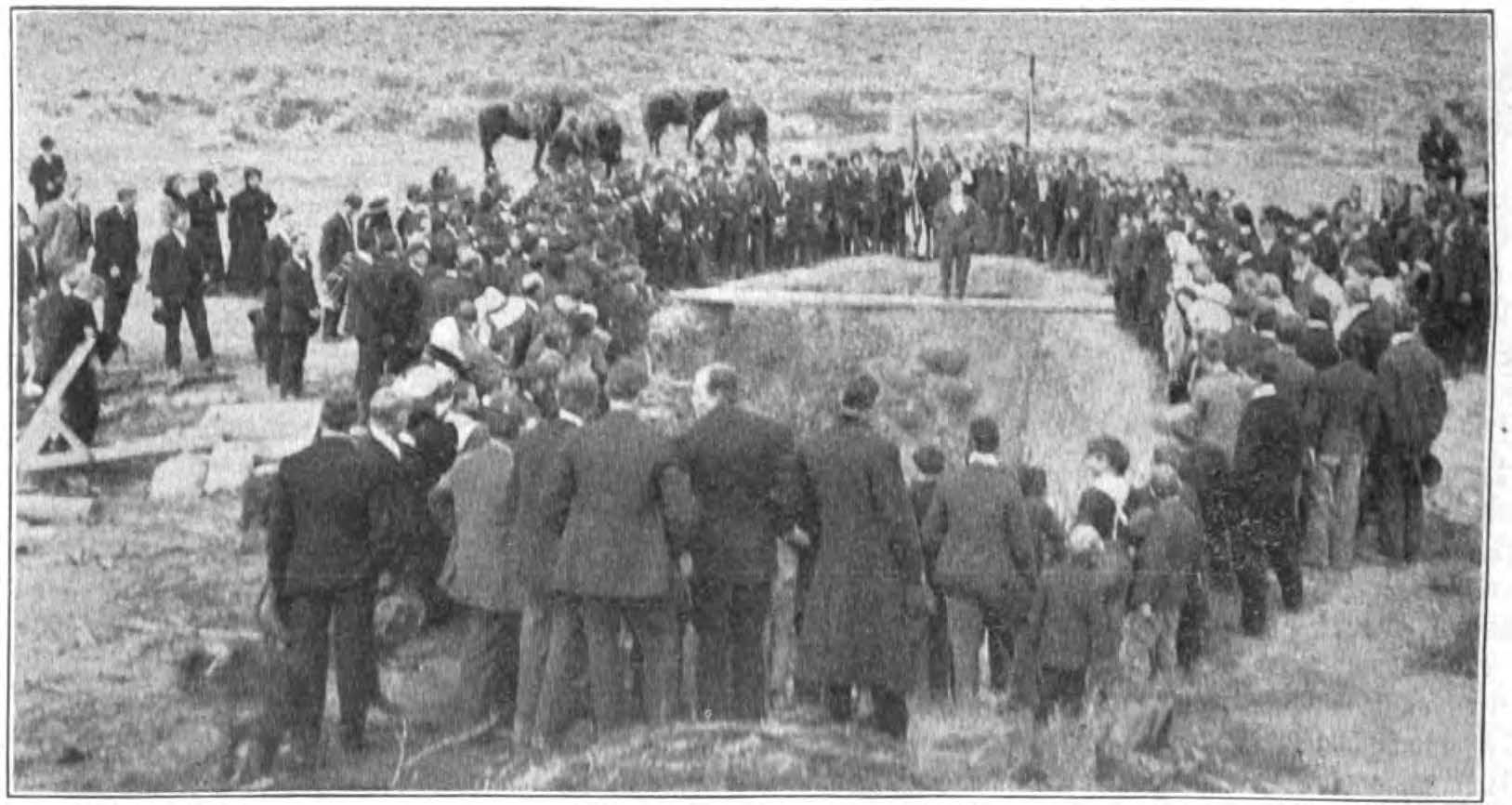
Mine No, 1 has been abandoned. On June 30, 1903, one hundred and sixty-nine men perished in an explosion here. On March 28, 1908, fifty-nine men died in the same mine, leaving thirty-eight widows and one hundred and four orphans. The total toll of life yielded up by the miners in Mine No. 1 is three hundred and seven-three. The explosions so damaged the properties, being of such force as to wreck completely the shafts and entrances, that the company hesitated about paying for the repairs so frequently necessary. And so the mine is closed. The anniversaries of these fearful accidents have been declared holidays by the miners, A picture herewith shows four hundred workers assembled at Mine No. 1 for memorial services on March 28th of this year. Twenty-nine bodies are here still entombed. These men kissed their little ones on a March morning two years ago and went below to return no more forever to the world’s song and sunlight.
“There’s never a mine blown skyward now/ But were buried alive for you/ There’s never a wreck drifts shoreward now/ But we are its ghastly crew.
“Go reckon our dead by the forges red/And the factories where we spin/ If blood be the price of your cursed wealth/ Good God, we have paid it in!”
The International Socialist Review (ISR) was published monthly in Chicago from 1900 until 1918 by Charles H. Kerr and critically loyal to the Socialist Party of America. It is one of the essential publications in U.S. left history. During the editorship of A.M. Simons it was largely theoretical and moderate. In 1908, Charles H. Kerr took over as editor with strong influence from Mary E Marcy. The magazine became the foremost proponent of the SP’s left wing growing to tens of thousands of subscribers. It remained revolutionary in outlook and anti-militarist during World War One. It liberally used photographs and images, with news, theory, arts and organizing in its pages. It articles, reports and essays are an invaluable record of the U.S. class struggle and the development of Marxism in the decades before the Soviet experience. It was closed down in government repression in 1918.
PDF of full issue: https://www.marxists.org/history/usa/pubs/isr/v11n01-jul-1910-ISR-gog-Corn-OCR.pdf
 Revolution's Newsstand