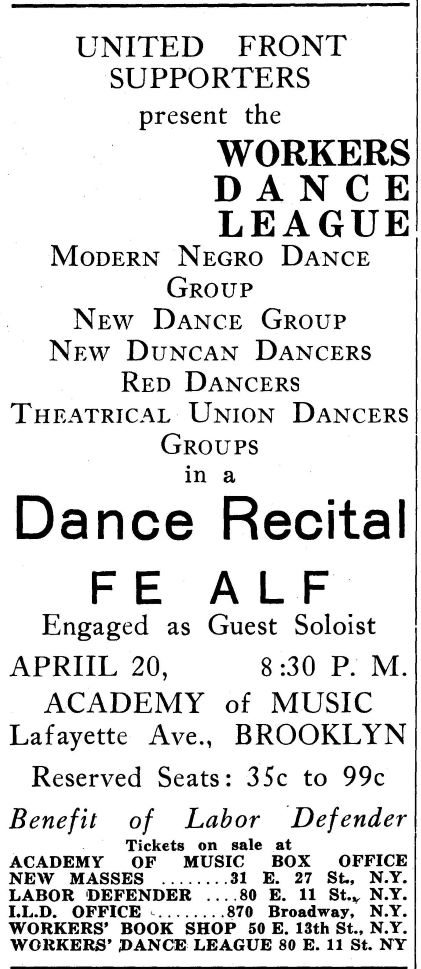
In the early 1930s, dance became one of the leading artistic vehicles for political and revolutionary expression. Here Ben Wolf reviews a Workers Dance League recital with performances from the Red Dancers, Modern Negro Dance Group, New Dance Group, Theatre Union Dance Group, Fe Alf, and the New Duncan Dancers.
‘Over 2,000 Cheer Workers’ Dance League Recital’ by Ben Wolf from the Daily Worker. Vol. 11 No. 98. April 24, 1934.
PROBABLY not since the appearance of the Isadora Duncan Dancers from the Soviet Union in 1928, have the staid walls of the Brooklyn Academy of Music Opera House reverberated with such warm and enthusiastic applause as that which greeted the Workers Dance League recital last Friday night.
The performance as a whole was far from perfect. There were many flaws. The program was poorly balanced, the lighting arrangements were badly managed, some of the artistic conceptions were crude, some of the individual dancers betrayed an obvious lack of technical training, some of the dances sorely needed first aid from an experienced choreographer; yet, notwithstanding all these, which are, after all faults of immaturity and can be overcome with added practice and experience, there was an all-pervading sincerity and vitality that completely captured the audience and furnished ample corroboration of a noted dance critic’s statement concerning the W.D.L. that, “Here is the nucleus about which the future American dance will develop.” Furthermore, two of the groups and the guest soloist gave performances that clearly ranked among the best ever seen on any concert stage within the past season.
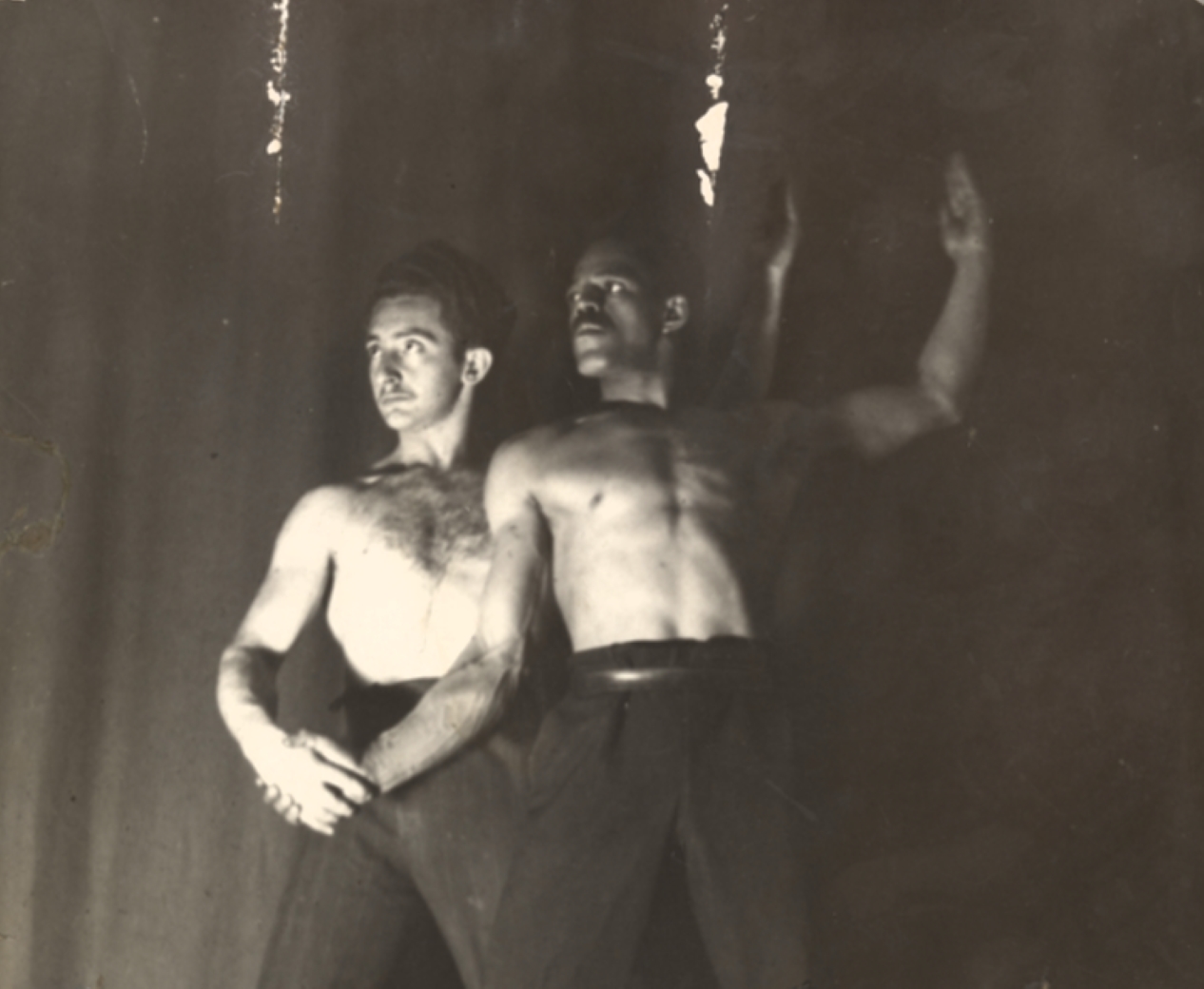
Outstanding, from the point of technical finish and perfection were the New Dance Group, Theatre Union Dance Group, and Fe Alf. For political clarity, however, the award must go to the well-known, but still popular “Black and White,” with Add Bates and Irv Lansky capably fulfilling their roles. As the final spotlight revealed the two figures, representing the Negro and the White races, in a firm hand-clasp of solidarity, the house spontaneously broke forth in a tremendous outburst of approval.
MOST encouraging was the New Dance Group. Showing marked artistic growth since their appearance at the City College recital, with a firmer grasp of technique and choreography, and a basically clear ideology, they stirred their audience with “Uprising” and “Van der Lubbe’s Head.” The latter was done to a recitation of Alfred Hayes’ poem. With the aid of striking costumes and masks, they realized to the fullest the dramatic potentialities of the poem.
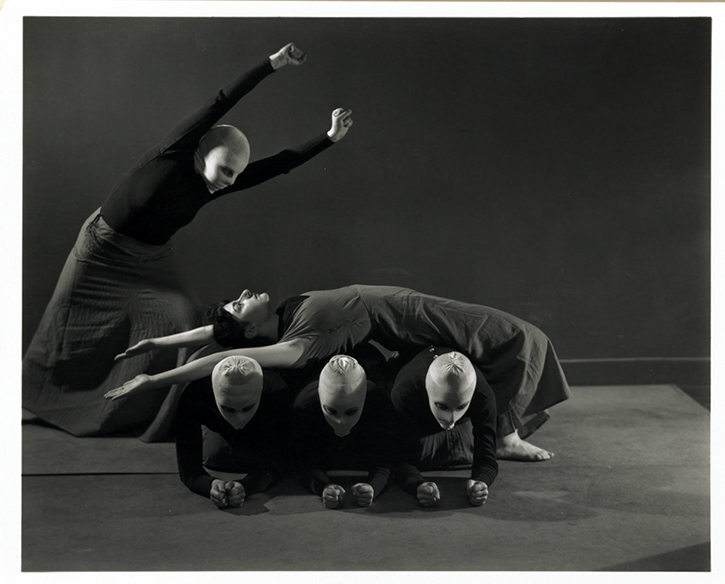
The Theatre Union Dance Group, with characteristic finesse, performed part of their Anti-War cycle, and a short and stirring “March of the Pioneers” to music by Prokofieff. Here is, undoubtedly, one of the foremost dance groups of the day, yet, despite its fine technique and consistently interesting choreography, it still lacks a clear and unmistakable proletarian orientation.
In winning over the support and sympathy of Fe Alf, the Workers Dance League has made a decided and worthwhile conquest. The reviewer has witnessed practically every dance recital of the past season, yet not once, has he seen as inspired, natural, and apparently spontaneous a bit of dancing as that which Miss Alf gave in her “Summer Witchery.” Mass pressure, in the form of “Bravos” and thunderous applause, forced a repetition of the number. In “Slavery,” she exhibited to good advantage the tremendous power and control of her movements. The dance suffered slightly, however, from too much repetition. In “Fille de Joie,” from the same cycle, “The City.” she expressed the forced gaiety of the prostitute. In the space of a review like this, one cannot adequately treat of all the elements of Fe Alf’s art, yet there can be little doubt, that, thought she is, as yet, not a revolutionary dancer, with time and further experience, much is to be hoped for.

THE New Duncan Dancers, bearing the unpleasant burden of opening the program, suffering from slight nervousness and the consequences of badly managed lighting, did not fare so well in their opening number, but came back later to give a fine and finished presentation of “In Memoriam.”
Similarly, the Modern Negro Dance Group, appearing for the first time and crippled by the absence of a number of its members, made an unfortunate appearance in “Life and Death,” but afterwards, their later number, “Black Hands, Black Feet,” a simple, rhythmic study, took six bows.
The Red Dancers presented for the first time their Scottsboro Dance. In choice and construction of theme, they displayed a commendable political consciousness. With further working over, this dance will undoubtedly be a strong presentation, for it has within it the elements of “good dance.” It is suggested, however, that in future presentations, a masculine voice be used for the reading.
In general, the recital forebodes well for the next big event of the Workers Dance League–the June Festival at which fifteen groups will compete for prizes.
The Daily Worker began in 1924 and was published in New York City by the Communist Party US and its predecessor organizations. Among the most long-lasting and important left publications in US history, it had a circulation of 35,000 at its peak. The Daily Worker came from The Ohio Socialist, published by the Left Wing-dominated Socialist Party of Ohio in Cleveland from 1917 to November 1919, when it became became The Toiler, paper of the Communist Labor Party. In December 1921 the above-ground Workers Party of America merged the Toiler with the paper Workers Council to found The Worker, which became The Daily Worker beginning January 13, 1924.
PDF of full issue: https://www.marxists.org/history/usa/pubs/dailyworker/1934/v11-n098-apr-24-1934-DW-LOC.pdf
 Revolution's Newsstand