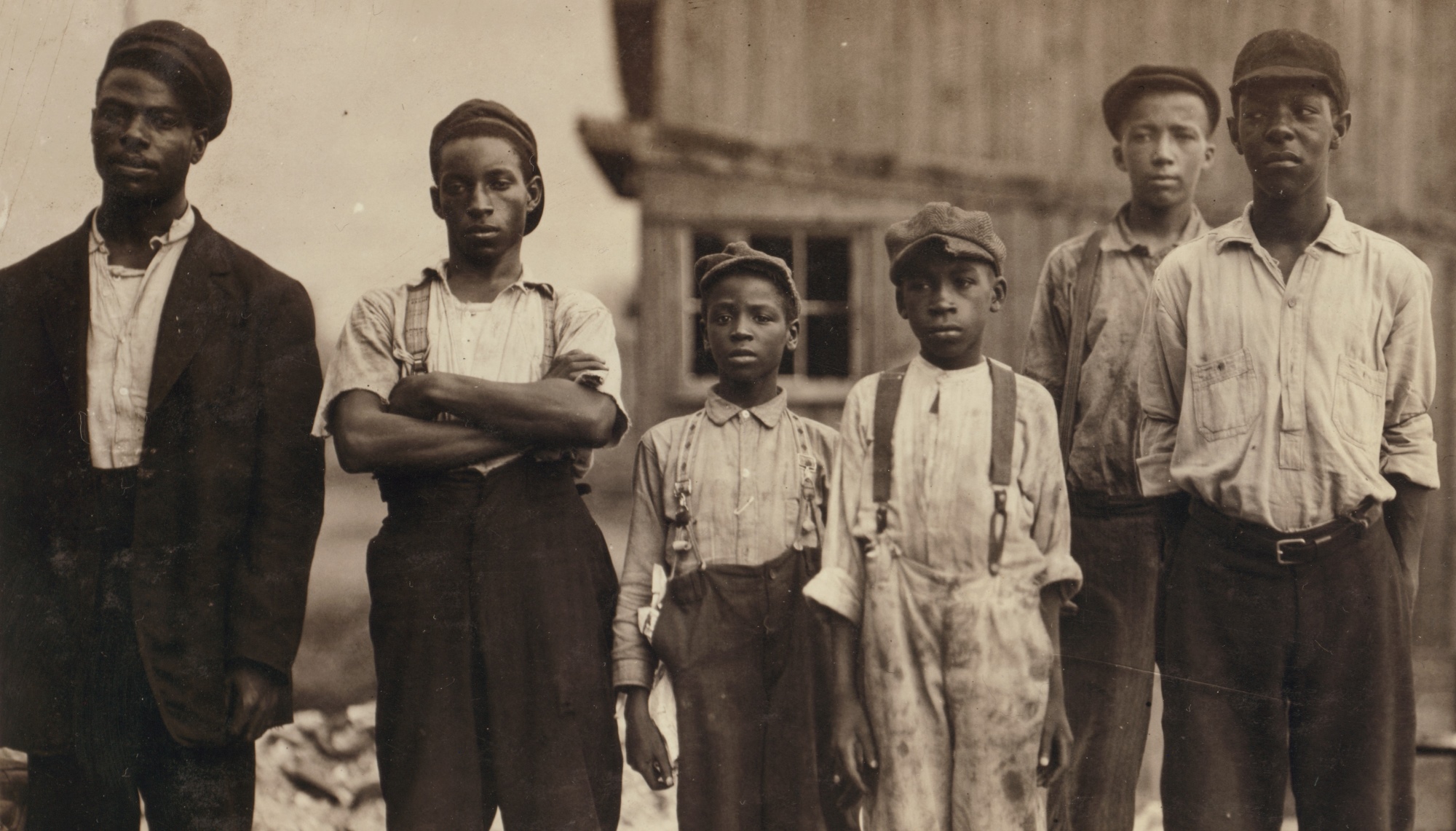
Haywood, as I.W.W. General Secretary-Treasurer, makes an appeal for Black workers to join the One Big Union.
‘To Colored Workingmen and Workingwomen’ by William D. Haywood from Solidarity. Vol. 8 No. 374. March 10, 1917.
Fellow Workers: There is one question which, more than any other, presses upon the mind of the worker today, regardless whether he be of one race or another, of one color or another; the question of how he can improve his conditions, raise his wage, shorten his hours. of labor and gain something more of freedom from his master-the owners of the industry wherein he labors.
To the black race who but recently, with the assistance of the white men of the northern states, broke their chains of bondage and ended chattel slavery, a prospect of further freedom, of REAL FREEDOM, should be most appealing. For it is a fact that the negro worker is no better off under the freedom he has gained than the slavery from which he has escaped. As chattel slaves we were the property of our master and, as a piece of valuable property, our master was considerate of us and careful of our health and welfare. Today, as wage workers, the boss may work us to death, at the hardest and most hazardous labor, the longest hours, at the lowest pay; we may quietly starve when out of work and the boss loses nothing by it and has no interest in us. To him the worker is but a machine for producing profits and, when you, as a slave who, sells himself to the master on the installment plan, become old, or broken in health or strength, or should you be killed while at work–the master merely gets another wage slave on the same terms.
We who have worked in the south, know that conditions in the lumber and turpentine camps, in the fields of cane, cotton and tobacco, in the mills and mines of Dixie, are such that the workers suffer a more miserable existence than ever prevailed among the chattel slaves before the great Civil War. Thousands of us have come and are coming northward, crossing the Mason and Dixon line, seeking better conditions. As wage slaves we have run away from the masters in the south but to become the wage slaves of the masters of the north. In the north we find that the hardest work and the poorest pay is our portion. We are driven while on the job and the high cost of living offsets any higher pay we might receive.
The white wage worker is little, if any, better off. He is a slave the same as we are and, like us, he is regarded by the boss only as a means of making profits. The working class as a whole grows poorer and more miserable year by year while the employing class, who do no work at all, enjoy wealth and luxury beyond the dreams of titled lords and kings.
As you are both wage workers you have a common interest in improving conditions of the wage working class. Understanding this, the employing class seeks to engender race hatred between the two. He sets the black worker against the white worker and the white against the black and keeps both divided and enslaved. Our change from chattel slaves to wage slaves has benefited no one but the masters of industry. They have used us as wage slaves to beat down the wages of the white wage slaves and by a continual talk of “race problems,” “negro questions,” “segregation,” etc., make an artificial race hatred and division by poisoning the minds of both whites and blacks in an effort to stop any movement of labor that threatens the dividends of the industrial kings. Race prejudice has no place in a labor organization. As Abraham Lincoln has said, “The strongest bond that should bind man to man in human society is that between the working people of all races and of all nations.”
The only problem then, which the colored worker should consider as a worker, is the problem of organizing with other working men in the labor organization that best expresses the interest of the whole working class against the slavery and oppression of the capitalist class. Such an organization is the I.W.W., the Industrial Workers of the World, the only labor union that has never in theory or practice, since its beginning twelve years ago, barred the workers of any race or nation from membership. There has stood as a principle of the I.W.W. embodied in its official constitution since its formation in 1905: “By-Laws. Article 1. Section 1. No working man or woman shall be excluded from membership in Unions because of creed or color.” If you are a wage worker you are welcome in the I.W.W. halls no matter what your color. By this you may see that the I.W.W. is not a white man’s union, not a black man’s union, not a red or yellow man’s union, but A WORKING MAN’S UNION. ALL OF THE WORKING CLASS IN ONE BIG UNION.
In the I.W.W. all wage workers meet on common ground. No matter what language you may speak, whether you were born in Europe, in Asia, or in any other part of the world, you will find a welcome as a fellow worker. In the harvest fields where the I.W.W. controls, last summer saw white men, black men and Japanese working together as union men and raising the pay of all who gathered the grain. In the great strikes the I.W.W. has conducted at Lawrence, Mass., in the woolen mills, in the iron mines of Minnesota and elsewhere, the I.W.W. has brought the workers of many races, colors and tongues together in victorious battles for a better life.
Not only does the I.W.W. differ from all other organizations in regards to admission of all races, but there is a fundamental difference in form of organization from all other labor unions. You have seen other labor unions organized on craft, or trade, lines. Craft unionism, means that any small section of an industry has a labor union separate from all other sections that cannot act in any concerted movement of labor because of this craft separation. For example, in the railroad industry there are the engineers’ union, the fireman’s union, the conductors’ union, the brakeman’s union, the switchmen’s union and many others on that road and in the shops and yards.
Each union acts for itself and usually has time agreements with the companies for a term of years, each agreement ending at a different time than the others. When one craft union goes on strike at the end of the time agreement the other craft unions keep at work and by remaining on the job act as scabs and strike-breakers in defeating their fellow workers of the craft on strike. Thus in 1911 the men in the shops of the Harriman lines went on strike and the trainmen, who belonged to different craft unions, remained at work; the train crews took cars from and delivered cars to the strike-breakers in the shops because they were organized separately and had separate time agreements with the companies. That strike was lost because the railroad workers were organized wrong. The I.W.W. has INDUSTRIAL UNIONISM, which means that all crafts in any industry are organized together and act together. Had the I.W.W. been in the place of the craft unions on the Harriman lines in 1911, all would have gone out together, not a wheel would have turned, not a train would have moved till the companies would have come to terms with the shopmen. For the I.W.W. makes NO TIME AGREEMENTS with any employer and makes AN INJURY TO ONE AN INJURY TO ALL The I.W.W. always leaves its members free to strike when they see an opportunity to better themselves or support their fellow workers.
The foundation of the I.W.W. is INDUSTRIAL UNIONISM. ALL workers in any division of any industry are organized into an INDUSTRIAL UNION of ALL the workers in the ENTIRE INDUSTRY these INDUSTRIAL UNIONS in turn are organized into INDUSTRIAL DEPARTMENTS of connecting, or kindred, industries, while all are brought together in THE GENERAL ORGANIZATION OF THE INDUSTRIAL WORKERS OF THE WORLD–ONE BIG UNION OF THE WORKING CLASS OF ALL THE WORLD. No one but actual wage workers may join. The working class cannot depend upon anyone but itself to free it from wage slavery. “He who would be free, himself must strike the blow.”
When the I.W.W. through this form of INDUSTRIAL UNIONISM has become powerful enough, it will institute an INDUSTRIAL DEMOCRACY; it will end slavery and oppression forever and in its place will be a world of the workers, by the workers and for the workers; a world where there will be nq poverty and want among those who feed and clothe and house, the world; a world where the words “master” and “slave” shall be forgot; a world where peace and happiness shall reign and where the children of men shall live as brothers in a world-wide INDUSTRIAL DEMOCRACY.
The I.W.W. welcomes you as a member no matter in what industry you may work. The initiation fee is $2.00, the dues are 50c a month. After you become a member you have the right of free transfer into any industry. All that is necessary to continue membership is the payment of dues regardless of where you go or what your work may be. For further information write to
WM. D. HAYWOOD, GEN’L SECY-TREAS., 164 West Washington Street, Chicago, Illinois.
The most widely read of I.W.W. newspapers, Solidarity was published by the Industrial Workers of the World from 1909 until 1917. First produced in New Castle, Pennsylvania, and born during the McKees Rocks strike, Solidarity later moved to Cleveland, Ohio until 1917 then spent its last months in Chicago. With a circulation of around 12,000 and a readership many times that, Solidarity was instrumental in defining the Wobbly world-view at the height of their influence in the working class. It was edited over its life by A.M. Stirton, H.A. Goff, Ben H. Williams, Ralph Chaplin who also provided much of the paper’s color, and others. Like nearly all the left press it fell victim to federal repression in 1917.
PDF of full issue: https://www.marxists.org/history/usa/pubs/solidarity-iww/1917/v8-w374-mar-10-1917-solidarity.pdf
 Revolution's Newsstand