
Charles Gray remembers a decade past and the ‘Everett Massacre’ of November 5, 1916 in which hundreds of armed thugs attempted to prevent the landing of of I.W.W. activists from Seattle onboard the Verona as it docked in Everett. The I.W.W. defended itself. 2 gunthugs were killed and two dozen wounded at least five wobblies died, potentially a dozen more drowned, and another thirty were wounded.
‘The Everett Massacre’ by Charles Gray from Labor Defender. Vol. 1 No. 11. November, 1926.
HAPPY and determined, 250 of us embarked on the steamer Verona from Seattle to Everett, Washington on Nov. 5, 1916. All of us members of the Industrial Workers of the World, we were prepared to run the gauntlet of terrorism carried on against the Wobblies who had been jailed and slugged by the tools of the lumber trust for speaking in the streets and halls of Everett. We had resolved to conduct a free speech fight to establish our right to speak for the I.W.W.
Our hall had been raided; our speakers were dragged from the platform and tortured in the jail; and the drunken Sheriff McRae had announced that no meeting of the I.W.W. would be held in town while he was running it. A host of deputies, actively supported by the Commercial Club, were constantly ready to support him the minute the blowing of the mill whistles, their prearranged signal, was heard.
The roads leading into Everett, and the trains were watched by the deputies. Anyone suspected of being a member of the I.W.W. was none too gently turned back. The only means we had of reaching Everett was by the water route. With our pooled finances we prepared to invade Everett and wrest our rights from the lumber trust.
The scum in our ranks, two stool pigeons, immediately relayed a message to Everett, warning the sheriff that the Wobblies were leaving on the Verona, armed to the teeth and prepared to capture and pillage the city. The mill whistles blew and hundreds of legalized gunmen, liberally supplied with arms, ammunition and whisky were rushed down to the dock in automobiles and stationed in ambush in the warehouse, on the nearby dock and on the scab tug Edison.
The Verona steamed slowly towards the landing while our lusty voices sang Hold the Fort. From an overlooking hillside thousands of Everett citizens sent us shouts of welcome and cheer. As soon as the bowline had been made fast by the warfinger, Sheriff McRae stepped forward and yelled to the occupants of the steamer. “Who is your leader?”
“We are all leaders!” the free speech army shouted back.
McRae drew his gun from its holster: “You can’t land here!”
“The hell we can’t!” And the men moved forward to disembark as the gangplank was being thrown off.
Then hell broke loose. The infuriated gunmen, their feelings irritated by the month-long determination and courage of the I.W.W., opened fire on the three hundred odd packed in the steamer. The cowardly beasts sent one volley after another into the mass of men as fast as their fingers could pull the triggers and reload the magazines.
Young Hugo Gerlot, who had waved a greeting to the friendly hillside from the flag pole of the Verona, doubled up, and his bullet-shattered body fell lifeless upon the men who had thrown themselves prostrate on the deck. The body, bleeding from a dozen wounds, acted as a shield for others.
Felix Baran was stopped by an abdominal wound. Dr. Mary Equi before Baran died in horrible pain at the hospital of internal hemorrhage, said that had he had surgical attention there would have been a more than even chance for recovery.
The list of the boat, when the frenzied men had rushed to the rail in order to escape the fusillade by jumping into the river, had thrown them m struggling heaps on the deck. Abraham Rabinowitz, who tried to extricate himself from one of the heaps, had almost regained his footing when a bullet from the shore tore off the whole rear of his head, and his blood and brains splattered over the bodies of fellow workers beneath him. Rabinowitz died in the arms of a friend without regaining consciousness.
Gus Johnson and John Looney, too, met their death like brave rebels, in the forefront of battle. Many others, their names unknown, were swept away by the undertow of the river into which they had jumped only to be peppered by the inexorable rifles and revolvers from the shore. Scores of dead and wounded were brought back to Seattle on the somber return voyage of the Verona. Ten minutes of massacre had brought their bitter toll. And the few rebels on board who were armed drew up a balance sheets of two dead deputies and sixteen injured.
Not content with this frightful massacre of workers, 74 of the men were seized and held on charge of murder in the first degree! Thirty-eight were held, charged with unlawful assembly! They did not need to hold the five who lay dead in the city morgue, or the six swept away to ocean graves, and the 32 severely wounded, of whom at least two were crippled for life.
The trial was fought bitterly. The lumber barons wanted to see the brave fighters buried in prison or strung to the gallows. Its prostituted press conducted a poisonous campaign against the I.W.W. It was only the fact that thousands of workers in Everett who saw the first shot fired came from the shore and was directed against the men on the Verona, that many more thousands of workers thruout the Northwest rallied like one great force to the defense of these courageous men threatened by the tools of the mill owners, which forced their final release. The jury brought in a verdict of Not Guilty in the trial.
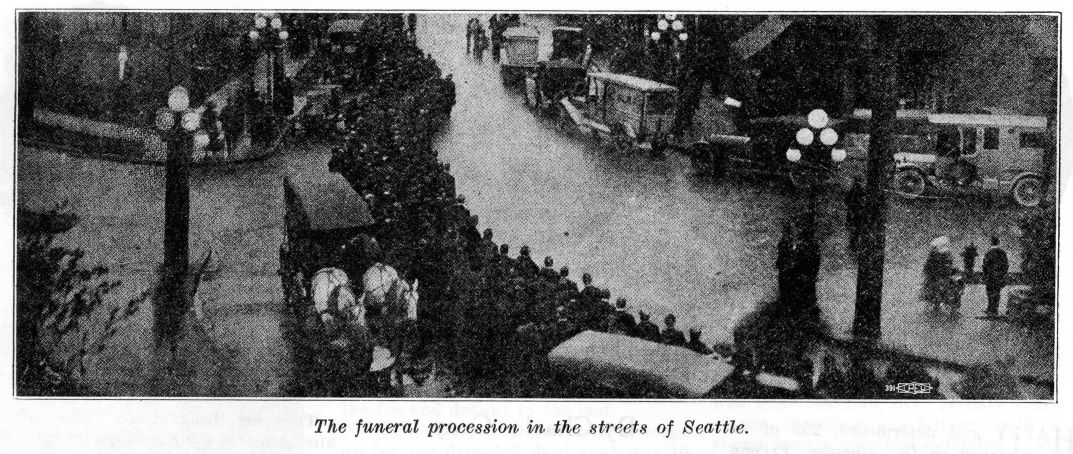
The torn bodies of Gustav Johnson and Abraham Rabinowitz were taken by their friends and relatives. But a sternly impressive funeral was arranged for the other three who had fallen in battle, Felix Baran, John Looney and Hugo Gerlot. Thousands of work- ers marched thru the streets of Seattle, each wearing a red flower, making a grim and sorrowful escort for their murdered brothers.
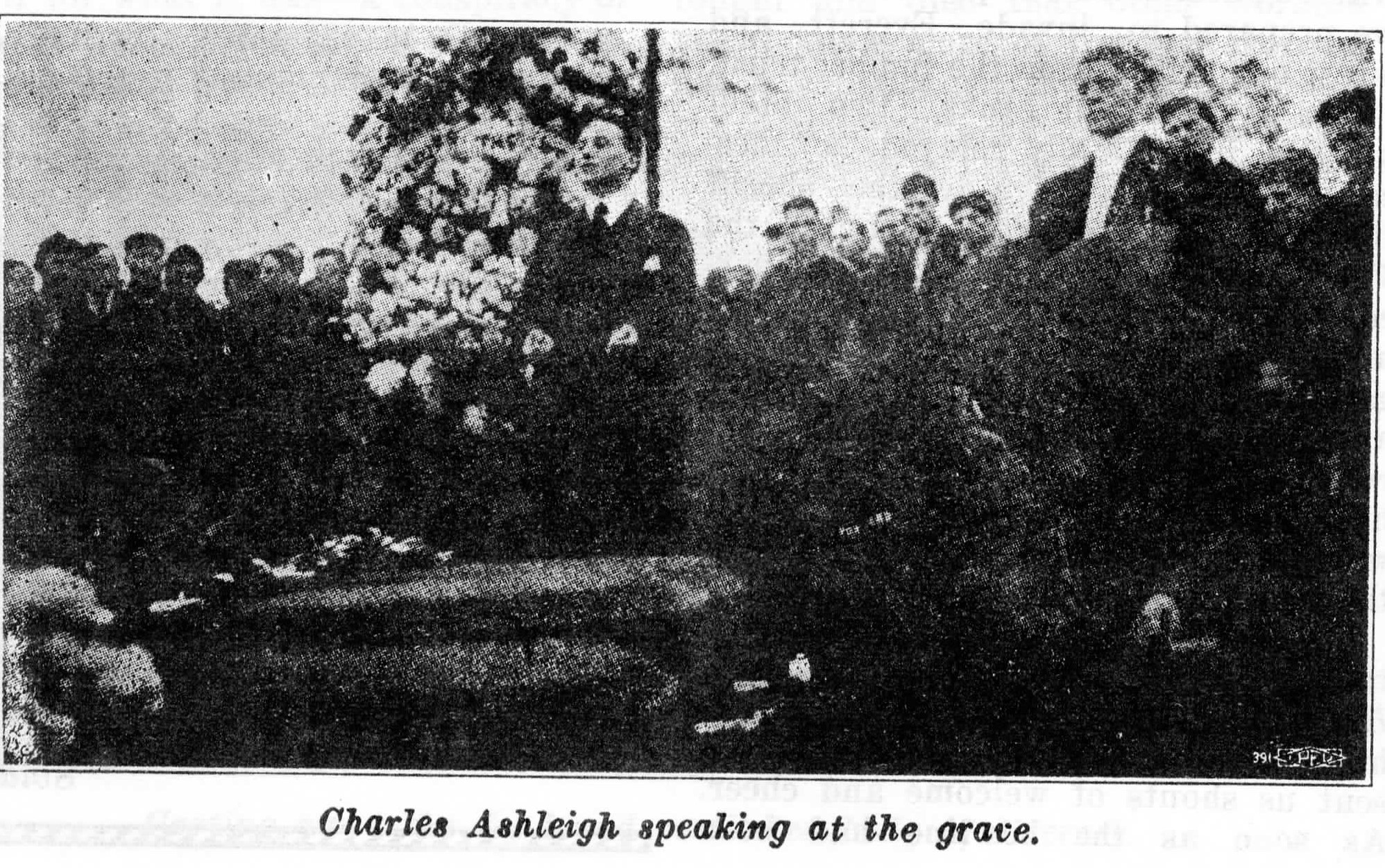
On the hill that looks down on Seattle, at Mount Pleasant cemetery, the coffins were lowered into the earth, and the workers stood by quietly while Charles Ashleigh spoke the last few words. “Today we pay tribute to the dead. Tomorrow, we turn, with spirit unquellable, to give battle to the foe!”
When Gustav Johnson was struck by the fatal bullet on November 5th, he cried out to his fellow-workers to hold him up. “I want to finish the song.” And with his lips blood-reddened and the hand of death upon him, he defied the drunken assassins on the shore and the barking of their guns with the last verse of Hold the Fort.
“Fierce and long the battle rages,
But we will not fear.
Help will come when’er it’s needed,
Cheer, my comrades, cheer!”
Five fine revolutionaries, and more, died on that day, Felix Baran, John Looney, Hugo Gerlot, Abraham Rabinowitz, and Gustav Johnson— Frenchman, Irishman, German, Russian Jew and Swede. They perished at the hands of cowards. They died in the struggle of the worker against those who rule, and its history is written in blood. The massacre at Everett is still fresh in the minds of the workers of the Northwest and must be remembered by workers everywhere.
To the brave spirits who fell on that bloody Sunday we pledge ourselves in – the words of the northwest rebels: “WE NEVER FORGET!”
Labor Defender was published monthly from 1926 until 1937 by the International Labor Defense (ILD), a Workers Party of America, and later Communist Party-led, non-partisan defense organization founded by James Cannon and William Haywood while in Moscow, 1925 to support prisoners of the class war, victims of racism and imperialism, and the struggle against fascism. It included, poetry, letters from prisoners, and was heavily illustrated with photos, images, and cartoons. Labor Defender was the central organ of the Scottsboro and Sacco and Vanzetti defense campaigns. Not only were these among the most successful campaigns by Communists, they were among the most important of the period and the urgency and activity is duly reflected in its pages. Editors included T. J. O’ Flaherty, Max Shactman, Karl Reeve, J. Louis Engdahl, William L. Patterson, Sasha Small, and Sender Garlin.
PDF of full issue: https://www.marxists.org/history/usa/pubs/labordefender/1926/v01n11-nov-1926-LD.pdf
 Revolution's Newsstand