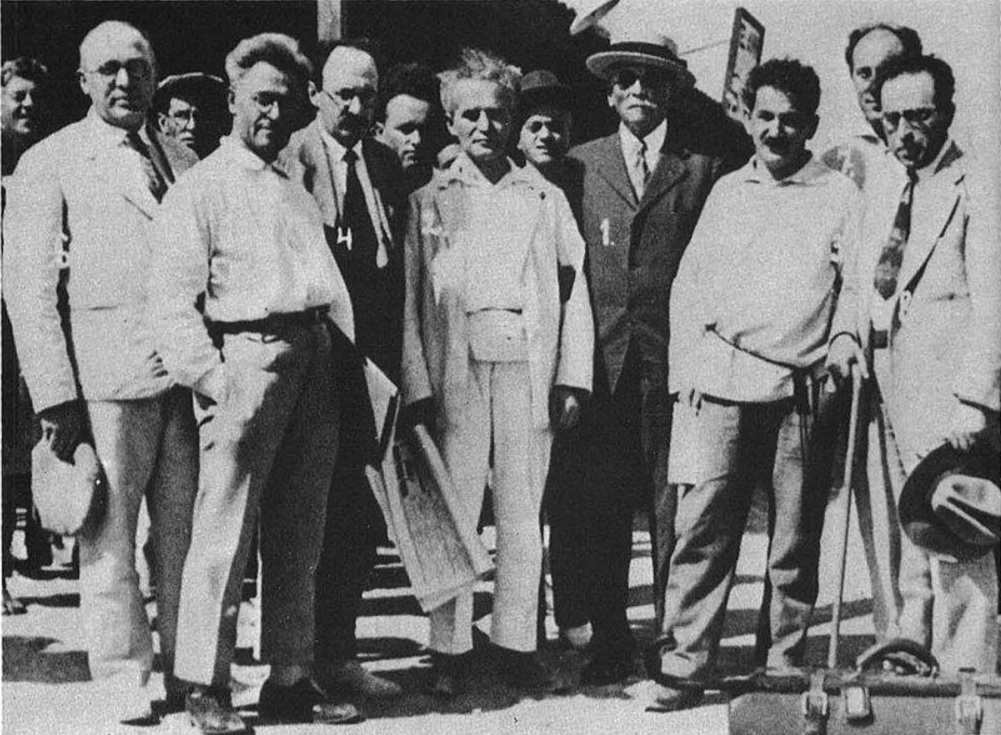
Joseph Berger, historic leader of the Palestine Communist Party, with a looks at the miserable state of Jewish migrants in the mid-1920s as the promises of Zionism met the reality of unemployment.
‘The Bankruptcy of Zionism’ by Joseph Berger from International Press Correspondence. Vol. 7 No. 21. March 27, 1927.
Jerusalem. The present state of things in Palestine is characterised by the disastrous situation of many thousands of Jewish immigrants. These people came to Palestine from various countries of Eastern Europe (Poland, Roumania, etc.) between 1920 and 1926, trusting in the assurances of the agents of the Zionist World Organisation, established everywhere, in regard to the national home for the Jewish people that was to be created in Palestine under British protection. This immigration reached its height in 1925, when as many as 4000 Jewish immigrants in a month came to the “promised land”.
But neither the British mandatory Government nor the Zionist organisation troubled about the fate of the immigrants, who could not be absorbed by the economy of the backward and poor little country, hampered as it was in its development by British imperialism. Instead of establishing the immigrants on agricultural settlements or employing them in the towns on productive work, they used them for constructional and other seasonal work, which was soon at an end. Since last year, unemployment has set in among the immigrants and is assuming increasing dimensions. Only quite a small fraction of the immigrants received land allotments or found permanent employment in the towns. The remainder are without means of subsistence, in a foreign country, helpless and unprotected (no manner of support having been granted them by the Government or the municipalities), and, in short, exposed to the greatest misery. Of 22,000 members registered in the Jewish trade union organisation, no fewer than 8000 are officially returned as unemployed. In reality the number of the unemployed is far larger.
While up to the present the unemployed have borne their fate and their hunger with quiet submission, being urged by the leaders of the reformist organisation to place no obstacles in the way of the “Zionist work of construction”, but rather, in case of extreme need, to board a ship and return whence they came (in which connection the Zionist writer R. Weltsch even suggests that the Zionist organisation help the “pioneers” to buy their return tickets), the patience of very many of them has now come to an end.
In all parts of the country, there is a recurrence of elementary outbreaks on the part of the starving unemployed; at Tel- Aviv, a town described by the Zionist propaganda as the crowning masterpiece of the Zionist action, but which has been most severely affected by the crisis, a meeting of many thousands of unemployed was followed by a great demonstration in the streets under Communist leadership. How far these demonstrations are merely a reflection of insupportable chronic misery, may be recognised by the fact that many formerly Zionist workers took part in it, as did also some members of the treacherous chauvinist party “Poale Zion”, which knew no other remedy for the sufferers than to cry insistently for more and more immigrants. It was only after a prolonged fight, in the course of which there were several injuries, that the Tel- Aviv police succeeded in dispersing the demonstrators.
The rage of the Zionist leaders and the reprisals of the Government against the organisers of the demonstration can naturally not alter the fact that the bankruptcy of Zionism is now quite obvious in Palestine, the country in which it was to have been realised. The breakdown of the Zionist planes, moreover, reacts on those countries in which the Zionists were wont to see their special strongholds. Thus, in Poland, e.g., the Jewish masses are becoming more and more emancipated from Zionist demagogy, the emigration to Palestine having in the month of January last figured at only 160 persons, out of a total of 440 that left the country. Under such circumstances, the Zionist object of forming a Jewish majority in Palestine, appears very far indeed from its fulfilment.
The British Government, which hitherto supported the Zionists only in so far as was necessary in connection with the suppression of the Arab national movement, and hardly thought seriously of keeping the promises made by Balfour, now feels menaced by the misery of the Jewish immigrants, seeing that their defection from Zionism ad their fraternisation with the emancipatory movement among the Arabs might seriously impair the British position, and would in the first place undermine that foundation of the British rule in Palestine, the national antagonism between the Jews and the Arabs. The British imperialists are therefore beginning to take some interest in the internal conditions of the Zionist enterprise. Delegates of the imperialist wing of the Labour Party, (Wedgwood, Kenworthy) have combined amicably with Liberal and Conservative imperialists to form a pro-Zionist committee and are helping the Zionist organisation in their collection of funds in Poland, the United States, and Germany, where members of the Social-Democratic Party, the Democrats, and the “Volkspartei” have likewise formed a committee on behalf of Zionism.
The credit granted by the British Parliament for the construction of a naval harbour at Halfa at a cost of 4.5 million pounds, a credit which it will take the population of Palestine years to repay, is in part to serve to provide occupation for the Jewish unemployed in Palestine.
For this reason, the Zionists all the world over must give proof of their loyalty to Great Britain by being more vehement than ever in their attacks on the Soviet Union. In Palestine they have also to fight energetically against the “Communist danger”.
All this, however, fails to furnish the Zionist Organisation with the means of providing for the tens of thousands of hungry immigrants in Palestine, to say nothing of encouraging further immigration. Therefore Weizmann, Chairman of the Zionist Organisation, has got into touch with the rich American philanthropists of the Marshall group. So far no agreement could be reached with this group, since they will on no account recognise the Zionist ideology as the one and only solution of the Jewish question. Unable to carry on the bankrupt business on their own account, the Zionists have now abandoned their ideology. Marshall will subscribe to the relief action in Palestine in just the same way as he and his philanthropic friends support poor Jews in other countries. A special investigatory commission is to examine into the possibilities of relief work in Palestine.
The Zionist Organisation thus loses the halo of a political renaissance movement and sinks politically to the level of a pronounced tool of British imperialism and economically to a branch of the philanthropic Jewish societies in the United States. If we add that the agrarianisation activity of the Soviet Government in Russia has done much more in two years for the solution of the Jewish question on that territory than Zionism has effected in fifty years, and that the healthy development of the Jewish colonies in the Soviet Union affords such an attraction for many of the disappointed Jewish emigrants to Palestine, that they are anxious to return to the Soviet Union by the hundred, it may serve as an indication as to where the Jewish masses, who have hitherto been dazzled by Zionism, must turn to find the escape from national and social oppression. It is not to Palestine they must turn, where they will merely serve to satisfy British colonial aims; but they must rather unite in a consistent class struggle with the proletarians of other countries, so that by means of the social revolution they may find their way to a real renaissance and recovery.
International Press Correspondence, widely known as”Inprecorr” was published by the Executive Committee of the Communist International (ECCI) regularly in German and English, occasionally in many other languages, beginning in 1921 and lasting in English until 1938. Inprecorr’s role was to supply translated articles to the English-speaking press of the International from the Comintern’s different sections, as well as news and statements from the ECCI. Many ‘Daily Worker’ and ‘Communist’ articles originated in Inprecorr, and it also published articles by American comrades for use in other countries. It was published at least weekly, and often thrice weekly.
PDF of full issue: https://www.marxists.org/history/international/comintern/inprecor/1927/v07n21-mar-27-1927-inprecor-op.pdf
 Revolution's Newsstand