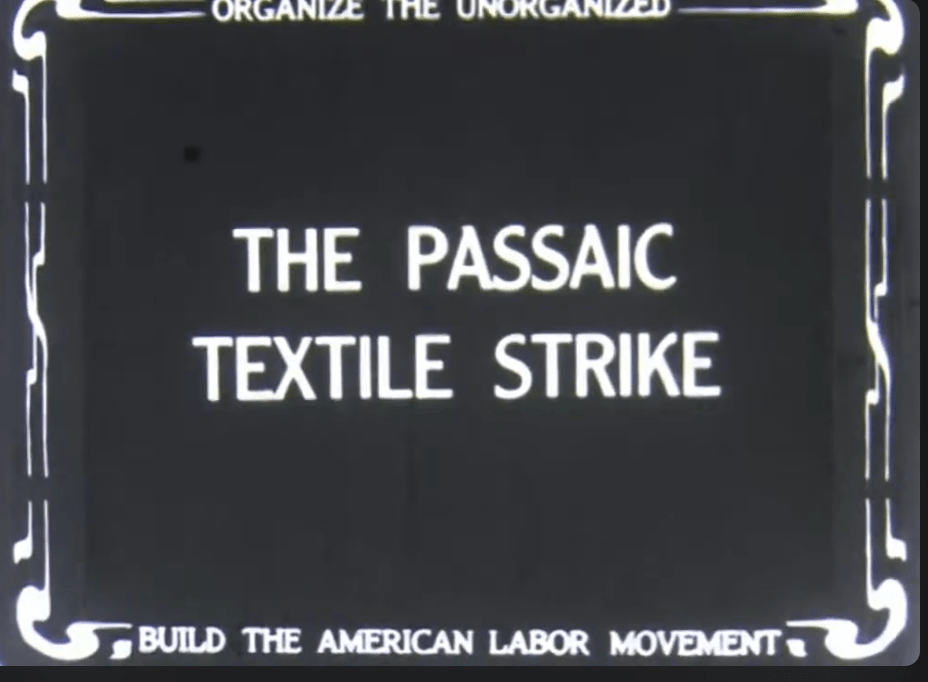
As soon as new media and communications technologies were introduced–and occasionally before–the Left made use of them. Film, from its earliest days, was no exception. The pioneering, REMARKABLE, silent film (shown below), full title ‘The Passaic Textile Strike: the Battle for Life of the Workers Who Make the Cloth that Clothes You Wear,’ is a such and example. Produced by the Communist Party to tell the story of the 1926-7 New Jersey strike, the film begins with the fictionalized life of Stefan Breznac, Polish immigrant working in the city’s mills. The film’s last hour becomes a documentary of the strike, including footage of actual events, as well as the lives of workers, along with recreations and staged shots. Communist seen in the film include George Ashkenuzi, John J. Ballam, Robert W. Dunn, Elizabeth Gurley Flynn, Leo Krzycki, Ella Reeve Bloor, Vera Buch, Norman Thomas, J.O. Bentall, British MP Ellen Wilkinson, Albert Weisbord, and Alfred Wagenknecht among others. 1 hour 19 minutes. A contemporary article on its production accompanies the film. A unique and wonderful document.
‘The Passaic Textile Strike: the Battle for Life of the Workers Who Make the Cloth that Clothes You Wear’ directed by Samuel Russak and Alfred Wagenknecht, 1926.
‘Passaic Strike Film is Truly a Labor Project’ from the Daily Worker. Vol. 4 No. 100. May 10, 1927.
CHICAGO (FP). It took over a month before the professional movie producers who, had been engaged to make the famous Passaic strike film, realized that the textile workers wanted pictures of actual happenings and not studio pipe dreams. When this finally penetrated, the professional producers quit and the strike organization began grinding its own movie camera and piecing together its own continuity. The result is a labor film that has fascinated thousands of worker audiences in big cities and little towns all over the United States as well as in foreign lands,

Alfred Wagenknecht, the Passaic relief director, stopping in Chicago for a few days, recounted the history of the film. “We wanted a photographic record in movie form of the epochal Passaic textile strike,” he said. “We wanted it not only as a vital bit of American labor history but to show the countless friends of the Passaic strikers all over the land what the struggle was about, what terrific police violence and other obstacles the workers had to face and also how effectively and carefully the generous relief contributions were put to use.
“So we engaged two professional producers from Boston for the job. They knew what we wanted but they hung around in their studio, planning fake scenes and talking of putting pretty girl strikers into the foreground of the film with lots of romance for the American movie public. We protested and told them to go to the picket lines and relief kitchens. But they did not like the idea of having their heads battered by police clubs for taking pictures of the lawless cossacks doing their stuff, and so we had to get rid of them.
Workers Got True Picture.
“We then bought a movie camera and a projector, got together a staff from the strikers and photographed the real happenings. It was dangerous but it was genuine adventure, not the warmed-over thrills carefully dolled up by Hollywood methods. Romance was there too, in the hard fight of the striker families, young and old, parents and children, against the mill owners and their allies in the government, police and church.
“The result is the remarkable film that is still drawing large audiences in many places. Numbers of workers have seen it several times. It is now the principal source of relief funds for the Passaic workers, who have settled their strike with most of the mills but are now disastrously hit by unemployment.”

The film headquarters are in the office of the Passaic local of the United Textile Workers, 734 Main Ave., Passaic, N.J. The Chicago office, where bookings are also made, is managed by Natalie Rogers, Room 48, 106 N. LaSalle St.
The Daily Worker began in 1924 and was published in New York City by the Communist Party US and its predecessor organizations. Among the most long-lasting and important left publications in US history, it had a circulation of 35,000 at its peak. The Daily Worker came from The Ohio Socialist, published by the Left Wing-dominated Socialist Party of Ohio in Cleveland from 1917 to November 1919, when it became became The Toiler, paper of the Communist Labor Party. In December 1921 the above-ground Workers Party of America merged the Toiler with the paper Workers Council to found The Worker, which became The Daily Worker beginning January 13, 1924.
PDF of full issue: https://www.marxists.org/history/usa/pubs/dailyworker/1927/1927-ny/v04-n100-NY-may-10-1927-DW-LOC.pdf
 Revolution's Newsstand