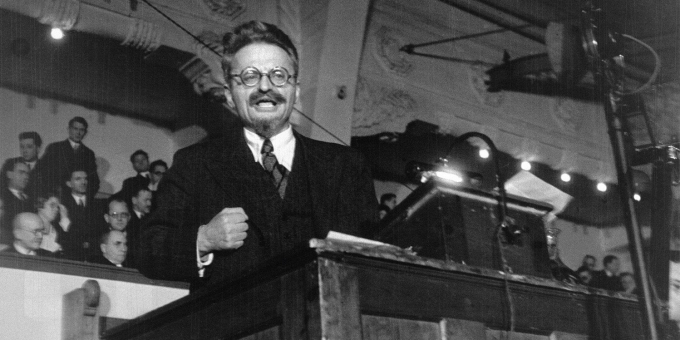
Trotsky’s mid-1920s collections on Britain largely dealt with the that particular pacifist animal of British Fabianism, the disastrous Labour MacDonald government, and the British general strike. ‘Whither Britain’ from which this essay comes, remains one of Trotsky’s most well-regarded works. Among the last officially published major works as a leader of the Soviet Union, it was widely discussed in Britain at the time, as saw many of his opponents in the factional struggle then underway praise and defend it. In this 1925 essay Trotsky systematically and forcefully dismantles English reformism’s long standing tradition of pacifism, fawning before their ‘betters’ and the ‘sacred’ legality of one of human history’s most violently transgressive states, the British Empire.
‘The Problem of Revolutionary Force’ by Leon Trotsky from Whither England. International Publishers, New York. 1925.
We have become acquainted with MacDonald’s views on the use of force in revolution and have found them to be a paraphrase of Mr. Baldwin’s Conservative theory of gradual changes. More curious—though somewhat more genuine—is the renunciation of violence on the part of the “Left” Lansbury. Lansbury, it seems, says simply that he does “not believe” in force. He also does “not believe” in the capitalist army or in armed uprisings. If he believed in force, he would not vote—he says—for the British fleet, but would join the Communists. What a brave fellow! But the fact that Lansbury, who does not believe in force, does believe in a future life makes it somewhat doubtful whether he is entirely consistent. Nevertheless, with Lansbury’s permission, certain facts in the world have been brought about with the aid of force. Whether Mr. Lansbury believes in the British Navy or not, the Hindoos know that this fleet exists. In April, 1919, the English General Dyer, without having issued any previous warnings, gave orders to shoot at an unarmed Hindoo meeting at Amritsar, with the result that 450 persons were killed and 1500 wounded. Leaving the dead out of consideration, we may feel safe in declaring that the wounded cannot afford “not to believe” in force. But even as a believing Christian, Lansbury should know enough to understand that if the cunning Hebrew priesthood, together with the cowardly Roman Pro-consul Pontius Pilate, a political predecessor of MacDonald, had not applied force to Jesus Christ, we should not have had the crown of thorns, nor the Resurrection, nor the Ascension, and even Mr. Lansbury would not have had the opportunity to be born a good Christian and to become a bad socialist. A disbelief in violence is equivalent to a disbelief in gravitation. All life is built up on various forms of violence, on the opposition of one mode of force to another, and renunciation of the use of force for purposes of liberation is equivalent to giving support to force used for oppression, which now rules the world.
But we are of the opinion that scattered observations will not be of much avail here.
The question of force and the “denial of force” by the pacifists, Christian socialists, and other sanctimonious persons, is such an extensive phenomenon in English politics, that a special, detailed treatment is necessary, adapted to the political understanding of the present-day “leaders” of the British Labor Party, for which reason we are obliged to beg the pardon of our other readers for descending to this level.
What is—at bottom—the meaning of a denial of any use of force? If—let us suppose—a burglar should break into Mr. Lansbury’s house, we very much fear that this respectable gentleman (we are speaking of the master of the house) would apply force or would call upon the nearest policeman to apply force. Even if Lansbury, in the fulness of his Christian mercy, should permit the burglar to depart in peace—of which we are not at all certain—it would of course only be under the obvious condition of the burglar’s immediately leaving the apartment. Furthermore, the honorable gentleman could only permit himself the luxury of so Christian a gesture by reason of the fact that his premises are under the protecting supervision of British property laws, and their numerous arguses, with the result that in general such nightly visits on the part of burglars are rather the exception than the rule. If Lansbury should attempt to answer that an intrusion into a respectable private Christian home is an application of force which calls for the necessary resistance, we shall answer him that such a view is an abandonment of the renunciation of force in general, equivalent—on the other hand—to a recognition of force in principle and in practice, which may also be applied with perfect correctness to the class struggle, where we find daily intrusions by predatory capital in the life of the proletariat and expropriations of surplus value which fully justify the offering of resistance. Perhaps Lansbury may reply that he does not imply every form of constraint when he uses the word “force”, for our excellent social life could not get along without some such forms, but only violations of the Sixth Commandment with its injunction “Thou shalt not kill.” In a defense of such an understanding of the question, it would be possible to adduce a great many high-sounding phrases concerning the sanctity of human life, and we should then be obliged to use the language of the parables in the Gospels, which is more accessible to the leaders of British socialism, and ask how Mr. Lansbury would act if he should behold a murderer falling upon little children with a club, if there were no other means of saving them than an immediate well-aimed shot from a revolver. If our supposed fellow-debater does not prefer to engage in absolutely empty sophisms, he will answer, I suppose, to render his position easier, that our example is a very exceptional one. But this answer would merely be equivalent once more to an admission that Lansbury would transfer his right to the use of murder under these circumstances to his police, the special organization of force which permits him to dispense in most cases with the necessity of using his revolver and even of considering its practical destination.
But now let us ask about the case in which armed strike-breakers beat up strikers or beat them to death. Such cases are every-day matters in America and are not unusual even in other countries. The workers cannot entrust the police with the execution of their right to resist the strike-breakers, because the police in all countries defends the right of strike-breakers to beat up strikers and beat them to death, for it is well known that the law concerning the sanctity of human life does not apply to strikers. Our question is this: Have the strikers the right to resort to the use of sticks, stones, revolvers, bombs, against the Fascisti, the bands of the Ku Klux Klan, and other hired thugs of capital? We should like to have a clear and straight answer to this question, without any evasive sanctimonious embroidery. If Lansbury should say to us that the task of socialism is to provide the masses of the people with such training as to prevent the Fascisti from being Fascisti, to prevent scoundrels from being scoundrels, this would be pure hypocrisy. The fact that the object of socialism is the elimination of force, first in its cruder and bloodier forms, and later in its other, less obvious forms—we do not dispute. But we are not speaking of the manners and morals of the coming communist society, but of the concrete ways and means of the struggle with capitalist violence. When the Fascisti break up strikes, occupy newspaper offices and seize their treasuries, beat up or beat to death the workers’ Parliamentary representatives, while the police surround the destroyers with a protective cordon, only the most contemptible hypocrite could under these circumstances advise the workers not to give back blow for blow, by urging that there will be no room for violence in the communist society. Of course, in each given case it will be necessary to decide how to answer the enemy’s violence, and to what extent to proceed in our opposition, depending on all the circumstances of the case. But this is a question of practical tactics, which has nothing to do with the recognition or renunciation of violence in general.
What is the true nature of force? Where does it begin? When is it permissible and practical for the collective action of the masses to enter the phase of violence? We very much doubt whether Lansbury or any other of the pacifists would be capable of giving a reply to this question unless it be by merely referring to the Criminal Code, which provides clearly what may be done and what not. The class struggle is a constant series of overt and covert violence “regulated”—to this or that extent—by the State, which is, in turn, the organized apparatus of force of the most powerful of the antagonists, i.e., the ruling class. Is the strike a form of violence? There was a time when strikes were prohibited and when every strike almost inevitably was combined with physical collisions. Later, as a result of the growth of the strike movement, i.e., as a result of the force applied by the masses against the laws, or, more correctly, as a result of the constant blows struck by the masses against the violence of the laws, strikes were legalized. Does this mean that Lansbury considers the only permissible instrument of struggle to be the peaceful, “legal” strikes, i.e., those permitted by the bourgeoisie? If the workers had not inaugurated strikes at the beginning of the Nineteenth Century, the English bourgeoisie would not have legalized them in 1824. If we approve of the strike, which is a form of applying power or force, we must accept all the consequences, including that of the defense of strikes against strike-breakers with the aid of practical measures of counter-force.
Furthermore, if strikes by the workers against the capitalists or against single groups of capitalists are desirable, will Lansbury refuse to recognize the necessity of a general strike of the workers against the Fascist Government, which oppresses the workers’ unions, destroys their press, fills the ranks of the workers with provocateurs and murderers?
Of course, it must again be pointed out that the general strike should be applied not at every moment, but only in certain concrete conditions. But this again is a question of practical strategy, not a general “moral” consideration. As far as the general strike is concerned, which is one of the most decisive instruments in the struggle, it would be hard for Lansbury and those who sympathize with him to devise any other instrument that could be used by the proletariat for the attainment of so significant a goal. Lansbury will surely not fall so low as to recommend the workers to wait until the spirit of brotherly love will have won the hearts—let us say—of the Italian Fascisti, who, by the way, are for the most part pious Catholics. And if we recognize that the proletariat not only has the right, but the obligation, to resort to a general strike against the Fascist régime, we are also obliged to draw the necessary conclusions from this admission. The general strike, unless it be a mere demonstration, is an extraordinary upheaval of society and, in any case, calls for strength on the part of the revolutionary class. The general strike may only be applied when the working class and particularly its vanguard, is ready to prosecute the struggle to the bitter end. But, of course, Fascism also is not prepared to yield to any peaceful strike manifestation. In a case of real immediate danger, the Fascisti will set all their forces in motion, will resort to provocations, murder, incendiarism, on an unheard-of scale. We now ask: Is it permissible for the leaders of the general strike to create little bands for the defense of the strikers from violence, for disarming and dispersing the Fascist bands? And as no one has ever succeeded, at least within our memory, in disarming savage enemies with the aid of religious hymns, it will obviously be necessary to equip the revolutionary detachments with revolvers and hand-grenades until such time as they may be able to take possession of rifles, machine-guns, and cannons. Or is this perhaps the stage where the domain of inadmissible violence begins? But if we pursue this argument, we shall become definitely involved in childish and shameful contradictions. A general strike which does not defend itself against violence and destruction is a demonstration of cowardice and is doomed to destruction. Only a madman or a traitor could call to arms under such conditions. An “unarmed” strike struggle, by the logic of conditions that do not depend on Lansbury, would bring about armed conflicts. In economic strikes this frequently is the case; in a revolutionary political strike it is absolutely inevitable where the strike has the object of overthrowing the existing order. He who renounces force should renounce the struggle altogether, i.e., should really stand in the ranks of the defenders of the triumphant violence of the ruling classes.
But this is not all. Our hypothetical general strike has as its object the overthrow of the Fascist power. This object can be attained only by gaining the upper hand over this power by means of armed forces. Here again two courses are possible: outright military victory over the forces of reaction, or the winning over of these forces to the side of the revolution. Neither of these two methods can be applied exclusively, in its pure form. A revolutionary uprising carries off the victory if it succeeds in defeating the firmest, most resolute and most reliable troops of the reaction, and wins over to its side the other armed forces of the system. This is possible, again, only under the condition that the vacillating troops of the Government become convinced that the working masses are not merely demonstrating their dissatisfaction but are firmly determined this time to overthrow the Government at any cost, and will not recoil from the most uncompromising forms of conflict. The hesitating military forces can only be brought over to the side of the people by impressing them with this fact. The more procrastinating, vacillating, yielding, the policy of the managers of the general strike, the less vacillation will there be among the troops, the more firmly will they support the existing power, the greater will be the latter’s chance of carrying off the victory in the crisis, thereupon to let loose upon the heads of the working class all the scorpions of bloody retaliation. In other words, when the working class is obliged, in order to secure its liberation, to resort to a general political strike, it must first thoroughly understand that the strike will inevitably produce detached as well as general, armed and half-armed conflicts; it must also thoroughly understand that the strike will fail to be immediately defeated only if it is able to offer the necessary resistance to the strike-breakers, provocateurs, Fascisti, etc.; they must understand in advance that the Government, whose existence is called in question, will inevitably, sooner or later in the struggle, call its armed forces into the streets, and that the destinies of the existing system will depend on the outcome of the collisions between the revolutionary masses with these armed forces, and consequently also the fate of the proletariat. The workers must first make use of every method in order to win over the soldiers to the side of the people by means of preliminary agitation; but the working class must also foresee that the Government will always have left a sufficient number of dependable or half-dependable soldiers, which it can call out to suppress the uprising and, consequently, the question will be finally decided in armed clashes, for which it is necessary to be prepared by means of the most thorough preliminary plan and which must be conducted with the fullest revolutionary resoluteness.
Only great boldness in the revolutionary struggle can strike the weapons from the hands of reaction, shorten the period of civil war, and diminish the number of its victims. He who is not prepared to go so far should not take up arms at all; he who will not take up arms should not inaugurate a general strike; he who renounces the general strike should not think of serious resistance at all. The only thing that would remain would be to educate the workers in the spirit of complete submission, which would be a work of supererogation, as it is already being performed by the official schools, the governing party, the priests of all the churches, and . . . the socialist preachers of the impropriety of force.
But here is an interesting point: just as philosophical idealists in practical life eat bread, meat and base material things in general, and, forgetting the fact that they have immortal souls, make every effort to escape being run over by automobiles, so these pacifists, impotent opponents of violence, moral “idealists”, in all cases when they find it consonant with their interests, invoke political violence and directly or indirectly make use of it. As Mr. Lansbury is apparently not without a certain amount of temperament, such cases occur with him more often than with others. In the Parliamentary debates on the question of the unemployed (House of Commons Session of March 9, 1925), Lansbury declared that the law on unemployment insurance in its present form was introduced in 1920 “not so much in order to safeguard the lives of the workers and their families, as—to use the words of Lord Derby—in order to prevent revolution.” “In 1920,” continued Lansbury, “all the workers serving in the army were included in the number of those insured, because the Government was at that time not quite sure that these workers would not turn their rifles in a direction not at all to the liking of the Government.” (Times, March 10, 1925.) After these words, the minutes of Parliament record “applause from the opposition benches,” i.e., the Labor Party, and cries of “Oho!” from the Cabinet benches. Lansbury does not believe in revolutionary force, but he nevertheless recognizes—following Lord Derby—that the fear of revolutionary violence gave birth to the law for Government insurance of the unemployed. Lansbury resists all efforts to abolish this law: he believes, therefore, that the law born from the fear of revolutionary violence has a certain value for the working class. But this almost mathematically proves the utility of revolutionary force, for, with Lansbury’s permission, if there were no such thing as violence, there would be no fear of violence; if there were no actual possibility (and necessity) for turning one’s rifles against the Government under certain conditions, the Government would never have reason to fear such a possibility. Consequently, Lansbury’s so-called disbelief in force is pure folly. As a matter of fact, he is making use of force, at least in the form of an argument, every day. And furthermore, he is actually utilizing in practice the achievements of revolutionary violence in past decades and centuries. He merely refuses to put two and two together in his own mind. He renounces revolutionary force for the seizure of power, i.e., for the full liberation of the proletariat, but he is on excellent terms with force and uses it in the struggle so long as the matter does not transcend the bounds of bourgeois society. Mr. Lansbury believes in force retail but not wholesale. He resembles the vegetarian who became reconciled to devouring the meat of ducks and rabbits, but renounced the slaughter of large cattle with pious disgust.
However, we predict that Mr. Lansbury, or some more diplomatic and hypocritical sympathizer of his, will answer us: Yes, against the Fascist régime, in fact against all despotic governments, force may, in the last analysis, we do not deny it, be used to a certain extent, so to speak; but force is entirely out of place in a democratic system. For our own part, we should at once register this statement as a surrender of the position in principle, for we were not speaking of the conditions under which force was permissible or desirable, but of whether force was permissible in general, from the somewhat abstract humanitarian-Christian socialist point of view.
When we are informed that revolutionary force is inadmissible only under a system of political democracy, the whole question is at once shifted to another plane. This does not mean, however, that the democratic opponents of force are more profoundly and more intelligently Christian or humane. We can easily show this to be the case.
Is it true that the question of the advisability and admissibility of revolutionary force can be decided on the basis of the greater or less democracy in the form of bourgeois rule? A negative answer is implied in all the experience of history. The struggle between revolutionary and conciliatory, legalistic, reformist tendencies within the workers’ movement begins long before the establishment of republics or the introduction of universal suffrage. In the time of Chartism, and down to 1868, the workers of England were absolutely deprived of the suffrage, this fundamental weapon of “peaceful” development. However, there was a split in the Chartist movement between the advocates of physical force, with the masses behind them, and the advocates of moral force, consisting chiefly of petty bourgeois intellectuals and the aristocracy of the workers. In Hohenzollern Germany, with an impotent Parliament, there was a struggle within the Social-Democracy between the advocates of Parliamentary reform and the preachers of a revolutionary general strike. Finally, even in Tsarist Russia, under the Régime of June 31 the Mensheviks abandoned revolutionary methods, under the slogan of the “struggle for legality”. Thus, to speak of the bourgeois republic or universal suffrage as a fundamentally reformist and legalistic method, is merely an expression of theoretical ignorance, short memory, or downright hypocrisy. As a matter of fact, legalistic reformism means the submission of the slaves to the institutions and laws of the slaveholders. Whether these institutions include in their number the general right of suffrage or not, whether they are headed by a king or a president, this question is of secondary importance even for the opportunist. The opportunist is always on his knees before the idol of the bourgeois state and consents to advance to his “ideal” only through the donkey-gates constructed for him by the bourgeoisie. And these gates are so made that no one can get through them.
What is political democracy and where does it begin? In other words, where, by what countries has the stage been reached where force is inadmissible? For instance, can we call a state democratic if it includes monarchy and an aristocratic upper house? Is it permissible to use revolutionary methods for the overthrow of these institutions? One may perhaps reply that the English House of Commons is strong enough, if it should find it necessary, to dismiss the royal power and the House of Lords, and that the working class has at its disposal a peaceful means of achieving a democratic system in its own country. Let us admit this for a moment. How does the case stand with the House of Commons itself? Can this institution really be called democratic, even from the formal point of view? By no means. Important portions of the population are actually deprived of the suffrage right. Women have the vote only after thirty, men only after twenty-one. A lowering of the age limit is, from the point of view of the working class, in which the working life begins early, a rudimentary demand of democracy. And, to cap the climax, the boundaries of the election districts in England are fixed in such an outrageously unjust manner that there are twice as many votes corresponding to one Labor delegate as to one Conservative. In raising the age limit, Parliament is actually excluding the active young people of both sexes, and entrusting the destinies of the nation predominantly to the older generations, who are more tired of life and whose eyes are directed rather to the ground than into the future. That is the mission of the high age limit. The vicious geometry of the election districts gives a Conservative vote twice as much weight as a worker’s vote. Thus, the present English Parliament is a crying distortion of the will of the people, even if we understand the latter in the bourgeois-democratic sense. Has the working class a right, still standing on the ground of the principles of democracy, to demand vigorously from the present privileged and at bottom usurping House of Commons the immediate introduction by the latter of a truly democratic suffrage? If Parliament should answer unfavorably, which we consider inevitable, for Baldwin’s government recently refused even to make the age limit the same for men and women, would the proletariat then have the “right” to obtain from the usurping Parliament, by means of a general strike, the introduction of a democratic suffrage system?
Even if we should further admit that the House of Commons—in its present usurping form or in some more democratic form, should decide to dismiss the royal power and the House of Lords—of which there is not the slightest hope—this would not at all mean that the reactionary classes, recognizing that they had a minority in the Parliament, would submit unconditionally to this decision. Only a short time ago we saw the Ulsterite reactionaries resort to open civil war under the leadership of Lord Carson when their opinion differed with that of the British Parliament on the question of the governmental system of Ireland, and the English Conservatives openly supported the Ulster rebels. But, we shall be told that this was an open uprising on the part of the privileged classes against the democratic Parliament, and this mutiny should of course have been put down with the aid of Government forces. We subscribe to this view but ask only that certain practical conclusions be drawn from it.
Assuming for a moment that a Labor majority in Parliament may be returned in the next elections, which will proceed by legal methods to decree that the lands of the landlords shall be transferred without compensation to the farmers and to those chronically unemployed, that there shall be a high capital levy, and that the king, the House of Lords, and some other indecent institutions must go. There is no doubt that the possessing classes will not yield without a fight, particularly when we remember that they have the entire mechanism of the police, the courts, and the army and navy in their hands. We have already had a case of civil war in England, in which the king was supported by a minority of the Commons and a majority of the Lords against the majority of the Commons and a minority of the Lords. This was in the 40’s of the Seventeenth Century. Only an idiot—we repeat—only a sorry idiot could seriously imagine that a repetition of a civil war of this kind (on the basis of the new class conditions) is impossible in the Twentieth Century, by reason of the obvious progress in the last three centuries in the Christian view of life, humanitarian feelings, democratic tendencies, and a lot of other fine things. The Ulster example alone should show us that the possessing classes do not trifle when Parliament, their own Parliament, is forced to limit their privileged position even to the slightest extent. Those who prepare to seize power must necessarily prepare also for all the consequences that will result from the inevitable opposition of the possessing classes. We must firmly grasp this fact: if a real workers’ government should come to power in England, even by the most extremely democratic means, civil war would be inevitable. The workers’ government would be obliged to put down the opposition of the privileged classes. It would be impossible to do this by means of the old governing apparatus, the old police, the old courts, the old militia. A workers’ government created by the Parliamentary method would be obliged to create for itself new revolutionary organs, drawing their strength from the trade unions and the workers’ organizations in general. This would lead to an immense increase in the activity and independent action of the working masses. On the basis of the immediate struggle with the exploiting classes, the trade unions would be actively welded together, not only in their upper ranks, but also in the masses, and would find it absolutely necessary to create local gatherings of delegates, i.e., soviets of workers’ deputies. The true workers’ government, i.e., the government which is entirely devoted to the interests of the proletariat, would thus be obliged to destroy the old government apparatus as an instrument of the possessing classes and would oppose it with workers’ soviets for that purpose. This means that the democratic origin of the workers’ government—if such a thing be at all possible—would lead to the necessity of opposing the strength of the revolutionary class to its reactionary opponent.
We have already pointed out that the present English Parliament is a monstrous distortion of the principles of bourgeois democracy, and that without applying revolutionary force it is hardly possible in England to obtain even an honest allotment of election districts, or the abolition of the monarchy and the House of Lords. But let us assume for a moment that these demands could be realized in one way or another. Would this mean that we should have a truly democratic Parliament in London? By no means. The London Parliament is a slaveholders’ Parliament. Even though it be said to represent in an ideal formal-democratic way 40,000,000 people, the English Parliament passes laws for 300,000,000 people in India and has control of financial resources which are obtained by the rule of England over her colonies. The population of India has no part in the legislation which determines that country’s fate. The English democracy resembles that of Athens in the sense that the equality of democratic rights (in reality non-existent) is concerned only with the “free-born”, and is based on the absence of rights in the “lower” nations. There are about nine colonial slaves for each inhabitant of the British Isles. Even if we consider that revolutionary force be not in place in a democracy, this principle cannot in any way be made to apply to the peoples of India, who do not rebel against democracy but against the despotism that oppresses them. This being the case, even an Englishman, if he be truly democratic, cannot consider binding the democratic force of British laws as far as India, Egypt, etc., are concerned. And since the entire social life of England, as a colonial power, is based on these laws, it is obvious that all the activity of the Westminster Parliament, as a concentration of a predatory colonial power, is anti-democratic at its very basis. From a consistent democratic point of view, we should be obliged to state: As long as Hindoos, Egyptians, etc., have not been given full rights of self-determination, i.e., the right of secession, as long as Hindoos, Egyptians, etc., do not send their representatives to the imperial Parliament, with rights equivalent to those of Englishmen, the Hindoos and Egyptians, as well as the English democrats, have the right to rebel against the predatory government created by a Parliament which represents an insignificant minority of the population of the British Empire. That is the state of things for England, if we approach the question of the use of force from purely democratic criteria, actually applying them consistently, however.
The denial by the English social-reformers of the right of the oppressed masses to use force is a shameful renunciation of democracy, a contemptible support of the imperialist dictatorship of a small minority over hundreds of millions of enslaved persons. Before undertaking to teach communists the sacredness of democracy and to criticize the Soviet power, Mr. MacDonald should rather sweep before his own door.
We have approached the question of force first from the “humanitarian”, Christian, clergyman’s point of view and have shown that the social-pacifists in their search for an escape from an inescapable contradiction are actually obliged to surrender their position and to recognize that revolutionary force is permissible even after passing the threshold of democracy. We have further shown that it is as difficult for the deniers of force to base themselves on the democratic point of view as on the Christian point of view. In other words, we have completely shown the untenable, lying, sanctimonious nature of social-pacifism, judged on its own terms.
But this by no means signifies that we are ready to recognize these terms. In solving the question of revolutionary force, the Parliamentary-democratic principle is by no means the highest instance in our eyes. Mankind does not exist for democracy, but democracy is one of the auxiliary tools on the path of mankind’s development. As soon as bourgeois democracy becomes an obstacle, it should be destroyed. The transition from capitalism to socialism does not emanate from formally democratic principles, standing above society, but from the material conditions of the development of society itself, from the growth of the productive forces, from the ineluctable capitalist contradictions, domestic and international, from the sharpening of the struggle between the proletariat and the bourgeoisie. A scientific analysis of the entire historical process and the political experience of our own generation, which includes the imperialist war, all bear unanimous witness that our civilization is threatened with stagnation and decay. Only the proletariat, led by its revolutionary vanguard, and followed by all the toiling and oppressed masses both of the home country and the colonies, can accomplish the transition to socialism. Our highest criterion in all our activity, in all our political decisions, is the interests of the revolutionary struggle of the proletariat for the seizure of power and the reconstruction of society. We consider it reactionary pedantry to judge the movement of the proletariat from the point of view of the abstract principles and legal paragraphs of democracy. We consider the only proper method to be to judge democracy from the point of view of the historical interests of the proletariat. We are interested not in the shell, but in the kernel of the nut. The talk of our Fabian friends about the inadmissibility of a “narrowly class point of view” is pure balderdash. They would subordinate the problem of the social revolution brought about by the proletariat to the scholastic rules of pedants. By the solidarity of mankind they mean an eclectic Philistinism corresponding to the narrow class horizon of the petty bourgeois. The bourgeoisie has placed the screen of democracy between its property and the revolutionary proletariat. Socialist pedants say to the workers: We must take possession of the means of production, but meanwhile we must introduce certain apertures and channels in this screen by legal methods. But why should we not throw down the screen? Oh, do not think of that! Why not? Because, if we should save society by this method, we should be overthrowing the complicated system of government force and deception which the bourgeoisie has taught us to consider as holy democracy.
Having been forced out of its first two positions, the opponents of force may retire to a third line of defense. They may consent to throw overboard Christian mysticism and democratic metaphysics, and attempt to defend the reformist-democratic peaceful Parliamentary method by means of considerations of mere political expediency. Some of them may say, for example: Of course, the teachings of Christ do not provide for a method of escaping from the contradictions of British capitalism; likewise, even democracy is not a holy institution, but only a temporary and useful product of the historical development; but why should the working class not make use of the democratic Parliament, and all its methods, as a legislative apparatus for the actual seizure of power and for the reconstruction of society? For this is a perfectly natural and, in view of the present circumstances, a more economical method for the accomplishment of the social revolution.
We communists are by no means disposed to advise the English proletariat to turn its back on Parliament. On the contrary, when a number of English communists displayed a tendency in this direction, they encountered opposition from our side in the international congresses. The question therefore is not whether it is worthwhile to use the Parliamentary method at all, but what is the place of Parliament in the evolution of society; whether the strength of the classes is in Parliament or outside of Parliament; what is the form and the field in which these forces will clash; is it possible to use Parliament, created by capitalism in the interests of its own growth and preservation, as a lever for the overthrow of capitalism?
To answer this question, we must try to picture to ourselves at least with some degree of definiteness, the future course of English political evolution. Of course, any such attempt to look into the future may be merely hypothetical and general in character. But without such efforts, we should be obliged to grope in the dark altogether.
The present Government has a solid majority in Parliament. It is not impossible, therefore, that it may remain in power for three or four years, although the time may be much shorter. In the course of this period, the Conservative Government, beginning with the “conciliation” speeches of Baldwin, will reveal that it is called upon, after all, to conserve all the contradictions and disabilities of post-war England. On the subject of the most menacing of these distempers, the chronic unemployment, the Conservative Party itself has no illusions. There can be no hope of any serious improvement in exports. The competition of America and Japan is growing; German industry is reviving. France is exporting with the aid of its declining currency. Baldwin declares that statesmen cannot provide any alleviation for industry, which must find its own remedy within itself. New efforts to reestablish the gold currency mean new sacrifices on the part of the population, and consequently also of industry, thus bringing about a further growth of discontent and unrest. The radicalism of the English working class is rapidly advancing. All this prepares for the Labor Party’s coming to power. But we have every reason to fear, or rather to hope, that this process will provide much dissatisfaction not only to Baldwin but also to MacDonald. We may expect, above all, increased industrial conflicts, and, with them, a greater pressure exerted by the working masses on their Parliamentary representation. But neither can be to the taste of such leaders as applaud the conciliation speeches of Baldwin and express their sorrow at Curzon’s death. The internal life of the Parliamentary fraction, as well as its position in Parliament, will thus be made harder and harder. On the other hand, there can be no doubt that the capitalist tiger will soon cease purring about gradual changes and will start to show its claws. Will MacDonald, under these conditions, succeed in preserving his leadership until the new elections? In other words, may we expect a shifting of the party leadership to the Left right away, during the Party’s opposition stage? This question, of course, is not a decisive one, and the answer to it may only be in the nature of a conjecture. At any rate, we can and should expect a further sharpening of the relations between the Right and the so-called Left wing of the Labor Party and—much more important—a strengthening of the revolutionary tendencies in the masses. The possessing classes are beginning to follow everything that goes on in the ranks of the working class with increasing uneasiness, and are preparing for the elections long in advance. The election campaign should under these conditions show considerable tension. The last elections, featured by a forged document, raised as an emblem by the campaign managers and circulated throughout the bourgeois press and at all meetings, was only a feeble harbinger of the coming elections.
One of three things is possible as a result of the elections, unless we assume that the latter will immediately bring about civil war (which, generally speaking, is by no means impossible): either the Conservatives will again be returned to power, with a considerably curtailed majority; or, neither of the parties will have an absolute majority, and we shall have a repetition of the Parliamentary condition of last year, but under political circumstances far less favorable for the conciliation tendency; or, finally, the Labor Party may have an absolute majority.
In the case of a new victory of the Conservatives, the restlessness and indignation of the workers will inevitably be increased. The question of the mechanism of elections, with their crooked allotment of election districts, must at once be faced in all its nakedness. The demand of a new, more democratic Parliament will resound in greater strength. For a time, this may retard to a certain extent the internal struggle in the Labor Party, but it will create more favorable conditions for the revolutionary elements. Will the Conservatives make peaceful concessions in this question which may involve their very existence? It is hardly probable. On the contrary, if the question of power is sharply raised, the Conservatives will attempt to split the workers by utilizing the Thomases on top and those trade unionists who refuse to pay the political contributions at the bottom. It is not at all impossible that the Conservative Government may even attempt to bring about isolated clashes, in order to put them down by force, frighten the leaders of the Labor Party, the Liberal Philistines, and thus force back the movement. Can this plan succeed? That also is not impossible. By leading the Labor Party with their eyes closed, without any breadth of view, without any understanding of social reality, these leaders make it easier for the Conservatives to deliver a blow to the movement at its next and higher stage. Such an event would involve a temporary more or less serious defeat of the laboring class, but would of course not have anything in common with Parliamentary methods, as they are depicted by the “conciliators”. On the contrary, such a defeat would prepare for a renewal of the class struggle at the next stage, in more decisive revolutionary forms, and consequently under a new leadership.
If neither of the parties should have a majority after the next elections, Parliament would fall into a state of prostration. A repetition of the Labor-Liberal coalition could hardly take place after their recent experience, and furthermore, under circumstances of new, more bitter inter-class and inter-party relations. A Conservative-Liberal Government seems more probable, but this would necessarily coincide with the above-discussed case of a Conservative majority. And, if it should be impossible to attain agreement, the only Parliamentary solution would be a revision of the electoral system. The question of the election districts, of by-elections, etc., would be an immediate subject of contention in the fight for power of the two principal parties. Would Parliament be capable, divided between parties of which none can obtain power, of passing a new electoral law? It is more than doubtful. At any rate, immense pressure would be needed from below. The weakness of Parliament without a sure majority would afford favorable occasion for such pressure. But here again we are faced with revolutionary possibilities.
However, this temporary situation has no importance for us as such, for it is evident that the unstable condition of Parliament must sooner or later be succeeded by a shift in one direction or the other, either a Conservative or a Labor Government. We have already considered the former case. The latter also is very interesting from our point of view. The question, consequently, stands as follows: May we assume that the Labor Party, having secured an absolute Parliamentary majority in the elections, and having set up its Government, will enforce by peaceful measures a nationalization of the most important branches of production, and develop the socialist construction within the framework and the methods of the present Parliamentary system?
In order not to render this question too complicated, let us assume that the Liberal-conciliation alignment of MacDonald will still retain the official leadership of the party in its hands at the next elections, with the result that the victory of the workers will lead to the creation of a MacDonald Government. This Government will, of course, not be a mere repetition of the former MacDonald Government: in the first place, because we are assuming it to have behind it an independent majority; in the second place, the inter-party relations will inevitably become more strained in the impending period, particularly in the case of a Labor Party victory. At present, the Conservatives, having a solid majority in their hands, are inclined to treat MacDonald, Thomas and Company, with a certain protecting condescension. But since the Conservatives are made of sterner stuff than the pseudo-socialists, they will immediately show their teeth and their claws when left in the minority. We may therefore not doubt that if the Conservatives cannot in one way or other—Parliamentary or otherwise—prevent the creation of an independent Government by the Labor Party—and this would perhaps be more favorable from the point of view of the peaceful development of the situation—the Conservatives left in the minority will do everything in their power to sabotage all the measures of the Labor Government with the aid of the officialdom, the courts, the armed forces, the House of Lords, and the nobility. The Conservatives, as well as the remnants of the Liberals, will be faced with the task of compromising at any cost the first independent Government of the working class. For this is a life and death struggle. We shall no longer be dealing with the old fight between the Liberals and the Conservatives, the differences between them remaining in the “family” of the possessing classes. Any reasonable, serious reforms by the Labor Government in the domain of taxation, nationalization, and true democratization of administration, would cause an immense outburst of enthusiasm on the part of the working masses, and, since appetite increases with eating, successful moderate reforms would inevitably serve as a stimulus for more radical reforms. In other words, each additional day would lessen the Conservatives’ possibility of returning to power. The Conservatives could not fail to be fully aware of the fact that they are not facing an ordinary change of Government, but the beginnings of the socialist revolution by Parliamentary methods. The resources of Government obstruction, of legislative and administrative sabotage, in the hands of the possessing classes are very large, for, regardless of the Parliamentary majority, the entire governing apparatus from top to bottom is indissolubly bound up with the bourgeoisie. The latter owns the entire press, the most important organs of local government, the universities, the schools, the churches, countless clubs, and voluntary associations in general. In its hands are the banks and the entire system of national credit, in fine, the mechanism of transportation and trade, with the result that the daily food supply of London, including that of the Labor Government, will depend on the great capitalist organizations. It is self-evident that all these gigantic instruments will be set in motion with furious energy in order to block the activity of the Labor Government, paralyze its strength, frighten it, introduce dissension in its Parliamentary majority, in short, to bring about a financial panic, interruptions in the food supply, lockouts, to terrorize the upper ranks of the workers’ organizations and cripple the proletariat. Only the most complete idiot could fail to understand that the bourgeoisie will move heaven, earth and hell itself if a workers’ government should really come to power.
The so-called English Fascism of the present day has thus far been of interest only as a curiosity, but this curiosity is nevertheless quite symptomatic. The Conservatives are today too firmly in the saddle to need the aid of the Fascisti, but an aggravation of the inter-party conditions, a growth of the firmness and aggressiveness of the working masses and the prospects of a victory of the Labor Party will inevitably call forth a growth of the Fascist tendencies in the Conservative right wing. In a country that has been getting poorer year by year, its petty and middle bourgeoisie becoming gradually impoverished, with chronic unemployment, there will be no lack of elements for the creation of Fascist bands. We therefore cannot doubt that by the time the Labor Party obtains victory in the elections, the Conservatives will have behind them not only the official Government apparatus, but also the unofficial bands of Fascism. They will begin their work of provocation and blood before the Parliament has a chance to hear the reading of the first bill for nationalizing the coal mines. What can the workers’ government then do? Either capitulate shamefully or offer resistance. The latter decision is not entirely a simple matter. The experience of Ireland has shown that to be able to offer resistance it is necessary to have real material strength and a strong government apparatus. The Labor Government will have neither. The police, the courts, the army, the militia, will be on the side of the disorganizers, the saboteurs, the Fascisti. It will be necessary to break down the bureaucratic apparatus, substituting Labor Party members for the reactionaries. There is no other way. But it is perfectly obvious that such sharp Government measures, though they be entirely “legal”, will extraordinarily aggravate the legal and illegal opposition of the united bourgeois reaction. In other words, this is the path to civil war.
But perhaps the Labor Party, once it is in power, will approach its task so cautiously, so tactfully, so ingeniously, that the bourgeoisie—how shall we put it?—will not feel the necessity of offering any active resistance. Of course, such a supposition is ludicrous; yet, we must not forget that precisely this is the fundamental hope of MacDonald and his friends. When the present pseudo-leader of the Independents says that the Labor Party will introduce only such reforms as are “scientifically” proved to be possible (we know MacDonald’s “science”), he means that the Labor Government will look questioningly into the eyes of the bourgeoisie before it takes any step in reform. Of course, if everything depended on the good will of MacDonald and his “scientifically” founded reforms, things would never come to the pass of civil war, for the bourgeoisie would have no reason for resorting to such action. If the second MacDonald Government should be like the first, we should have no reason for taking up the question of bringing about socialism by a Parliamentary method, for the budget of the City has nothing in common with the budget of socialism. However, the policy of the Labor Government, even if it should retain its present membership, would suffer some changes. It would be absurd to imagine that the powerful surge of labor, capable of lifting MacDonald into power, would at once recede respectfully after this accomplishment. No, the exactions of the working class would grow enormously, for it would no longer feel that it depended on Liberal votes. The opposition of the Conservatives, the House of Lords, the bureaucracy, the monarchy, would redouble the energy, the impatience, the spirit of the workers. The calumnies and intrigues of the capitalist press would drive them on. Even the most unfaltering energy displayed by their own Government under these conditions will seem insufficient. But to expect MacDonald, Clynes and Snowden to display revolutionary energy is as reasonable as to expect fragrance from rotten mangold roots. Between the revolutionary onslaught of the masses and the fierce opposition of the bourgeoisie, the MacDonald Government will be thrown from side to side, antagonizing some elements, failing to satisfy others, angering the bourgeoisie with their half-measures, redoubling the revolutionary discontent of the workers, kindling civil war and making every effort, at the same time, to deprive it of the necessary leadership on the proletarian side. Meanwhile, the revolutionary wing will inevitably become strengthened and more far-sighted; resolute and revolutionary elements of the working class will come to the top. On this path, the MacDonald Government sooner or later, owing to the alignment of power outside of Parliament, will have to yield place either to a Conservative Government, with Fascist and not with conciliation tendencies, or to a revolutionary government, truly capable of putting the thing through. In either case, a new outburst of civil war, a sharp clash between the classes, is inevitable all along the line. In the case of a victory of the Conservatives, there will be merciless destruction of the workers’ organizations; in the case of a victory of the proletariat, the opposition of the exploiters will be crushed by measures of revolutionary dictatorship. You do not like this, gentlemen? What can we do about it? The fundamental springs of action are as little dependent on us as on you. We are “decreeing” nothing; we are merely analyzing the situation.
Among the “Left” half-supporters, half-opponents of MacDonald, who, like MacDonald, stand on a democratic basis, there are some who will probably say: Of course, if the bourgeois classes attempt to offer resistance to the democratically elected Labor Government, the latter will not recoil from methods of the harshest compulsion, but this will not be a class dictatorship, but the force of the democratic state which . . . etc., etc. There is no use pursuing the argument on this plane. To imagine, indeed, that the destinies of society may be determined by the election to Parliament of either three hundred and seven Labor delegates, i.e., a minority, or three hundred and eight, i.e., a majority, and not by the actual alignment of power at the moment of the stern collision of classes fighting for their existence, would be equivalent to a complete surrender to the fetishism of Parliamentary arithmetic. But—we ask—suppose the Conservatives, faced with a growing revolutionary audacity and with the danger of a Labor Government, should not only refuse to democratize the election system, but, on the contrary, should introduce further limitations of it? “Not very probable!” reply those simple-minded folk who do not know that in matters of life and death anything is probable. In England there is already a tremendous preliminary scurry with regard to the reorganization and strengthening of the House of Lords. In this connection, MacDonald recently said that he could understand the concern felt by certain Conservative Lords, but he “could not understand why the Liberals should work in the same direction.” The sage does not grasp why the Liberals are strengthening a second line of trenches against the advance of the working class! He does not understand this because he is himself a Liberal, but of the highly provincial, petty, narrow-minded type. He does not understand that the bourgeoisie means business, that it is preparing for mortal combat, that the Crown and the House of Lords will play a prominent part in this combat. If they are successful in reducing the rights of the House of Commons, i.e., in putting through a legal coup d’état, the Conservatives, in spite of all the difficulties attending this enterprise, will be in a far more favorable position than if they were obliged to organize opposition against a successful Labor Government in process of consolidation. “Well, in that case, of course,” some mouthing “Left” might exclaim, “we shall call upon the masses to offer resistance.” You mean revolutionary violence? We must infer, therefore, that revolutionary force is not only admissible but even inevitable in case the Conservatives accomplish a preventive Government coup d’état, by legal parliamentary methods. Would it not be a plainer way of putting it to say that revolutionary force is useful whenever and wherever it strengthens the position of the proletariat, weakens or repels the enemy, accelerates the socialist evolution of society?
However, heroic promises to hurl thunderbolts of resistance if the Conservatives should “dare”, etc., are not worth a single bad penny. It is futile to lull the masses to sleep from day to day with prattling about peaceful, painless, Parliamentary, democratic transitions to socialism and then, at the first serious punch delivered at one’s nose, to call upon the masses for armed resistance. This is the best method for facilitating the destruction of the proletariat by the powers of reaction. In order to be capable of offering revolutionary resistance, the masses must be prepared for such action mentally, materially, and by organization. They must understand the inevitability of a more and more savage class struggle, and its transformation, at a certain stage, into civil war. The political education of the working class and the selection of the leading members must be in accordance with this understanding. The illusion of conciliation must be fought from day to day, war to the knife must be declared against MacDonaldism. That is the present state of the question.
Disregarding concrete conditions, for the moment, we may perhaps say that MacDonald did in the past have an opportunity to facilitate considerably the transition to socialism, and to reduce to a minimum the commotions of civil war. This was on the occasion of the Labor Party’s first accession to power. If MacDonald had confronted Parliament at once with a resolute program (liquidation of the monarchy and House of Lords, a high capital levy, nationalization of the most important instruments of production, etc.) and, after having prorogued Parliament, had appealed to the country with revolutionary courage, he might have hoped to catch the possessing classes, to a certain extent, unawares, before they could gather their strength, to crush them under the onslaught of the working masses, to conquer and reconstruct the government apparatus before British Fascism could succeed in organizing itself, and thus to bring about the revolution through the portals of Parliament, “legalize it”, and lead it to victory with a firm hand. But it is perfectly clear that such a possibility is merely theoretical. For such a purpose, you would need a different party with different leaders, and this would in turn presuppose entirely different circumstances. If we set up this theoretical possibility in the case of the past, it is only in order to show the more clearly its impossibility in the future. The first experience of a Labor Government, in all its cowardly emptiness, was nevertheless an important historical warning to the governing classes. It is hopeless to take them unawares, they are now following everything that goes on among the workers with far more far-sightedness. “Under no circumstances will we shoot first,” most unexpectedly declared the most humane, pious and Christian Baldwin, in his Parliamentary speech of March 5. And a few donkeys on the Labor benches actually applauded these words. Baldwin does not doubt for a moment that there will be shooting, but wishes only to shift the responsibility for the impending civil war in advance—at least in the eyes of the intermediate classes—to the shoulders of the enemy, i.e., the workers. This is precisely the method used by the diplomacy of each country when war is impending; each country attempts to transfer the guilt to the opposite side. Of course, the party of the proletariat is also interested in throwing the responsibility for civil war on the capitalist leaders and, in the last analysis, the Labor Party has and will have much more political and moral justification for this procedure. We may assume that the assault of the Conservatives on the House of Commons would be one of the “favorable” motives for agitation, but this is after all a matter of third or fifth importance. We are here not considering the question of the methods preceding revolutionary conflicts, but that of the methods of seizing the Government with the object of securing a transition to socialism. Parliament will in no wise assure a peaceful transition: the revolutionary force of the class will be necessary and inevitable. We must expect and prepare for this situation. The masses must be trained and tempered for revolutionary action. The first condition for such training is an uncompromising struggle with the corrupting spirit of MacDonaldism.
On March 25, 1925, a Committee of the House of Lords solemnly proclaimed that the title of Duke of Somerset should pass to a certain Mr. Seymour, who thus obtains the right to legislate in the House of Lords, which decision had depended on the solution of another Parliamentary question: when in 1787, a certain Colonel Seymour married, in order to give Great Britain a new lord after the lapse of several generations, was his wife’s first husband still living, or had the latter died in Calcutta?
This question, it appears, was of very great importance for the destinies of the English democracy. In the same issue of the Daily Herald which reports this instructive episode in the life of the first husband of the ancestress of legislator Seymour, the editors defend themselves against the accusation of desiring to introduce a soviet system in England; no, by no means; we are only for trade with the Soviets, not at all for a soviet system in England.

And what could be so very bad, we ask, about the application of the soviet order to English technology and English industry, to the cultural habits of the English working class? Let the Daily Herald consider the consequences of the introduction of a soviet system in Great Britain. In the first place, the royal power would be abolished, and Mrs. Snowden would be relieved of the necessity of bemoaning the superhuman exertions put upon the members of the royal family. In the second place, the House of Lords would be abolished, together with Mr. Seymour, now obliged to legislate by virtue of a mandate given him by the timely death of the first husband of his great-grandmother in Calcutta. In the third place, the present Parliament would be liquidated, concerning whose dishonesty and impotence even the Daily Herald reports every day. The agrarian parasitism of the landlords would be destroyed for ever. The basic branches of industry would pass into the hands of the working class, which constitutes in England an overwhelming majority of the population. The powerful apparatus of the Conservative and Liberal newspapers and publishing houses might be utilized for the instruction of the working class. “Give me a dictatorship over Fleet Street (London’s newspaper row) for a single month, and I shall destroy the hypnosis!” cried Robert Williams in 1920. Williams himself has since changed, but Fleet Street is still waiting for its proletarian master. . . . The workers would elect their representatives not on the basis of the dishonest election districts into which England is at present divided, but in their works and factories. The soviets of workers’ deputies would renew the governing apparatus from top to bottom. Privileges of birth and wealth would disappear, together with the false democracy kept by the banks. A true workers’ democracy would rule, combining the government of industry with the political administration of the country. Such a government, for the first time in the history of England, truly based on the people, would establish free, equal and fraternal relations with India, Egypt, and other colonies. It would immediately conclude a powerful political and military alliance with workers’ and peasants’ Russia. Such an alliance would be designed for years in advance. The economic plans of the two countries would be adjusted to each other, in their corresponding divisions, a number of years at a time. The exchange of resources, products and services between these two countries, each supplementing the other, would raise to an unheard-of height the material and mental well-being of the toiling masses of both countries. That would not be so bad, would it? Why, therefore, defend oneself against the accusation of a desire to introduce the soviet order in England? By terrorizing the social opinion of the workers, the bourgeoisie wishes to inspire them with a wholesome fear of any attack on the present British system, and the Labor press, instead of mercilessly unmasking this policy of reactionary hypnosis, is basely adapting itself to the latter and thus supporting it. This also is MacDonaldism.
The English as well as the Continental opportunists have more than once said that the Bolsheviks arrived at their dictatorship only by virtue of their position and in spite of all their principles. In this connection, it would be extremely instructive to trace the evolution of Marxian thought, as well as of revolutionary thought in general, on the question of democracy. We shall content ourselves here with two cursory quotations. As early as 1887, Lafargue, Marx’s closest disciple and related to Marx by close personal ties, outlined the general course of revolution in France in the following broad strokes: “The working class will rule,” wrote Lafargue, “in the industrial cities which will all become revolutionary centers and will form a federation in order to win over the villages to the side of the revolution and put down the resistance that may be organized in such trading and seaport cities as Havre, Bordeaux, Marseilles. In the industrial cities, the socialists must seize power in the local institutions, arm the workers, and organize them in a military way; he who has the rifle also has the bread, said Blanqui. They will open the doors of the jails, in order to release the petty thieves, and will put under lock and key such great thieves as bankers, capitalists, great industrialists, large property-holders, etc. Nothing will be done to these men, but they will be considered as hostages, responsible for the good conduct of their class. The revolutionary power is built up by the method of simple seizure and only when the new power is in full control of the situation will the socialists turn for a consolidation of their activities to the suffrage which is called universal. The bourgeoisie hesitated so long to admit the indigent classes to the ballot box that they should not be too much surprised to find all the former capitalists deprived of the suffrage right until such moment as the revolutionary party is assured of its victory.”2 The destinies of the revolution are not decided for Lafargue by appealing to any constituent assembly, but by the revolutionary organization of the masses in the process of their struggle with the enemy. “When the local revolutionary institutions have been established, they must organize, by the method of delegation or otherwise, a central power, upon which will be imposed the obligation to take general measures in the interest of the revolution and to prevent the formation of a reactionary party.”3 Of course, we do not find in these few lines any fully formulated characterization of the soviet system, but an inference from revolutionary experience. Yet, the construction of a central revolutionary power by the method of sending delegates from the local revolutionary organs which are engaged in the struggle with reaction, is a close approximation to the idea of the soviet system. And at any rate, as far as formal democracy is concerned, Lafargue’s attitude on this subject is indicated with remarkable clearness. The working class may only attain power by the path of revolutionary seizure. “The suffrage which is called universal,” Lafargue ironically remarks, “may be introduced only after the proletariat is in control of the apparatus of the state.” But even then, the bourgeoisie is to be deprived of the suffrage right, and the great capitalists are to be reduced to the status of hostages. Anyone even slightly aware of the character of the relations between Lafargue and Marx will be fully convinced that Lafargue developed his opinions on the dictatorship of the proletariat on the basis of many conversations with Karl Marx. If Marx himself did not dwell exhaustively on the expounding of these questions, it is probable only for the reason that the character of the revolutionary dictatorship of the class appeared self-evident to him. At any rate, Marx’s own words on this subject, not only in 1848-49, but also in 1871 on the occasion of the Paris Commune, do not leave any doubt as to the fact that Lafargue is merely developing Marx’s thought on the subject.
However, Lafargue is not alone in favoring a class dictatorship in opposition to democracy. This idea was advanced with considerable fulness already in the time of Chartism. In the periodical, The Poor Man’s Guardian, in connection with a proposed extension of the suffrage right, the following “sole true reform” was advanced: “It is but common justice that the people who make the goods should have the sole privilege of making the laws.4 The significance of Chartism is precisely in the fact that all the subsequent history of the class struggle is recapitulated concisely in the decade of its history. After this time, the movement in many ways lay dormant. It extended its base, and acquired new experience. On its new and higher basis, it will inevitably return to many of the ideas and methods of Chartism.
NOTES.
1. June 3, 1907, when Stolypin introduced the so-called “organic reforms”.—TRANSLATOR.
2. Paul Lafargue, Complete Works, vol. i, Russian ed., p. 330.
3. Ibid.
4. Quoted in Max Beer’s History of Socialism in England, vol. i, p. 307.
Contents: Preface to the American edition, Foreword, England’s Decline, Mr. Baldwin and Gradualness, Some Peculiarities of English Labour Leaders, The Fabian ‘Theory’ of Socialism, The Problem of Revolutionary Force, Two Traditions: The Great Rebellion and Chartism, Trade Unions and Bolshevism, Forecast of the Future. 200 pages.
International Publishers was and is the printing house of the Communist Party USA. This is the last major work by Leon Trotsky produced and distributed by the CP in the US.
PDF of original book: https://books.google.com/books/download/Whither_England.pdf?id=HW9MAAAAMAAJ&output=pdf
 Revolution's Newsstand
I cannot stress enough that your site is an excellent resource for those that want to understand socialism.communism…..thanx chuq
LikeLike
Thank you so much. I often wonder if any of this work is seen, and deeply appreciate the encouragement. It’s more work than it seems, but I learn something (good, bad, or ugly) with every post, which makes it all worthwhile. I’ve been a leftist since 1987 and my day job is a public historian with an African American History museum; I have come to feel a sacred obligation to remember the lives and continue the work of comrades who came before. They walk around with me every day. Again, many thanks.
LikeLiked by 1 person
I am an old fart I have been a Leftist since 1969 this site brings history to life….I share your site with all my fellow bloggers but sadly there are not many true Leftist left anymore….keep up the good work….we need your site to keep the ideas alive….thank you chuq
LikeLike