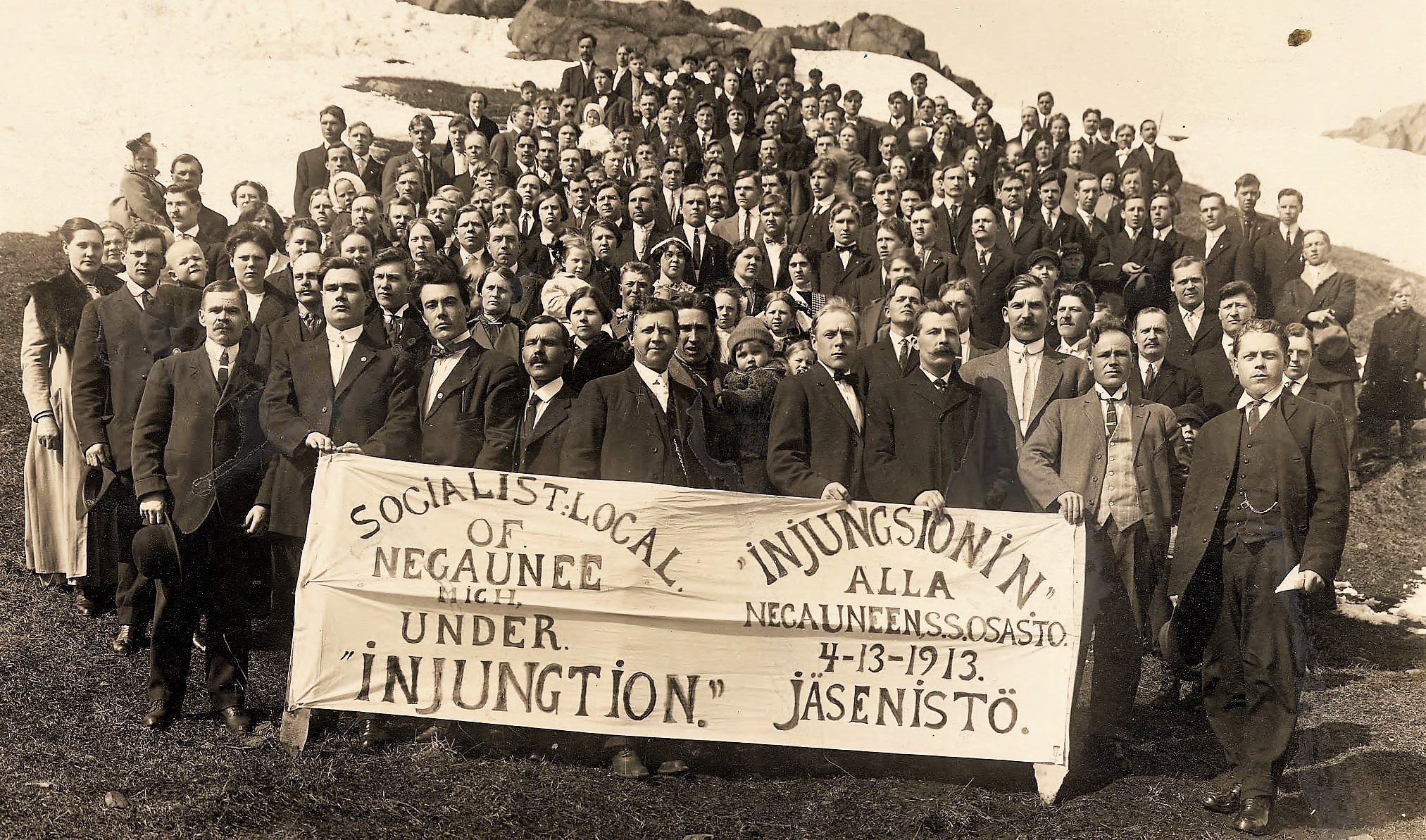
The revolutionary socialists and industrial unionists that dominated the northern Great Lakes Finnish-speaking Socialist Party came to power in the third national convention of the Finnish Socialist Federation of the Socialist Party held in 1912 in Minnesota. The largest single constituency of S.P. membership, in 1912 the Finns counted 248 branches and 11,535 members. Long the target of the Party’s right, who in 1915 they succeeded in overturning the majority left in a number of Upper Great Lakes Finnish-dominated revolutionary locals. A few years later, the entire Michigan Socialist Party would be expelled, a first, in May, 1919 for their left wing opposition to the Party’s reformist path. The expelled went on to become the first independent formation in the U.S. to call for a new Communist Party. Unironically, it was the radical Finnish workers of Michigan that provided the majority base for the new party in the state., while much of the Detroit English-speaking leadership would later found the Proletarian Party.
‘’Reds’ Win in Finnish Socialist Convention’ from the International Socialist Review. Vol. 13 No. 1. July, 1912.
Beginning June 1 the Finnish Socialists of the United States held their national convention at Smithville, a suburb of Duluth, Minn. It required ten days to settle the matters that came up, not the least interesting of which was the question of Industrial Unionism. This opened a discussion that lasted two days, ending in a complete victory for the “Reds.” The resolution which opened the fight declared in substance, that since industrial evolution is daily making class lines more distinct and forcing the workers together into class-conscious masses, this convention should endorse the principle of Industrial Unionism, without approving any particular organization, and that it is the duty of every party member to work whether within or without the trade unions for the adoption of this form of organization; that party members should guard against anti-Socialist tendencies savoring of anarchism, anti-parliamentarism, and individual violence; against Revisionism in the form of non-class conscious political action, bourgeois reformism, “great man”-ism, and reformistic unionism, and against any general tendency to lay too much stress on either one of the two arms of the Socialist movement, economic or political, at the expense of the other. This opened up a warm debate in which practically every one of the delegates took part. The Central and Western groups led the fight for a revolutionary policy, the Eastern delegates being the conservatives. Among those who fought for the resolution were Leo Laukki of Michigan, Professor Sirola of the Finnish Working People’s College, Jack Juntunen of the Butte miners, and John Kolu of Illinois. The New York delegates, among whom were Olga Fast and K. Lindstrom, led the opposition. The resolution was finally carried almost unanimously, there being but two dissenting votes. The “Reds” made no attempt to conceal their satisfaction over the outcome, as the last convention at Hancock, Mich., four years ago Showed opportunistic tendencies.
Fifty-three delegates were present. including the four editors of the Finnish Socialist papers and seven women comrades. It was the sense of the convention that the Finnish and English-speaking Socialist organizations must be brought into closer touch. The Finnish secretary, Comrade Sarlund, and the Executive Committee were instructed to make more frequent reports to the national office and to the party press concerning the progress of the movement among the Finns and to report on affairs in the English-speaking world for the benefit of the Finnish press. that the young people shall hereafter not form separate organizations. but are advised to Join the societies of the English-speaking young comrades.
The Executive Committee, formerly with seven members, was reduced to five, with the addition of the secretaries of each of the three great districts, Eastern, Middle, and Western, who are to have two votes each.
The managing editors of the Finnish papers are hereafter to be elected by a referendum of the shareholders in each publishing company. It was decided that the principal of “Työväen Opisto,” the Working People’s College at Smithville, shall be elected by the Executive Committee and the Board of Directors; that the college shall open a correspondence course in the English language to be furnished at cost, and courses in citizenship and legal requirements, to be financed by an assessment of 50 cents a year on each member. The faculty is also to be increased by four English-speaking teachers. The college at present has 140 students and owns $35,000 worth of property.
The convention also recommended that all Finnish working women take out citizens’ papers and that party members shall use their influence to have Finnish servant girls, of whom there are many thousand in this country, organized into unions. А resolution against “slave contracts” was then adopted, recommending an agitation to be started against these, to which many Finnish workingmen, employed in iron, coal and copper mines, fall victims. The convention adjourned with the utmost harmony prevailing.
The International Socialist Review (ISR) was published monthly in Chicago from 1900 until 1918 by Charles H. Kerr and critically loyal to the Socialist Party of America. It is one of the essential publications in U.S. left history. During the editorship of A.M. Simons it was largely theoretical and moderate. In 1908, Charles H. Kerr took over as editor with strong influence from Mary E Marcy. The magazine became the foremost proponent of the SP’s left wing growing to tens of thousands of subscribers. It remained revolutionary in outlook and anti-militarist during World War One. It liberally used photographs and images, with news, theory, arts and organizing in its pages. It articles, reports and essays are an invaluable record of the U.S. class struggle and the development of Marxism in the decades before the Soviet experience. It was closed down in government repression in 1918.
PDF of full issue: https://www.marxists.org/history/usa/pubs/isr/v13n01-jul-1912-ISR-gog-ocr.pdf
 Revolution's Newsstand