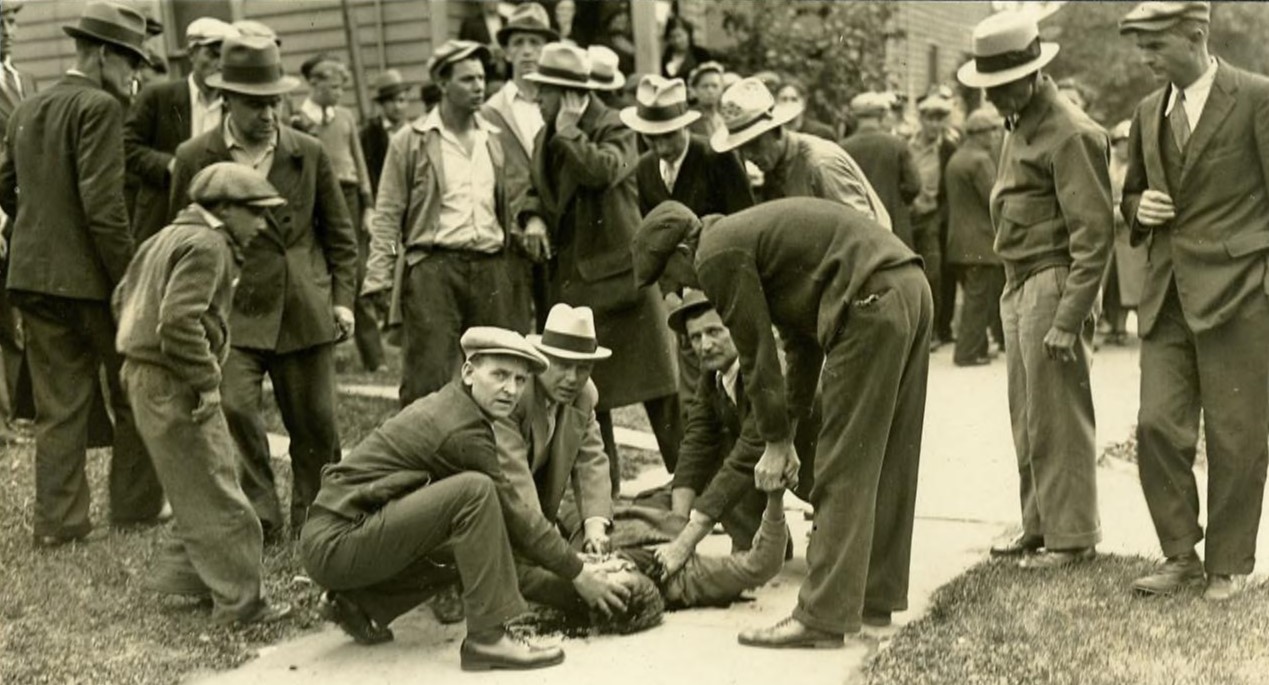
Arne Swabeck , in the midst of the great class battles being waged 90 years ago this summer, surveys the quickly shifting landscape as a new unionism takes hold five years into the Great Depression.
‘Sharper Struggles in Strike Wave’ by Arne Swabeck from The Militant. Vol. 7 No. 31. August 4, 1934.
In the gigantic strikes, rolling on like an avalanche from coast to coast some trends are apparent which will be of the greatest importance in future developments of these labor struggles. The main issue is union organization. That stands out clearly and unequivocally and it is pursued consciously. But by the very nature of these struggles there is already implied in them the trends toward a new type of union, new in character and broader in scope than heretofore. Simultaneously with this there is expressed also, although still unconsciously as far as the mass of the workers are concerned, the efforts toward bringing forward new type of union leadership.
Throughout the country the effects of the crisis upon the workers drives them forward. Their grievances multiply and come to a head. A seething discontent is manifest. The need for union organization grows as it meets the open ruthless attacks of the master class. All along the line there is a sharpening of the class struggle. The powerful strikes for union organization become ever broader in scope. Ever more political in character, and they will tend to advance the American working class rapidly to higher levels–toward class consciousness.
Deeper Meaning in Struggles
On this general background the fight for union organization begins to assume а deeper significance than before. The unions that are emerging represent something new in the sense that they are distinct from the traditional type of craft unions going along with such concessions as it could wrest from capitalism through the means of class- collaboration and obtained at the cost of keeping the large masses unorganized and subsisting on a lower standard of living. In the minds of the many new trade union recruits their organization is conceived of from the outset as an instrument of struggle for better conditions and this is immediately translated into practical action. To this extent it is a new kind of unionism which stands on the order of the day. Equally as important, however, in the present situation is the beginning of the struggle for a new type of union leadership. While it is not yet a conscious object, nevertheless, it grows directly out of the needs of the working class and the conditions under which it exists. The old time reactionary trade union leadership now stands out more clearly as an obstacle in the path. By its whole outlook, its actions as agents of capitalism, this leadership serves as an instrument not only to prevent further working class advance but also to betray the struggle for the aims of today.
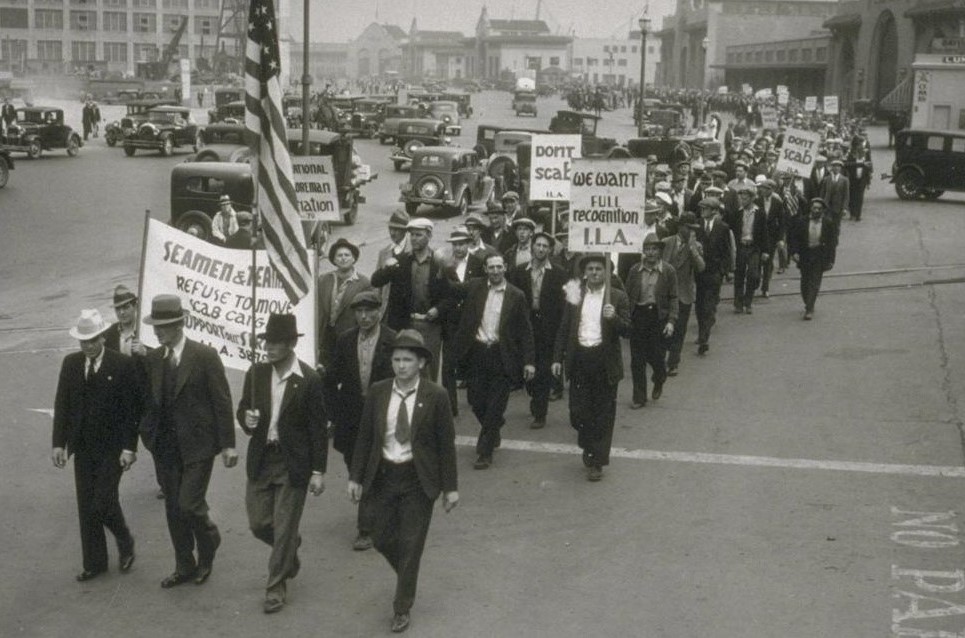
The issue of union organization and union recognition cannot be arbitrated. That will mean only a postponement of the struggle. In the automobile industry an arbitration procedure was accepted. It became a blow to the unions which were emerging and the grievances of the workers remained. In the steel industry the acceptance of Wm. Green’s proposal means that the struggle for union recognition is given up for the time being. In Minneapolis and Toledo, in the strikes of last May, the issue was fought out. Union recognition was gained, though only partly in Toledo, and in Minneapolis the recognition in order to also include the inside men, organized by the truck drivers union, has to be fought out again.
The Bosses’ Offensive
On a nation-wide scale the employers are now determined to put a stop to the union organization developments. The forces of the state power stands at their disposal because they are the forces of the capitalist state. The employers had their own idea of section 1a of the National Industrial Recovery Act. But they never accepted the working class interpretation and they immediately sensed the danger to their special privilege of exploitation when the workers began to struggle for unions of a mass character to perform a new role distinct from that of the craft unions as they existed heretofore. By their terrific onslaught they now hope to head this off before it is too late.
On the other hand the splendid spontaneous actions by the working class throughout the country testifies to the fact that it senses the great opportunity for organization and for making new gains which are at hand whenever it avails it- self of this opportunity. The working class is set into motion and proceeds to break down the barriers which stand in the way. The rising curve of struggles give new inspiration and creates new and favorable opportunities for further progress. The grievances and the discontent of the workers is connected directly with the fight for organization and it is militant from the start. In this process the unions have of necessity taken on a broader scope and are becoming more industrial in character.
Breaking the Craft Lines
There is involved in this not merely the pedantic question of form, but rather the question of substance. The Minneapolis Truck Drivers Union, for example, found it necessary to organize also the inside men who are directly connected with their line of commercial transportation. It is reported now that the longshoremen’s union in the cities along the Gulf is similarly beginning to organize within its ranks the inside men connected with the handling of ships’ cargo. We already know that the unions developing in the automobile and the steel industry among others, could proceed to organize only on an industrial basis, taking in all workers to make common cause in the fight. This to a considerable degree also accounts for the fact of the militancy which has been displayed by the workers and it accounts much more directly for the violent opposition and head-on attacks by the bosses.
In San Francisco the strike involved almost from the outset, not only the longshoremen, but all the maritime unions. From the point of view of the bosses that progressive combination had to be broken up and the state forces, the police and the troops, were brought onto the scene, not to maintain “law and order” but to protect scabs and break the strike. All the union men of San Francisco sensed in this a menace to their organizations. The general strike resulted. It became a contest with the state powers because of the use of the armed forces to attempt to break the maritime strike and to attempt to crush the unions.
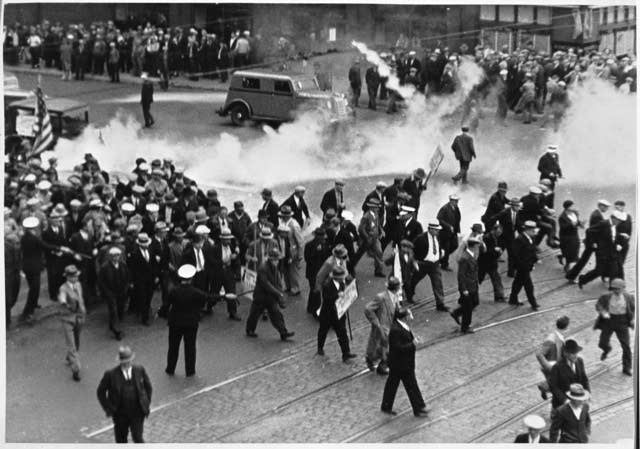
In Minneapolis at the very beginning of the present strike, police were armed, not to maintain “law and order”, as is the usual plea made for public consumption, but to convoy the moving of trucks manned by scabs and moving in defiance of the strike. Following this brazen provocation, the farmer-labor governor brought the national guard to the city as a further threat to the strike and to the truck drivers union. On a whole it is the terrific attacks made by the employers and their government which will give the exceptionally intense political character to the present strikes. But this is also the point at which the capitalist lieutenants, the reactionary labor leaders, swept on by the force of the movement, head it in order to behead it as they did in San Francisco.
That is the contradiction today–a general strike, challenging the government strike-breaking, but headed by leaders who are the agents of capitalism. These leaders do not want a conflict with the system of exploitation no matter how much the life of the unions are threatened. They play at all times the role of a brake upon the movement, even when appearing to lead it forward, and their purpose is to keep the working class in subjection.
Unions–A Life and Death Issue
Union organization is today the main working class issue. By the head-on attack it meets from the employers and their government the struggle for its realization intensifies. Bigger battles can therefore be expected to follow Minneapolis, Toledo and San Francisco. Bearing in mind the general background already created, it is safe to say that these coming battles will bring forward much more distinctly as a working class objective the new type and new methods of unionism and the new type of union leadership which these new conditions require. This new type of leadership is developing in the fire of the class struggle and it stands out already today in Minneapolis as a tower of strength. It is bound to emerge elsewhere.
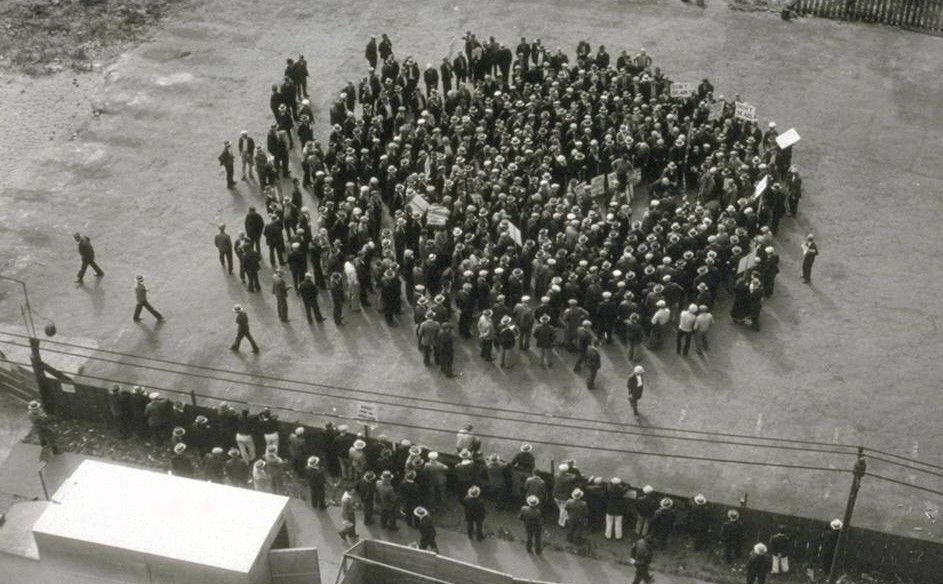
But this course, however clearly indicated in the present situation, depends upon the attention and guidance from the conscious revolutionary forces.
The Militant was a weekly newspaper begun by supporters of the International Left Opposition recently expelled from the Communist Party in 1928 and published in New York City. Led by James P Cannon, Max Schacthman, Martin Abern, and others, the new organization called itself the Communist League of America (Opposition) and saw itself as an outside faction of both the Communist Party and the Comintern. After 1933, the group dropped ‘Opposition’ and advocated a new party and International. When the CLA fused with AJ Muste’s American Workers Party in late 1934, the paper became the New Militant as the organ of the newly formed Workers Party of the United States.
PDF of full issue: https://www.marxists.org/history/etol/newspape/themilitant/1934/aug-04-1934.pdf
 Revolution's Newsstand