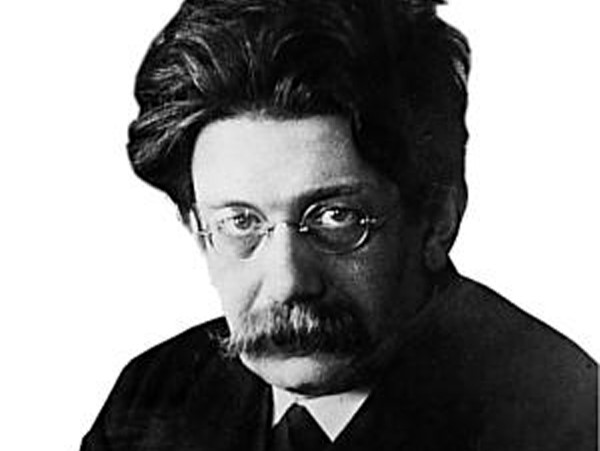
Published not long after he killed the Austrian minister-president Count Karl von Stürgkh, Friedrich Adler looks at the difference between national and class solidarity, inside and outside the Second International.
‘Majority Limitations and Minority Rights’ by Friedrich Adler from Class Struggle. Vol. 1 No. 1. May-June, 1917.
Translated by Eric Niel.
PART I. SOLIDARITY.
In the early months of the war a veritable fit of exaltation seized the Bourgeoisie. Its members became conscious of a sentiment heretofore unknown to them, the ecstasy that is founded on the subordination of the individual to community interest; they experienced in its full intensity SOLIDARITY of thought and sentiment.
Under ordinary conditions the sphere of solidarity in the upper classes is very limited. It does not as a rule extend beyond the family, and as often as not is absent altogether so that the ego is then the centre of gravity. This type views the world in the following order of importance — myself first, then the family, after that, friends, finally the community, and on the occasion of very exceptional celebrations the whole of humanity comes in for temporary consideration. This unsocial viewpoint is based on the theory that everything immediately attainable or within reach is reserved for the smallest sphere, it is taken for granted that the outside world is to content itself with the total of remoter blessings that are “left over.”
We can readily understand the nature of the exaltation which follows the change from a self-centred to a social process of thought. The ego or family cease to be basic considerations; the primary problem now consists entirely of the needs and interests of the community. All paths of thought and all efforts travel henceforth not from the individual to the mass but the other way around from the mass to the individual. The reversal of attitude is complete. On the basis of the solidarity of the community, the smaller group adjusts its activity to the allotment that it receives from the larger body, the formation being hierarchical. The whole no longer gets what is “left over” just the other way — the part gets its share by subdivision of the total. The interest of the part is subordinated to the interest of the whole.
In practice we usually figure the interests of individual and community separately before coordinating them finally. This reasoning is dialectic, nevertheless, the facts established concerning the nature of solidarity show that where the process of thought is social instead of self-centered, the deciding angle must be the interest of the larger unit exclusively, and not a compromise between the whole and any of its parts.
The community based on Solidarity is far more than the sum of the interests of the individuals composing it. The difference is not alone quantitative but becomes qualitative. The mere combining of interests into a sum total is replaced by the attitude and sentiment of each toward the community as a separate superior entity.
This fundamental change was experienced for the first time by the present generation of the Bourgeoisie, it became conscious of its Solidarity with the rest of the people of the country, in the shape of patriotism. In the proletariat the feeling of Solidarity could not produce the effect of something new or overwhelming, as it was already a living force in the ranks of the wage earners. And all that Socialist teaching does, in the end, is to get the worker to think socially, so as to develop the understanding of the interest of all when taken together, of the community based on Solidarity.
Superficial opponents of the labor movement persist in saddling upon Socialist agitation the objection that it merely aims to awaken the dormant egotism of the proletarians However, the task of Socialism is not to stimulate individual wants and demands, which after all occur automatically even without agitation, but to awaken understanding of the destiny of the entire class. The opening up of the field of vision begins with a sense of Solidarity in the factory and the union, and expands in extent until it culminates in the conception of the Solidarity of the proletariat of all countries; this constitutes the highest form of mass action until it is superseded by the attainment of the final goal— the brotherhood of Humanity.
The worker reaches the stage of Solidarity once he realizes that his individual interests are best served by effort in common, or “organized effort.” But he has not learned to think in social terms until his interest in organization has attained the breadth of a consciousness of Solidarity, that is to say, when his attitude is no longer based on the personal interest which was its starting point, but when the interest of his class has become the deciding factor. His point of view is social in just so far as it obeys the general law of social thinking, which places the interest of the greater body above any part.
The sentiment of Solidarity at the outset of the war could not be a new thing to the proletariat in view of its entire historical development, but what did prove to be new was the community of interests to which Solidarity was applied. In place of the accustomed Solidarity of the working class of all countries there was unexpectedly substituted the solidarity of all classes within the nation.
Humanity is divided doubly nowadays. On the one hand is the division, into classes, in hierarchical formation, on the other geographically plus industrially into nations, in adjacent formation. Both entities involve solidarity of interests. But we know that solidarities of both class and nation are not eternal essentials of society. They are attributes of a stage indicating a split condition of society. Their existence is a relative manifestation due to an inferior stage of human solidarity. Both will disappear when solved by the higher stage which Socialism aims to establish, a society based on the absence of class lines and national divisions, the Solidarity of Humanity.
National solidarity was looked upon all along as a defensive instrument, merely intended to preserve existing conditions as a sphere of activity. Class solidarity on the other hand is an instrument of offense which is supposed to contain the germs of a future society. It is not for us to investigate here which of these solidarities is superior. Our problem is to deal with the astonishing fact that whereas the Bourgeoisie underwent a great advance in the direction of solidarity, the war, which turns all things upside down, caused the proletariat to suffer to a marked degree, a decline of its previously known and tried integrity.
The existence of the solidarity of the nation alongside of the international solidarity of the working class, is by no means impossible as a mental conception. On the contrary, the last generation of socialists never dreamed that the necessity of defending the home country would break up the International. In fact many socialists were firmly convinced that the proletariat as an international unit would take the side of the attacked nation, and support its defensive fight, if not by actual participation, at least by all other means mental and moral.
Nothing of the sort occurred. The war disrupted the International, its first victim. And when we ask ourselves to-day why this happened, we see that the present period of history which is an epoch of Imperialism, is based on conditions entirely different than were taken into account in former deductions. All peoples felt themselves threatened, all were under the impression that they were the attacked, and not a single one of the lot waged a purely defensive war such as the democratic leaders of former decades had in mind. A war of such a character might still occur as an exception, in the case of little democratic Switzerland, for example. But as a ruling principle, wars of this sort belong to a period when the peoples were still striving to attain national unity, and are utterly excluded in an era in which the objective is maximum industrial growth based on territorial expansion under the supremacy of the Bourgeoisie which even undertakes to absorb or subordinate any resulting agglomeration of nationalities.
Solely on the assumption that the proletarians of all countries would participate in purely defensive wars only, could the ability of the International to function effectively have been maintained. As this premise did not exist, the participation of the party in the solidarity of action of the classes of the country, excluded solidarity of action by the international proletariat.
Notwithstanding that the political stand taken in Germany and France on August 4 excluded solidarity of action by the International, international thought and sentiment might have and ought to have remained. But even this vanished in very many instances. We still remember the acute reaction that was produced in our ranks when the English iron and steel workers extolled the war as a weapon of the competitive struggle, thus placing their organization in the service of the imperialism of the ruling class.
Since then we have learned to become accustomed to this sort of thing — not only in England. Nearly everywhere, unfortunately, we see time and again, the consequences that must result when social thinking is sacrificed. The socialist movement loses its foundation whenever the interest of the entire proletariat is not made the supreme essential. The struggle of the workers united against the common enemy is then supplanted by the fight of the workers against one another.
Whereas in ordinary times of peace, violations against social thinking used to occur principally in subordinate spheres and minor relations, the war developed a disregard for the unity of the movement in its highest phases, involving the disruption of the International. The proletariat was thereby thrown completely out of its course, Socialist thought was undermined, and imperialistic processes of reasoning were given free field. The only thing for us to do, is to return to the position of the communist Manifesto where Marx and Engels described what we have here called social thinking, as the distinguished characteristic of their movement over against all other proletarian movements. They there stated:
“The Communists are distinguished from the other working class parties by this only: 1. In the national struggles of proletarians of the different countries, they point out and bring to the front the common interests of the entire proletariat independently of all nationality. 2. In the various stages of development which the struggle of the working class against the Bourgeoisie has to pass through, they always and everywhere represent the interests of the movement as a whole.”
To think socially is a necessary premise of all solidarity. But to characterize social thought in this way in respect to form, does not determine the contents or substance, i.e., does not determine which solidarity of interests is considered the highest. We can think perfectly in social terms whether we choose the “Solidarity of classes” of a country, or the solidarity of the workers of all countries as the supreme ideal. Which one is superior depends upon our understanding of the historical evolution of humanity. If a person believes that the International of the proletariat in the present historical situation is not the highest community of interest, or if he formerly believed that it was, but has since become convinced that it is not, we cannot find fault with him for refusing to adhere to a solidarity which his social process of thinking does not recognize. But on the other hand it would be just as mistaken to attach any blame to an internationalist in the Marxian sense if he values Solidarity of the World Proletariat above any other community of interests.
PART 2. PARTY RULE
All party work consists of action in common to realize the party program. The result in each instance depends on the decision of the majority of the integral whole. The operation of party rule is subject to two dangers: on the part of the majority and on the part of the minority. There is always the danger that the majority may arrive at a decision which is not in accord with the party program; this then involves a contradiction of principles fundamental to the whole movement, consequently of the supreme interests and purposes inherent in the party itself. There is the danger that the minority may break up the agreed basis of operation by not submitting to the majority, and by going its own way may impede the accomplishment of the result decided upon. Majority as well as minority may hinder the accomplishment of party purposes.
In general we surely agree that action in common by all assembled is to be taken for granted, and that the democratic vote is the basic principle within the party, calling for the obedience of the minority. In the interest of the party and its development, the minority will submit to the decision of the majority even when convinced that the latter is not pursuing the proper course on the theory that, “I will stand by my brother though he be mistaken, rather than break with him and be right.”
But this course while proper in general, is true to a relative extent only. Situations are possible where the majority may so violate the common program, on which the solidarity rests, that the unity of the corporate whole is affected.
If a branch of the party decides not to remit any more dues to its local, but decides instead to join an association in its locality devoted to sports and amusements, then the Social Democratic minority of that branch, although outvoted, will nevertheless maintain solidarity, not with the branch, but with the local. And the same sort of thing will recur, only on a much larger scale if the majority of the party joins hands with the “class combination” of the country, thereby breaking through the Solidarity of the World proletariat and destroying the relation to the International, perhaps regretfully but inevitably.
The deviation from the International to the Union of classes actually makes a new solidarity supreme, and so the minority that continues to remain international is confronted by the question whether it is still possible “to stand by my brother though he be mistaken.”
The conclusion will depend on how far we have reason to hope that the mistake is transitory, and what the prospects are of rectifying it. If the majority of the party were to decide absolutely to become national we certainly cannot expect anyone who is international to recognize the supremacy of such a solidarity. If we have reason to hope on the other hand, that the majority will find its way back, then it is essential to take into account whether it is more important for the good of the whole movement during such a period, that unity of action be preserved, or that the minority make its influence felt in the right direction.
The parliamentary minority in Germany regarded the action of the majority on August 4 as a violation of the program. But the minority, trusting time and again that the majority would come to its senses, and realizing fully the value of unity, displayed the utmost self-denial toward the political violations of the universal interests of the proletariat, trying by education and analysis to overcome the breaking up of the International without destroying party action. The minority waited and hoped. It grew steadily stronger, but could not possibly think of becoming a majority. Therefore the difficulty grew in intensity so that it finally became necessary to decide whether the highest interests of the proletariat did not demand that the minority choose what it saw to be the only possible way of re-establishing the International. The question whether the unity of the Social Democratic group in the Reichstag, or the recording of the International stand of the minority was of greater importance was finally decided in the latter sense after severe internal struggles. The unity of the group in the German Reichstag was destroyed but a way had been opened up to the proletarians of all countries. The highest solidarity, the Solidarity of the World Proletariat was the deciding factor in the conflict with the solidarity of a limited group.
And it is on this fundamental point that any judgment regarding violation of discipline by the minority must be based. A violation of discipline constitutes a real crime against the interests of the working class whenever used to place the interest of a group above the whole, as it is then a violation against social thinking. But the minority in the Reichstag were not thinking of their own group, on the contrary they were thoroughly inspired by the principles of social thought; their point of departure was based on the International Solidarity of the working class, the highest point of view in the movement, which in their opinion was menaced by the political action of the majority.
We are not investigating whether the minority figured its prospects of becoming a majority correctly — whether the adopted policy was the most practical for that purpose. We merely wish to make clear this much: that the policy chosen cannot be attacked as a violation of party morality, for it did not violate social thinking, but on the contrary was the result of it. The unity of action was destroyed by the minority. Of course the majority has the power and also the formal right, where unity of action has been interfered with, to resort to the privilege of excluding the opposition from the organization. But even so, morally the minority is in the right. For while it destroyed party unity in the Reichstag, the majority broke up the International. The real crime against the integrity of the working class was committed in all countries by those whose political course involved the disruption of the International, and not by those minorities whose activity was founded on the true spirit of International Solidarity.
The Class Struggle is considered among the first pro-Bolshevik journal in the United States and began in the aftermath of Russia’s February Revolution. A bi-monthly published between May 1917 and November 1919 in New York City by the Socialist Publication Society, its original editors were Ludwig Lore, Louis B. Boudin, and Louis C. Fraina. The Class Struggle became the primary English-language theoretical periodical of the Socialist Party’s left wing and emerging Communist movement. Its last issue was published by the Communist Labor Party of America.
PDF of full issue: https://www.marxists.org/history/usa/pubs/class-struggle/v1n1may-jun1917.pdf
 Revolution's Newsstand