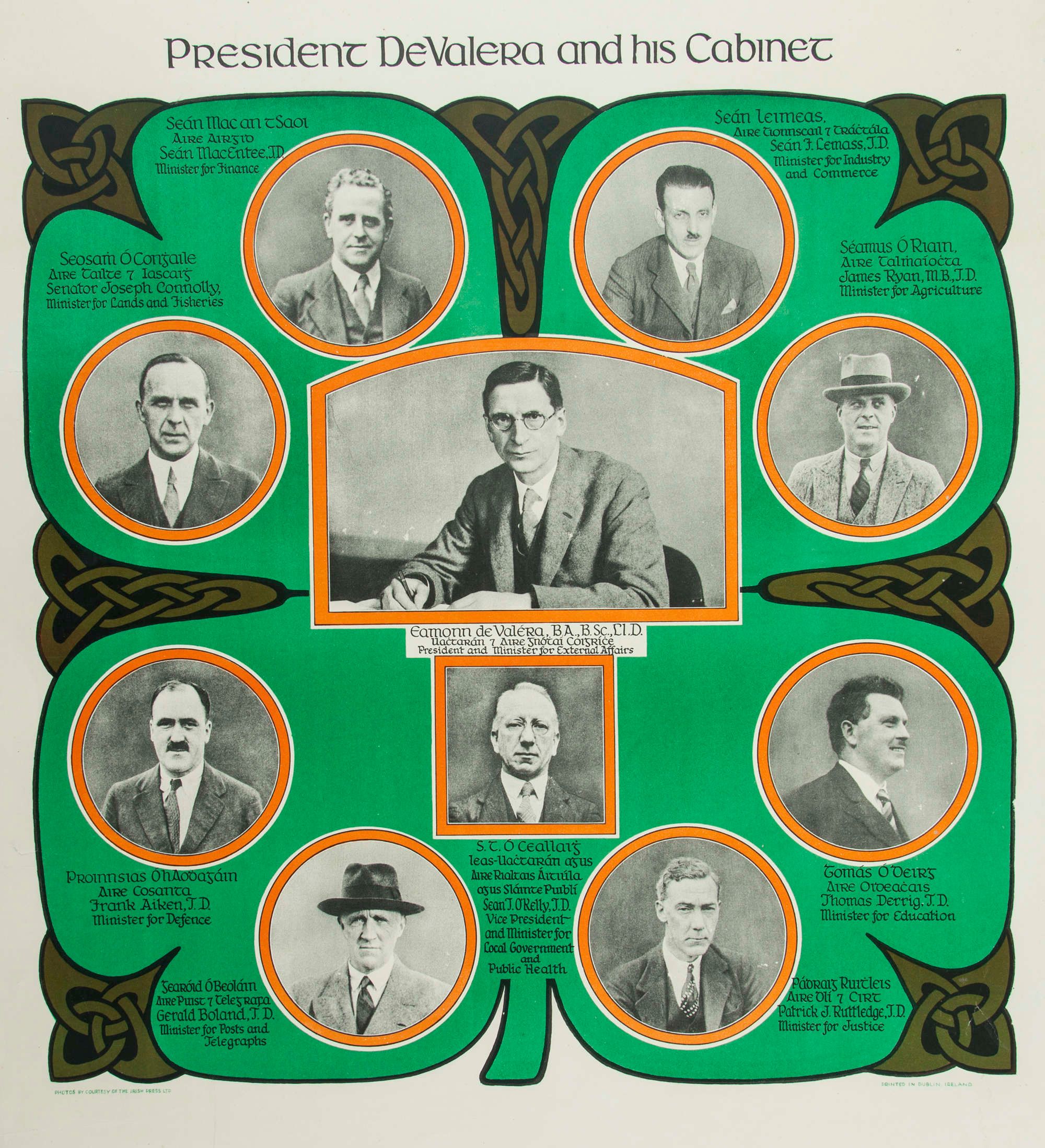
Irish politics are still dominated by two capitalist parties who fought a Civil War a century ago. Sinn Fein had split in 1926, with De Valera’s new party, Fianna Fail, recognizing the Irish Free State (minus its Oath of Allegiance), with the pro-Treaty Fine Gael becoming increasingly fascistic. A decade after losing the War, and running on a populist promise of a ‘Free, Gaelic and Catholic’ Ireland, Fianna Fail was able to form a government with the Irish Labour Party. Brian O’Neill of the proto-Communist Party Revolutionary Workers’ Groups analyzes that seminal election.
‘The Role of the DeValera Government in Ireland’ by Brian O’Neill from International Press Correspondence. Vol. 12 No. 14. March 24, 1932.
A Fianna Fail (“Band of Destiny”) Government (deValera Party), backed by the handful of Labour deputies, is now in power in the Irish Free State-that is, the Irish bourgeoisie is now to rule through its parliamentary republican wing. The position of the parties now, compared with 1927, is as follows:
1927–1932
Fianna Fail 57-72
Cumann Nan Gaedheal 61-56
Labour Party 13-7
Farmers 6-4
Independents 15-13
DeValera’s. rise to power reflects the growing crisis in Ireland. Cumann Nan Gaedheal (“Association of the Gael”) had been in office ten years, during which it ruled nakedly as the agent of the Irish bourgeoisie and the ally of British Imperialism. Its record was a foul one. During its rule, the employers attacked every section of the working class. Unemployment grew, while the amount paid in workless benefit dwindled. Teachers, civil servants, police and soldiers all came under the lash. The small farmers sank further into the morass of debt as a result of the price slump due to the agrarian crisis, while the burden of the Land Annuities they paid annually to the British Land Stock holders became heavier than ever. And every symptom of revolt was savagely attacked, culminating in the Coercion Act last September, proclaim ng illegal the Irish Republican Army, the Revolutionary Workers’ Groups and several other organisations.
So Fianna Fail climbed to power, posing as the “party of the masses, not the classes”, and using the most shameless demagogy. The chief points in its programme were:
“1. Promote the industrial revival, securing the establishment of at least 200 new factories and the employment of an additional 80,000 hands.
“2. Secure the erection of 40,000 new houses for the proper accommodation of our people and let them at rents which the average working-class family can afford to pay.
“3. Reduce taxation by rigid economy in all branches of the public service.
“4. Improve social legislation, including better provision of Old Age Pensions and for necessitous widows and orphans.
“5. Direct the affairs of the Irish people so as to create a self-supporting and self-reliant nation.”
In addition, the release of the revolutionary fighters jailed by the Cosgrave government was a big feature of their election propaganda. So, on the shoulders of the radicalised masses, and canalising their revolt, Fianna Fail rode to power. As the crisis toppled Cosgrave from office, it has raised de Valera, who, under new forms and using new phrases, is to continue and intensify the attempt of the bourgeoisie to “hand the baby” of crisis to the masses of the people.
How swiftly the world crisis has drawn the Irish Free State into the vortex may be seen from the fact that the total trade of this Liliputian State dropped £5,000,000 in 1931 compared with 1930. Exports (including re-exports) in 1930 were £45,745,019 and imports £56,768,702. In 1931 they were £37,070,896 and £50,468,114 respectively. The returns for January, just published, show the position further aggravated. Exports for the month were £2 329,529; imports were £3 585 278. The debit balance was £1,203,616 as compared with £563,356 in January of last year.

The capitalist Government of deValera will attempt to solve this crisis by three methods: tariffs, “retrenchment” and wage reductions. Tariffs are the corner-stone of the “Gaelic and Catholic Ireland” de Valera hopes to build up. By building a tariff wall high enough to shut out the products of the large scale industry of Britain and other countries, he hopes to have shelter to build a number of small industries in this under-developed country. It is a mad notion, but it is the workers and the peasants who are to pay for the madness; the tariffs already imposed have increased the cost of living so that it is among the highest in Europe; the coming tariffs on the people’s food and necessities of life will worsen the position. The “retrenchment” will mean, of course, attacks on the social services, already miserably inadequate. A clever piece of demagogic “window-dressing” has already been performed by the new Government: in order to give the lead to the country, the Cabinet Ministers have agreed to reductions in their salaries. With this example of self-sacrifice before them, can the Irish masses justly complain when education, health and other social services are slashed? As for the wage reductions, the employers in almost every industry of any importance have given notice of the attack. At the annual meeting of the Great Northern Railway, on February 24th, the chairman said: “To maintain wages at the present rates, is I fear, imposing on the Irish railways a greater burden than they can bear”. The shareholders of the Great Southern Railway, at both their last meetings, demanded immediate wage cuts if there were to be any dividends at all. The chairman of the Dublin Tramway Company, reporting a record year at their meeting on March 11th, pointed out that British tramway workers had just received a cut, and he licked his lips in anticipation.
In addition to continuing the capitalist offensive, the Fianna Fail has another role. Launched as the parliamentary wing of the republican struggle, to it falls the task of killing that struggle for ever. Its policy is not one of fighting imperialism, but of making peace with Britain on the basis of a new agreement. And the Irish Republican Army (I.R.A.) and the other republican organisations, which dragged at the tail of Fianna Fail in the Election as the result of its promise to release the prisoners and abolish the Coercion Act and the Oath of Allegiance to King George V., have now fallen completely into its arms. For ten years the leaders of the republican movement, with all the capacity of the petty bourgeoisie for regarding forms and ignoring realities, howled against the Oath. The prisoners are free now, and the Oath will probably be abolished soon, and they are left high and dry–imperialist tribute will remain, the partition of Ireland will still exist, but for them the struggle will be over.
The republican leaders express this clearly themselves. “An Phoblacht” (The Republic) has re-appeared after its suppression under the Coercion Act. Maurice Twomey, the I.R.A. chief, writes about the new situation:
“Members of Fianna Fail express friendliness with the ideals of the I.R.A., and under their administration the movement could become what it ought to be, a normal feature of our national struggle, popularising our national ideal and encouraging the people forward to the redeclaration of a united Republic.”
(“An Phoblacht”, 12-3-32.) Madame Gonne McBride, Secretary of the Prisoners’ Defence League, in the same journal even more revealingly states the abdication of the petty bourgeoisie:
“When Eamonn deValera takes over power and releases all the Republican prisoners the shame of imprisoning the men who fought for her freedom will be lifted from Ireland. The work of the Women’s Prisoners’ Defence League will be concluded and the ‘mothers’ can take a rest. The opening of the jail gates will have accomplished what machine guns and proclamations failed to do…”
The battle over for them, the Defence League is to be wound up; the next prisoners will be workers fighting not for phrases but for bread and freedom, but that will be no concern of the petty bourgeoisie. As the “Irish Press”, the chief Government organ, says (12-3-32):

Irishmen of any section will no longer have to feel that the independence of their country can be established only through armed conflict in which their own fellow Irishmen will be opposed to them. The way is being opened to secure by peaceful means the realisation of our national ideals, and henceforth the responsibility to avail themselves of those means rests upon all sections equally. There is no longer cause for anyone to believe that when the national rights are to be asserted that must be done by a protesting minority. In future that assertion of national rights will be, as it should always have been, the exclusive right of the Government chosen by the majority of the electorate.”
But while the petty bourgeois leaders of the republican movement may be satisfied with this, the rank and file of the republican movement–the peasant lads and the proletarian youth who have formed the backbone of the struggle against British Imperialism–will not be content to starve under a de Valera Government any more than they were under Cosgrave. The task now of the revolutionary forces is to win these genuine fighters against imperialism away from the petty bourgeois elements who are trying to shackle them to the chariot of a capitalist government, and to lead them along the path of class struggle and the final fight to end capitalist and landlord domination.
International Press Correspondence, widely known as”Inprecorr” was published by the Executive Committee of the Communist International (ECCI) regularly in German and English, occasionally in many other languages, beginning in 1921 and lasting in English until 1938. Inprecorr’s role was to supply translated articles to the English-speaking press of the International from the Comintern’s different sections, as well as news and statements from the ECCI. Many ‘Daily Worker’ and ‘Communist’ articles originated in Inprecorr, and it also published articles by American comrades for use in other countries. It was published at least weekly, and often thrice weekly.
PDF of full issue: https://www.marxists.org/history/international/comintern/inprecor/1932/v12n14-mar-24-1932-Inprecor-op.pdf
 Revolution's Newsstand