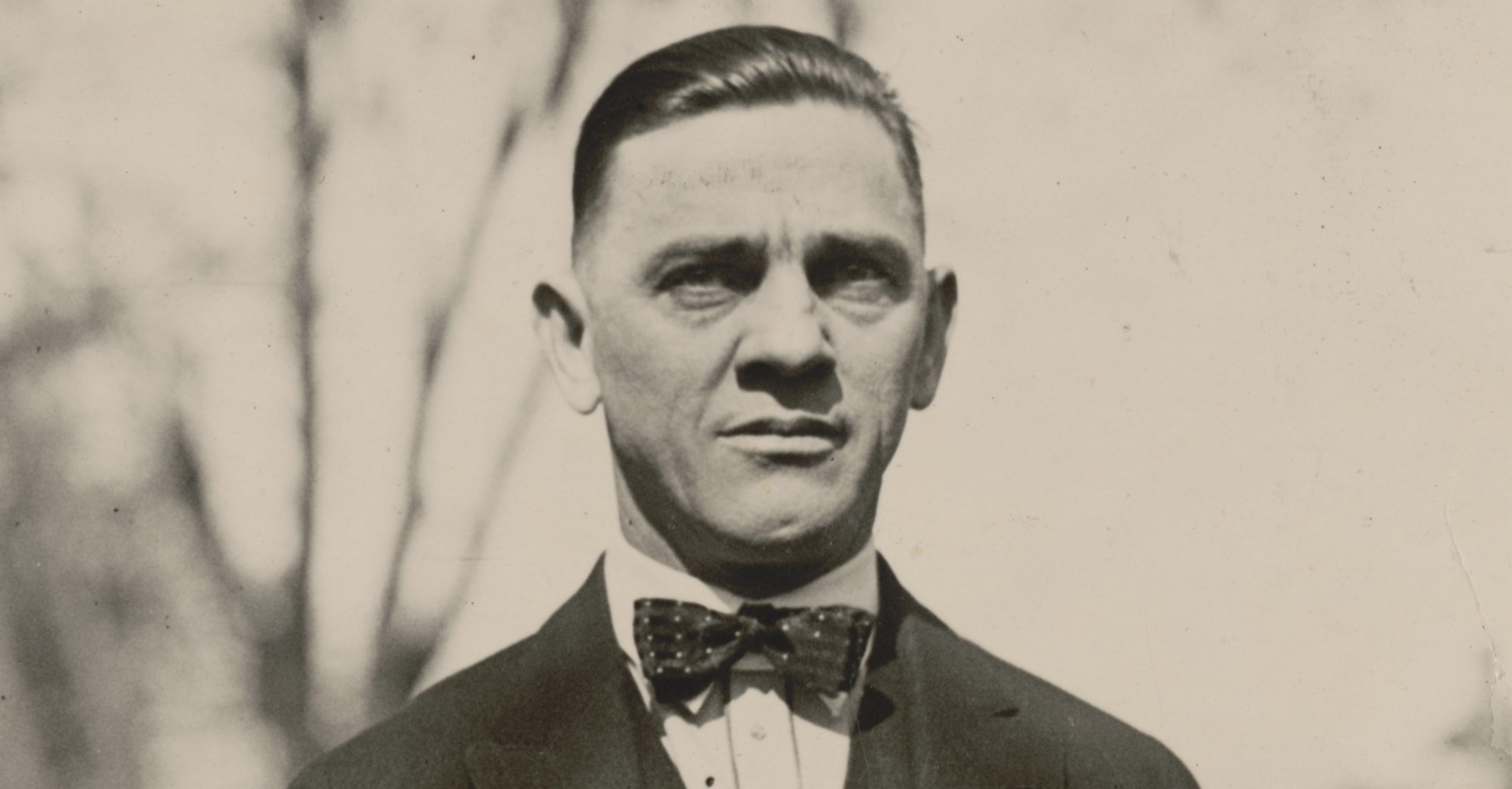
Outstanding working class leader Frank Keeney was central to the West Virginia Mine Workers Union and associated Labor Party founded in 1931.
‘Labor Party and Unionism in West Virginia’ from Labor Age. Vol. 21 No. 1. January, 1932.
ON March 19, 1931, the independent West Virginia Mine Workers Union was founded by the miners of the Kanawha Valley led by Frank Keeney, Brant Scott and Boots Scherer, and aided by such C.P.L.A.’ers as Tom Tippett and chairman A.J. Muste. On December 15, 1931 40 delegates, representing 20 local unions of the Kanawha Valley, met in the union office in Charleston and definite steps to found a Labor Party and thus to put into effect the resolution of their first convention which had pledged the union to independent political action, were taken.
It requires a little knowledge about the background to enable one to realize just how brave, clear-sighted and important a thing this Labor Party conference was. Following the March convention, as the readers of Labor Age know, the union organized nearly all of the 23,000 miners in Kanawha Valley. It asked the operators to confer about a contract, checkweighmen and wages. The operators refused. In July the union was forced into a strike against starvation. The battle was bravely fought. The operators were made to realize, in the words of a song written by one of these miners, Walter Seacrist, that “there’s a union in them West Virginia hills.” The strike was, however, “lost”’ in the ordinary sense of the term. They did not get a contract. They did not get a raise in wages.
In other days and under other leadership this would have meant the end of the union. The leaders would have told the workers a cock-and-bull story about a “moral victory” —and then would have vanished. In this case, as Tom Tippett pointed out in a recent Labor Age article, the union stayed on the field, It was helped to do so by friends in the C.P.L.A., the Emergency Strike Relief Committee and others. Keeney and his colleagues told the men that their battle was lost but that the union would stay by them if they would stay by the union and that they would get ready to “fight another day.”
The result has been amazing, or maybe not so amazing, but at any rate encouraging to those who had insisted that the C.P.L.A. policy, of not abandoning a situation after a strike, would bring results. Already the union is again nearly as strong as it was before the strike began. Union meetings are attended by hundreds. The union is carrying on educational work, it is looking after the worst cases of destitution. There is actually a chance that the union may soon spread into the historic Mingo and Logan counties.
Now, in laying the foundations for a Labor Party the union has taken another forward step. Its leaders have once again demonstrated that they are genuine militants and progressives—men of action and not of empty words.
The resolution which summarized the action of the conference contained the following points:
1. Reaffirmation of the March decision that just as the workers need a fighting industrial union, so they must organize their own labor political power.
2. Decision to take immediate steps to get out petitions for candidates for local offices, such as, constable, Justice of the Peace, etc. in order that in the next organizing campaign or strike these so-called officers of the law may not be mere tools of the operators. This decision applies for the present to the five Kanawha Valley counties—namely, Kanawha, Fayette, Raleigh, Putman and Boone.
3. Decision to give further study to the question of extending the Labor Party move to other sections of the state and also to the question of national affiliation. Representatives of the Socialist Party were present at the conference by invitation; but while the miners welcome all possible assistance both in their union activities and in carrying out their policy of independent political action, they decided that for the present they wanted to build a Labor Party and to leave the question of national affiliation open.
4. The conference appointed a committee of seven to carry out the above decisions and to issue a call for a Labor Party convention to be held early in 1932. Harold W. Houston, prominent Charleston attorney who has appeared for the miners in many historic cases, is the chairman of this committee. The other members are working miners. The committee will have the enthusiastic support of President Frank Keeney and the other officers of the West Virginia Mine Workers union.
The final paragraph of the conference resolution was noteworthy. It stated that the principal purpose in the minds of the miners was the establishment of “a fighting, progressive, powerful union for the coal miners of West Virginia” and that any steps taken on the political field must be taken with that purpose in mind. The conference had previously cheered Chairman A.J. Muste of the C.P.L.A., who was also present by invitation, when he had stressed the same point saying:
“Your union is primary. The struggle on the industrial field against the boss is the fundamental thing. Let that be your guiding star. If you follow that star you will not be led astray in the bogs of politics. If you fail to follow that star your politics will become a racket like any other. A labor political party which has not the backing of a powerful industrial organization is a scrap of paper.”
LABOR AGE extends heartiest congratulations to the West Virginia Mine Workers Union for this fresh evidence it has given in the movement to found a Labor Party of its fighting spirit, its realism and its sound sense. Political action in the hands of such a union can prove a very useful weapon for the workers.
Labor Age was a left-labor monthly magazine with origins in Socialist Review, journal of the Intercollegiate Socialist Society. Published by the Labor Publication Society from 1921-1933 aligned with the League for Industrial Democracy of left-wing trade unionists across industries. During 1929-33 the magazine was affiliated with the Conference for Progressive Labor Action (CPLA) led by A. J. Muste. James Maurer, Harry W. Laidler, and Louis Budenz were also writers. The orientation of the magazine was industrial unionism, planning, nationalization, and was illustrated with photos and cartoons. With its stress on worker education, social unionism and rank and file activism, it is one of the essential journals of the radical US labor socialist movement of its time.
PDF of full issue: https://www.marxists.org/history/usa/pubs/laborage/v21n01-jan-1932-labor-age.pdf
 Revolution's Newsstand