
The Hungarian left in the U.S. was relatively small and peripheral historically; except for its theater. Lajos Egri reports.
‘The Hungarian Workers Theatre in America’ by Lajos Egri from Workers Theatre. Vol. 3 No. 7-8. July-August, 1933.
There isn’t another nationality to date in America that would be so isolated as the Hungarian. No one knows anything about their activities, no one even remotely suspects that they are here. Looking thru “Workers Theatre” monthly, or the “International Theatre” we can note with happy exultation that all over the world the workers theatre groups are growing like mushrooms after rain. But in vain do we search for the activities of the Hungarians in America. This lack of news is even more shocking if we know that the Hungarians have the most theatrical groups in U.S. and in nine months out of twelve they are extremely active. Dozens of plays are produced weekly and there is a constant demand for new material.
Their stages are surprisingly well equipped and several playwrights are looking after their daily growing demand for new manuscripts. Why this sectarianism then? It would be a complete mystery (for the outsider) if we luckily wouldn’t know them so well, being Hungarian ourselves. We can offer an explanation which of course will not exonerate them completely for their neglecting to let the outside world know of their existence. They have many good, enthusiastic, even sacrificing comrades all over the country who do their utmost to arouse their fellow workers. They have initiated all year round Red Sundays when they go by twos from door to door selling tickets among the Hungarians with surprisingly good results.
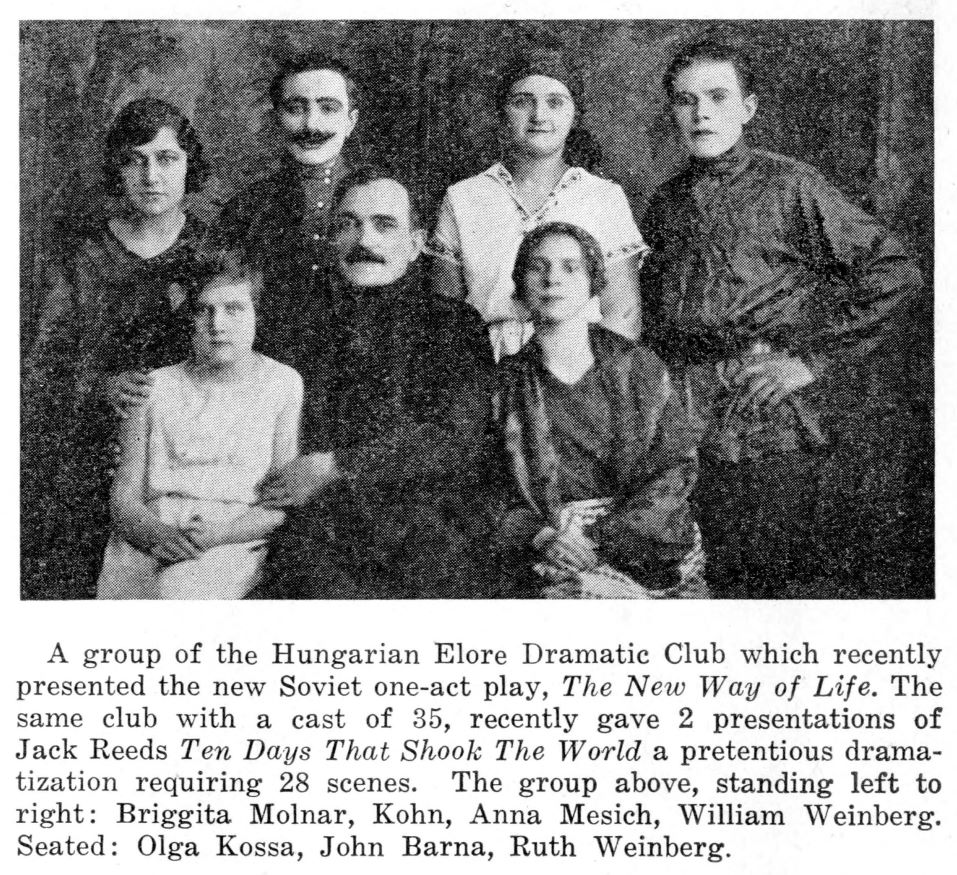
Getting subscription for our daily the “Uj Elore” and selling various kind of communist literature besides is not an easy burden to carry. Our homes, clubs numbering about a hundred also need attention. The financial burden falls in a good measure on the theatrical groups, of course. The Hungarians do their share generously in the international struggle of the workers without thinking for a moment that their heroic struggle would interest anyone else besides themselves. This is erroneous of course and with this writing we will break the ice which isolated us from the international workers theatre movement of the world.
Here are a few notes on Hungarian activities until we can appoint correspondents for every group operating in America. Two tournaments were held last month.
The first: Bridgeport, Newark, Passaic and Perth Amboy. Newark and Bridgeport both tied for first place. The winning plays were: “The Awakening of Kargaret Kovacs” by Endre Olexo and the “Wild Cat” by Lajos agri. The second tournament included Bronx, New Brunswick and Bethlehem. The winning group was the Bronx with the “Soviet” by Lajos Egri.
The New Theater continued Workers Theater. Workers Theater began in New York City in 1931 as the publication of The Workers Laboratory Theater collective, an agitprop group associated with Workers International Relief, becoming the League of Workers Theaters, section of the International Union of Revolutionary Theater of the Comintern. The rough production values of the first years were replaced by a color magazine as it became primarily associated with the New Theater. It contains a wealth of left cultural history and ideas. Published roughly monthly were Workers Theater from April 1931-July/Aug 1933, New Theater from Sept/Oct 1933-November 1937, New Theater and Film from April and March of 1937, (only two issues).
PDF of full issue: https://www.marxists.org/history/usa/pubs/workers-theatre/v3n7-n8-jul-aug-1933-Workers-Theatre-yale-mf.pdf
 Revolution's Newsstand